The False Consensus Behind the Ceasefire: US-Iran Proposals Have Almost No Common Ground, Analyzing the Truth Behind the Unfathomable Fall in Oil Prices
2026-04-09 14:32:59
With Pakistan's mediation, the United States, Israel, and Iran have agreed to a two-week ceasefire, and U.S. and Iranian officials are expected to hold talks on Friday (April 10) to discuss a long-term solution.
Although Tehran and Washington have agreed to talks, Iran’s 10-point proposal (which US President Trump called a “workable basis” for negotiations) has little overlap with Washington’s previously proposed 15-point plan, indicating that there are still significant differences between the two sides that need to be bridged .
For example, Iran's proposal includes a requirement for uranium enrichment, an option that Washington has previously explicitly ruled out. Furthermore, the 10-point proposal does not address Iran's missile capabilities, which both Israel and the United States have stated must be significantly reduced.
Due to the continued existence of core differences after a two-week ceasefire agreement, US crude oil prices rebounded by more than 2.5% after touching around $91 per barrel on Wednesday. The price continued to fluctuate upwards during the Asian and European sessions on Thursday, and is currently trading around $97.50 per barrel, with a daily increase of about 3.2%.
Pakistani Prime Minister Shahbaz announced on the X platform that Iran and the United States have agreed to a temporary ceasefire, stating that both sides agreed to an immediate ceasefire in all areas, including Lebanon, where Israel launched its strikes.
Shabaz made no mention of Iran's 10-point proposal, nor of the United States' 15-point plan, and his statement made no mention of any agreement with Israel.
A Pakistani official stationed in the region said that Iran is expected to win several of its demands, focusing on reconstruction, compensation, and the lifting of sanctions, but cannot expect an agreement on uranium enrichment .
Trump posted on Truth Social that the U.S. military would suspend strikes against Iran for two weeks if Iran agreed to “fully, immediately and safely open the Strait of Hormuz.”
He stated that the two sides were quite close to reaching a final agreement on achieving lasting peace with Iran and peace in the Middle East. While he described Iran's 10-point proposal as providing a "workable basis" for negotiations, he did not list specific points and indicated that some major issues that had been contentious in the past had been settled .
Israeli sources revealed that Trump had previously delivered a 15-point proposal to Iran through Pakistan, demanding that Iran remove its highly enriched uranium stockpile, halt uranium enrichment activities, curb its ballistic missile program, and cut off financial support to regional allies.
In a statement, Iranian Foreign Minister Araqchi said that Iran agrees to cease what it calls "defensive actions" if attacks against Iran cease; he added that this is based on the US's negotiation demands under its 15-point proposal and Trump's agreement to use Iran's 10-point plan as the basis for negotiations.
He stated that safe passage through the Strait of Hormuz is possible in the next two weeks, provided that it is "coordinated with the Iranian armed forces and takes into account appropriate technical restrictions."
In a statement, Iran's Supreme National Security Council said that Washington had agreed to accept Iran's 10-point plan, and that "the United States has committed in principle":
Do not take aggressive action;
Continue to recognize Iran's control over the Strait of Hormuz;
Accepting Iran's uranium enrichment;
Lift all Level 1 and Level 2 sanctions;
Terminating all resolutions adopted by the UN Security Council and the Board of Governors of the International Atomic Energy Agency (IAEA);
U.S. combat troops have withdrawn from the area;
And to cease hostilities on all fronts, including operations against the Lebanese Islamic Resistance Movement.
Prior to the ceasefire agreement, a senior Iranian official stated that Iran would impose transit fees on ships passing through the Strait of Hormuz, which is considered an international waterway.
Israel says it has reached an agreement with Iran on a ceasefire, but emphasizes that the agreement does not include a halt to military operations in Lebanon .
An Israeli official said the United States had coordinated with Israel beforehand on the temporary ceasefire, adding that Iran agreed to open the Strait of Hormuz but made no commitments on issues such as ending the war, reparations, or lifting sanctions.
The official also stated that the Trump administration has informed Israel that in negotiations with Iran over the next two weeks, the United States will insist on the removal of nuclear materials, a halt to uranium enrichment, and the elimination of the ballistic missile threat, in addition to addressing other issues.
The ceasefire has calmed oil prices from the "war panic," but the fundamental differences between the US and Iran on three core issues—control of the Strait of Hormuz, uranium enrichment rights, and the Lebanese front—mean that oil prices cannot return to pre-war levels below $80 per barrel.
Over the next two weeks, every statement made in each round of negotiations could trigger sharp fluctuations in oil prices , leaving the market in a highly sensitive state where both rises and falls are justified.
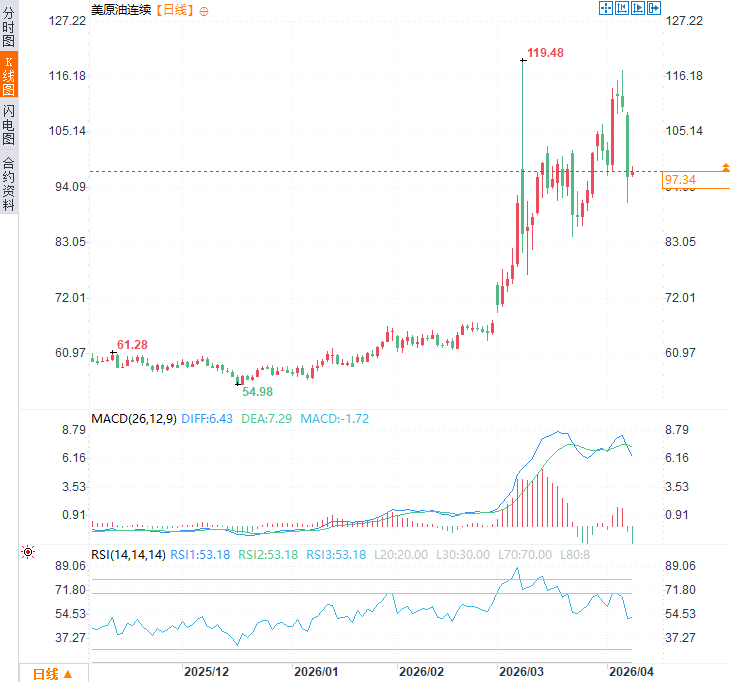
(US crude oil daily chart, source: FX678)
The two-week temporary ceasefire agreement reached between the US and Iran under Pakistan's mediation marks a temporary de-escalation of the conflict, but statements from both sides reveal significant differences in their interpretations of the agreement's content. Trump emphasized that the Strait of Hormuz must be fully, immediately, and securely opened, while Iran insisted on its 10-point proposal, including demands for uranium enrichment rights, the lifting of sanctions, and regional security.
Israel has explicitly excluded the Lebanese operation from the ceasefire. Formal negotiations over the next two weeks will focus on core disagreements such as reconstruction, sanctions, nuclear issues, and missile capabilities, and whether the ceasefire can translate into lasting peace remains a serious challenge.
At 14:32 Beijing time, US crude oil futures were trading at $97.47 per barrel.
Although Tehran and Washington have agreed to talks, Iran’s 10-point proposal (which US President Trump called a “workable basis” for negotiations) has little overlap with Washington’s previously proposed 15-point plan, indicating that there are still significant differences between the two sides that need to be bridged .
For example, Iran's proposal includes a requirement for uranium enrichment, an option that Washington has previously explicitly ruled out. Furthermore, the 10-point proposal does not address Iran's missile capabilities, which both Israel and the United States have stated must be significantly reduced.
Due to the continued existence of core differences after a two-week ceasefire agreement, US crude oil prices rebounded by more than 2.5% after touching around $91 per barrel on Wednesday. The price continued to fluctuate upwards during the Asian and European sessions on Thursday, and is currently trading around $97.50 per barrel, with a daily increase of about 3.2%.
Pakistani mediators express their stance
Pakistani Prime Minister Shahbaz announced on the X platform that Iran and the United States have agreed to a temporary ceasefire, stating that both sides agreed to an immediate ceasefire in all areas, including Lebanon, where Israel launched its strikes.
Shabaz made no mention of Iran's 10-point proposal, nor of the United States' 15-point plan, and his statement made no mention of any agreement with Israel.
A Pakistani official stationed in the region said that Iran is expected to win several of its demands, focusing on reconstruction, compensation, and the lifting of sanctions, but cannot expect an agreement on uranium enrichment .
Trump and the US position
Trump posted on Truth Social that the U.S. military would suspend strikes against Iran for two weeks if Iran agreed to “fully, immediately and safely open the Strait of Hormuz.”
He stated that the two sides were quite close to reaching a final agreement on achieving lasting peace with Iran and peace in the Middle East. While he described Iran's 10-point proposal as providing a "workable basis" for negotiations, he did not list specific points and indicated that some major issues that had been contentious in the past had been settled .
Israeli sources revealed that Trump had previously delivered a 15-point proposal to Iran through Pakistan, demanding that Iran remove its highly enriched uranium stockpile, halt uranium enrichment activities, curb its ballistic missile program, and cut off financial support to regional allies.
Iran's position
In a statement, Iranian Foreign Minister Araqchi said that Iran agrees to cease what it calls "defensive actions" if attacks against Iran cease; he added that this is based on the US's negotiation demands under its 15-point proposal and Trump's agreement to use Iran's 10-point plan as the basis for negotiations.
He stated that safe passage through the Strait of Hormuz is possible in the next two weeks, provided that it is "coordinated with the Iranian armed forces and takes into account appropriate technical restrictions."
In a statement, Iran's Supreme National Security Council said that Washington had agreed to accept Iran's 10-point plan, and that "the United States has committed in principle":
Do not take aggressive action;
Continue to recognize Iran's control over the Strait of Hormuz;
Accepting Iran's uranium enrichment;
Lift all Level 1 and Level 2 sanctions;
Terminating all resolutions adopted by the UN Security Council and the Board of Governors of the International Atomic Energy Agency (IAEA);
U.S. combat troops have withdrawn from the area;
And to cease hostilities on all fronts, including operations against the Lebanese Islamic Resistance Movement.
Prior to the ceasefire agreement, a senior Iranian official stated that Iran would impose transit fees on ships passing through the Strait of Hormuz, which is considered an international waterway.
Israel's position
Israel says it has reached an agreement with Iran on a ceasefire, but emphasizes that the agreement does not include a halt to military operations in Lebanon .
An Israeli official said the United States had coordinated with Israel beforehand on the temporary ceasefire, adding that Iran agreed to open the Strait of Hormuz but made no commitments on issues such as ending the war, reparations, or lifting sanctions.
The official also stated that the Trump administration has informed Israel that in negotiations with Iran over the next two weeks, the United States will insist on the removal of nuclear materials, a halt to uranium enrichment, and the elimination of the ballistic missile threat, in addition to addressing other issues.
The ceasefire suppressed crude oil premiums, but oil prices did not fall significantly.
The ceasefire has calmed oil prices from the "war panic," but the fundamental differences between the US and Iran on three core issues—control of the Strait of Hormuz, uranium enrichment rights, and the Lebanese front—mean that oil prices cannot return to pre-war levels below $80 per barrel.
Over the next two weeks, every statement made in each round of negotiations could trigger sharp fluctuations in oil prices , leaving the market in a highly sensitive state where both rises and falls are justified.
(US crude oil daily chart, source: FX678)
Editor's Summary
The two-week temporary ceasefire agreement reached between the US and Iran under Pakistan's mediation marks a temporary de-escalation of the conflict, but statements from both sides reveal significant differences in their interpretations of the agreement's content. Trump emphasized that the Strait of Hormuz must be fully, immediately, and securely opened, while Iran insisted on its 10-point proposal, including demands for uranium enrichment rights, the lifting of sanctions, and regional security.
Israel has explicitly excluded the Lebanese operation from the ceasefire. Formal negotiations over the next two weeks will focus on core disagreements such as reconstruction, sanctions, nuclear issues, and missile capabilities, and whether the ceasefire can translate into lasting peace remains a serious challenge.
At 14:32 Beijing time, US crude oil futures were trading at $97.47 per barrel.
- Risk Warning and Disclaimer
- The market involves risk, and trading may not be suitable for all investors. This article is for reference only and does not constitute personal investment advice, nor does it take into account certain users’ specific investment objectives, financial situation, or other needs. Any investment decisions made based on this information are at your own risk.