The British pound is consolidating around 1.3400 against the US dollar, and may continue its rebound in the short term.
2026-04-09 16:01:21
The British pound traded in a narrow range against the US dollar during the Asian session, currently consolidating around 1.3400. Overall, the market lacks a clear direction, and the exchange rate is in a volatile pattern, mainly influenced by both geopolitical tensions and macroeconomic expectations.
From a fundamental perspective, the uncertainty surrounding the Middle East situation has once again become the focus of the market. Despite a short-term ceasefire agreement reached between the US and Iran, the situation quickly deteriorated. Israel's continued military operations in Lebanon have raised questions about the sustainability of the ceasefire. Iran has also explicitly stated that some of the terms of the ceasefire have been violated and that continuing to pursue a long-term agreement lacks justification. These developments have reignited market concerns about a prolonged conflict.
Against this backdrop, market risk appetite declined, putting pressure on risk assets. US stock futures fell slightly, indicating a more cautious investor sentiment. Meanwhile, the US dollar index rose slightly to around 99, reflecting safe-haven demand supporting the dollar. This put some downward pressure on the pound against the dollar, limiting its upward momentum.
From a macroeconomic perspective, the market is awaiting guidance from key inflation data. Expectations suggest that the US March CPI year-on-year increase may rise to 3.3%, higher than the previous 2.4%, mainly driven by rising energy prices. If the data is higher than expected, it will strengthen expectations that the Federal Reserve will maintain high interest rates, thereby further supporting the dollar; conversely, it may ease pressure on the dollar and provide room for a rebound in the pound.
From a market sentiment perspective, investors are currently adopting a wait-and-see attitude. On the one hand, geopolitical uncertainties limit the recovery of risk appetite; on the other hand, key economic data has not yet been released, leaving the market lacking a clear direction. In this environment, exchange rates are more likely to fluctuate within a range.
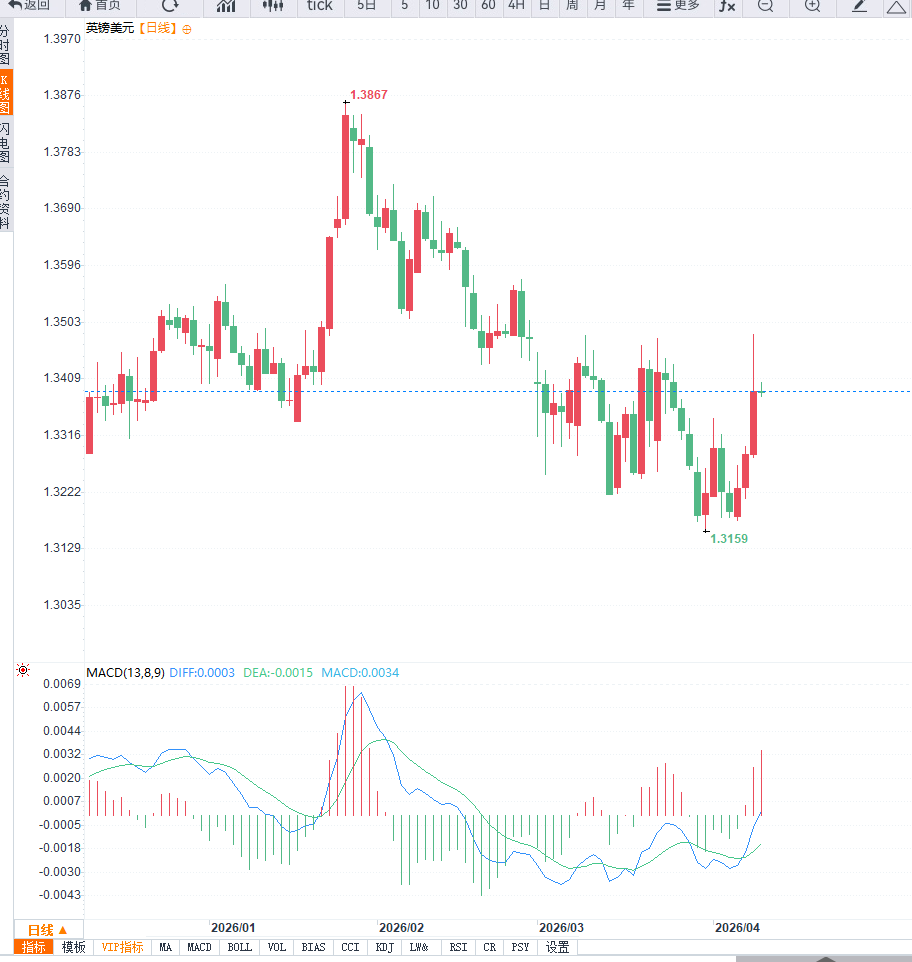
From a technical perspective, the daily chart shows that the GBP/USD pair remains in a slightly bullish trend. The price is trading above the 20-day moving average, with dynamic support around 1.3325, indicating that downside potential is temporarily limited. As long as this level is not decisively broken, the overall structure remains biased towards a slightly bullish consolidation.
In terms of momentum, the 14-day RSI is around 54, in the neutral to slightly bullish zone, indicating that the bulls still have some advantage, but the momentum is not strong. The moving average system is showing a gentle upward trend, but the slope is gradually slowing down, indicating that the upward trend has entered a consolidation phase.
From a 4-hour chart perspective, the exchange rate is trading within a sideways range, lacking a clear short-term trend. A break below the 1.3325 support level could trigger a further pullback, testing lower support areas; conversely, a renewed strength and break above previous highs could open up new upside potential. The current structure suggests that, as long as key support levels hold, the exchange rate is generally biased towards a sideways-to-upward trend.
Editor's Summary:
The British pound is currently in a typical consolidation phase against the US dollar. In the short term, the ongoing Middle East situation and safe-haven demand for the dollar are putting downward pressure on the exchange rate, but the technical structure has not yet turned bearish. In the medium term, the exchange rate still has some upside potential, but new fundamental catalysts are needed to break through key resistance levels. Before the release of key data, the market is likely to maintain a range-bound trading pattern, awaiting a directional move.
From a fundamental perspective, the uncertainty surrounding the Middle East situation has once again become the focus of the market. Despite a short-term ceasefire agreement reached between the US and Iran, the situation quickly deteriorated. Israel's continued military operations in Lebanon have raised questions about the sustainability of the ceasefire. Iran has also explicitly stated that some of the terms of the ceasefire have been violated and that continuing to pursue a long-term agreement lacks justification. These developments have reignited market concerns about a prolonged conflict.
Against this backdrop, market risk appetite declined, putting pressure on risk assets. US stock futures fell slightly, indicating a more cautious investor sentiment. Meanwhile, the US dollar index rose slightly to around 99, reflecting safe-haven demand supporting the dollar. This put some downward pressure on the pound against the dollar, limiting its upward momentum.
From a macroeconomic perspective, the market is awaiting guidance from key inflation data. Expectations suggest that the US March CPI year-on-year increase may rise to 3.3%, higher than the previous 2.4%, mainly driven by rising energy prices. If the data is higher than expected, it will strengthen expectations that the Federal Reserve will maintain high interest rates, thereby further supporting the dollar; conversely, it may ease pressure on the dollar and provide room for a rebound in the pound.
From a market sentiment perspective, investors are currently adopting a wait-and-see attitude. On the one hand, geopolitical uncertainties limit the recovery of risk appetite; on the other hand, key economic data has not yet been released, leaving the market lacking a clear direction. In this environment, exchange rates are more likely to fluctuate within a range.
From a technical perspective, the daily chart shows that the GBP/USD pair remains in a slightly bullish trend. The price is trading above the 20-day moving average, with dynamic support around 1.3325, indicating that downside potential is temporarily limited. As long as this level is not decisively broken, the overall structure remains biased towards a slightly bullish consolidation.
In terms of momentum, the 14-day RSI is around 54, in the neutral to slightly bullish zone, indicating that the bulls still have some advantage, but the momentum is not strong. The moving average system is showing a gentle upward trend, but the slope is gradually slowing down, indicating that the upward trend has entered a consolidation phase.
From a 4-hour chart perspective, the exchange rate is trading within a sideways range, lacking a clear short-term trend. A break below the 1.3325 support level could trigger a further pullback, testing lower support areas; conversely, a renewed strength and break above previous highs could open up new upside potential. The current structure suggests that, as long as key support levels hold, the exchange rate is generally biased towards a sideways-to-upward trend.
Editor's Summary:
The British pound is currently in a typical consolidation phase against the US dollar. In the short term, the ongoing Middle East situation and safe-haven demand for the dollar are putting downward pressure on the exchange rate, but the technical structure has not yet turned bearish. In the medium term, the exchange rate still has some upside potential, but new fundamental catalysts are needed to break through key resistance levels. Before the release of key data, the market is likely to maintain a range-bound trading pattern, awaiting a directional move.
- Risk Warning and Disclaimer
- The market involves risk, and trading may not be suitable for all investors. This article is for reference only and does not constitute personal investment advice, nor does it take into account certain users’ specific investment objectives, financial situation, or other needs. Any investment decisions made based on this information are at your own risk.