Gold prices surged and then retreated, consolidating above $4700. Caution is advised against a potential further downward correction.
2026-04-09 16:08:05
Gold prices remained weak ahead of the European session, having retreated from a three-week high but still holding above the $4,700 level. Overall, the market is currently in a typical tug-of-war between bulls and bears, with the direction still unclear.

From a fundamental perspective, the uncertainty surrounding the Middle East situation continues to impact market sentiment. Israel launched large-scale airstrikes in Lebanon and explicitly stated that the ceasefire agreement did not cover the Lebanese region, casting doubt on the stability of the temporary ceasefire agreement previously reached between the US and Iran. Meanwhile, Iran re-closed shipping through the Strait of Hormuz and warned that it might withdraw from the ceasefire agreement if the conflict continued. This series of events has weakened market expectations for a de-escalation of the situation.
Against this backdrop, the US dollar received some safe-haven support, thus putting downward pressure on gold. Generally, a stronger dollar reduces the attractiveness of dollar-denominated gold, putting downward pressure on its price. Therefore, although geopolitical risks are generally favorable for gold, their supporting effect on the dollar has a negative impact on gold prices in the short term.
From a monetary policy perspective, the Federal Reserve's stance remains a crucial factor influencing gold prices. The latest meeting minutes indicate that the Fed favors maintaining higher interest rates to address inflation risks from rising energy prices. This expectation of "higher interest rates for longer" continues to exert downward pressure on gold, as gold, as a non-interest-bearing asset, becomes less attractive in a high-interest-rate environment.
However, in the medium term, policymakers still hint at room for future interest rate cuts, with one cut expected this year and further adjustments over the longer term. This expectation has limited the upside potential of the dollar and provided some support for gold, preventing a trend of decline.
Market behavior suggests that investors are generally cautious ahead of key data releases. The market is awaiting the upcoming US PCE price index and Friday's CPI data. Expectations indicate that US inflation may continue to rise, which will significantly impact the Federal Reserve's policy path. Therefore, funds are inclined to reduce directional bets before the data is released.
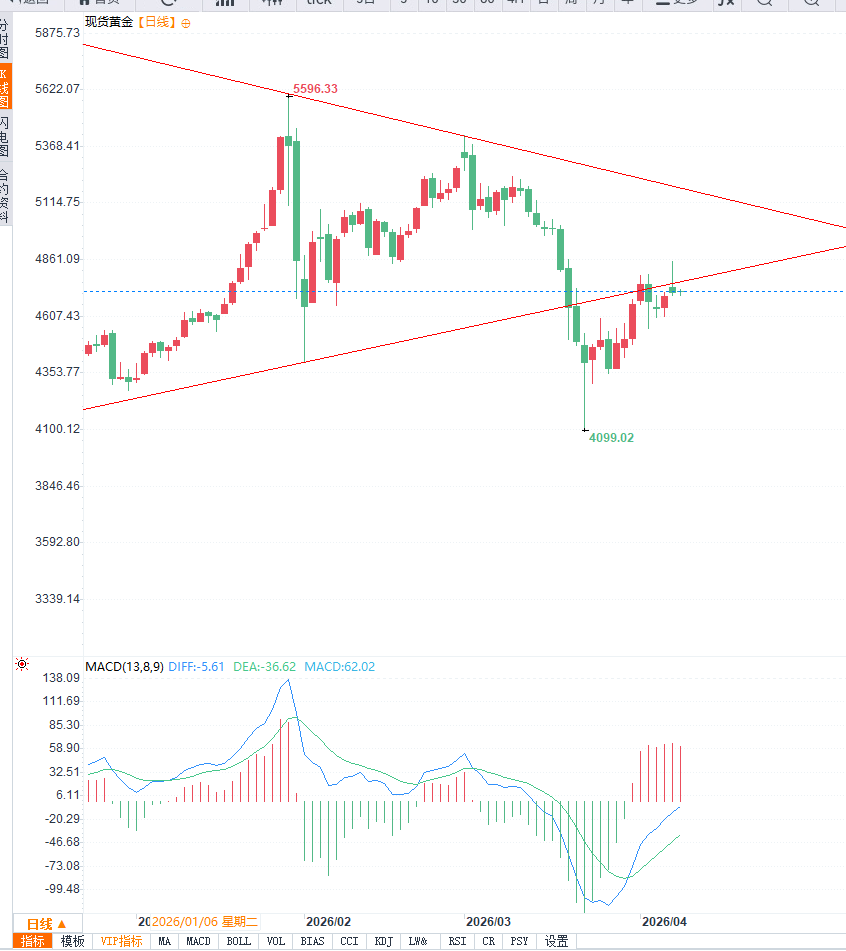
From a technical perspective, the daily chart shows that gold has entered a consolidation phase after pulling back from its highs, with the overall trend still within a high-level oscillation range. Currently, $4700 forms a key short-term support level; a decisive break below this level could trigger further declines. On the upside, the key resistance level to watch is around $4758, a crucial retracement level.
From a 4-hour chart perspective, the price is trading below the 200-period moving average and is also constrained by the 50% retracement level, indicating an overall bearish structure. The MACD has entered negative territory, showing weakening short-term momentum, while the RSI remains near neutral, suggesting insufficient bullish momentum but not yet a complete shift to bearish. If the price fails to regain a foothold above 4750, the rebound is likely to be a technical correction.
On the downside, $4600 is a key short-term support level, with further support at $4410 and $4100, which are previous lows. On the upside, in addition to $4758, further resistance levels to watch are the $4895-$4914 range and the psychological level of $5000.
Editor's Summary:
Gold is currently in a typical phase of "high-level consolidation + bullish/bearish tug-of-war." In the short term, the ongoing Middle East situation and safe-haven demand for the US dollar are putting downward pressure on gold prices, while the expectation of the Federal Reserve maintaining high interest rates is further weakening upward momentum. However, in the medium term, the potential for interest rate cuts still provides bottom support for gold. Before the release of key inflation data, the market lacks a clear direction, and gold is likely to maintain a range-bound trading pattern. Future price movements will depend on inflation data performance and changes in policy expectations.
From a fundamental perspective, the uncertainty surrounding the Middle East situation continues to impact market sentiment. Israel launched large-scale airstrikes in Lebanon and explicitly stated that the ceasefire agreement did not cover the Lebanese region, casting doubt on the stability of the temporary ceasefire agreement previously reached between the US and Iran. Meanwhile, Iran re-closed shipping through the Strait of Hormuz and warned that it might withdraw from the ceasefire agreement if the conflict continued. This series of events has weakened market expectations for a de-escalation of the situation.
Against this backdrop, the US dollar received some safe-haven support, thus putting downward pressure on gold. Generally, a stronger dollar reduces the attractiveness of dollar-denominated gold, putting downward pressure on its price. Therefore, although geopolitical risks are generally favorable for gold, their supporting effect on the dollar has a negative impact on gold prices in the short term.
From a monetary policy perspective, the Federal Reserve's stance remains a crucial factor influencing gold prices. The latest meeting minutes indicate that the Fed favors maintaining higher interest rates to address inflation risks from rising energy prices. This expectation of "higher interest rates for longer" continues to exert downward pressure on gold, as gold, as a non-interest-bearing asset, becomes less attractive in a high-interest-rate environment.
However, in the medium term, policymakers still hint at room for future interest rate cuts, with one cut expected this year and further adjustments over the longer term. This expectation has limited the upside potential of the dollar and provided some support for gold, preventing a trend of decline.
Market behavior suggests that investors are generally cautious ahead of key data releases. The market is awaiting the upcoming US PCE price index and Friday's CPI data. Expectations indicate that US inflation may continue to rise, which will significantly impact the Federal Reserve's policy path. Therefore, funds are inclined to reduce directional bets before the data is released.
From a technical perspective, the daily chart shows that gold has entered a consolidation phase after pulling back from its highs, with the overall trend still within a high-level oscillation range. Currently, $4700 forms a key short-term support level; a decisive break below this level could trigger further declines. On the upside, the key resistance level to watch is around $4758, a crucial retracement level.
From a 4-hour chart perspective, the price is trading below the 200-period moving average and is also constrained by the 50% retracement level, indicating an overall bearish structure. The MACD has entered negative territory, showing weakening short-term momentum, while the RSI remains near neutral, suggesting insufficient bullish momentum but not yet a complete shift to bearish. If the price fails to regain a foothold above 4750, the rebound is likely to be a technical correction.
On the downside, $4600 is a key short-term support level, with further support at $4410 and $4100, which are previous lows. On the upside, in addition to $4758, further resistance levels to watch are the $4895-$4914 range and the psychological level of $5000.
Editor's Summary:
Gold is currently in a typical phase of "high-level consolidation + bullish/bearish tug-of-war." In the short term, the ongoing Middle East situation and safe-haven demand for the US dollar are putting downward pressure on gold prices, while the expectation of the Federal Reserve maintaining high interest rates is further weakening upward momentum. However, in the medium term, the potential for interest rate cuts still provides bottom support for gold. Before the release of key inflation data, the market lacks a clear direction, and gold is likely to maintain a range-bound trading pattern. Future price movements will depend on inflation data performance and changes in policy expectations.
- Risk Warning and Disclaimer
- The market involves risk, and trading may not be suitable for all investors. This article is for reference only and does not constitute personal investment advice, nor does it take into account certain users’ specific investment objectives, financial situation, or other needs. Any investment decisions made based on this information are at your own risk.