Has the US-Iran ceasefire agreement changed? Why is gold holding firm at high levels?
2026-04-09 21:14:29
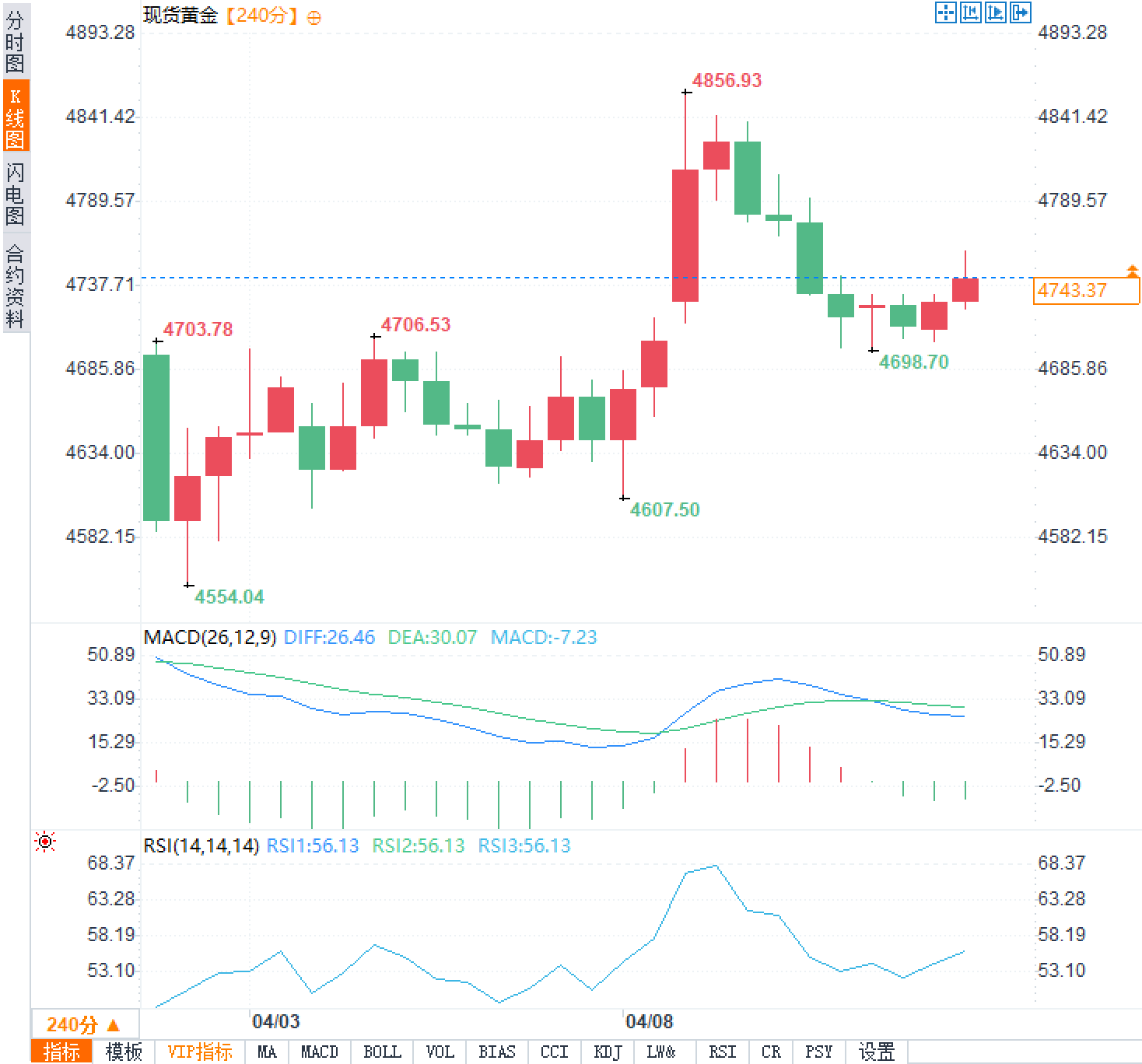
On Thursday, April 9th, spot gold prices remained stable around $4750 during the North American session. Following the release of the US February Personal Consumption Expenditures Price Index, which met expectations, gold prices failed to maintain the previous day's momentum above $4800. The US dollar index remained largely unchanged at 98.95. Uncertainty surrounding the US-Iran ceasefire agreement in the Middle East, coupled with signals from US economic data, led to a cautious market sentiment. Traders are assessing how robust inflation, economic slowdown, and geopolitical risks will intertwine to influence the Federal Reserve's policy path, and the balance between gold's role as a safe haven and an inflation hedge.
The U.S. Personal Consumption Expenditures (PCE) price index rose 2.8% year-on-year in February, in line with market expectations, and increased 0.4% month-on-month. The core PCE price index fell to 3.0% year-on-year from 3.1% in January, also in line with expectations. Personal income fell 0.1% month-on-month, while personal spending increased 0.5%. These data reflect that price pressures in the U.S. consumer sector remain stable, but there are no significant signs of cooling, indicating that underlying inflation remains somewhat sticky.
As the Federal Reserve's preferred measure of inflation, the stable performance of the PCE data suggests that policymakers are unlikely to significantly adjust the interest rate path in the short term. Inflation remaining above the 2% long-term target limits the scope for aggressive easing, but its within-expectations also avoid excessive market concerns about tightening. For gold, this balance reduces upward pressure on interest rates while maintaining its attractiveness as a hedging tool. Traders need to pay attention to how subsequent details of personal income and spending affect consumer resilience and whether this will transmit to broader price pressures, thereby assessing the linkage between the dollar exchange rate and gold pricing.
The stability of spot gold prices is closely linked to the situation in the Middle East. The temporary ceasefire agreement reached between the US and Iran is facing a severe test. Iranian Parliament Speaker Mohammad Bagher Ghalibaf pointed out that three parts of the agreement have been violated, particularly the Israeli military action concerning Lebanon. Iran emphasizes that Lebanon is included in the ceasefire, while the US and Israel hold different views. Tehran warned that it might withdraw from the agreement if the attacks on Lebanon continue. US President Trump stated on social media that US troops will remain in positions in and around Iran until a genuine agreement is reached and fully implemented. Negotiations between the two sides will begin on Saturday in Pakistan, aiming to achieve a permanent ceasefire and reopen the Strait of Hormuz. Against this backdrop, crude oil prices have rebounded, further exacerbating global inflation concerns.
The minutes of the Federal Reserve's March meeting revealed the policymakers' dilemma. Most participants believed that a prolonged conflict in the Middle East could weaken labor market conditions, thus supporting additional interest rate cuts; at the same time, many pointed out that the risk of continued rising oil prices could lead to inflation remaining at higher levels for a longer period, even necessitating consideration of the possibility of interest rate hikes. The fragility of the ceasefire agreement directly amplified short-term risk aversion, while the rebound in crude oil prices indirectly affected inflation expectations through cost-push channels, forming a dual transmission mechanism for gold.
The third estimate for U.S. GDP growth in the fourth quarter of 2025 has been revised downward to 0.5%, a further downward revision from the second estimate of 0.7% and the initial estimate of 1.4%, and a stark contrast to the 4.4% in the third quarter. The main reason for the downward revision is the adjustment in investment data. This figure indicates a significant slowdown in economic growth, even approaching the contractionary range seen earlier this year.
Slower economic growth could reinforce market expectations for further easing by the Federal Reserve, despite some constraints from inflation data. Lower growth prospects typically increase demand for safe-haven assets, and gold, as a non-yielding asset, tends to be more robust during periods of interest rate expectation adjustment. The combination of weakening economic momentum and sticky inflation could prolong the Fed's wait-and-see approach, thus providing a macroeconomic basis for range-bound gold prices.
The minutes of the Federal Reserve's March meeting further amplified uncertainty about the policy path. Most participants focused on the potential drag on the labor market from the prolonged Middle East conflict, believing this could open room for further rate cuts; many others emphasized the continued upward pressure on inflation from rising oil prices, warning that high inflation could force policy tightening. This divergence highlights the difficulty policymakers face in balancing growth and price targets. Combined with the February PCE data and the downward revision of fourth-quarter GDP, traders are recalibrating their expectations for peak interest rates and the timing of easing, leaving the gold market caught in a tug-of-war between macroeconomic signals and geopolitical events.
Inflation data met expectations; Fed policy expectations remained balanced.
The U.S. Personal Consumption Expenditures (PCE) price index rose 2.8% year-on-year in February, in line with market expectations, and increased 0.4% month-on-month. The core PCE price index fell to 3.0% year-on-year from 3.1% in January, also in line with expectations. Personal income fell 0.1% month-on-month, while personal spending increased 0.5%. These data reflect that price pressures in the U.S. consumer sector remain stable, but there are no significant signs of cooling, indicating that underlying inflation remains somewhat sticky.
| index | February actual | Market expectations | Previous value |
|---|---|---|---|
| PCE year-on-year | 2.8% | 2.8% | 2.8% |
| Core PCE year-on-year | 3.0% | 3.0% | 3.1% |
| PCE month-on-month change | 0.4% | 0.4% | -- |
The fragility of the Middle East ceasefire agreement has boosted safe-haven premiums.
The stability of spot gold prices is closely linked to the situation in the Middle East. The temporary ceasefire agreement reached between the US and Iran is facing a severe test. Iranian Parliament Speaker Mohammad Bagher Ghalibaf pointed out that three parts of the agreement have been violated, particularly the Israeli military action concerning Lebanon. Iran emphasizes that Lebanon is included in the ceasefire, while the US and Israel hold different views. Tehran warned that it might withdraw from the agreement if the attacks on Lebanon continue. US President Trump stated on social media that US troops will remain in positions in and around Iran until a genuine agreement is reached and fully implemented. Negotiations between the two sides will begin on Saturday in Pakistan, aiming to achieve a permanent ceasefire and reopen the Strait of Hormuz. Against this backdrop, crude oil prices have rebounded, further exacerbating global inflation concerns.
The minutes of the Federal Reserve's March meeting revealed the policymakers' dilemma. Most participants believed that a prolonged conflict in the Middle East could weaken labor market conditions, thus supporting additional interest rate cuts; at the same time, many pointed out that the risk of continued rising oil prices could lead to inflation remaining at higher levels for a longer period, even necessitating consideration of the possibility of interest rate hikes. The fragility of the ceasefire agreement directly amplified short-term risk aversion, while the rebound in crude oil prices indirectly affected inflation expectations through cost-push channels, forming a dual transmission mechanism for gold.
Weakening economic growth momentum highlights gold's defensive properties
The third estimate for U.S. GDP growth in the fourth quarter of 2025 has been revised downward to 0.5%, a further downward revision from the second estimate of 0.7% and the initial estimate of 1.4%, and a stark contrast to the 4.4% in the third quarter. The main reason for the downward revision is the adjustment in investment data. This figure indicates a significant slowdown in economic growth, even approaching the contractionary range seen earlier this year.
| Estimation stage | Annualized quarterly rate |
|---|---|
| Preliminary values | 1.4% |
| Second forecast | 0.7% |
| Final value | 0.5% |
The dual risks of the Fed meeting minutes
The minutes of the Federal Reserve's March meeting further amplified uncertainty about the policy path. Most participants focused on the potential drag on the labor market from the prolonged Middle East conflict, believing this could open room for further rate cuts; many others emphasized the continued upward pressure on inflation from rising oil prices, warning that high inflation could force policy tightening. This divergence highlights the difficulty policymakers face in balancing growth and price targets. Combined with the February PCE data and the downward revision of fourth-quarter GDP, traders are recalibrating their expectations for peak interest rates and the timing of easing, leaving the gold market caught in a tug-of-war between macroeconomic signals and geopolitical events.
Frequently Asked Questions
Question 1: How do doubts about the US-Iran ceasefire agreement specifically affect the gold market?
A: The fragile ceasefire has pushed up prices of commodities such as crude oil, increased the complexity of inflation expectations, and reinforced global risk aversion. Iran's questioning of the agreement's implementation and the upcoming negotiations with Pakistan have injected uncertainty into the market. Gold, as a traditional safe-haven asset, reflects investors' concerns about a potential escalation of geopolitical conflict, while also taking into account the potential impact of rising energy prices on the Federal Reserve's policy path.
Question 2: What implications does the downward revision of the Q4 2025 GDP growth rate have for the logic of gold pricing?
A: The continuous downward revisions to GDP data highlight weakening US economic momentum, potentially providing the Federal Reserve with more room for easing, although inflation indicators remain sticky. Slower economic growth is typically accompanied by a lower real interest rate environment, which is beneficial for gold, which has a higher holding cost.
- Risk Warning and Disclaimer
- The market involves risk, and trading may not be suitable for all investors. This article is for reference only and does not constitute personal investment advice, nor does it take into account certain users’ specific investment objectives, financial situation, or other needs. Any investment decisions made based on this information are at your own risk.