The Middle East is a powder keg, yet the US dollar remains flat? Analysis of the underlying reasons.
2026-04-09 21:06:03
The two-week ceasefire agreement reached between the US and Iran on Tuesday faced serious challenges the day after it took effect.
Iranian Deputy Foreign Minister Saeed Khatibzadeh stated explicitly that Israel's airstrikes against Lebanon on Wednesday constituted a "serious violation" of the ceasefire agreement, which Lebanon should have been included in—a claim jointly denied by the United States and Israel.
The sudden military operation has killed at least 203 people in Lebanon, while Israel insists that the attack targeted Hezbollah's command center and military facilities.
When asked whether Iran would restrain Hezbollah, Khatibzadeh stated without hesitation that Hezbollah, as the "Freedom Movement of Lebanon," has always received support from Iran and that the organization has "strictly adhered" to the ceasefire agreement.
Paradoxically, Hezbollah responded on Thursday, stating that its nighttime attack on Israel was a retaliation for "ceasefire violations" and threatening to continue its actions until the "Israeli-American aggression" completely ends.
This statement casts a shadow over the prospects for implementing the US-Iran ceasefire, and the confrontation between the two sides' allies continues to escalate.
White House mouthpiece, National Economic Council Director Hassett, simultaneously stated that the US-Iran dialogue was of positive significance and that the two sides were negotiating a major cooperation agreement.
The navigation dispute in the Strait of Hormuz has further complicated the situation.
As a strategic waterway carrying about one-fifth of the world's oil and liquefied natural gas, the strait was supposed to resume normal traffic during the ceasefire, but Iranian state media claimed that the strait remained closed due to Israel's continued attacks on Hezbollah.
The White House publicly refuted this claim, stating that the "closure of the Strait" was false information and that the number of ships passing through had "increased."
Khatibzadeh emphasized that Iran will abide by international law, but if the United States withdraws its "aggressive actions," Iran is willing to cooperate with Oman and the international community to formulate a passage agreement to ensure the safety of the Strait and prevent "abuse of warships." This statement was interpreted by the market as Iran retaining actual control over the Strait.
Hassett added that if the Strait of Hormuz opens, the oil market will quickly return to normal; currently, Asian oil reserves are increasingly depleted, while US supply is less affected in comparison. The US has consulted with its allies on ensuring a stable oil supply, and is striving to complete a reconciliation bill by June, with a second bill to be studied in the fall.
While the US February PCE inflation data met expectations across the board, core indicators remained sticky (core PCE 0.4% month-on-month and 3.0% year-on-year). However, in a peacetime context, the reference value of this supplementary data is limited.
Only the services sector PCE, excluding energy and housing, cooled to 0.2% month-on-month, becoming one of the few signs of easing. Market expectations for interest rate cuts are still constrained by inflation stickiness and geopolitical premiums, and the focus has shifted to the March CPI report.
Meanwhile, initial jobless claims rose slightly to 219,000 in the week ending April 4. Although this is at a historically low level and there has been no wave of layoffs triggered by oil price shocks, the labor market is stuck in a stalemate of low hiring and low layoffs. Businesses are freezing new jobs due to policy uncertainty, and unemployment among young people may be underestimated. The minutes of the Fed’s March meeting showed that some policymakers were inclined to raise interest rates to combat inflation, and the employment data has not changed the wait-and-see attitude of the policy.
It is worth noting that against the backdrop of escalating geopolitical risks triggered by Israeli airstrikes, the traditional safe-haven currency, the US dollar, did not see the expected rise. Instead, it came under pressure and declined, hitting a new low in nearly a month.
Behind this unusual trend is the combined effect of multiple market logics.
Core reason one: The ceasefire framework remains intact, and risk appetite is recovering.
From a foreign exchange trading perspective, the core reason for the dollar's "failure" this time lies in the restoration of risk appetite brought about by the ceasefire agreement. Despite Israel's attack, the market is still focused on the fact that the core framework of the two-week ceasefire between the US and Iran has not been completely broken, and funds are more inclined to chase risky assets rather than hold the dollar as a safe haven.
This phenomenon, where "geopolitical conflict has not translated into safe-haven buying," highlights that the market's core assessment of the Middle East situation has shifted to "ceasefire resilience," thus putting pressure on the US dollar in traditional safe-haven scenarios.
Second key reason: The plunge in oil prices eased inflation and boosted expectations of interest rate cuts.
White House National Economic Council Director Hassett explicitly advocated for lower U.S. interest rates, while also revealing that Trump has nominated former Federal Reserve Governor Warsh as the next Federal Reserve Chairman. His Senate hearing will be held next week, and if the nomination is approved, Warsh is expected to take office in May.
Current Federal Reserve Chairman Jerome Powell stated that he has no intention of resigning before the Department of Justice's investigation concludes, and his term as a Federal Reserve governor will continue until January 2028. The reduction of the Federal Reserve's balance sheet needs to be carried out gradually.
From a technical perspective, the US dollar index has broken below the key 100-day moving average and the crucial support level of 99, indicating that the dollar may resume its downward trend.
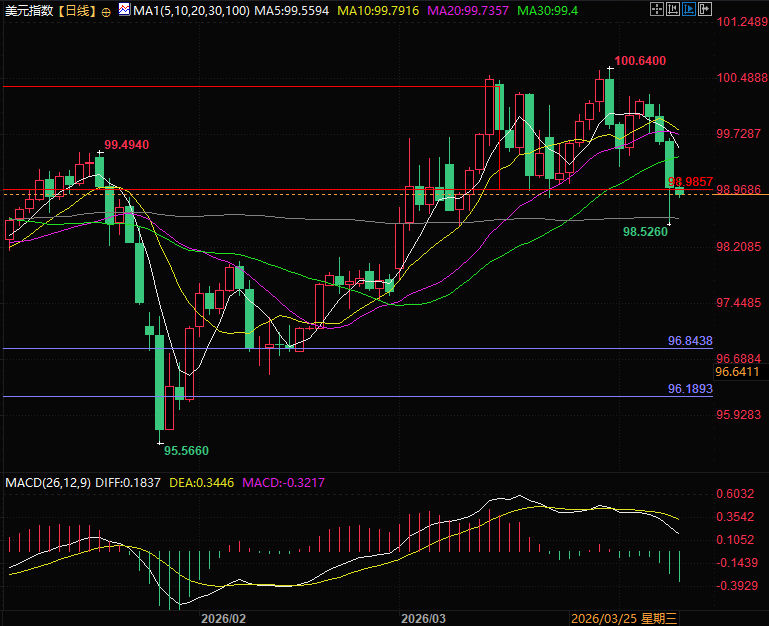
(US Dollar Index daily chart, source: EasyForex)
At 21:02 Beijing time, the US dollar index is currently at 98.91.
Iranian Deputy Foreign Minister Saeed Khatibzadeh stated explicitly that Israel's airstrikes against Lebanon on Wednesday constituted a "serious violation" of the ceasefire agreement, which Lebanon should have been included in—a claim jointly denied by the United States and Israel.
The sudden military operation has killed at least 203 people in Lebanon, while Israel insists that the attack targeted Hezbollah's command center and military facilities.
Hezbollah's counterattack exacerbates tensions: the prospects for ceasefire implementation remain uncertain.
When asked whether Iran would restrain Hezbollah, Khatibzadeh stated without hesitation that Hezbollah, as the "Freedom Movement of Lebanon," has always received support from Iran and that the organization has "strictly adhered" to the ceasefire agreement.
Paradoxically, Hezbollah responded on Thursday, stating that its nighttime attack on Israel was a retaliation for "ceasefire violations" and threatening to continue its actions until the "Israeli-American aggression" completely ends.
This statement casts a shadow over the prospects for implementing the US-Iran ceasefire, and the confrontation between the two sides' allies continues to escalate.
White House mouthpiece, National Economic Council Director Hassett, simultaneously stated that the US-Iran dialogue was of positive significance and that the two sides were negotiating a major cooperation agreement.
Strait of Hormuz stalemate: Navigation disputes exacerbate the complexity of the situation.
The navigation dispute in the Strait of Hormuz has further complicated the situation.
As a strategic waterway carrying about one-fifth of the world's oil and liquefied natural gas, the strait was supposed to resume normal traffic during the ceasefire, but Iranian state media claimed that the strait remained closed due to Israel's continued attacks on Hezbollah.
The White House publicly refuted this claim, stating that the "closure of the Strait" was false information and that the number of ships passing through had "increased."
Khatibzadeh emphasized that Iran will abide by international law, but if the United States withdraws its "aggressive actions," Iran is willing to cooperate with Oman and the international community to formulate a passage agreement to ensure the safety of the Strait and prevent "abuse of warships." This statement was interpreted by the market as Iran retaining actual control over the Strait.
Hassett added that if the Strait of Hormuz opens, the oil market will quickly return to normal; currently, Asian oil reserves are increasingly depleted, while US supply is less affected in comparison. The US has consulted with its allies on ensuring a stable oil supply, and is striving to complete a reconciliation bill by June, with a second bill to be studied in the fall.
Limited Economic Data: Sticky Inflation and Employment Impasse Coexist?
While the US February PCE inflation data met expectations across the board, core indicators remained sticky (core PCE 0.4% month-on-month and 3.0% year-on-year). However, in a peacetime context, the reference value of this supplementary data is limited.
Only the services sector PCE, excluding energy and housing, cooled to 0.2% month-on-month, becoming one of the few signs of easing. Market expectations for interest rate cuts are still constrained by inflation stickiness and geopolitical premiums, and the focus has shifted to the March CPI report.
Meanwhile, initial jobless claims rose slightly to 219,000 in the week ending April 4. Although this is at a historically low level and there has been no wave of layoffs triggered by oil price shocks, the labor market is stuck in a stalemate of low hiring and low layoffs. Businesses are freezing new jobs due to policy uncertainty, and unemployment among young people may be underestimated. The minutes of the Fed’s March meeting showed that some policymakers were inclined to raise interest rates to combat inflation, and the employment data has not changed the wait-and-see attitude of the policy.
An unusual signal amid geopolitical conflict: The dollar fell instead of rising after the Israeli airstrike.
It is worth noting that against the backdrop of escalating geopolitical risks triggered by Israeli airstrikes, the traditional safe-haven currency, the US dollar, did not see the expected rise. Instead, it came under pressure and declined, hitting a new low in nearly a month.
Behind this unusual trend is the combined effect of multiple market logics.
Core reason one: The ceasefire framework remains intact, and risk appetite is recovering.
From a foreign exchange trading perspective, the core reason for the dollar's "failure" this time lies in the restoration of risk appetite brought about by the ceasefire agreement. Despite Israel's attack, the market is still focused on the fact that the core framework of the two-week ceasefire between the US and Iran has not been completely broken, and funds are more inclined to chase risky assets rather than hold the dollar as a safe haven.
This phenomenon, where "geopolitical conflict has not translated into safe-haven buying," highlights that the market's core assessment of the Middle East situation has shifted to "ceasefire resilience," thus putting pressure on the US dollar in traditional safe-haven scenarios.
Second key reason: The plunge in oil prices eased inflation and boosted expectations of interest rate cuts.
White House National Economic Council Director Hassett explicitly advocated for lower U.S. interest rates, while also revealing that Trump has nominated former Federal Reserve Governor Warsh as the next Federal Reserve Chairman. His Senate hearing will be held next week, and if the nomination is approved, Warsh is expected to take office in May.
Current Federal Reserve Chairman Jerome Powell stated that he has no intention of resigning before the Department of Justice's investigation concludes, and his term as a Federal Reserve governor will continue until January 2028. The reduction of the Federal Reserve's balance sheet needs to be carried out gradually.
From a technical perspective, the US dollar index has broken below the key 100-day moving average and the crucial support level of 99, indicating that the dollar may resume its downward trend.
(US Dollar Index daily chart, source: EasyForex)
At 21:02 Beijing time, the US dollar index is currently at 98.91.
- Risk Warning and Disclaimer
- The market involves risk, and trading may not be suitable for all investors. This article is for reference only and does not constitute personal investment advice, nor does it take into account certain users’ specific investment objectives, financial situation, or other needs. Any investment decisions made based on this information are at your own risk.