Crude Oil Trading Alert: The interplay between ceasefire negotiations and inflation data expectations continues to drive oil price adjustments.
2026-04-10 09:29:45
International crude oil markets saw a significant rebound on Friday, with WTI crude oil prices rising to around $98.69, a sharp recovery from previous lows and approaching the key psychological level of $100 again. Market sentiment quickly shifted from "expectations of a ceasefire easing" to "supply risk dominating," resulting in a marked strengthening of the oil price structure.

From a geopolitical perspective, although the interim ceasefire agreement between the United States and Iran is still progressing, uncertainty persists in its implementation. Israel's simultaneous signals of negotiations with Lebanon and its continued military operations against relevant targets cast doubt on the stability of the ceasefire. This "talking while fighting" scenario suggests that the risk of conflict has not truly been eliminated, and the market is re-incorporating geopolitical premiums.
Meanwhile, the situation in the Strait of Hormuz remains a key variable determining oil price direction. As one of the world's most critical energy transport hubs, this passage handles approximately 20% of global seaborne crude oil shipments . Previous restrictions on shipping by Iran rapidly escalated market concerns about supply chain disruptions. Although there have been some signs of recovery recently, overall transport remains uncertain, and this instability continues to support oil prices.
Statements from the United States further heightened market tensions. President Donald Trump criticized Iran's handling of energy transport issues and warned that he would not rule out resuming military action if the agreement failed. This suggests a potential escalation of geopolitical tensions, causing market risk premiums to rise again.
From the supply side, the actual shocks remain the core driver of rising oil prices. The damage to key energy facilities in the Middle East has not yet fully recovered, with Saudi Arabia's Khurais and Manifa oil fields reducing production by approximately 600,000 barrels per day combined, while the east-west pipeline's transport capacity has decreased by about 700,000 barrels per day , resulting in an overall supply impact of nearly 1.3 million barrels per day. This supply gap is unlikely to be filled in the short term, keeping the market supply and demand structure persistently tight.
Furthermore, structural changes in the market are exacerbating volatility. The Intercontinental Exchange (ICE) officially raised margin requirements for energy futures after Friday's close, with Brent crude futures margin rising to slightly above $11,000 and diesel futures margin approaching $21,000 . Against the backdrop of sharp market fluctuations, the increased margin significantly raises transaction costs, potentially leading to some leveraged funds being forced to adjust their positions, thereby amplifying price volatility.
At the macro level, the market is also paying close attention to the impact of US inflation data on the path of monetary policy. If inflation data reinforces tightening expectations, it could push up the dollar and put short-term downward pressure on oil prices; however, in the current environment, geopolitical risks remain the dominant factor, and the impact of macroeconomic variables is relatively minor.
From a technical perspective, the WTI daily chart structure has strengthened again, with the price approaching a key resistance zone. Current price action indicates that bulls have regained control. The $100 level represents a key psychological and technical resistance level ; a decisive break above this level could open up further upside potential to the $103-$105 range. Support has moved up to the $95 area; a break below this level could lead to a pullback to the $92 level. Momentum indicators show significantly increased upward momentum, suggesting a bullish trend.
On the 4-hour chart, oil prices are showing a clear upward channel structure, with short-term moving averages in a bullish alignment, and prices steadily rising along the trend. Short-term support has moved up to around $97, while resistance is concentrated around the $100 mark . A break above $100 would trigger technical buying; conversely, if resistance is encountered, a period of consolidation at higher levels is possible.
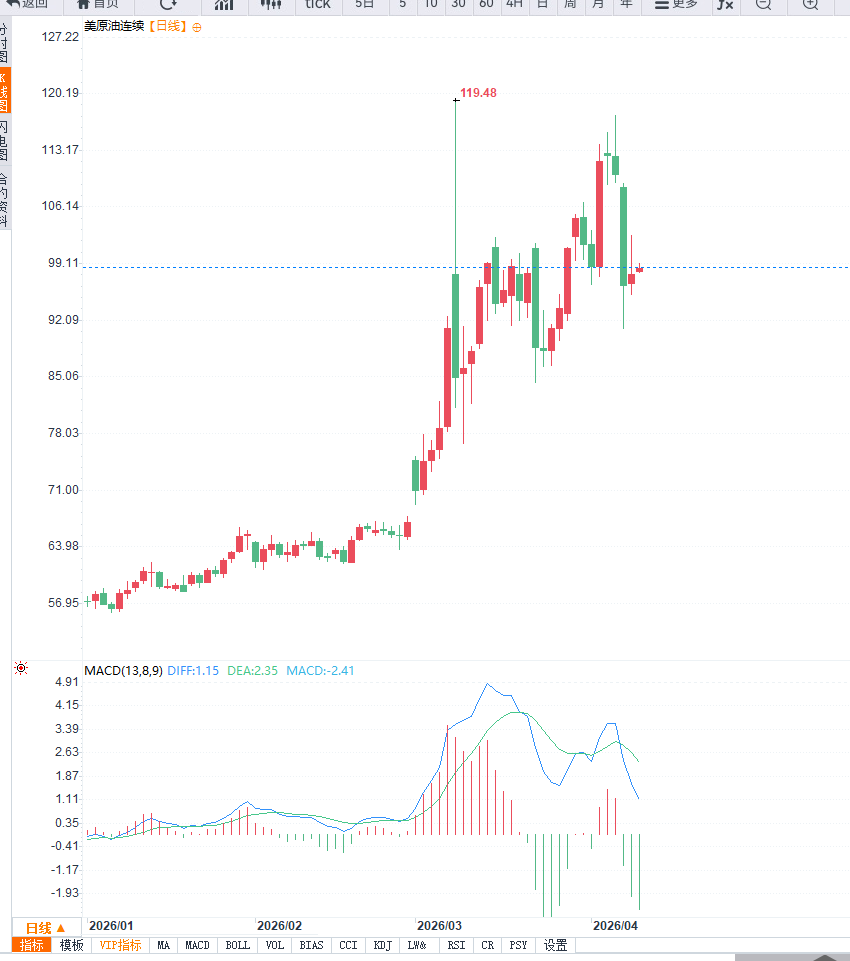
Overall, oil prices have moved from a previous correction phase back into an upward-driven phase, with the market logic returning to "supply dominance."
Editor's Summary : The current crude oil market has clearly shifted from being driven by "ceasefire expectations" to "supply risk pricing." Despite diplomatic signals of easing tensions, actual supply disruptions and transportation uncertainties continue to have a substantial impact on the market. Coupled with the liquidity contraction caused by increased margin requirements, oil price volatility has further amplified. In the short term, the $100 mark will be a key watershed; a break above it could trigger a new upward cycle. However, if the situation eases or supply recovers more than expected, a rapid correction could occur. Overall, oil prices remain in a high-risk, high-volatility phase.
From a geopolitical perspective, although the interim ceasefire agreement between the United States and Iran is still progressing, uncertainty persists in its implementation. Israel's simultaneous signals of negotiations with Lebanon and its continued military operations against relevant targets cast doubt on the stability of the ceasefire. This "talking while fighting" scenario suggests that the risk of conflict has not truly been eliminated, and the market is re-incorporating geopolitical premiums.
Meanwhile, the situation in the Strait of Hormuz remains a key variable determining oil price direction. As one of the world's most critical energy transport hubs, this passage handles approximately 20% of global seaborne crude oil shipments . Previous restrictions on shipping by Iran rapidly escalated market concerns about supply chain disruptions. Although there have been some signs of recovery recently, overall transport remains uncertain, and this instability continues to support oil prices.
Statements from the United States further heightened market tensions. President Donald Trump criticized Iran's handling of energy transport issues and warned that he would not rule out resuming military action if the agreement failed. This suggests a potential escalation of geopolitical tensions, causing market risk premiums to rise again.
From the supply side, the actual shocks remain the core driver of rising oil prices. The damage to key energy facilities in the Middle East has not yet fully recovered, with Saudi Arabia's Khurais and Manifa oil fields reducing production by approximately 600,000 barrels per day combined, while the east-west pipeline's transport capacity has decreased by about 700,000 barrels per day , resulting in an overall supply impact of nearly 1.3 million barrels per day. This supply gap is unlikely to be filled in the short term, keeping the market supply and demand structure persistently tight.
Furthermore, structural changes in the market are exacerbating volatility. The Intercontinental Exchange (ICE) officially raised margin requirements for energy futures after Friday's close, with Brent crude futures margin rising to slightly above $11,000 and diesel futures margin approaching $21,000 . Against the backdrop of sharp market fluctuations, the increased margin significantly raises transaction costs, potentially leading to some leveraged funds being forced to adjust their positions, thereby amplifying price volatility.
At the macro level, the market is also paying close attention to the impact of US inflation data on the path of monetary policy. If inflation data reinforces tightening expectations, it could push up the dollar and put short-term downward pressure on oil prices; however, in the current environment, geopolitical risks remain the dominant factor, and the impact of macroeconomic variables is relatively minor.
From a technical perspective, the WTI daily chart structure has strengthened again, with the price approaching a key resistance zone. Current price action indicates that bulls have regained control. The $100 level represents a key psychological and technical resistance level ; a decisive break above this level could open up further upside potential to the $103-$105 range. Support has moved up to the $95 area; a break below this level could lead to a pullback to the $92 level. Momentum indicators show significantly increased upward momentum, suggesting a bullish trend.
On the 4-hour chart, oil prices are showing a clear upward channel structure, with short-term moving averages in a bullish alignment, and prices steadily rising along the trend. Short-term support has moved up to around $97, while resistance is concentrated around the $100 mark . A break above $100 would trigger technical buying; conversely, if resistance is encountered, a period of consolidation at higher levels is possible.
Overall, oil prices have moved from a previous correction phase back into an upward-driven phase, with the market logic returning to "supply dominance."
Editor's Summary : The current crude oil market has clearly shifted from being driven by "ceasefire expectations" to "supply risk pricing." Despite diplomatic signals of easing tensions, actual supply disruptions and transportation uncertainties continue to have a substantial impact on the market. Coupled with the liquidity contraction caused by increased margin requirements, oil price volatility has further amplified. In the short term, the $100 mark will be a key watershed; a break above it could trigger a new upward cycle. However, if the situation eases or supply recovers more than expected, a rapid correction could occur. Overall, oil prices remain in a high-risk, high-volatility phase.
- Risk Warning and Disclaimer
- The market involves risk, and trading may not be suitable for all investors. This article is for reference only and does not constitute personal investment advice, nor does it take into account certain users’ specific investment objectives, financial situation, or other needs. Any investment decisions made based on this information are at your own risk.