The US dollar index fluctuated slightly, awaiting the release of CPI data.
2026-04-10 14:51:58
On Friday during Asian trading hours, the US dollar index (DXY) rebounded slightly to around 98.90, temporarily ending its four-day losing streak. Current market sentiment is generally cautious, and the dollar has remained relatively strong, supported by safe-haven demand and policy expectations.
From a fundamental perspective, the situation in the Middle East remains a core variable influencing the market. Although the ceasefire agreement between the US and Iran remains in effect in form, significant differences exist in its implementation. Israel continues military operations against relevant targets while stating its intention to advance direct negotiations with Lebanon. Meanwhile, the US emphasizes that it will maintain its military presence until the agreement is fully implemented. This complex situation keeps the market highly vigilant about geopolitical risks, driving funds towards safe-haven assets such as the US dollar.
Furthermore, further negotiations between the US and Iran are scheduled to begin this weekend, but significant differences remain in their understanding of ceasefire conditions, particularly regarding the situation in Lebanon. This uncertainty makes it difficult for market risk appetite to improve significantly, further supporting the dollar's performance.
On the macro level, market focus is on the upcoming US March CPI data. Driven by rising energy prices, the market expects a significant rebound in inflation. The market generally anticipates the year-on-year CPI growth rate to rise to approximately 3.3% , a significant increase from the previous figure. If the data exceeds expectations, it could reinforce the Federal Reserve's stance of maintaining high interest rates, thereby further boosting the US dollar; conversely, it could weaken the dollar's performance.
The minutes of the Federal Reserve's previous meeting showed that policymakers are currently taking a wait-and-see approach, while noting that the risk of inflation from rising energy prices is increasing. This indicates that there remains considerable uncertainty regarding a policy shift until inflation has clearly subsided.
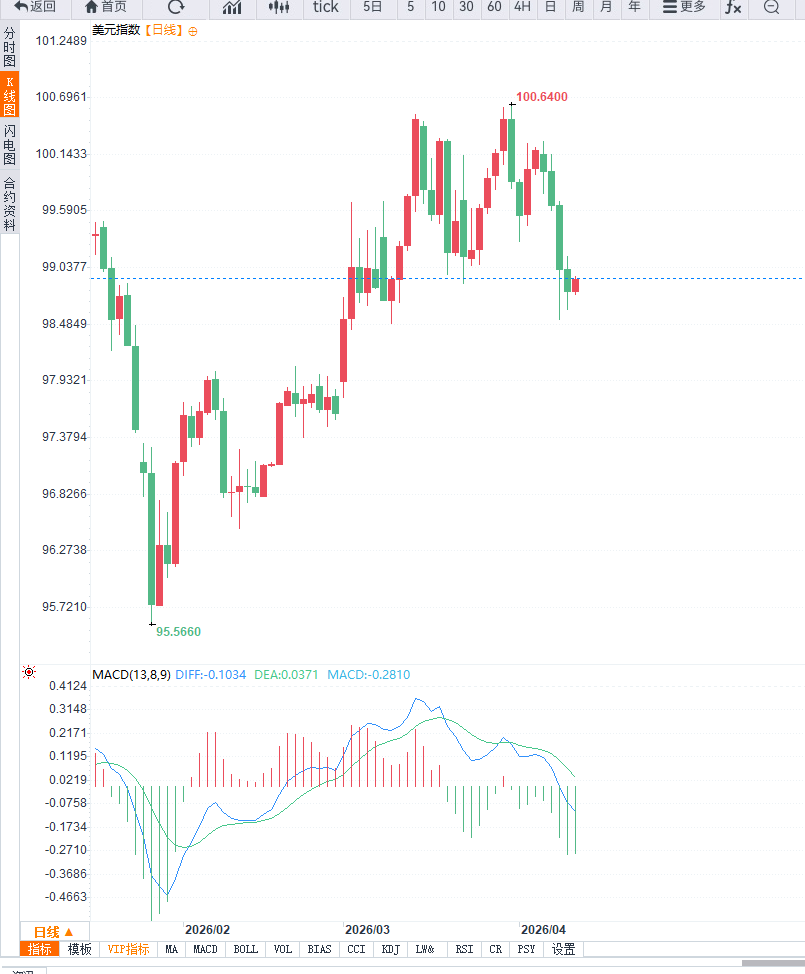
From a technical perspective, the daily chart of the US dollar index shows that the previous pullback has approached a key support area. The index has rebounded after finding support near 98.50, forming a short-term bottoming signal. If it can subsequently hold above 99.00, it may further test the 100 level; conversely, if it falls below 98.50 again, the downward trend may continue. Looking at momentum indicators, the RSI has rebounded from its lows, and the MACD histogram is shortening, indicating weakening bearish momentum.
In the 4-hour timeframe, the US dollar index is exhibiting a consolidation and recovery pattern. The price has broken through the downtrend line in the short term, indicating strengthening rebound momentum. The RSI has risen to around 50, suggesting a balance between bullish and bearish forces; the MACD is gradually approaching the zero line, indicating a shift from a weak to a stable short-term trend. In the short term, a break above the resistance around 99.20 could lead to a further rebound; however, if it encounters resistance and falls back, it will likely maintain a range-bound trading pattern.
Editor's Summary : The current trend of the US dollar index is mainly driven by both risk aversion and inflation expectations. Uncertainty surrounding the Middle East situation provides support for the dollar, while rising energy prices and resulting inflationary pressures reinforce expectations that the Federal Reserve will maintain high interest rates. In the short term, US CPI data will be a key variable determining the dollar's direction. Strong inflation data could lead to a continued rebound in the dollar; conversely, weak data could put renewed pressure on it, leaving the dollar in a crucial directional decision-making phase.
From a fundamental perspective, the situation in the Middle East remains a core variable influencing the market. Although the ceasefire agreement between the US and Iran remains in effect in form, significant differences exist in its implementation. Israel continues military operations against relevant targets while stating its intention to advance direct negotiations with Lebanon. Meanwhile, the US emphasizes that it will maintain its military presence until the agreement is fully implemented. This complex situation keeps the market highly vigilant about geopolitical risks, driving funds towards safe-haven assets such as the US dollar.
Furthermore, further negotiations between the US and Iran are scheduled to begin this weekend, but significant differences remain in their understanding of ceasefire conditions, particularly regarding the situation in Lebanon. This uncertainty makes it difficult for market risk appetite to improve significantly, further supporting the dollar's performance.
On the macro level, market focus is on the upcoming US March CPI data. Driven by rising energy prices, the market expects a significant rebound in inflation. The market generally anticipates the year-on-year CPI growth rate to rise to approximately 3.3% , a significant increase from the previous figure. If the data exceeds expectations, it could reinforce the Federal Reserve's stance of maintaining high interest rates, thereby further boosting the US dollar; conversely, it could weaken the dollar's performance.
The minutes of the Federal Reserve's previous meeting showed that policymakers are currently taking a wait-and-see approach, while noting that the risk of inflation from rising energy prices is increasing. This indicates that there remains considerable uncertainty regarding a policy shift until inflation has clearly subsided.
From a technical perspective, the daily chart of the US dollar index shows that the previous pullback has approached a key support area. The index has rebounded after finding support near 98.50, forming a short-term bottoming signal. If it can subsequently hold above 99.00, it may further test the 100 level; conversely, if it falls below 98.50 again, the downward trend may continue. Looking at momentum indicators, the RSI has rebounded from its lows, and the MACD histogram is shortening, indicating weakening bearish momentum.
In the 4-hour timeframe, the US dollar index is exhibiting a consolidation and recovery pattern. The price has broken through the downtrend line in the short term, indicating strengthening rebound momentum. The RSI has risen to around 50, suggesting a balance between bullish and bearish forces; the MACD is gradually approaching the zero line, indicating a shift from a weak to a stable short-term trend. In the short term, a break above the resistance around 99.20 could lead to a further rebound; however, if it encounters resistance and falls back, it will likely maintain a range-bound trading pattern.
Editor's Summary : The current trend of the US dollar index is mainly driven by both risk aversion and inflation expectations. Uncertainty surrounding the Middle East situation provides support for the dollar, while rising energy prices and resulting inflationary pressures reinforce expectations that the Federal Reserve will maintain high interest rates. In the short term, US CPI data will be a key variable determining the dollar's direction. Strong inflation data could lead to a continued rebound in the dollar; conversely, weak data could put renewed pressure on it, leaving the dollar in a crucial directional decision-making phase.
- Risk Warning and Disclaimer
- The market involves risk, and trading may not be suitable for all investors. This article is for reference only and does not constitute personal investment advice, nor does it take into account certain users’ specific investment objectives, financial situation, or other needs. Any investment decisions made based on this information are at your own risk.