US-Iran negotiations in full swing, navigation in the Strait of Hormuz recovers.
2026-04-10 15:48:57
On Friday (April 10), during the Asian and European sessions, international oil prices continued to fluctuate narrowly at recent lows. The sharp rise and fall on Thursday evening indicated that short-term market concerns about oil prices have subsided significantly. Although oil prices are currently trading at low levels, the bullish trend has not been broken, and the market is in a state where tensions have eased considerably but fundamentals still provide support.
On April 10 local time, the crucial peace talks between the United States and Iran in Islamabad, the capital of Pakistan, officially entered their final countdown. To ensure the safe and smooth progress of the negotiations, Pakistan has activated its highest level of security measures.
More than 10,000 military, police and security personnel have been deployed to build a comprehensive protection network;
The delegation's itinerary utilized a dedicated, closed passageway and followed the "Blue Book" high-level protocol procedures.
The bodyguards are prohibited from carrying any electronic devices such as mobile phones and smartwatches to eliminate the risk of information leakage;
Traffic control measures were implemented on several key roads during the conference to reduce the movement of unrelated personnel.
The smooth preparation for these negotiations was inseparable from Pakistan's active mediation. Iranian Deputy Foreign Minister Saeed Khatibzadeh revealed that Iran had planned to respond to the ceasefire violation on the evening of the 8th. However, after Pakistan promptly conveyed the key message of US pressure on Israel, Iran ultimately agreed to attend the meeting in Islamabad, clearing the final obstacle for the negotiations.
Although negotiations have entered a substantive phase, the core differences between the US and Iran remain centered on the issue of Lebanon, which has become a key variable in reaching an agreement.
Iran has explicitly demanded that the United States fulfill its commitment to prevent Israeli military attacks on Lebanon, emphasizing that "any peace agreement must include Lebanon, and the next few hours are crucial," directly linking Lebanese security to the outcome of the negotiations.
From the US perspective: President Trump is "very optimistic" about reaching an agreement, saying that the Iranian leadership was "much more reasonable" in private conversations, and confirmed that he had spoken with Israeli Prime Minister Netanyahu, asking him to "keep a low profile" regarding the military operation in Lebanon;
Israel's stance: Netanyahu had previously stated clearly that he insisted the US-Iran temporary ceasefire agreement should not include Hezbollah in Lebanon, emphasizing that "Israel will continue to strongly combat the organization," adding uncertainty to the negotiations.
Despite differences in their demands, both the US and Iran have completed preparations for negotiations, and the general trend of easing geopolitical tensions brings positive expectations for the stability of energy corridors.
As the "lifeline" of global crude oil transportation (handling 20% of global crude oil and liquefied natural gas transport), the Strait of Hormuz has also seen a key breakthrough in its navigation status. According to real-time monitoring data from MarineTraffic:
The first non-Iranian oil tanker since the ceasefire—the MSG flying the Gabonese flag—has successfully passed through the strait.
The tanker was carrying 7,000 tons of UAE fuel oil and was destined for Bibavawao Port in India.
This development signifies a substantial easing of the previous strait shipping blockade caused by tensions, and the gradual resumption of international commercial shipping.
The deeper significance of this breakthrough lies in the gradual lifting of restrictions on the passage of Very Large Crude Carriers (VLCCs), which is expected to further improve the efficiency of global crude oil transportation.
Industry analysts point out that the successful passage of the first non-Iranian oil tanker signifies that cross-strait shipping is transitioning from "priority to Iranian-related vessels" to "full opening to international commercial shipping," further eliminating obstacles to the passage of large oil tankers such as VLCCs.
Iran had previously planned to charge temporary passage fees to ships passing through the strait, with supertankers charged as much as $2 million each. However, the plan faced the dual challenges of fee regulation and passage speed in practice, and was opposed by the International Maritime Organization.
The author speculates that as US-Iran negotiations progress, the temporary toll mechanism in the Strait of Hormuz may be canceled by Iran as a bargaining chip in its negotiations with the US. This is because the efficiency of toll collection affects navigation, which would significantly reduce global crude oil transportation costs and accelerate the recovery of the energy supply chain. Of course, it cannot be completely ruled out that if navigation efficiency can be guaranteed, the US may start a toll collection model together with Iran. The reasons for this seemingly far-fetched view can be found in a VIP article to be published later.
From a data perspective, the trend of recovery in navigation in the Strait of Hormuz has begun to emerge:
Before the conflict, an average of about 120 ships passed through the strait daily;
In the initial stages of the ceasefire, the average daily passage volume plummeted to 5-15 vessels.
With the passage of the first non-Iranian oil tanker, it is expected that the more than 800 oil tankers and cargo ships that were stranded will be gradually cleared.
The energy team at CITIC Securities pointed out that the resumption of navigation in the Strait of Hormuz will be carried out in three phases. It is expected that global crude oil transportation capacity will recover to pre-conflict normal levels within 3-6 months, providing important support for the stability of international oil prices.
For the third consecutive day, I have emphasized that the negotiations will proceed smoothly, or rather, I have made a prediction in advance, indicating a shift in market expectations. My current view remains that the negotiations will proceed smoothly and successfully.
However, the pullback in oil prices is more of a relief in sentiment, and from a fundamental perspective, it is difficult to avoid an upward shift in the valuation center of crude oil.
From a technical perspective, WTI crude oil futures are still in an upward trend, with resistance around 102 and 106, and support at the red trend line.
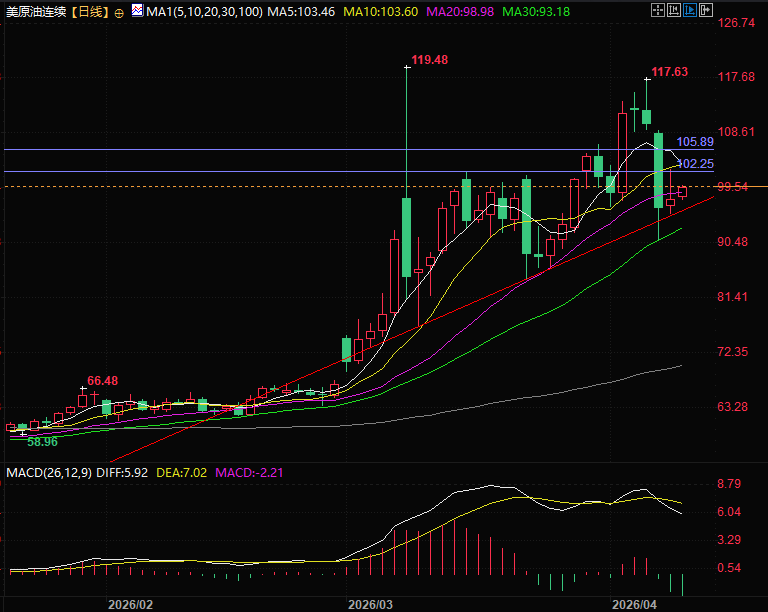
(WTI crude oil futures contract daily chart, source: FX678)
At 15:47 Beijing time, WTI crude oil futures contracts were trading at $99.88 per barrel.
On April 10 local time, the crucial peace talks between the United States and Iran in Islamabad, the capital of Pakistan, officially entered their final countdown. To ensure the safe and smooth progress of the negotiations, Pakistan has activated its highest level of security measures.
More than 10,000 military, police and security personnel have been deployed to build a comprehensive protection network;
The delegation's itinerary utilized a dedicated, closed passageway and followed the "Blue Book" high-level protocol procedures.
The bodyguards are prohibited from carrying any electronic devices such as mobile phones and smartwatches to eliminate the risk of information leakage;
Traffic control measures were implemented on several key roads during the conference to reduce the movement of unrelated personnel.
The smooth preparation for these negotiations was inseparable from Pakistan's active mediation. Iranian Deputy Foreign Minister Saeed Khatibzadeh revealed that Iran had planned to respond to the ceasefire violation on the evening of the 8th. However, after Pakistan promptly conveyed the key message of US pressure on Israel, Iran ultimately agreed to attend the meeting in Islamabad, clearing the final obstacle for the negotiations.
The core disagreement centers on the Lebanon issue, with differences remaining between the two sides' demands.
Although negotiations have entered a substantive phase, the core differences between the US and Iran remain centered on the issue of Lebanon, which has become a key variable in reaching an agreement.
Iran has explicitly demanded that the United States fulfill its commitment to prevent Israeli military attacks on Lebanon, emphasizing that "any peace agreement must include Lebanon, and the next few hours are crucial," directly linking Lebanese security to the outcome of the negotiations.
From the US perspective: President Trump is "very optimistic" about reaching an agreement, saying that the Iranian leadership was "much more reasonable" in private conversations, and confirmed that he had spoken with Israeli Prime Minister Netanyahu, asking him to "keep a low profile" regarding the military operation in Lebanon;
Israel's stance: Netanyahu had previously stated clearly that he insisted the US-Iran temporary ceasefire agreement should not include Hezbollah in Lebanon, emphasizing that "Israel will continue to strongly combat the organization," adding uncertainty to the negotiations.
Despite differences in their demands, both the US and Iran have completed preparations for negotiations, and the general trend of easing geopolitical tensions brings positive expectations for the stability of energy corridors.
A breakthrough in navigation across the Strait of Hormuz: the maiden voyage of a non-Iranian oil tanker was successful.
As the "lifeline" of global crude oil transportation (handling 20% of global crude oil and liquefied natural gas transport), the Strait of Hormuz has also seen a key breakthrough in its navigation status. According to real-time monitoring data from MarineTraffic:
The first non-Iranian oil tanker since the ceasefire—the MSG flying the Gabonese flag—has successfully passed through the strait.
The tanker was carrying 7,000 tons of UAE fuel oil and was destined for Bibavawao Port in India.
This development signifies a substantial easing of the previous strait shipping blockade caused by tensions, and the gradual resumption of international commercial shipping.
VLCC traffic obstruction removed; temporary toll mechanism may be cancelled.
The deeper significance of this breakthrough lies in the gradual lifting of restrictions on the passage of Very Large Crude Carriers (VLCCs), which is expected to further improve the efficiency of global crude oil transportation.
Industry analysts point out that the successful passage of the first non-Iranian oil tanker signifies that cross-strait shipping is transitioning from "priority to Iranian-related vessels" to "full opening to international commercial shipping," further eliminating obstacles to the passage of large oil tankers such as VLCCs.
Iran had previously planned to charge temporary passage fees to ships passing through the strait, with supertankers charged as much as $2 million each. However, the plan faced the dual challenges of fee regulation and passage speed in practice, and was opposed by the International Maritime Organization.
The author speculates that as US-Iran negotiations progress, the temporary toll mechanism in the Strait of Hormuz may be canceled by Iran as a bargaining chip in its negotiations with the US. This is because the efficiency of toll collection affects navigation, which would significantly reduce global crude oil transportation costs and accelerate the recovery of the energy supply chain. Of course, it cannot be completely ruled out that if navigation efficiency can be guaranteed, the US may start a toll collection model together with Iran. The reasons for this seemingly far-fetched view can be found in a VIP article to be published later.
With air traffic data continuing to recover, transport capacity is expected to return to normal.
From a data perspective, the trend of recovery in navigation in the Strait of Hormuz has begun to emerge:
Before the conflict, an average of about 120 ships passed through the strait daily;
In the initial stages of the ceasefire, the average daily passage volume plummeted to 5-15 vessels.
With the passage of the first non-Iranian oil tanker, it is expected that the more than 800 oil tankers and cargo ships that were stranded will be gradually cleared.
The energy team at CITIC Securities pointed out that the resumption of navigation in the Strait of Hormuz will be carried out in three phases. It is expected that global crude oil transportation capacity will recover to pre-conflict normal levels within 3-6 months, providing important support for the stability of international oil prices.
Summary and Technical Analysis:
For the third consecutive day, I have emphasized that the negotiations will proceed smoothly, or rather, I have made a prediction in advance, indicating a shift in market expectations. My current view remains that the negotiations will proceed smoothly and successfully.
However, the pullback in oil prices is more of a relief in sentiment, and from a fundamental perspective, it is difficult to avoid an upward shift in the valuation center of crude oil.
From a technical perspective, WTI crude oil futures are still in an upward trend, with resistance around 102 and 106, and support at the red trend line.
(WTI crude oil futures contract daily chart, source: FX678)
At 15:47 Beijing time, WTI crude oil futures contracts were trading at $99.88 per barrel.
- Risk Warning and Disclaimer
- The market involves risk, and trading may not be suitable for all investors. This article is for reference only and does not constitute personal investment advice, nor does it take into account certain users’ specific investment objectives, financial situation, or other needs. Any investment decisions made based on this information are at your own risk.