Goldman Sachs warns that continued blockage in the Strait of Hormuz could push natural gas prices up by another 50% to 100%, signaling a crisis.
2026-04-10 15:25:53
According to APP, Goldman Sachs analysts warned that natural gas prices could rise by another 50% to 100% if the Strait of Hormuz remains blocked. Goldman Sachs pointed out that there is insufficient global production capacity to fill the supply gap, and if the crisis continues beyond April, natural gas will enter "crisis mode."

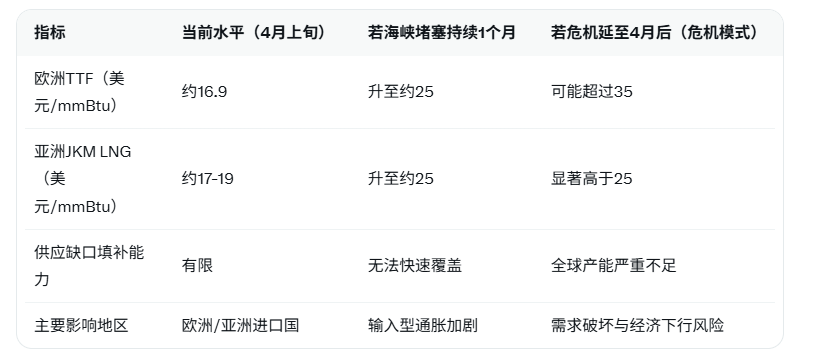
Goldman Sachs strategist Dan Struve recently emphasized in a report that current European TTF benchmark natural gas and Asian spot LNG prices have not fully factored in geopolitical risk premiums. If shipping through the Strait of Hormuz were to be disrupted for a month, both European natural gas prices and Asian JKM spot LNG prices could surge to approximately $25 per million British thermal units (MMBtu), a significant increase from current levels. This assessment is based on the reality that approximately 20% of global liquefied natural gas (LNG) is transported through the Strait of Hormuz, and major exporting countries like Qatar cannot fully replace this route in the short term.
Latest market data shows that as of early April 2026, the European TTF natural gas May contract was around $16.9 per million British thermal units (MMBtu), the Asian JKM spot LNG price fell back to around $17 per MMBtu, and the US Henry Hub price remained at a low of $2.8 per MMBtu. Although the recent US-Iran ceasefire agreement has brought some relief, if the blockade continues, the sharp drop in cross-strait shipping volume will directly push up import costs for Asia and Europe. Coupled with accelerated inventory depletion, the supply gap will be difficult to quickly fill in the short term through Australian, US, or other non-Gulf LNG imports.
Goldman Sachs further analyzed that the commissioning cycle for new global LNG production capacity is several years long, and the limited liquidity in the spot market cannot immediately fill the transportation gap of tens of millions of tons per month. If the crisis extends beyond April, Europe and Asia will face a "crisis mode," with downstream industrial, power generation, and heating demand being forced to cut sharply, which will then be transmitted to the overall energy price system.
The following table compares key scenarios for natural gas prices:
This warning highlights the strategic vulnerability of the Strait of Hormuz as a global energy chokepoint: not only crude oil is affected, but liquefied natural gas (LNG) transport also faces systemic risks. Goldman Sachs ' assessment reminds the market that while the short-term ceasefire has led to a price decline, the sustainability of the agreement remains a key variable. In the coming weeks, close monitoring of actual strait traffic, global LNG inventory dynamics, and the release of emergency reserves by major importing countries is crucial.
Editor's Summary:
Goldman Sachs' warning about the continued blockage in the Strait of Hormuz clearly outlines the potential for dramatic volatility in the natural gas market. While benchmark prices have retreated from their March highs, the structural imbalance of insufficient global alternative production capacity means that any continuation of the blockade will quickly push prices up and trigger a crisis. Major importing regions, especially large Asian countries, will face significant import pressure, while European energy security faces a historic test. Investors and policymakers need to proactively hedge against these risks and closely monitor geopolitical developments to assess the potential for price declines.
Goldman Sachs strategist Dan Struve recently emphasized in a report that current European TTF benchmark natural gas and Asian spot LNG prices have not fully factored in geopolitical risk premiums. If shipping through the Strait of Hormuz were to be disrupted for a month, both European natural gas prices and Asian JKM spot LNG prices could surge to approximately $25 per million British thermal units (MMBtu), a significant increase from current levels. This assessment is based on the reality that approximately 20% of global liquefied natural gas (LNG) is transported through the Strait of Hormuz, and major exporting countries like Qatar cannot fully replace this route in the short term.
Latest market data shows that as of early April 2026, the European TTF natural gas May contract was around $16.9 per million British thermal units (MMBtu), the Asian JKM spot LNG price fell back to around $17 per MMBtu, and the US Henry Hub price remained at a low of $2.8 per MMBtu. Although the recent US-Iran ceasefire agreement has brought some relief, if the blockade continues, the sharp drop in cross-strait shipping volume will directly push up import costs for Asia and Europe. Coupled with accelerated inventory depletion, the supply gap will be difficult to quickly fill in the short term through Australian, US, or other non-Gulf LNG imports.
Goldman Sachs further analyzed that the commissioning cycle for new global LNG production capacity is several years long, and the limited liquidity in the spot market cannot immediately fill the transportation gap of tens of millions of tons per month. If the crisis extends beyond April, Europe and Asia will face a "crisis mode," with downstream industrial, power generation, and heating demand being forced to cut sharply, which will then be transmitted to the overall energy price system.
The following table compares key scenarios for natural gas prices:
This warning highlights the strategic vulnerability of the Strait of Hormuz as a global energy chokepoint: not only crude oil is affected, but liquefied natural gas (LNG) transport also faces systemic risks. Goldman Sachs ' assessment reminds the market that while the short-term ceasefire has led to a price decline, the sustainability of the agreement remains a key variable. In the coming weeks, close monitoring of actual strait traffic, global LNG inventory dynamics, and the release of emergency reserves by major importing countries is crucial.
Editor's Summary:
Goldman Sachs' warning about the continued blockage in the Strait of Hormuz clearly outlines the potential for dramatic volatility in the natural gas market. While benchmark prices have retreated from their March highs, the structural imbalance of insufficient global alternative production capacity means that any continuation of the blockade will quickly push prices up and trigger a crisis. Major importing regions, especially large Asian countries, will face significant import pressure, while European energy security faces a historic test. Investors and policymakers need to proactively hedge against these risks and closely monitor geopolitical developments to assess the potential for price declines.
- Risk Warning and Disclaimer
- The market involves risk, and trading may not be suitable for all investors. This article is for reference only and does not constitute personal investment advice, nor does it take into account certain users’ specific investment objectives, financial situation, or other needs. Any investment decisions made based on this information are at your own risk.