The Canadian dollar's predicament amid high energy prices: who is the winner?
2026-04-10 19:44:44
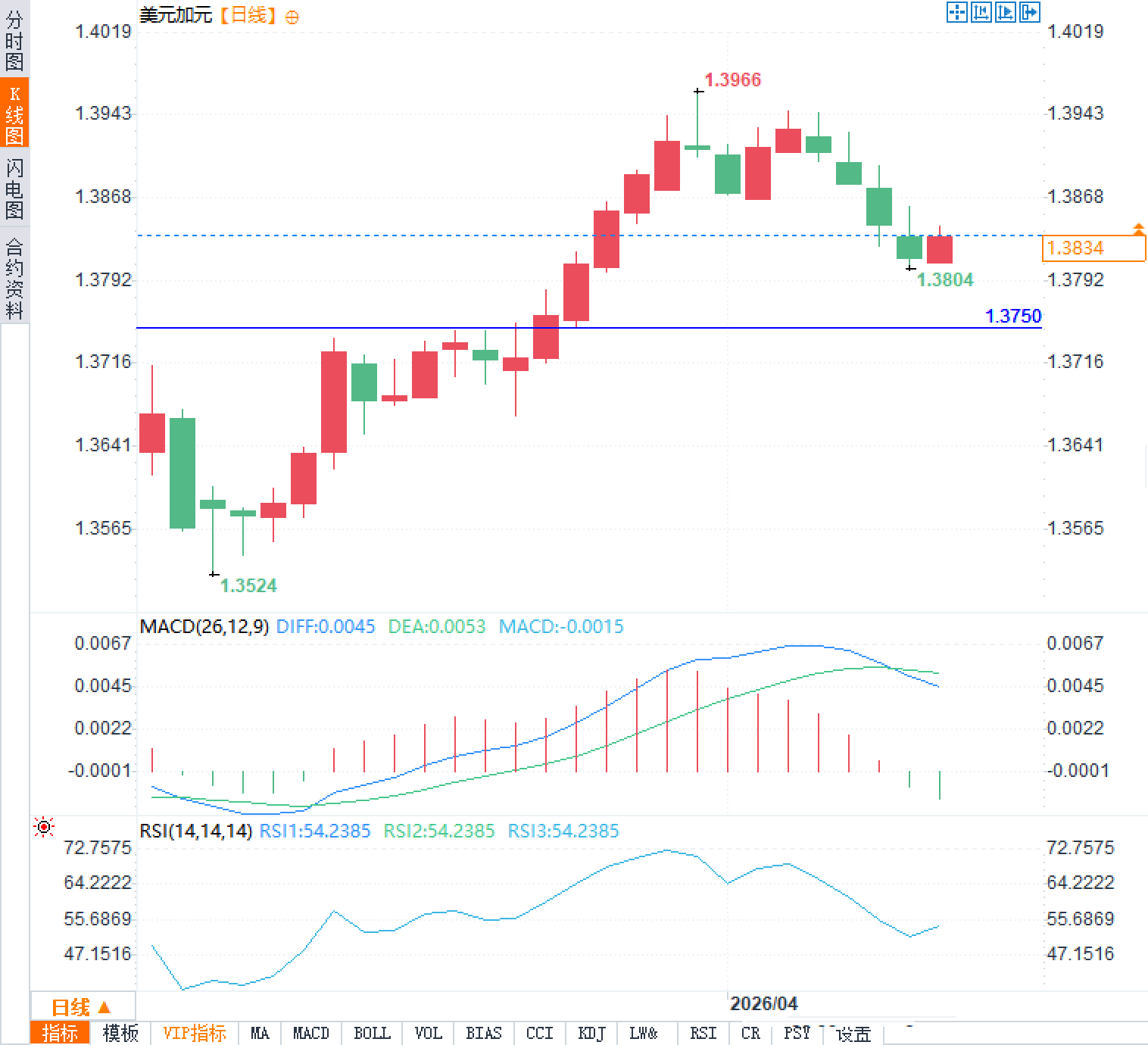
The USD/CAD pair traded around 1.383 in European trading on Friday, April 10, after a significant pullback from its highs following a two-week ceasefire agreement between the US and Iran, but remained close to the key resistance level of 1.390. Market focus quickly shifted to later-to-date Canadian employment data and the US-Iran peace talks scheduled for Saturday in Islamabad. While the ceasefire agreement has temporarily eased geopolitical tensions, ongoing attacks in Lebanon and uncertainty surrounding the Strait of Hormuz's accessibility continue to keep global risk sentiment cautious.
The US dollar index fell across the board after the agreement was announced, reflecting a temporary waning of safe-haven demand, while traders began to repric the Federal Reserve's potential easing path. As for the Canadian dollar, recent economic data has consistently fallen short of expectations, and although energy prices remain high due to geopolitical factors, weak domestic demand is dragging down the currency's performance. The Bank of Canada is currently maintaining a neutral stance and remains highly cautious about adjusting monetary policy. Traders are closely watching whether today's jobs report further confirms downward economic pressures and whether the negotiation outcome will trigger a renewed energy supply shock, thus affecting the directional breakout of the USD/CAD pair.

The announcement of the two-week ceasefire agreement between the US and Iran provided temporary relief to the market, but the fragility of the agreement is evident. Israel's military operations against Lebanon continue after the ceasefire, and while Iran emphasizes that its actions are within the framework of the agreement, it has failed to completely eliminate the risk of retaliation. The Islamabad negotiations this weekend will be a decisive turning point: if a long-term peace agreement is reached, global risk appetite is expected to recover, and the safe-haven premium for the US dollar will further decline; conversely, if negotiations break down, the risk of energy supply disruptions will again push up oil prices and boost the US dollar. Current energy prices remain high, providing some support for the Canadian dollar, but also amplifying the supply-side shock for Canada as an energy exporter. Traders observed that after the ceasefire announcement, the USD/CAD pair quickly fell by about 0.8% from a high of around 1.394, indicating that the market quickly digested geopolitical optimism. Subsequent price movements will heavily depend on the outcome of the negotiations; if the peace process proceeds smoothly, the US dollar may face more selling pressure; conversely, a renewed conflict will push the USD/CAD pair to test higher resistance levels.
Canadian economic data has shown a downward trend for several consecutive months. February saw a loss of 84,000 jobs, a 0.4% decline, far below market expectations, and the unemployment rate rose to 6.7%. This data highlights weak domestic demand and a cooling labor market. Although high energy prices provided some buffer, the loss of full-time jobs in the private sector was significant, and the unemployment rate for core working-age men rose accordingly. The March jobs report, to be released today, will be a key catalyst. The market generally expects a slight rebound of about 15,000 jobs, but if it continues to fall short of expectations, it will strengthen the Bank of Canada's case for maintaining its current interest rate. Below is a comparison of recent key Canadian employment indicators:
Weaker-than-expected employment data has exacerbated market concerns about Canadian economic growth and amplified the Canadian dollar's sensitivity to external shocks. While energy prices remain high due to geopolitical factors, weak domestic consumption and investment activity are limiting the Canadian dollar's upside potential.
The Bank of Canada is currently maintaining its target overnight rate at 2.25% and clearly stated a neutral stance at its March meeting, indicating a cautious approach to monetary policy adjustments. Although the market is currently pricing in approximately 36 basis points of tightening this year, the central bank prefers to extend the period of stable interest rates amid weak economic data, unless geopolitical conflicts completely end and bring about a significant recovery in demand. The central bank governor recently emphasized the need to balance the upside risks to inflation from supply shocks with the downside pressures on economic growth, and trade policy uncertainty further complicates the policy path. Compared to the divergence in policy from the Federal Reserve, the Bank of Canada focuses more on domestic data-driven decision-making logic, which provides a relatively independent pricing basis for the Canadian dollar. If today's employment data continues to weaken, market pricing in expectations of Bank of Canada tightening may further decline.
The USD/CAD pair is currently consolidating around 1.383, just shy of the previous high of 1.394. The 1.390 area presents significant resistance, converging multiple moving averages, Fibonacci retracement levels, and a cluster of recent highs. A decisive break above and close above 1.394 could see the price test the psychological level of 1.400; conversely, a pullback would likely find initial support at 1.375-1.370. Recent price action has been range-bound following the ceasefire announcement, with trading volume decreasing during pullbacks, indicating temporarily limited bullish momentum. Traders are watching for a breakout with significant volume to assess the validity of the resistance levels.
The US dollar index fell across the board after the agreement was announced, reflecting a temporary waning of safe-haven demand, while traders began to repric the Federal Reserve's potential easing path. As for the Canadian dollar, recent economic data has consistently fallen short of expectations, and although energy prices remain high due to geopolitical factors, weak domestic demand is dragging down the currency's performance. The Bank of Canada is currently maintaining a neutral stance and remains highly cautious about adjusting monetary policy. Traders are closely watching whether today's jobs report further confirms downward economic pressures and whether the negotiation outcome will trigger a renewed energy supply shock, thus affecting the directional breakout of the USD/CAD pair.
Geopolitical factors dominate short-term exchange rate fluctuations
The announcement of the two-week ceasefire agreement between the US and Iran provided temporary relief to the market, but the fragility of the agreement is evident. Israel's military operations against Lebanon continue after the ceasefire, and while Iran emphasizes that its actions are within the framework of the agreement, it has failed to completely eliminate the risk of retaliation. The Islamabad negotiations this weekend will be a decisive turning point: if a long-term peace agreement is reached, global risk appetite is expected to recover, and the safe-haven premium for the US dollar will further decline; conversely, if negotiations break down, the risk of energy supply disruptions will again push up oil prices and boost the US dollar. Current energy prices remain high, providing some support for the Canadian dollar, but also amplifying the supply-side shock for Canada as an energy exporter. Traders observed that after the ceasefire announcement, the USD/CAD pair quickly fell by about 0.8% from a high of around 1.394, indicating that the market quickly digested geopolitical optimism. Subsequent price movements will heavily depend on the outcome of the negotiations; if the peace process proceeds smoothly, the US dollar may face more selling pressure; conversely, a renewed conflict will push the USD/CAD pair to test higher resistance levels.
Canadian employment data and signs of economic downturn
Canadian economic data has shown a downward trend for several consecutive months. February saw a loss of 84,000 jobs, a 0.4% decline, far below market expectations, and the unemployment rate rose to 6.7%. This data highlights weak domestic demand and a cooling labor market. Although high energy prices provided some buffer, the loss of full-time jobs in the private sector was significant, and the unemployment rate for core working-age men rose accordingly. The March jobs report, to be released today, will be a key catalyst. The market generally expects a slight rebound of about 15,000 jobs, but if it continues to fall short of expectations, it will strengthen the Bank of Canada's case for maintaining its current interest rate. Below is a comparison of recent key Canadian employment indicators:
| month | Changes in employment (in ten thousands) | unemployment rate(%) | Employment rate (%) |
|---|---|---|---|
| February 2026 | -8.4 | 6.7 | 60.6 |
| January 2026 | -2.5 | 6.5 | 60.8 |
| December 2025 | +3.2 | 6.3 | 61.0 |
Divergence between Bank of Canada's policy path and interest rate expectations
The Bank of Canada is currently maintaining its target overnight rate at 2.25% and clearly stated a neutral stance at its March meeting, indicating a cautious approach to monetary policy adjustments. Although the market is currently pricing in approximately 36 basis points of tightening this year, the central bank prefers to extend the period of stable interest rates amid weak economic data, unless geopolitical conflicts completely end and bring about a significant recovery in demand. The central bank governor recently emphasized the need to balance the upside risks to inflation from supply shocks with the downside pressures on economic growth, and trade policy uncertainty further complicates the policy path. Compared to the divergence in policy from the Federal Reserve, the Bank of Canada focuses more on domestic data-driven decision-making logic, which provides a relatively independent pricing basis for the Canadian dollar. If today's employment data continues to weaken, market pricing in expectations of Bank of Canada tightening may further decline.
Technical key levels and price action analysis
The USD/CAD pair is currently consolidating around 1.383, just shy of the previous high of 1.394. The 1.390 area presents significant resistance, converging multiple moving averages, Fibonacci retracement levels, and a cluster of recent highs. A decisive break above and close above 1.394 could see the price test the psychological level of 1.400; conversely, a pullback would likely find initial support at 1.375-1.370. Recent price action has been range-bound following the ceasefire announcement, with trading volume decreasing during pullbacks, indicating temporarily limited bullish momentum. Traders are watching for a breakout with significant volume to assess the validity of the resistance levels.
- Risk Warning and Disclaimer
- The market involves risk, and trading may not be suitable for all investors. This article is for reference only and does not constitute personal investment advice, nor does it take into account certain users’ specific investment objectives, financial situation, or other needs. Any investment decisions made based on this information are at your own risk.