Gold Trading Alert: US-Iran negotiations stall, Trump orders severance of the Strait of Hormuz, gold prices jump nearly $100; is a bigger storm brewing?
2026-04-13 07:39:16
Global financial markets were once again thrown into turmoil by the situation in the Middle East. Just when investors thought the US-Iran peace talks might offer a respite, the marathon talks in Islamabad, Pakistan, over the weekend ended in failure, and the US subsequently ordered its navy to blockade the Strait of Hormuz. This unexpected event caused gold prices to plummet by as much as 2.3%, erasing all of last week's gains, and on Monday (April 13) in early Asian trading, they fell to around $4,640 per ounce.
Last week, the US and Iran reached a brief ceasefire agreement, which eased market concerns about an escalation of the Middle East conflict. The US dollar index weakened for five consecutive trading days, falling 1.5% for the week, while gold prices rebounded 1.56%, closing near $4,749. Investors are optimistic that the six-week-long regional conflict may gradually subside, and inflationary pressures will also ease.
However, the intensive negotiations held in Pakistan over the weekend failed to translate the ceasefire into lasting peace . The talks lasted 21 hours, with US Vice President Vance leading the delegation and clearly outlining "red lines": Iran must not develop nuclear weapons, nor retain the means to rapidly acquire them; the talks also demanded "equal distribution" of benefits and management rights in the Strait of Hormuz, the removal of highly enriched uranium, and restrictions on future uranium enrichment rights. Iran, on the other hand, accused the US demands of being "excessive," emphasizing that these conditions infringed upon its core national interests and rights, and an atmosphere of mutual distrust permeated the entire meeting. Upon leaving Islamabad, Vance stated bluntly that this was "more detrimental" to Iran, while Iranian Parliament Speaker Ghalibaf responded strongly, stating that the US must win Iran's trust, otherwise "there is no way out."
After negotiations ended without result, US President Trump swiftly ordered a naval blockade of the Strait of Hormuz, and the US Central Command announced it would begin intercepting ships entering and leaving Iranian ports on the 13th . This decision immediately ignited market tensions, highlighting the irreconcilable differences between the two sides on core issues such as nuclear programs and control of the Strait. Although Middle Eastern officials have stated that diplomatic channels remain open and a second round of negotiations may resume within days, the protracted nature of infrastructure repairs and the lack of mutual trust make the ceasefire agreement exceptionally sensitive and fragile.
The Strait of Hormuz is a vital global energy artery, carrying approximately one-fifth of the world's oil trade. Trump's lockdown order immediately triggered significant fluctuations in energy prices. European natural gas futures surged by as much as 18%, with Dutch TTF futures reaching €51.30 per megawatt-hour; since the escalation of the conflict at the end of February, European natural gas prices have risen by more than 50%. Oil prices also jumped, with US crude oil rising nearly 10% at one point, breaking through the $100 per barrel mark, reaching a high of $105.53.
This energy shock quickly spilled over into inflation. The US Consumer Price Index (CPI) rose at its highest level in nearly four years in March, further amplifying the combined effects of war-driven oil price increases and tariffs. Central banks around the world, which had hoped to stimulate the economy through an interest rate cut cycle, now face a more intractable dilemma: the possibility of delaying rate cuts or even shifting to rate hikes has increased. For gold, which does not generate returns, high borrowing costs undoubtedly constitute a direct negative factor, as a low-interest-rate environment is the main driver of gold prices.
Market analysts point out that although energy tensions may worsen in the short term, a large number of Iranian fast attack craft remain operational, and their maneuverability in narrow waters could pose a challenge to blockade operations. Meanwhile, competition for global liquefied natural gas resources will intensify, with Europe facing particular pressure to build up its stockpiles for the next winter. These factors have collectively pushed up inflation expectations, but have also suppressed gold's "safe-haven" status in the short term due to the strengthening of the US dollar.
Following the breakdown of US-Iran negotiations and news of a potential blockade of the Strait of Hormuz, the market exhibited a typical risk-averse reaction. The US dollar index rose as much as 0.47% to 99.19, quickly recovering its earlier losses and strengthening against all major currencies. Joe Capurso, global head of macroeconomics at Commonwealth Bank of Australia, analyzed that traders did not have high expectations for a quick peace agreement, but the lengthy repair cycle of damaged infrastructure means that uncertainty will persist for a long time.
In this environment, the US dollar's appeal as a traditional safe-haven asset has increased, squeezing the space for gold. Although gold is often seen as a hedge against geopolitical risks, its performance often exhibits a "decoupling" phenomenon under the dual pressure of a strong dollar and high interest rate expectations. Recent data shows that even with ongoing tensions in the Middle East, gold has sometimes failed to rise as strongly as expected, instead coming under pressure due to a rebounding dollar.
However, Capurso also mentioned that there is still hope for negotiations to resume this week, and the two-week ceasefire may be extended to facilitate further dialogue. This leaves room for speculation in the market: if diplomatic efforts make progress, energy prices fall, and inflation concerns ease, gold may see a recovery.
Overall, the evolving US-Iran situation remains the market focus this week. Economic indicators such as the Federal Reserve Chair nomination hearings, US ADP employment data, PPI, initial jobless claims, and speeches by central bank officials from various countries will collectively shape interest rate expectations. The G20 finance ministers and central bank governors summit, as well as China's first-quarter GDP and trade data, will also provide new clues to global risk sentiment.
From a gold perspective, the surge in oil and gas prices in the short term, pushing up inflation and strengthening the US dollar, may continue to suppress gold prices. In the short term, soaring energy prices will indeed push up inflation, thus putting downward pressure on gold. However, it's worth noting that this downward pressure is not without limits. If geopolitical conflicts escalate further into a larger-scale military confrontation, market risk aversion will completely overwhelm inflation concerns. At that time, the value of gold as the ultimate safe-haven asset will be re-priced by the market. In fact, over 60% of the Iranian Islamic Revolutionary Guard Corps' fast attack craft remain intact. These small, agile vessels are well-suited for conducting asymmetric warfare missions in the narrow waters of the Strait of Hormuz. Although the US military claims to have inflicted a devastating blow on the Iranian navy, the real challenge may have only just begun.
However, in the medium to long term, the persistence of regional conflicts, the risk of global supply chain disruptions, and the cautious attitude of central banks towards interest rate cuts all provide solid fundamental support for gold.
Furthermore, Iranian President Peschisyan emphasized his readiness to reach a "balanced and fair" agreement, and Iran also demonstrated a degree of flexibility, suggesting that diplomatic space is not completely closed. Market opinions are divided: optimists believe that gold will return to an upward trend after short-term volatility, while pessimists warn that the high-interest-rate environment may prolong the adjustment period for gold.
This means the coming week will be an extremely sensitive window. Whether the ceasefire can be extended and whether the second round of negotiations can be held smoothly will directly determine the direction of energy prices and the sentiment in the gold market. If diplomatic efforts achieve a breakthrough, energy prices will fall, the dollar will weaken, and gold may see a retaliatory rebound. Conversely, if the ceasefire breaks down and the military conflict escalates, gold will face further panic selling in the short term (due to liquidity needs).
The breakdown of US-Iran negotiations and the blockade of the Strait of Hormuz, like a sudden storm, instantly reshaped the global commodity and currency markets. The flash crash in gold prices reflects the dual pressures of a safe-haven rush for the US dollar and inflationary expectations, but it also exposes the complexity of market pricing in geopolitical risks. Against the backdrop of energy security challenges and a severe blow to economic confidence, investors need to remain vigilant: short-term volatility may continue, but any diplomatic breakthrough or escalation of conflict could become a key catalyst for a shift in gold prices.
From a technical perspective, the $4,600 support level for gold is crucial. If gold prices can stabilize at this level, the current decline may simply be a deep correction within a bull market. However, if geopolitical concerns continue to be suppressed by inflation and interest rate hike expectations, gold prices may fall further. Nevertheless, from a broader perspective, global geopolitical risks are systemically rising, the trend of de-dollarization continues, and central banks' demand for gold remains strong; these structural factors have not fundamentally changed.
In the short term, inflation-driven expectations of interest rate hikes have suppressed gold prices; however, in the medium term, if geopolitical conflicts continue to escalate or even spiral out of control, or if global economic growth slows significantly due to energy shocks, gold's safe-haven and anti-stagflation properties will once again shine. Investors need to closely monitor the evolution of the ceasefire deadline this week and the progress of the second round of negotiations.
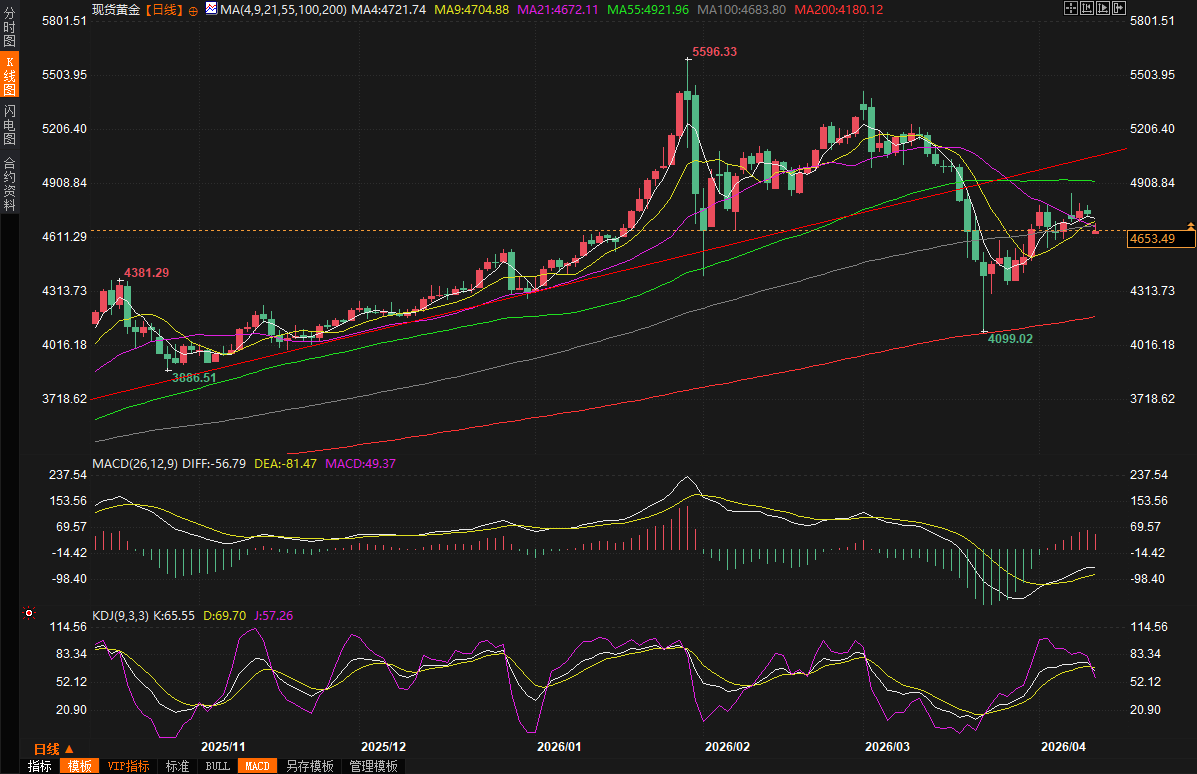
(Spot gold daily chart, source: FX678)
At 07:37 Beijing time, spot gold was trading at $4657.03 per ounce.
Negotiations break down: From fragile ceasefire to full-blown standoff
Last week, the US and Iran reached a brief ceasefire agreement, which eased market concerns about an escalation of the Middle East conflict. The US dollar index weakened for five consecutive trading days, falling 1.5% for the week, while gold prices rebounded 1.56%, closing near $4,749. Investors are optimistic that the six-week-long regional conflict may gradually subside, and inflationary pressures will also ease.
However, the intensive negotiations held in Pakistan over the weekend failed to translate the ceasefire into lasting peace . The talks lasted 21 hours, with US Vice President Vance leading the delegation and clearly outlining "red lines": Iran must not develop nuclear weapons, nor retain the means to rapidly acquire them; the talks also demanded "equal distribution" of benefits and management rights in the Strait of Hormuz, the removal of highly enriched uranium, and restrictions on future uranium enrichment rights. Iran, on the other hand, accused the US demands of being "excessive," emphasizing that these conditions infringed upon its core national interests and rights, and an atmosphere of mutual distrust permeated the entire meeting. Upon leaving Islamabad, Vance stated bluntly that this was "more detrimental" to Iran, while Iranian Parliament Speaker Ghalibaf responded strongly, stating that the US must win Iran's trust, otherwise "there is no way out."
After negotiations ended without result, US President Trump swiftly ordered a naval blockade of the Strait of Hormuz, and the US Central Command announced it would begin intercepting ships entering and leaving Iranian ports on the 13th . This decision immediately ignited market tensions, highlighting the irreconcilable differences between the two sides on core issues such as nuclear programs and control of the Strait. Although Middle Eastern officials have stated that diplomatic channels remain open and a second round of negotiations may resume within days, the protracted nature of infrastructure repairs and the lack of mutual trust make the ceasefire agreement exceptionally sensitive and fragile.
Energy Market Turmoil: Soaring Oil and Gas Prices Exacerbate Global Inflation Concerns
The Strait of Hormuz is a vital global energy artery, carrying approximately one-fifth of the world's oil trade. Trump's lockdown order immediately triggered significant fluctuations in energy prices. European natural gas futures surged by as much as 18%, with Dutch TTF futures reaching €51.30 per megawatt-hour; since the escalation of the conflict at the end of February, European natural gas prices have risen by more than 50%. Oil prices also jumped, with US crude oil rising nearly 10% at one point, breaking through the $100 per barrel mark, reaching a high of $105.53.
This energy shock quickly spilled over into inflation. The US Consumer Price Index (CPI) rose at its highest level in nearly four years in March, further amplifying the combined effects of war-driven oil price increases and tariffs. Central banks around the world, which had hoped to stimulate the economy through an interest rate cut cycle, now face a more intractable dilemma: the possibility of delaying rate cuts or even shifting to rate hikes has increased. For gold, which does not generate returns, high borrowing costs undoubtedly constitute a direct negative factor, as a low-interest-rate environment is the main driver of gold prices.
Market analysts point out that although energy tensions may worsen in the short term, a large number of Iranian fast attack craft remain operational, and their maneuverability in narrow waters could pose a challenge to blockade operations. Meanwhile, competition for global liquefied natural gas resources will intensify, with Europe facing particular pressure to build up its stockpiles for the next winter. These factors have collectively pushed up inflation expectations, but have also suppressed gold's "safe-haven" status in the short term due to the strengthening of the US dollar.
The surge in safe-haven demand for US dollars is the direct driver of short-term pressure on gold.
Following the breakdown of US-Iran negotiations and news of a potential blockade of the Strait of Hormuz, the market exhibited a typical risk-averse reaction. The US dollar index rose as much as 0.47% to 99.19, quickly recovering its earlier losses and strengthening against all major currencies. Joe Capurso, global head of macroeconomics at Commonwealth Bank of Australia, analyzed that traders did not have high expectations for a quick peace agreement, but the lengthy repair cycle of damaged infrastructure means that uncertainty will persist for a long time.
In this environment, the US dollar's appeal as a traditional safe-haven asset has increased, squeezing the space for gold. Although gold is often seen as a hedge against geopolitical risks, its performance often exhibits a "decoupling" phenomenon under the dual pressure of a strong dollar and high interest rate expectations. Recent data shows that even with ongoing tensions in the Middle East, gold has sometimes failed to rise as strongly as expected, instead coming under pressure due to a rebounding dollar.
However, Capurso also mentioned that there is still hope for negotiations to resume this week, and the two-week ceasefire may be extended to facilitate further dialogue. This leaves room for speculation in the market: if diplomatic efforts make progress, energy prices fall, and inflation concerns ease, gold may see a recovery.
Gold Price Outlook: Short-term volatility coexisting with long-term support
Overall, the evolving US-Iran situation remains the market focus this week. Economic indicators such as the Federal Reserve Chair nomination hearings, US ADP employment data, PPI, initial jobless claims, and speeches by central bank officials from various countries will collectively shape interest rate expectations. The G20 finance ministers and central bank governors summit, as well as China's first-quarter GDP and trade data, will also provide new clues to global risk sentiment.
From a gold perspective, the surge in oil and gas prices in the short term, pushing up inflation and strengthening the US dollar, may continue to suppress gold prices. In the short term, soaring energy prices will indeed push up inflation, thus putting downward pressure on gold. However, it's worth noting that this downward pressure is not without limits. If geopolitical conflicts escalate further into a larger-scale military confrontation, market risk aversion will completely overwhelm inflation concerns. At that time, the value of gold as the ultimate safe-haven asset will be re-priced by the market. In fact, over 60% of the Iranian Islamic Revolutionary Guard Corps' fast attack craft remain intact. These small, agile vessels are well-suited for conducting asymmetric warfare missions in the narrow waters of the Strait of Hormuz. Although the US military claims to have inflicted a devastating blow on the Iranian navy, the real challenge may have only just begun.
However, in the medium to long term, the persistence of regional conflicts, the risk of global supply chain disruptions, and the cautious attitude of central banks towards interest rate cuts all provide solid fundamental support for gold.
Furthermore, Iranian President Peschisyan emphasized his readiness to reach a "balanced and fair" agreement, and Iran also demonstrated a degree of flexibility, suggesting that diplomatic space is not completely closed. Market opinions are divided: optimists believe that gold will return to an upward trend after short-term volatility, while pessimists warn that the high-interest-rate environment may prolong the adjustment period for gold.
This means the coming week will be an extremely sensitive window. Whether the ceasefire can be extended and whether the second round of negotiations can be held smoothly will directly determine the direction of energy prices and the sentiment in the gold market. If diplomatic efforts achieve a breakthrough, energy prices will fall, the dollar will weaken, and gold may see a retaliatory rebound. Conversely, if the ceasefire breaks down and the military conflict escalates, gold will face further panic selling in the short term (due to liquidity needs).
Conclusion: Golden Opportunities Amidst Chaos
The breakdown of US-Iran negotiations and the blockade of the Strait of Hormuz, like a sudden storm, instantly reshaped the global commodity and currency markets. The flash crash in gold prices reflects the dual pressures of a safe-haven rush for the US dollar and inflationary expectations, but it also exposes the complexity of market pricing in geopolitical risks. Against the backdrop of energy security challenges and a severe blow to economic confidence, investors need to remain vigilant: short-term volatility may continue, but any diplomatic breakthrough or escalation of conflict could become a key catalyst for a shift in gold prices.
From a technical perspective, the $4,600 support level for gold is crucial. If gold prices can stabilize at this level, the current decline may simply be a deep correction within a bull market. However, if geopolitical concerns continue to be suppressed by inflation and interest rate hike expectations, gold prices may fall further. Nevertheless, from a broader perspective, global geopolitical risks are systemically rising, the trend of de-dollarization continues, and central banks' demand for gold remains strong; these structural factors have not fundamentally changed.
In the short term, inflation-driven expectations of interest rate hikes have suppressed gold prices; however, in the medium term, if geopolitical conflicts continue to escalate or even spiral out of control, or if global economic growth slows significantly due to energy shocks, gold's safe-haven and anti-stagflation properties will once again shine. Investors need to closely monitor the evolution of the ceasefire deadline this week and the progress of the second round of negotiations.
(Spot gold daily chart, source: FX678)
At 07:37 Beijing time, spot gold was trading at $4657.03 per ounce.
- Risk Warning and Disclaimer
- The market involves risk, and trading may not be suitable for all investors. This article is for reference only and does not constitute personal investment advice, nor does it take into account certain users’ specific investment objectives, financial situation, or other needs. Any investment decisions made based on this information are at your own risk.