Oil prices surge after Strait blockade; analysts say panic peak has passed and the market is immune to Trump?
2026-04-13 14:16:24
Following the US announcement of a blockade of the Strait of Hormuz, the market reacted familiarly: crude oil prices surged, bond yields rose, and the dollar strengthened. However, unlike in the past, this time, apart from oil prices, other assets reacted relatively restrainedly. US crude oil prices jumped at the open on Monday (April 13) and are currently trading around $104.10 per barrel, a daily increase of approximately 7.8%.
Asian stocks generally declined, but the losses were modest, with major benchmark indices falling by about 1%. U.S. stock index futures also kept their declines below 1%, indicating that panic has not spread widely and that investors have already priced in some geopolitical risks, making them less sensitive to headlines.
Billy Leung, investment strategist at Global X ETFs, said many believe Trump's lockdown announcement was a negotiating tactic. He noted, "The market has reached peak uncertainty, and the reaction function is no longer as extreme as before." Recent market movements indicate that investors are more resilient to geopolitical shocks, with volatility moderated compared to previous weeks .
Jun Bei Liu, chief portfolio manager at Ten Cap, believes volatility indicators suggest the worst of the panic may be over. He stated, "The VIX rose significantly a few weeks ago, which was likely the peak of fear and selling... From now on, the market is adjusting itself."
Both pointed out that investors have a deeper understanding of Trump's motives and the market is no longer overreacting .
The Strait of Hormuz, a global energy chokepoint, has seen a significant reduction in traffic since the start of the conflict. The blockade has reinforced expectations of supply shortages, pushing up oil prices and exacerbating global inflation concerns . US crude oil prices jumped at the open on Monday, and US gasoline prices returned to above $4 per gallon. The 10-year US Treasury yield has risen by more than 300 basis points since the conflict began.
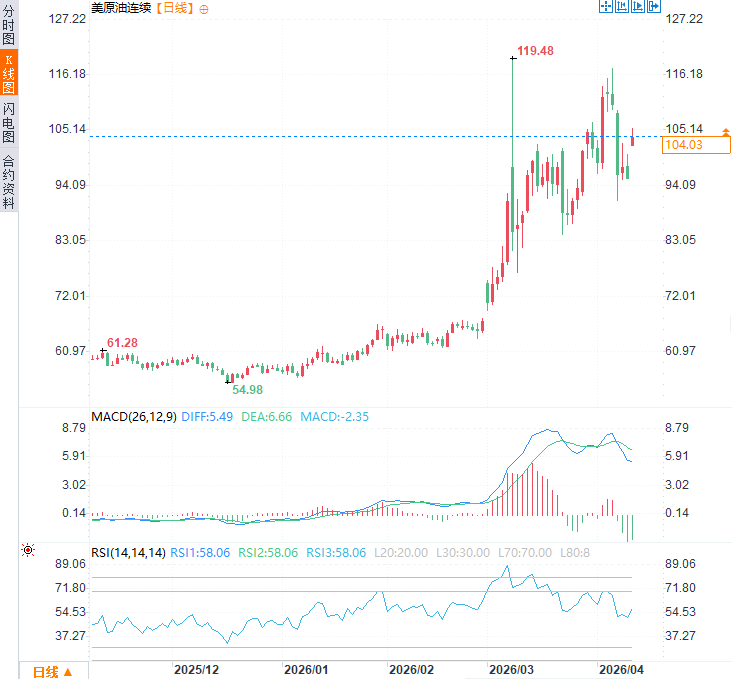
(US crude oil daily chart, source: FX678)
Gold prices bucked the trend, declining slightly amid escalating geopolitical tensions, primarily due to emerging market central banks selling gold to stabilize their currencies. Spot gold was trading around $4,725 per ounce during Monday's Asian and European sessions, down about 0.5% from the previous trading day's close. Nevertheless, analysts expect gold demand could rebound if tensions in the Middle East ease .
Analysts generally expect oil prices to fall back after a short period of volatility. Michael Yoshikami of Destination Wealth Management said, "I am quite confident that oil prices will fall from their current levels...we will see oil prices return to $80 per barrel." He believes that the US and Iran will eventually reach a negotiated solution, and the current risk premium will quickly dissipate .
Steve Brice of Standard Chartered points out that high oil prices will delay expectations of looser monetary policy, putting upward pressure on bond yields and the dollar, but these are temporary phenomena as the US seeks a way to downgrade.
Brice believes that as long as the situation does not deteriorate significantly, the stock market is positioned to support a rebound. "Investors are still in a defensive position, but the macroeconomic background is relatively constructive, leaving room for a stock market rebound."
The market is currently in a delicate balance: on the one hand, it acknowledges the increased geopolitical risks, and on the other hand, it anticipates that hostilities will eventually de-escalate. Investors are interpreting Trump's statements with greater composure, no longer triggering the panic selling seen in the early stages of the conflict .
Yoshikami concluded, "This is not a binary outcome, but rather a gray area." Political timelines such as the war powers resolution pose key risks in the near term, and the Trump administration may face greater pressure in the coming weeks. Markets still need to pay more attention to these constraints.
Overall, the market has shifted from the initial panic to a risk pricing phase, and the decline in volatility indicators suggests that the peak fear may have passed, but geopolitical events will still affect short-term trends .
While the US blockade of the Strait of Hormuz pushed up oil prices and sparked inflation concerns, risk assets such as stocks reacted mildly, indicating that investors had already priced in some of the risks and shifted their focus to expectations for future negotiations. Oil prices may remain high in the short term, but analysts believe they will decline as the situation stabilizes. Gold prices showed mixed performance, and bond yields reflected adjustments in monetary policy expectations. The future market direction depends on the speed of de-escalation and pressure from the political timetable; short-term uncertainty remains, but the panic phase appears to have passed.
At 14:16 Beijing time, US crude oil futures were trading at $104.90 per barrel.
Asian stocks generally declined, but the losses were modest, with major benchmark indices falling by about 1%. U.S. stock index futures also kept their declines below 1%, indicating that panic has not spread widely and that investors have already priced in some geopolitical risks, making them less sensitive to headlines.
Billy Leung, investment strategist at Global X ETFs, said many believe Trump's lockdown announcement was a negotiating tactic. He noted, "The market has reached peak uncertainty, and the reaction function is no longer as extreme as before." Recent market movements indicate that investors are more resilient to geopolitical shocks, with volatility moderated compared to previous weeks .
Jun Bei Liu, chief portfolio manager at Ten Cap, believes volatility indicators suggest the worst of the panic may be over. He stated, "The VIX rose significantly a few weeks ago, which was likely the peak of fear and selling... From now on, the market is adjusting itself."
Both pointed out that investors have a deeper understanding of Trump's motives and the market is no longer overreacting .
Oil price increases and asset performance
The Strait of Hormuz, a global energy chokepoint, has seen a significant reduction in traffic since the start of the conflict. The blockade has reinforced expectations of supply shortages, pushing up oil prices and exacerbating global inflation concerns . US crude oil prices jumped at the open on Monday, and US gasoline prices returned to above $4 per gallon. The 10-year US Treasury yield has risen by more than 300 basis points since the conflict began.
(US crude oil daily chart, source: FX678)
Gold prices bucked the trend, declining slightly amid escalating geopolitical tensions, primarily due to emerging market central banks selling gold to stabilize their currencies. Spot gold was trading around $4,725 per ounce during Monday's Asian and European sessions, down about 0.5% from the previous trading day's close. Nevertheless, analysts expect gold demand could rebound if tensions in the Middle East ease .
Short-term risks and expectations of a stock market rebound
Analysts generally expect oil prices to fall back after a short period of volatility. Michael Yoshikami of Destination Wealth Management said, "I am quite confident that oil prices will fall from their current levels...we will see oil prices return to $80 per barrel." He believes that the US and Iran will eventually reach a negotiated solution, and the current risk premium will quickly dissipate .
Steve Brice of Standard Chartered points out that high oil prices will delay expectations of looser monetary policy, putting upward pressure on bond yields and the dollar, but these are temporary phenomena as the US seeks a way to downgrade.
Brice believes that as long as the situation does not deteriorate significantly, the stock market is positioned to support a rebound. "Investors are still in a defensive position, but the macroeconomic background is relatively constructive, leaving room for a stock market rebound."
The market has shifted from panic to pricing.
The market is currently in a delicate balance: on the one hand, it acknowledges the increased geopolitical risks, and on the other hand, it anticipates that hostilities will eventually de-escalate. Investors are interpreting Trump's statements with greater composure, no longer triggering the panic selling seen in the early stages of the conflict .
Yoshikami concluded, "This is not a binary outcome, but rather a gray area." Political timelines such as the war powers resolution pose key risks in the near term, and the Trump administration may face greater pressure in the coming weeks. Markets still need to pay more attention to these constraints.
Overall, the market has shifted from the initial panic to a risk pricing phase, and the decline in volatility indicators suggests that the peak fear may have passed, but geopolitical events will still affect short-term trends .
Editor's Summary
While the US blockade of the Strait of Hormuz pushed up oil prices and sparked inflation concerns, risk assets such as stocks reacted mildly, indicating that investors had already priced in some of the risks and shifted their focus to expectations for future negotiations. Oil prices may remain high in the short term, but analysts believe they will decline as the situation stabilizes. Gold prices showed mixed performance, and bond yields reflected adjustments in monetary policy expectations. The future market direction depends on the speed of de-escalation and pressure from the political timetable; short-term uncertainty remains, but the panic phase appears to have passed.
At 14:16 Beijing time, US crude oil futures were trading at $104.90 per barrel.
- Risk Warning and Disclaimer
- The market involves risk, and trading may not be suitable for all investors. This article is for reference only and does not constitute personal investment advice, nor does it take into account certain users’ specific investment objectives, financial situation, or other needs. Any investment decisions made based on this information are at your own risk.