Silver gapped down 2% at the open, indicating that safe-haven demand had failed.
2026-04-13 19:50:26
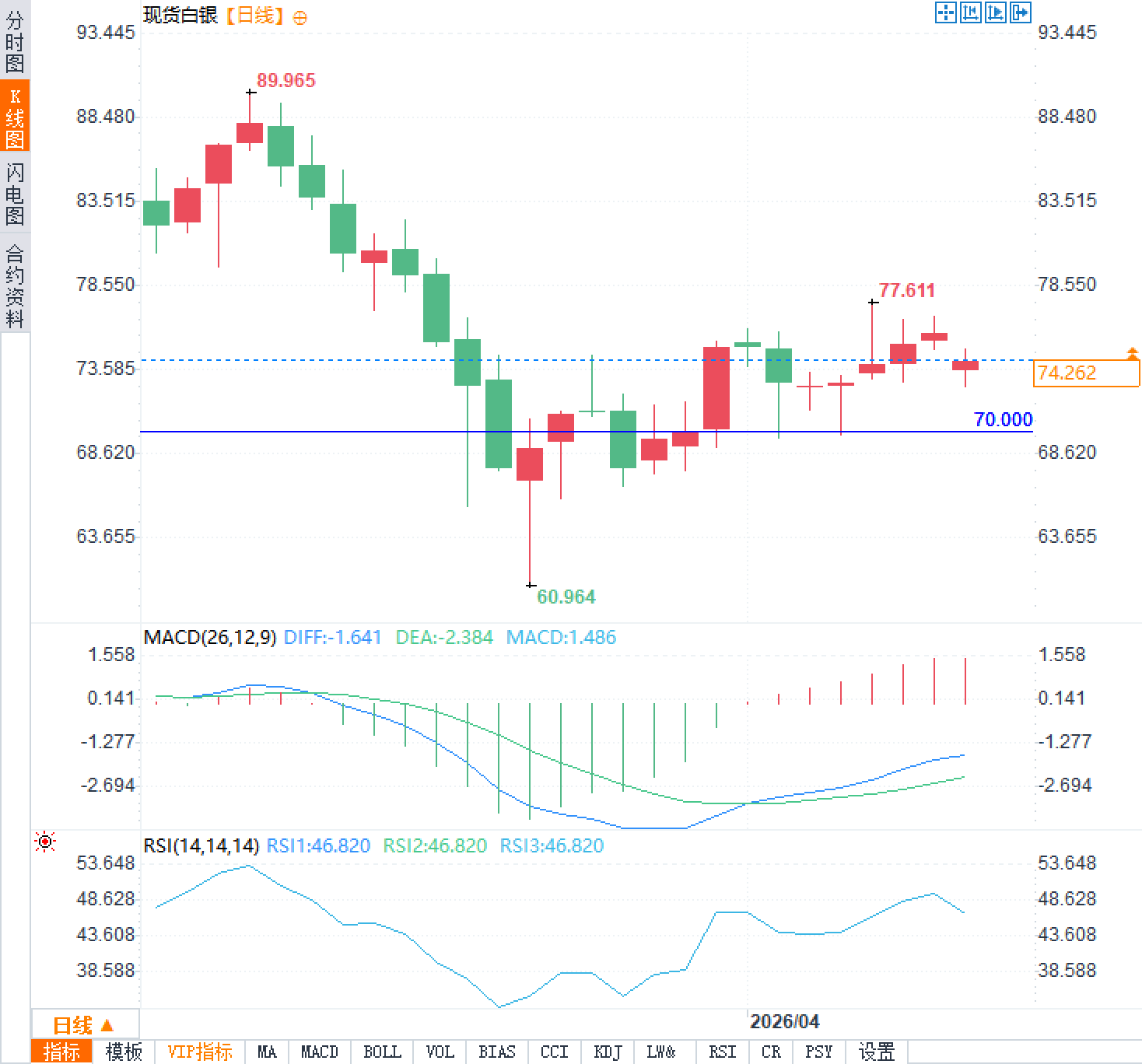
On Monday, April 13, spot silver prices opened lower and are currently trading around $74.20 per ounce, down about 2% on the day, moving in tandem with gold. Following the breakdown of US-Iran negotiations in Islamabad over the weekend, market risk appetite cooled significantly, and traders' concerns about a potential escalation of geopolitical tensions intensified. Although the ceasefire agreement remains in place, port blockades have exacerbated uncertainty.
Meanwhile, policy expectations from major central banks such as the Federal Reserve have shifted to a hawkish stance, further delaying the prospect of interest rate easing and putting pressure on precious metals as a whole. Silver, as a commodity with both monetary and industrial attributes, has seen its recent correction highlight the complex interplay between fundamentals and sentiment, resulting in short-term range-bound trading.
News of the failure to reach an agreement in weekend US-Iran talks quickly spread to the commodities market, causing a gap down in spot silver. This event stemmed from significant differences in the positions of the two sides. Although information continues to be exchanged through diplomatic channels, the date for the next round of official negotiations has not yet been determined. While the ceasefire agreement is temporarily maintained, it faces the potential risk of collapse due to port blockade measures. Traders are highly sensitive, and silver prices followed gold's decline against this backdrop. However, the correction was relatively restrained, reflecting that the market had already priced in some of the risk. Traders are paying close attention to developments in the Strait of Hormuz. If the blockade continues or escalates, energy prices could push up inflation expectations, indirectly affecting silver's currency premium.
The recent correction in spot silver prices has been highly correlated with gold, with the gold-silver ratio remaining around 63 to 1, indicating that the safe-haven logic for both remains dominant. Current data shows that gold prices are around $4,720 per ounce, down slightly by 0.6% intraday, while silver's decline is slightly larger, highlighting the volatility inherent in both commodities due to their dual nature.
Silver's industrial demand accounts for a larger share, and 2026 will mark the sixth year of a supply shortage, with an estimated deficit of approximately 67 million ounces, and total supply increasing by 1.5% to 1.05 billion ounces. Demand from the solar energy, electric vehicle, and electronics industries remains robust, but declining risk appetite due to geopolitical risks has temporarily outweighed fundamental support, causing prices to be pressured in tandem with gold rather than rising independently.
The recent hawkish signals from the Federal Reserve and other central banks have significantly increased, leading to a substantial decline in market bets on continued interest rate easing throughout 2026. The Fed's federal funds rate remains in the 3.50%-3.75% range, and the dot plot suggests no rate cuts are likely this year; some option pricing even includes the probability of a rate hike. Rising energy prices due to geopolitical factors have further fueled inflation concerns, prompting central banks to adopt a more cautious policy stance. This expectation directly diminishes silver's attractiveness as a non-yielding asset, with traders reducing long positions and focusing instead on changes in real interest rates. The European Central Bank and the Bank of England are also maintaining a wait-and-see approach. Given the tightening global liquidity environment, a sustained rebound in silver prices is unlikely in the short term. Traders are closely monitoring upcoming economic data; if inflation data continues to exceed expectations, precious metals will face greater downward pressure.
In summary, spot silver is likely to remain range-bound in the short term, with support around $70 per ounce and resistance at $78 per ounce. On the fundamental side, persistent supply shortages and resilient industrial demand provide medium- to long-term support, but sentiment and policy factors are exerting downward pressure, limiting the strength of any rebound. Close monitoring of diplomatic developments and central bank statements is necessary to avoid overreactions driven by a single event. Overall, the market is currently in a cautious and balanced state, and any breakthrough news could disrupt the current range-bound pattern.
Meanwhile, policy expectations from major central banks such as the Federal Reserve have shifted to a hawkish stance, further delaying the prospect of interest rate easing and putting pressure on precious metals as a whole. Silver, as a commodity with both monetary and industrial attributes, has seen its recent correction highlight the complex interplay between fundamentals and sentiment, resulting in short-term range-bound trading.
Renewed geopolitical tensions have a direct impact on silver prices.
News of the failure to reach an agreement in weekend US-Iran talks quickly spread to the commodities market, causing a gap down in spot silver. This event stemmed from significant differences in the positions of the two sides. Although information continues to be exchanged through diplomatic channels, the date for the next round of official negotiations has not yet been determined. While the ceasefire agreement is temporarily maintained, it faces the potential risk of collapse due to port blockade measures. Traders are highly sensitive, and silver prices followed gold's decline against this backdrop. However, the correction was relatively restrained, reflecting that the market had already priced in some of the risk. Traders are paying close attention to developments in the Strait of Hormuz. If the blockade continues or escalates, energy prices could push up inflation expectations, indirectly affecting silver's currency premium.
The correlation and current divergence between gold and silver prices
The recent correction in spot silver prices has been highly correlated with gold, with the gold-silver ratio remaining around 63 to 1, indicating that the safe-haven logic for both remains dominant. Current data shows that gold prices are around $4,720 per ounce, down slightly by 0.6% intraday, while silver's decline is slightly larger, highlighting the volatility inherent in both commodities due to their dual nature.
Silver's industrial demand accounts for a larger share, and 2026 will mark the sixth year of a supply shortage, with an estimated deficit of approximately 67 million ounces, and total supply increasing by 1.5% to 1.05 billion ounces. Demand from the solar energy, electric vehicle, and electronics industries remains robust, but declining risk appetite due to geopolitical risks has temporarily outweighed fundamental support, causing prices to be pressured in tandem with gold rather than rising independently.
The downward pressure on silver prices is due to expectations regarding major central bank policies.
The recent hawkish signals from the Federal Reserve and other central banks have significantly increased, leading to a substantial decline in market bets on continued interest rate easing throughout 2026. The Fed's federal funds rate remains in the 3.50%-3.75% range, and the dot plot suggests no rate cuts are likely this year; some option pricing even includes the probability of a rate hike. Rising energy prices due to geopolitical factors have further fueled inflation concerns, prompting central banks to adopt a more cautious policy stance. This expectation directly diminishes silver's attractiveness as a non-yielding asset, with traders reducing long positions and focusing instead on changes in real interest rates. The European Central Bank and the Bank of England are also maintaining a wait-and-see approach. Given the tightening global liquidity environment, a sustained rebound in silver prices is unlikely in the short term. Traders are closely monitoring upcoming economic data; if inflation data continues to exceed expectations, precious metals will face greater downward pressure.
Short-term outlook and key risks in the silver market
In summary, spot silver is likely to remain range-bound in the short term, with support around $70 per ounce and resistance at $78 per ounce. On the fundamental side, persistent supply shortages and resilient industrial demand provide medium- to long-term support, but sentiment and policy factors are exerting downward pressure, limiting the strength of any rebound. Close monitoring of diplomatic developments and central bank statements is necessary to avoid overreactions driven by a single event. Overall, the market is currently in a cautious and balanced state, and any breakthrough news could disrupt the current range-bound pattern.
Question 1: Why did the breakdown of US-Iran negotiations directly lead to a gap down in spot silver prices?
A: The breakdown in negotiations exacerbated geopolitical uncertainty, leading to a decline in traders' risk appetite. While silver's safe-haven appeal was activated, it failed to offset overall selling pressure. Coupled with a simultaneous decline in gold, this created a ripple effect, resulting in a gap-down opening. The ceasefire remains in place, but the port blockade measures increase the potential risk of further breakdown, amplifying market volatility. This event highlights silver's sensitivity to sudden geopolitical news, with short-term sentiment dominating price movements.
Question 2: How will the hawkish expectations of the central bank suppress the upside potential of silver prices?
A: With major central banks like the Federal Reserve maintaining relatively high interest rates, the market has largely ruled out the possibility of multiple rate cuts in 2026. Rising real interest rates have weakened the willingness to hold non-yielding assets like silver. Rising energy prices are pushing up inflation, further reinforcing expectations of policy tightening, leading to overall pressure on precious metals. While industrial demand provides support for silver due to its dual nature, policy factors have become the main drag, limiting the potential for a rebound.
- Risk Warning and Disclaimer
- The market involves risk, and trading may not be suitable for all investors. This article is for reference only and does not constitute personal investment advice, nor does it take into account certain users’ specific investment objectives, financial situation, or other needs. Any investment decisions made based on this information are at your own risk.