Gold prices fell slightly as tensions between the US and Iran escalated.
2026-04-14 01:09:42
Gold prices fell slightly after opening on Monday (April 13), with upside potential significantly limited by escalating tensions between the US and Iran. The price hovered around $4737.61 per ounce, down 0.26%, before recovering from an intraday low of approximately $4639.

The market is currently driven by risk aversion. The peace talks between the US and Iran in Islamabad on April 12 ended without result, with significant disagreements between the two sides on key issues such as the nuclear issue and their rights in the Strait of Hormuz, causing the optimism previously fueled by the ceasefire to quickly dissipate. US President Trump ordered a maritime blockade of the Strait of Hormuz, warning that any Iranian vessels approaching the strait would be "immediately destroyed." The blockade began on Monday, April 13 (US Eastern Time), covering all ships entering and leaving Iranian ports in the Arabian Gulf and the Gulf of Oman. NATO and some Gulf states have indicated they will provide assistance. The Iranian Islamic Revolutionary Guard Corps responded strongly, stating that the Strait of Hormuz is under its control and that any warships approaching the strait are considered to be violating the ceasefire agreement and will face strong retaliation. Previously, two US destroyers attempted to enter the Persian Gulf but were forced to retreat after being targeted by Iranian forces.
Soaring oil prices fuel inflation fears
Following the cooling of expectations for a Federal Reserve rate cut and the breakdown of negotiations, crude oil prices rebounded rapidly, briefly breaking through $100 per barrel. Currently, West Texas Intermediate (WTI) crude is trading at approximately $99.97 per barrel, up more than 6% from last week's low, with a daily increase of 3.52%, reaching a high of $105.63 per barrel. Market concerns about prolonged global energy supply disruptions have directly exacerbated inflationary pressures. The latest US March inflation data shows that the US CPI rose 3.3% year-on-year, significantly higher than February's 2.4%, the highest level since June 2024. Energy costs rose 10.9% month-on-month from 0.3%, the largest monthly increase since September 2005, with gasoline prices rising 21.2%, contributing nearly three-quarters of the month's CPI increase. High oil prices not only support the dollar and US Treasury yields but also lead investors to expect the Federal Reserve to maintain high interest rates for a longer period, and even potentially tighten policy further if the conflict continues. According to CME's FedWatch tool, the probability of the Federal Reserve maintaining interest rates unchanged in April is currently 98.4%, and the probability of a cumulative rate cut of 25 basis points by the end of the year has risen to 35.2% (previously 21%). This increases the cost of holding gold, which does not generate returns. Although gold's attributes as an inflation hedge remain, its ability to attract large-scale buying has significantly weakened since the outbreak of the conflict, with some institutions engaging in short-term selling due to liquidity needs.
Expert opinion: Focus on crude oil and Federal Reserve policy
“This is a market that is very much driven by news headlines. Everyone’s eyes are on oil prices because oil prices directly affect inflation, and inflation directly affects the Federal Reserve’s policy,” said Philip Streble, chief market strategist at Blue Line Futures.
SP Angel analysts noted, "We believe the war-induced sell-off is beneficial to the long-term outlook for gold as speculative positions have decreased."
In a report, Paul Wong, market strategist at Sprott Asset Management, said that uncertainty surrounding future oil supplies could drive strong structural demand for silver by accelerating investment in solar photovoltaic power generation.
Technical Analysis: Neutral to Weak
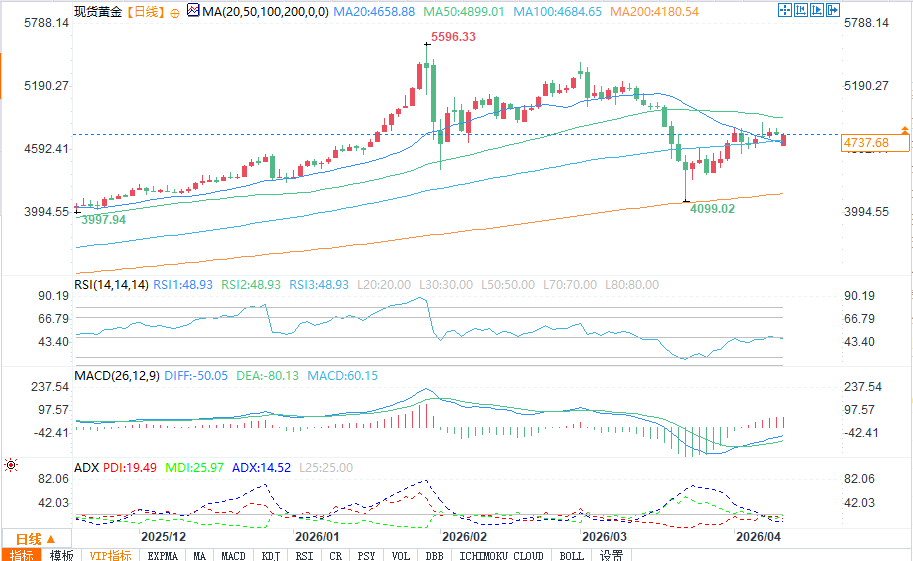
(Spot gold daily chart source: FX678)
From a technical perspective, the daily chart for spot gold shows that the current price is above the 100-day moving average (approximately $4684.64) and well above the 200-day moving average (approximately $4180.54), but still below the 50-day moving average (approximately $4899.01). The 50-day moving average is a key indicator reflecting recent gold price trends; the current price is under pressure from below it, suggesting that the short-term market remains weak, exhibiting an overall neutral-to-weak range-bound consolidation pattern.
Momentum indicators also lack a clear direction: the current value of the 14-day RSI is about 48.92, close to the neutral level, neither entering the overbought nor oversold range, indicating that the game between the bulls and bears is deadlocked and the buyers lack confidence; in the MACD indicator, the DIFF line (about -50.07) is still above the DEA line (about -80.13), and the histogram is positive, but the momentum has converged; the current value of the ADX indicator is about 14.52, far below the critical value of 25, indicating that the current market lacks a clear trend and is in a typical oscillation phase, with +DI (19.49) and -DI (25.97) showing that the bears have a slight advantage.
Key signals to watch for in the future: If the price successfully holds above the 50-day moving average, the short-term bullish momentum will strengthen, with the next resistance level pointing to the $5,000-$5,200 range near the previous high. Conversely, if the price falls below the 100-day moving average support, the first support level to be tested will be the $4,600-$4,500 range. If it falls further, the strong support of the 200-day moving average (around $4,180) should be noted.
Market Outlook: Geopolitical Risks and Fed Signals Coexist
This week's US economic data is relatively light, with the focus on Tuesday's (April 15th) Producer Price Index (PPI). According to data from China Merchants Securities, the March PPI rose 0.5% year-on-year and 1.0% month-on-month, with the five major petrochemical industry chains contributing significantly. This will directly reflect the transmission effect of rising energy prices on production-side inflation. Also of interest are speeches from several Federal Reserve officials, including Goolsby and Harker, as well as the Fed's Beige Book, which will provide more clues about interest rate trends. Despite short-term pressure from high interest rates and inflation concerns, the long-term outlook for gold and silver remains optimistic against the backdrop of escalating geopolitical conflicts, continued central bank gold purchases, declining confidence in fiat currencies, and high sovereign debt. The People's Bank of China has increased its gold holdings for 17 consecutive months, with a single-month increase of 160,000 ounces at the end of March 2026, the largest monthly increase in nearly a year, reflecting a counter-cyclical investment strategy. The overall trend of global central bank gold purchases remains unchanged, with only some countries tactically reducing their holdings due to fiscal or liquidity needs. Investors should closely monitor developments in the Strait of Hormuz and the ripple effects of oil prices on the global economy.
The market is currently driven by risk aversion. The peace talks between the US and Iran in Islamabad on April 12 ended without result, with significant disagreements between the two sides on key issues such as the nuclear issue and their rights in the Strait of Hormuz, causing the optimism previously fueled by the ceasefire to quickly dissipate. US President Trump ordered a maritime blockade of the Strait of Hormuz, warning that any Iranian vessels approaching the strait would be "immediately destroyed." The blockade began on Monday, April 13 (US Eastern Time), covering all ships entering and leaving Iranian ports in the Arabian Gulf and the Gulf of Oman. NATO and some Gulf states have indicated they will provide assistance. The Iranian Islamic Revolutionary Guard Corps responded strongly, stating that the Strait of Hormuz is under its control and that any warships approaching the strait are considered to be violating the ceasefire agreement and will face strong retaliation. Previously, two US destroyers attempted to enter the Persian Gulf but were forced to retreat after being targeted by Iranian forces.
Soaring oil prices fuel inflation fears
Following the cooling of expectations for a Federal Reserve rate cut and the breakdown of negotiations, crude oil prices rebounded rapidly, briefly breaking through $100 per barrel. Currently, West Texas Intermediate (WTI) crude is trading at approximately $99.97 per barrel, up more than 6% from last week's low, with a daily increase of 3.52%, reaching a high of $105.63 per barrel. Market concerns about prolonged global energy supply disruptions have directly exacerbated inflationary pressures. The latest US March inflation data shows that the US CPI rose 3.3% year-on-year, significantly higher than February's 2.4%, the highest level since June 2024. Energy costs rose 10.9% month-on-month from 0.3%, the largest monthly increase since September 2005, with gasoline prices rising 21.2%, contributing nearly three-quarters of the month's CPI increase. High oil prices not only support the dollar and US Treasury yields but also lead investors to expect the Federal Reserve to maintain high interest rates for a longer period, and even potentially tighten policy further if the conflict continues. According to CME's FedWatch tool, the probability of the Federal Reserve maintaining interest rates unchanged in April is currently 98.4%, and the probability of a cumulative rate cut of 25 basis points by the end of the year has risen to 35.2% (previously 21%). This increases the cost of holding gold, which does not generate returns. Although gold's attributes as an inflation hedge remain, its ability to attract large-scale buying has significantly weakened since the outbreak of the conflict, with some institutions engaging in short-term selling due to liquidity needs.
Expert opinion: Focus on crude oil and Federal Reserve policy
“This is a market that is very much driven by news headlines. Everyone’s eyes are on oil prices because oil prices directly affect inflation, and inflation directly affects the Federal Reserve’s policy,” said Philip Streble, chief market strategist at Blue Line Futures.
SP Angel analysts noted, "We believe the war-induced sell-off is beneficial to the long-term outlook for gold as speculative positions have decreased."
In a report, Paul Wong, market strategist at Sprott Asset Management, said that uncertainty surrounding future oil supplies could drive strong structural demand for silver by accelerating investment in solar photovoltaic power generation.
Technical Analysis: Neutral to Weak
(Spot gold daily chart source: FX678)
From a technical perspective, the daily chart for spot gold shows that the current price is above the 100-day moving average (approximately $4684.64) and well above the 200-day moving average (approximately $4180.54), but still below the 50-day moving average (approximately $4899.01). The 50-day moving average is a key indicator reflecting recent gold price trends; the current price is under pressure from below it, suggesting that the short-term market remains weak, exhibiting an overall neutral-to-weak range-bound consolidation pattern.
Momentum indicators also lack a clear direction: the current value of the 14-day RSI is about 48.92, close to the neutral level, neither entering the overbought nor oversold range, indicating that the game between the bulls and bears is deadlocked and the buyers lack confidence; in the MACD indicator, the DIFF line (about -50.07) is still above the DEA line (about -80.13), and the histogram is positive, but the momentum has converged; the current value of the ADX indicator is about 14.52, far below the critical value of 25, indicating that the current market lacks a clear trend and is in a typical oscillation phase, with +DI (19.49) and -DI (25.97) showing that the bears have a slight advantage.
Key signals to watch for in the future: If the price successfully holds above the 50-day moving average, the short-term bullish momentum will strengthen, with the next resistance level pointing to the $5,000-$5,200 range near the previous high. Conversely, if the price falls below the 100-day moving average support, the first support level to be tested will be the $4,600-$4,500 range. If it falls further, the strong support of the 200-day moving average (around $4,180) should be noted.
Market Outlook: Geopolitical Risks and Fed Signals Coexist
This week's US economic data is relatively light, with the focus on Tuesday's (April 15th) Producer Price Index (PPI). According to data from China Merchants Securities, the March PPI rose 0.5% year-on-year and 1.0% month-on-month, with the five major petrochemical industry chains contributing significantly. This will directly reflect the transmission effect of rising energy prices on production-side inflation. Also of interest are speeches from several Federal Reserve officials, including Goolsby and Harker, as well as the Fed's Beige Book, which will provide more clues about interest rate trends. Despite short-term pressure from high interest rates and inflation concerns, the long-term outlook for gold and silver remains optimistic against the backdrop of escalating geopolitical conflicts, continued central bank gold purchases, declining confidence in fiat currencies, and high sovereign debt. The People's Bank of China has increased its gold holdings for 17 consecutive months, with a single-month increase of 160,000 ounces at the end of March 2026, the largest monthly increase in nearly a year, reflecting a counter-cyclical investment strategy. The overall trend of global central bank gold purchases remains unchanged, with only some countries tactically reducing their holdings due to fiscal or liquidity needs. Investors should closely monitor developments in the Strait of Hormuz and the ripple effects of oil prices on the global economy.
- Risk Warning and Disclaimer
- The market involves risk, and trading may not be suitable for all investors. This article is for reference only and does not constitute personal investment advice, nor does it take into account certain users’ specific investment objectives, financial situation, or other needs. Any investment decisions made based on this information are at your own risk.