Silver has retreated from its high of over $120 and is now consolidating; its future direction depends on inflation.
2026-04-14 12:07:52
Although silver prices have retreated from their record high of over $120 per ounce in January, the era of prices below $20 is long gone. One fund manager pointed out that silver is forming a relatively high bottoming range, marking a significant structural change in the precious metals market.
Nate Miller, Vice President of Product Development for Amplify ETFs, stated that silver is currently entering a consolidation phase after a significant rise at the beginning of the year. Despite short-term volatility, the overall market environment remains constructive. Strong industrial demand and macroeconomic factors are providing robust support for silver.
Miller noted, "When silver is in the $60 or $70 range, it's obviously not as exciting as it was at $120, but it's still very important and will continue to be a key asset." He added that the market is gradually finding significant stability, reflecting a fundamental structural shift in silver after decades of trading roughly in the $25 to $30 per ounce range. While silver hasn't yet achieved a decisive upward breakout, holding onto these higher price levels is itself a positive and important signal for investors and producers.
While the current consolidation phase in silver prices has caused some frustration among market participants, Miller describes it as a necessary "healthy digestion" process. He believes this adjustment helps the market fully absorb the gains from the previous rapid rise, laying a more solid foundation for future price movements.
He remains optimistic, believing that silver prices will ultimately continue to rise . The driving factors could come from two aspects: renewed investor interest in precious metals and further strengthening of industrial demand. He emphasized that regardless of which driving force prevails, the fundamental support for silver is relatively solid.
Miller also cautioned investors that a return of silver to extreme highs like $100 or even $120 would largely depend on macroeconomic conditions, particularly inflation. He stated, "If inflation remains stubbornly persistent, this could reignite the trading logic of precious metals as a store of value." In this scenario, both silver and gold would benefit as investors actively seek protection against potential declines in purchasing power.
However, he also pointed out that gold's price movement is more directly tied to its role as a monetary metal in an inflationary environment. Gold's price movement is mainly driven by its value storage properties, while silver crosses both monetary and industrial demand channels, thus exhibiting a more complex dual characteristic.
Conversely, if inflationary pressures ultimately prove to be temporary, silver's upside potential may be relatively modest, primarily supported by industrial applications. In this scenario, Miller expects silver prices to likely trade within the $70-$80 range rather than experience a significant breakout.
Miller further emphasized that silver plays a crucial role in portfolio diversification. He described the silver sector as an "uncorrelated source of returns" relative to traditional stocks and fixed-income assets. This characteristic, combined with the current consolidation phase, may present investors with a good opportunity to gradually rebuild or increase their silver-related positions.
Beyond investment demand, the stability of silver prices has also had a significant positive impact on the mining industry. Miller explained that the higher but relatively stable price level is giving mining operators greater confidence to proceed with projects that were previously economically unfeasible.
Miller stated, "Projects that were unprofitable at $25 per ounce become reasonable at $70." He added that price stability is crucial for the long-term planning of mining companies. Meanwhile, a potential upward trend in production is also expected to attract more new investment capital into the sector.
From an investment perspective, Miller remains bullish on silver-related stocks, particularly junior mining companies. He believes these assets are attractive, but also relatively volatile. Because junior mining companies are more sensitive to underlying silver prices, they can significantly amplify investment returns during bull markets. However, he emphasizes that investors must focus on strict portfolio management and discipline. In the past year, some silver-focused investment strategies have achieved gains exceeding 200%, making timely portfolio rebalancing particularly necessary to avoid over-exposed risks to a single sector.
While the current economic uncertainty has provided some support for the silver market, Miller also points out some potential challenges. Concerns about rising input costs persist, particularly regarding energy costs. Although rising Brent crude prices may squeeze mining companies' profit margins in the short term, he believes this impact is likely temporary.
Furthermore, he observed that many mining companies are now in a more robust financial position compared to previous cycles. They are using higher price levels to improve their balance sheets rather than taking on excessive risk, which provides a better foundation for the long-term healthy development of the industry.
Overall , the silver market is currently in a bottoming-out phase after falling from its highs. While the short-term consolidation appears calm, the long-term outlook still depends on the combined effects of industrial demand strength and the macroeconomic inflation environment. For investors focusing on precious metals and related mining investments, this may be a period worthwhile to closely observe and cautiously position themselves.
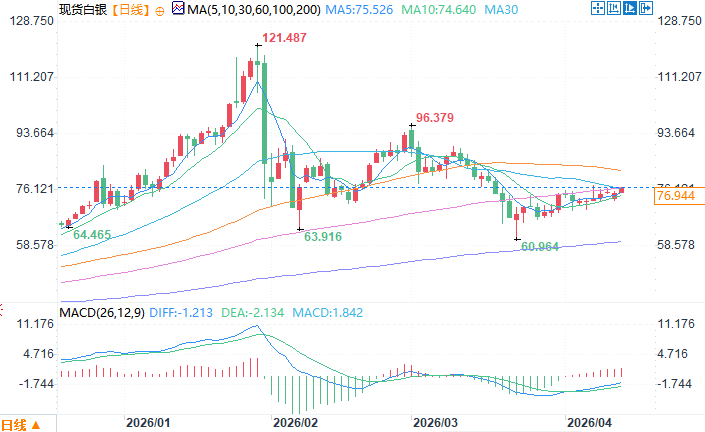
Spot silver daily chart source: EasyForex
At 12:07 Beijing time on April 14, spot silver was trading at $76.89 per ounce.
Current market situation and consolidation characteristics of silver
Nate Miller, Vice President of Product Development for Amplify ETFs, stated that silver is currently entering a consolidation phase after a significant rise at the beginning of the year. Despite short-term volatility, the overall market environment remains constructive. Strong industrial demand and macroeconomic factors are providing robust support for silver.
Miller noted, "When silver is in the $60 or $70 range, it's obviously not as exciting as it was at $120, but it's still very important and will continue to be a key asset." He added that the market is gradually finding significant stability, reflecting a fundamental structural shift in silver after decades of trading roughly in the $25 to $30 per ounce range. While silver hasn't yet achieved a decisive upward breakout, holding onto these higher price levels is itself a positive and important signal for investors and producers.
The significance of the consolidation period and the "healthy digestion" process
While the current consolidation phase in silver prices has caused some frustration among market participants, Miller describes it as a necessary "healthy digestion" process. He believes this adjustment helps the market fully absorb the gains from the previous rapid rise, laying a more solid foundation for future price movements.
He remains optimistic, believing that silver prices will ultimately continue to rise . The driving factors could come from two aspects: renewed investor interest in precious metals and further strengthening of industrial demand. He emphasized that regardless of which driving force prevails, the fundamental support for silver is relatively solid.
The difference in the impact of inflation on silver and gold
Miller also cautioned investors that a return of silver to extreme highs like $100 or even $120 would largely depend on macroeconomic conditions, particularly inflation. He stated, "If inflation remains stubbornly persistent, this could reignite the trading logic of precious metals as a store of value." In this scenario, both silver and gold would benefit as investors actively seek protection against potential declines in purchasing power.
However, he also pointed out that gold's price movement is more directly tied to its role as a monetary metal in an inflationary environment. Gold's price movement is mainly driven by its value storage properties, while silver crosses both monetary and industrial demand channels, thus exhibiting a more complex dual characteristic.
Conversely, if inflationary pressures ultimately prove to be temporary, silver's upside potential may be relatively modest, primarily supported by industrial applications. In this scenario, Miller expects silver prices to likely trade within the $70-$80 range rather than experience a significant breakout.
The value of silver as a portfolio diversification tool
Miller further emphasized that silver plays a crucial role in portfolio diversification. He described the silver sector as an "uncorrelated source of returns" relative to traditional stocks and fixed-income assets. This characteristic, combined with the current consolidation phase, may present investors with a good opportunity to gradually rebuild or increase their silver-related positions.
Positive impacts on the mining sector and production end
Beyond investment demand, the stability of silver prices has also had a significant positive impact on the mining industry. Miller explained that the higher but relatively stable price level is giving mining operators greater confidence to proceed with projects that were previously economically unfeasible.
Miller stated, "Projects that were unprofitable at $25 per ounce become reasonable at $70." He added that price stability is crucial for the long-term planning of mining companies. Meanwhile, a potential upward trend in production is also expected to attract more new investment capital into the sector.
From an investment perspective, Miller remains bullish on silver-related stocks, particularly junior mining companies. He believes these assets are attractive, but also relatively volatile. Because junior mining companies are more sensitive to underlying silver prices, they can significantly amplify investment returns during bull markets. However, he emphasizes that investors must focus on strict portfolio management and discipline. In the past year, some silver-focused investment strategies have achieved gains exceeding 200%, making timely portfolio rebalancing particularly necessary to avoid over-exposed risks to a single sector.
Opportunities and Challenges Amidst Current Economic Uncertainty
While the current economic uncertainty has provided some support for the silver market, Miller also points out some potential challenges. Concerns about rising input costs persist, particularly regarding energy costs. Although rising Brent crude prices may squeeze mining companies' profit margins in the short term, he believes this impact is likely temporary.
Furthermore, he observed that many mining companies are now in a more robust financial position compared to previous cycles. They are using higher price levels to improve their balance sheets rather than taking on excessive risk, which provides a better foundation for the long-term healthy development of the industry.
Overall , the silver market is currently in a bottoming-out phase after falling from its highs. While the short-term consolidation appears calm, the long-term outlook still depends on the combined effects of industrial demand strength and the macroeconomic inflation environment. For investors focusing on precious metals and related mining investments, this may be a period worthwhile to closely observe and cautiously position themselves.
Spot silver daily chart source: EasyForex
At 12:07 Beijing time on April 14, spot silver was trading at $76.89 per ounce.
- Risk Warning and Disclaimer
- The market involves risk, and trading may not be suitable for all investors. This article is for reference only and does not constitute personal investment advice, nor does it take into account certain users’ specific investment objectives, financial situation, or other needs. Any investment decisions made based on this information are at your own risk.