Repeated geopolitical tensions pressured the dollar index lower, while gold continued its rebound.
2026-04-14 14:22:22
Gold (XAU/USD) continued its modest upward trend in Asian trading on Tuesday, climbing to around $4,770 at one point, a daily gain of over 0.65%. This rebound was mainly driven by the market's repricing of the global macroeconomic risk environment. Following the failure of the US and Iran to reach a substantial breakthrough over the weekend, the market still expects continued negotiations between the two sides. While geopolitical risks have not subsided, there is a prospect of temporary easing, keeping risk aversion within a manageable range.

In an interview, US Vice President JD Vance stated that the negotiations had made some "constructive progress" and that a framework agreement remained a possibility. This statement improved market risk appetite to some extent, but did not completely eliminate uncertainty. Therefore, gold was both supported by safe-haven demand and suppressed by improved risk sentiment, exhibiting a high-level consolidation pattern.
Meanwhile, the overall weakness of the US dollar provided additional support for gold. Markets are divided on the future path of Federal Reserve interest rates, especially given the renewed rise in inflation data driven by energy prices, leading to a repricing of the timing of a policy shift. Although some data shows US inflation near a four-year high, the futures market still implies expectations of a rate cut by the end of the year, which weakens the dollar's real yield advantage and thus increases the attractiveness of gold.
Uncertainty in the energy market remains a significant backdrop to gold price volatility. As tensions escalate in the Middle East, market concerns about increased shipping safety risks in the Strait of Hormuz have amplified oil price volatility and further reinforced inflation expectations. This combination of "geopolitical risk + energy inflation" typically supports gold, as it possesses anti-inflationary properties in high-inflation environments.
However, from a market structure perspective, the bulls have not achieved a strong breakout. Although the price has rebounded to $4775, it remains capped by the 200-period moving average, which is located around $4854 and represents a key short-term technical resistance area. As long as the price fails to break through this level effectively, the overall trend can only be considered a weak rebound structure, not a trend reversal.
From a daily chart perspective, gold is currently in a correction phase after its previous pullback from highs. Prices rebounded after finding support around $4650, but the overall trend remains within a medium-term consolidation pattern. Momentum indicators suggest that bullish forces are recovering, but have not yet fully taken control, indicating that the market is still in a tug-of-war between bulls and bears.
From the 4-hour chart, the short-term trend presents a "rebound correction + momentum convergence" structure. The Relative Strength Index (RSI) remains in the neutral-to-strong zone, close to the 57 level, indicating that bullish momentum has recovered somewhat but has not yet entered the overbought zone. The MACD histogram is gradually converging towards the zero axis, indicating that downward pressure is weakening, but a trend-up signal has not yet been fully confirmed.
Technically, key resistance levels are at $4854 (200-period moving average) and $4913 (61.8% Fibonacci retracement level). A successful break above these levels could open up further upside potential towards the historical high of $5133 and even $5413. However, if the rebound fails, the price may retest the $4759 support level, with further support at the $4604 and $4413 areas.
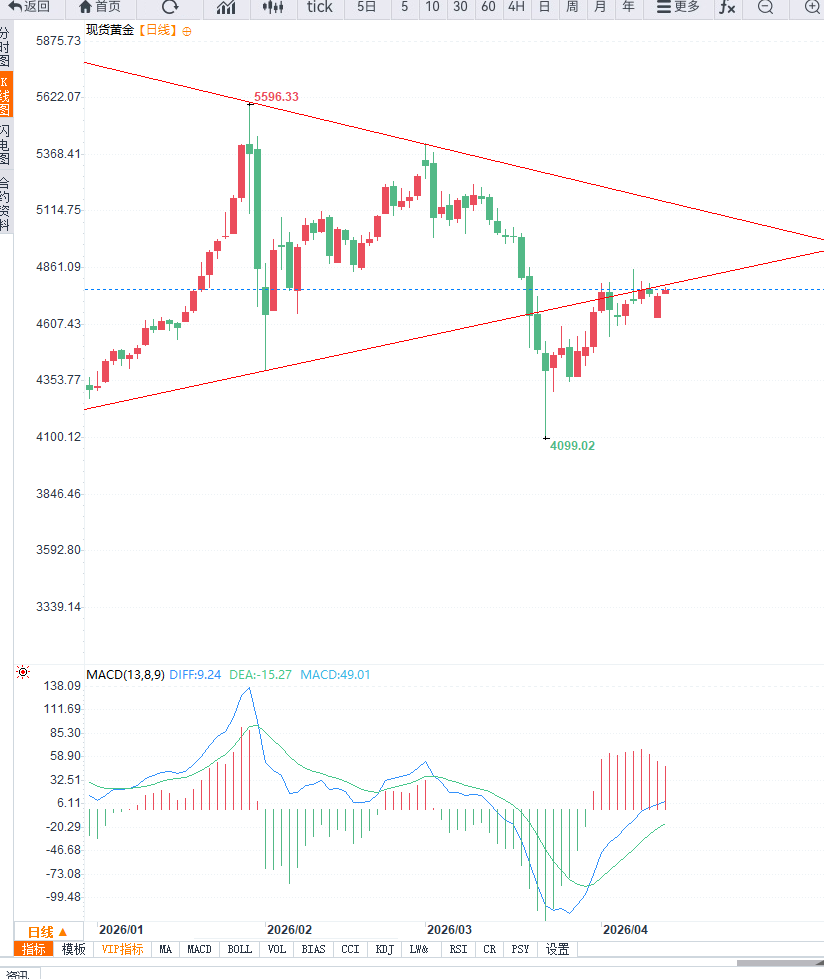
Editor's Summary : Overall, gold is currently in a phase of coexistence of "macroeconomic support + technical resistance." On the one hand, geopolitical risks, energy inflation, and a weakening dollar provide medium-term support for gold prices; on the other hand, the 200-day moving average resistance and improved risk sentiment limit upside potential. The key to gold's future direction lies in two points: first, whether the US-Iran negotiations make substantial progress; and second, whether the Federal Reserve releases clearer signals of a policy shift. Without a breakthrough catalyst, gold is more likely to maintain a high-level consolidation pattern.
In an interview, US Vice President JD Vance stated that the negotiations had made some "constructive progress" and that a framework agreement remained a possibility. This statement improved market risk appetite to some extent, but did not completely eliminate uncertainty. Therefore, gold was both supported by safe-haven demand and suppressed by improved risk sentiment, exhibiting a high-level consolidation pattern.
Meanwhile, the overall weakness of the US dollar provided additional support for gold. Markets are divided on the future path of Federal Reserve interest rates, especially given the renewed rise in inflation data driven by energy prices, leading to a repricing of the timing of a policy shift. Although some data shows US inflation near a four-year high, the futures market still implies expectations of a rate cut by the end of the year, which weakens the dollar's real yield advantage and thus increases the attractiveness of gold.
Uncertainty in the energy market remains a significant backdrop to gold price volatility. As tensions escalate in the Middle East, market concerns about increased shipping safety risks in the Strait of Hormuz have amplified oil price volatility and further reinforced inflation expectations. This combination of "geopolitical risk + energy inflation" typically supports gold, as it possesses anti-inflationary properties in high-inflation environments.
However, from a market structure perspective, the bulls have not achieved a strong breakout. Although the price has rebounded to $4775, it remains capped by the 200-period moving average, which is located around $4854 and represents a key short-term technical resistance area. As long as the price fails to break through this level effectively, the overall trend can only be considered a weak rebound structure, not a trend reversal.
From a daily chart perspective, gold is currently in a correction phase after its previous pullback from highs. Prices rebounded after finding support around $4650, but the overall trend remains within a medium-term consolidation pattern. Momentum indicators suggest that bullish forces are recovering, but have not yet fully taken control, indicating that the market is still in a tug-of-war between bulls and bears.
From the 4-hour chart, the short-term trend presents a "rebound correction + momentum convergence" structure. The Relative Strength Index (RSI) remains in the neutral-to-strong zone, close to the 57 level, indicating that bullish momentum has recovered somewhat but has not yet entered the overbought zone. The MACD histogram is gradually converging towards the zero axis, indicating that downward pressure is weakening, but a trend-up signal has not yet been fully confirmed.
Technically, key resistance levels are at $4854 (200-period moving average) and $4913 (61.8% Fibonacci retracement level). A successful break above these levels could open up further upside potential towards the historical high of $5133 and even $5413. However, if the rebound fails, the price may retest the $4759 support level, with further support at the $4604 and $4413 areas.
Editor's Summary : Overall, gold is currently in a phase of coexistence of "macroeconomic support + technical resistance." On the one hand, geopolitical risks, energy inflation, and a weakening dollar provide medium-term support for gold prices; on the other hand, the 200-day moving average resistance and improved risk sentiment limit upside potential. The key to gold's future direction lies in two points: first, whether the US-Iran negotiations make substantial progress; and second, whether the Federal Reserve releases clearer signals of a policy shift. Without a breakthrough catalyst, gold is more likely to maintain a high-level consolidation pattern.
- Risk Warning and Disclaimer
- The market involves risk, and trading may not be suitable for all investors. This article is for reference only and does not constitute personal investment advice, nor does it take into account certain users’ specific investment objectives, financial situation, or other needs. Any investment decisions made based on this information are at your own risk.