The conflict in Iran has pushed up inflation in the Eurozone this year, and the European Central Bank's interest rate decisions face uncertainty.
2026-04-14 16:27:14
According to APP, European Central Bank (ECB) Governing Council member Rehn stated that inflation will inevitably rise this year due to the ongoing conflict in Iran and high energy prices, but policymakers are currently uncertain about the direction of interest rates. Rehn explicitly stated: "Interest rate decisions are not predetermined. While overall inflation will inevitably rise this year, it is unclear what impact this war will have on medium-term inflation. The ECB will closely monitor developments in the Middle East conflict and its spillover effects on the economy." This statement places greater emphasis on the uncertainty of external shocks than previous ones, highlighting the central bank's data-dependent assessment of policy space.
In a recent public speech, Rehn further added that the persistently high oil prices caused by the war are rapidly being transmitted to core inflation in the Eurozone through energy imports, potentially amplifying price pressures in the short term. However, the medium-term impact depends on the duration of the conflict, the progress of supply chain recovery, and the strength of global demand response. Latest market data shows that as of April 14, 2026, Brent crude oil spot prices remained around $98 per barrel, still up approximately 50% from pre-conflict levels, directly pushing up energy and transportation costs in the Eurozone. This is expected to increase the overall inflation rate in 2026 by 0.3-0.5 percentage points compared to the initial forecast.
The following table compares the impact scenarios of the Iranian conflict on Eurozone inflation and interest rate policy:
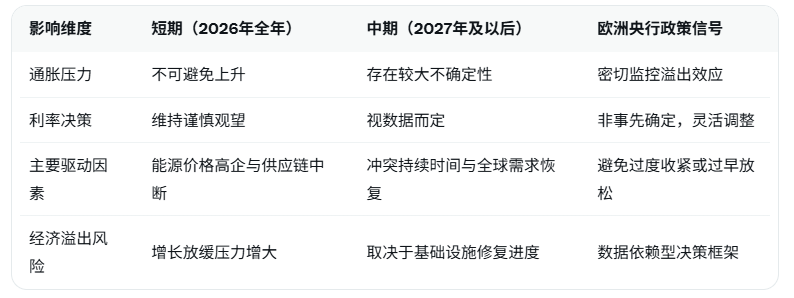
This policy stance reflects the dilemma currently facing the European Central Bank: on the one hand, imported inflation driven by the war necessitates maintaining higher interest rates to anchor expectations; on the other hand, if the conflict prolongs and leads to a significant decline in economic activity, overly tight monetary policy could exacerbate the risk of recession. For major Asian countries, as important trading partners of the Eurozone, a high-inflation environment will indirectly affect export competitiveness and cross-border capital flows, and rising energy costs may also be transmitted to global supply chains, amplifying regional economic volatility.
From a broader perspective, the current situation highlights the amplifying effect of geopolitical events on the monetary policies of developed economies. Investors need to closely monitor subsequent ECB meeting minutes, Eurozone PMI data, and progress on the restoration of the Strait of Hormuz. If the medium-term inflation impact is weaker than expected, the path of interest rate cuts may begin sooner; conversely, the period of maintaining restrictive interest rates may be prolonged, thereby affecting the euro exchange rate and bond market trends.
Editor's Summary : The Iranian conflict has clearly pushed up short-term inflation in the Eurozone through energy prices, while also introducing significant uncertainty to medium-term price trends. The European Central Bank's cautious data-dependent strategy aims to balance the dual objectives of price stability and economic growth. Market participants should flexibly assess the risks of policy shifts and adjust asset allocations based on the latest geopolitical dynamics and economic indicators.
In a recent public speech, Rehn further added that the persistently high oil prices caused by the war are rapidly being transmitted to core inflation in the Eurozone through energy imports, potentially amplifying price pressures in the short term. However, the medium-term impact depends on the duration of the conflict, the progress of supply chain recovery, and the strength of global demand response. Latest market data shows that as of April 14, 2026, Brent crude oil spot prices remained around $98 per barrel, still up approximately 50% from pre-conflict levels, directly pushing up energy and transportation costs in the Eurozone. This is expected to increase the overall inflation rate in 2026 by 0.3-0.5 percentage points compared to the initial forecast.
The following table compares the impact scenarios of the Iranian conflict on Eurozone inflation and interest rate policy:
This policy stance reflects the dilemma currently facing the European Central Bank: on the one hand, imported inflation driven by the war necessitates maintaining higher interest rates to anchor expectations; on the other hand, if the conflict prolongs and leads to a significant decline in economic activity, overly tight monetary policy could exacerbate the risk of recession. For major Asian countries, as important trading partners of the Eurozone, a high-inflation environment will indirectly affect export competitiveness and cross-border capital flows, and rising energy costs may also be transmitted to global supply chains, amplifying regional economic volatility.
From a broader perspective, the current situation highlights the amplifying effect of geopolitical events on the monetary policies of developed economies. Investors need to closely monitor subsequent ECB meeting minutes, Eurozone PMI data, and progress on the restoration of the Strait of Hormuz. If the medium-term inflation impact is weaker than expected, the path of interest rate cuts may begin sooner; conversely, the period of maintaining restrictive interest rates may be prolonged, thereby affecting the euro exchange rate and bond market trends.
Editor's Summary : The Iranian conflict has clearly pushed up short-term inflation in the Eurozone through energy prices, while also introducing significant uncertainty to medium-term price trends. The European Central Bank's cautious data-dependent strategy aims to balance the dual objectives of price stability and economic growth. Market participants should flexibly assess the risks of policy shifts and adjust asset allocations based on the latest geopolitical dynamics and economic indicators.
- Risk Warning and Disclaimer
- The market involves risk, and trading may not be suitable for all investors. This article is for reference only and does not constitute personal investment advice, nor does it take into account certain users’ specific investment objectives, financial situation, or other needs. Any investment decisions made based on this information are at your own risk.