The British pound has risen strongly for seven consecutive days, with new highs being reached.
2026-04-14 17:57:27
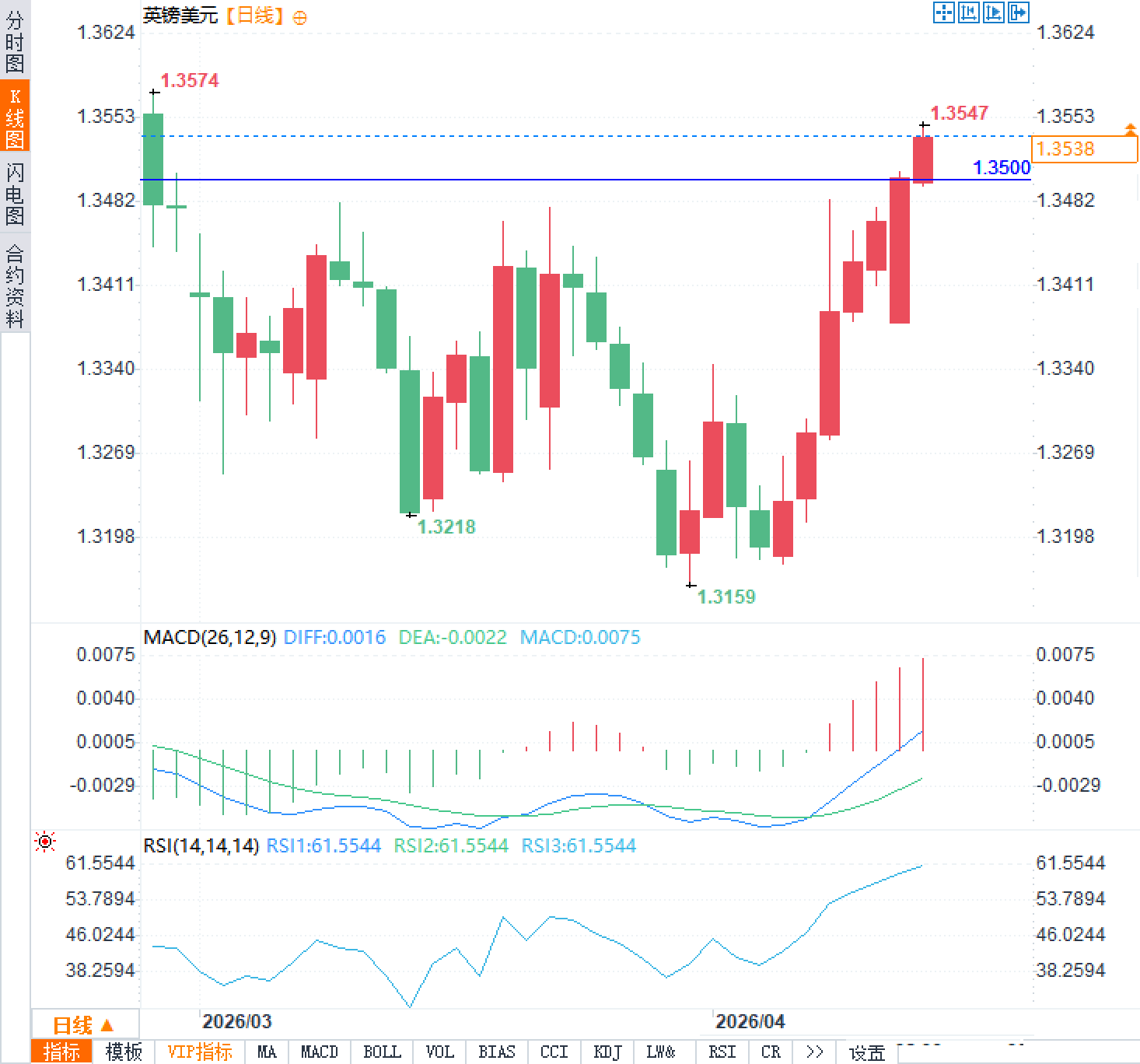
On Tuesday, April 14th, the British pound continued its strong upward trend against the US dollar in early European trading, rising approximately 125 points from the previous day for the seventh consecutive trading day. The current price is in the 1.3535-1.3540 range, its highest level since February 26th. Traders continued to shift towards risk assets, primarily driven by optimism regarding the prospects of US-Iran negotiations. Although the talks failed to achieve a breakthrough over the weekend, expectations that diplomatic channels remain open have weakened the safe-haven appeal of the US dollar. Meanwhile, the upcoming release of the US Producer Price Index and speeches by several Federal Reserve officials are also contributing to the current exchange rate movement.
US Vice President Vance recently commented on the Iran negotiations with cautious optimism, noting that while no breakthrough has been achieved, substantial progress has been made, and emphasizing that a comprehensive agreement framework could be reached as long as Iran takes the next step. Furthermore, reports indicate that the US and Iran negotiating teams may continue consultations in the near future. This development has eased tensions in the Middle East, prompting investors to reduce their safe-haven demand for the US dollar, directly benefiting the British pound against the dollar.
Despite US President Trump's announcement that the US Navy had officially begun blockading the Strait of Hormuz, and Iran's threat to close all ports in the Persian Gulf and the Gulf of Oman, the market generally viewed this as a manageable power struggle. As a result, crude oil prices remained relatively low, easing global inflationary pressures and further weakening support for the US dollar. Traders are closely watching the potential energy shocks caused by instability in the Strait, but current diplomatic optimism is prevailing, limiting the upside potential for dollar long positions.
The Bank of England's Monetary Policy Committee recently kept its benchmark interest rate unchanged at 3.75%, but the market has already significantly increased its tightening expectations, pricing in approximately three 25-basis-point rate hikes in 2026, possibly starting as early as April. This expectation stems from renewed inflation concerns triggered by the situation in the Middle East. In contrast, the Federal Reserve's target range for the federal funds rate remains at 3.5% to 3.75%, and its dot plot still indicates only one possible rate cut in 2026, with some officials hinting at zero rate adjustments if inflationary pressures persist.
This policy divergence is driving the pound against the dollar, with the Bank of England's relatively hawkish stance increasing the pound's attractiveness. Below is a brief comparison of recent interest rate expectations in the UK and the US:
This divergence is not only reflected in short-term interest rate expectations, but also extends to yield curve differences, which traders adjust their position allocation accordingly, further consolidating the strength of the pound.
While tensions in the Middle East have shown signs of easing, crude oil prices remain constrained by potential disturbances in the Strait of Hormuz, preventing a significant decline. This limits the downside potential for inflation and also somewhat curbs further weakening of the US dollar. Investors are concerned that external energy shocks could push up the US Producer Price Index (PPI), thereby influencing the Federal Reserve's policy direction. The latest US PPI data shows a 0.7% month-on-month increase and a 3.4% year-on-year increase in February, with both service and goods prices rising, confirming market concerns about lagged effects.
As a net energy importer, the UK is more directly affected by fluctuations in oil prices regarding its inflation path. This has reinforced market bets on the Bank of England tightening monetary policy earlier than anticipated, while the Federal Reserve faces increased pressure to make data-dependent decisions. This asymmetry provides sustained upward momentum for the pound against the dollar. Traders are watching the upcoming US Producer Price Index and speeches by Federal Reserve officials, as these data will directly test the strength of dollar demand.
From a technical perspective, the pound/dollar exchange rate has broken through the key resistance level of 1.3500, with the 20-day moving average around 1.3370 providing solid support. As long as the exchange rate remains above this moving average, any downward correction is likely to attract buying interest, and the overall fundamental outlook is bullish.
Market sentiment indicates that risk appetite continues to dominate, with the dollar index hovering near its lowest level since early March. The pound's rise against the dollar reflects traders pricing in both policy divergence and geopolitical easing; in the short term, a shift in fundamentals will continue to limit downside potential.
Geopolitical easing supports risk appetite
US Vice President Vance recently commented on the Iran negotiations with cautious optimism, noting that while no breakthrough has been achieved, substantial progress has been made, and emphasizing that a comprehensive agreement framework could be reached as long as Iran takes the next step. Furthermore, reports indicate that the US and Iran negotiating teams may continue consultations in the near future. This development has eased tensions in the Middle East, prompting investors to reduce their safe-haven demand for the US dollar, directly benefiting the British pound against the dollar.
Despite US President Trump's announcement that the US Navy had officially begun blockading the Strait of Hormuz, and Iran's threat to close all ports in the Persian Gulf and the Gulf of Oman, the market generally viewed this as a manageable power struggle. As a result, crude oil prices remained relatively low, easing global inflationary pressures and further weakening support for the US dollar. Traders are closely watching the potential energy shocks caused by instability in the Strait, but current diplomatic optimism is prevailing, limiting the upside potential for dollar long positions.
The policy paths of the Bank of England and the Bank of America have diverged significantly.
The Bank of England's Monetary Policy Committee recently kept its benchmark interest rate unchanged at 3.75%, but the market has already significantly increased its tightening expectations, pricing in approximately three 25-basis-point rate hikes in 2026, possibly starting as early as April. This expectation stems from renewed inflation concerns triggered by the situation in the Middle East. In contrast, the Federal Reserve's target range for the federal funds rate remains at 3.5% to 3.75%, and its dot plot still indicates only one possible rate cut in 2026, with some officials hinting at zero rate adjustments if inflationary pressures persist.
This policy divergence is driving the pound against the dollar, with the Bank of England's relatively hawkish stance increasing the pound's attractiveness. Below is a brief comparison of recent interest rate expectations in the UK and the US:
| Central Bank | Current benchmark interest rate | Market pricing changes in 2026 |
|---|---|---|
| Bank of England | 3.75% | Approximately three 25 basis point rate hikes |
| Fed | 3.5%-3.75% | One or zero interest rate cuts |
Energy price fluctuations and inflation transmission mechanisms
While tensions in the Middle East have shown signs of easing, crude oil prices remain constrained by potential disturbances in the Strait of Hormuz, preventing a significant decline. This limits the downside potential for inflation and also somewhat curbs further weakening of the US dollar. Investors are concerned that external energy shocks could push up the US Producer Price Index (PPI), thereby influencing the Federal Reserve's policy direction. The latest US PPI data shows a 0.7% month-on-month increase and a 3.4% year-on-year increase in February, with both service and goods prices rising, confirming market concerns about lagged effects.
As a net energy importer, the UK is more directly affected by fluctuations in oil prices regarding its inflation path. This has reinforced market bets on the Bank of England tightening monetary policy earlier than anticipated, while the Federal Reserve faces increased pressure to make data-dependent decisions. This asymmetry provides sustained upward momentum for the pound against the dollar. Traders are watching the upcoming US Producer Price Index and speeches by Federal Reserve officials, as these data will directly test the strength of dollar demand.
Technical support and fundamental bias
From a technical perspective, the pound/dollar exchange rate has broken through the key resistance level of 1.3500, with the 20-day moving average around 1.3370 providing solid support. As long as the exchange rate remains above this moving average, any downward correction is likely to attract buying interest, and the overall fundamental outlook is bullish.
Market sentiment indicates that risk appetite continues to dominate, with the dollar index hovering near its lowest level since early March. The pound's rise against the dollar reflects traders pricing in both policy divergence and geopolitical easing; in the short term, a shift in fundamentals will continue to limit downside potential.
Frequently Asked Questions
Question 1: Why has the British pound been able to rise against the US dollar for several consecutive days and hit a new high for the period?
A: This is mainly due to the optimistic expectations surrounding the US-Iran negotiations weakening the dollar's safe-haven appeal, coupled with the widening policy divergence between the Bank of England and the Federal Reserve. Recent statements by Vance suggest promising diplomatic progress, and the combination of low oil prices has supported the pound's rise against the dollar for the seventh consecutive day, reaching the 1.3535 range.
Question 2: What is the specific path of the impact of the Middle East situation on the British pound exchange rate?
A: Easing tensions reduce global demand for safe-haven assets, directly negatively impacting the US dollar; while limited declines in oil prices alleviate inflationary pressures, potential energy shocks remain, reinforcing expectations of tightening by the Bank of England rather than easing by the Federal Reserve. This asymmetric inflation transmission makes the pound relatively strong.
- Risk Warning and Disclaimer
- The market involves risk, and trading may not be suitable for all investors. This article is for reference only and does not constitute personal investment advice, nor does it take into account certain users’ specific investment objectives, financial situation, or other needs. Any investment decisions made based on this information are at your own risk.