The dollar collapsed and copper prices soared! Approaching previous highs, just one step away, is the countdown to sulfuric acid supply disruptions triggering panic over production cuts?
2026-04-14 19:13:09
After a period of consolidation, the global copper market showed strong upward momentum on Tuesday (April 14). Copper prices reached their highest level in six weeks, and market risk appetite rebounded significantly. The core logic driving this round of gains lies in the improvement of macro sentiment driven by the easing of geopolitical tensions, and cost support from raw material shortages in the supply chain. Currently, both LME copper and SHFE copper are showing a highly synchronized unilateral rebound, with market anxiety about future supply gradually outweighing concerns about slowing demand, and a clear upward trend in prices.

From a macro perspective, the potential turning point in the geopolitical situation is the biggest positive factor for today's market. According to reports from well-known institutions, peace talks between relevant countries may resume later this week in Islamabad. This news effectively offset the pressure previously accumulated in the market due to soaring energy costs and expectations of weak growth. Commodity strategists from well-known institutions pointed out that the expectation of the resumption of peace talks is reversing the previous sluggish sentiment in the metals market. At the same time, the US dollar index fell to its lowest level since early March, enhancing the premium of dollar-denominated metal assets and attracting more buying inflows from holders of non-US currencies, further consolidating the upward price trend.
In terms of fundamentals, supply-side "production cut anxiety" is spreading from the mining sector to the smelting process. First, mine supply constraints persist. As a top global copper producer, Chile's copper production has consistently fallen short of expectations since 2026. More impactful news comes from the chemical auxiliary materials sector: reports indicate that major supplying countries may halt sulfuric acid exports starting in May. Since sulfuric acid is an indispensable auxiliary material in the hydrometallurgical copper smelting process, disruptions to its supply have raised market concerns about potential reductions in global copper and nickel production. Cost pressures are also rising significantly. Energy price volatility driven by the Middle East situation has increased production costs for top global copper miners such as Codelco by 10 cents per pound, and mining companies like Antofagasta have also expressed concern about soaring fuel and input costs. This bottom-up cost-push logic provides a solid valuation foundation for the market.
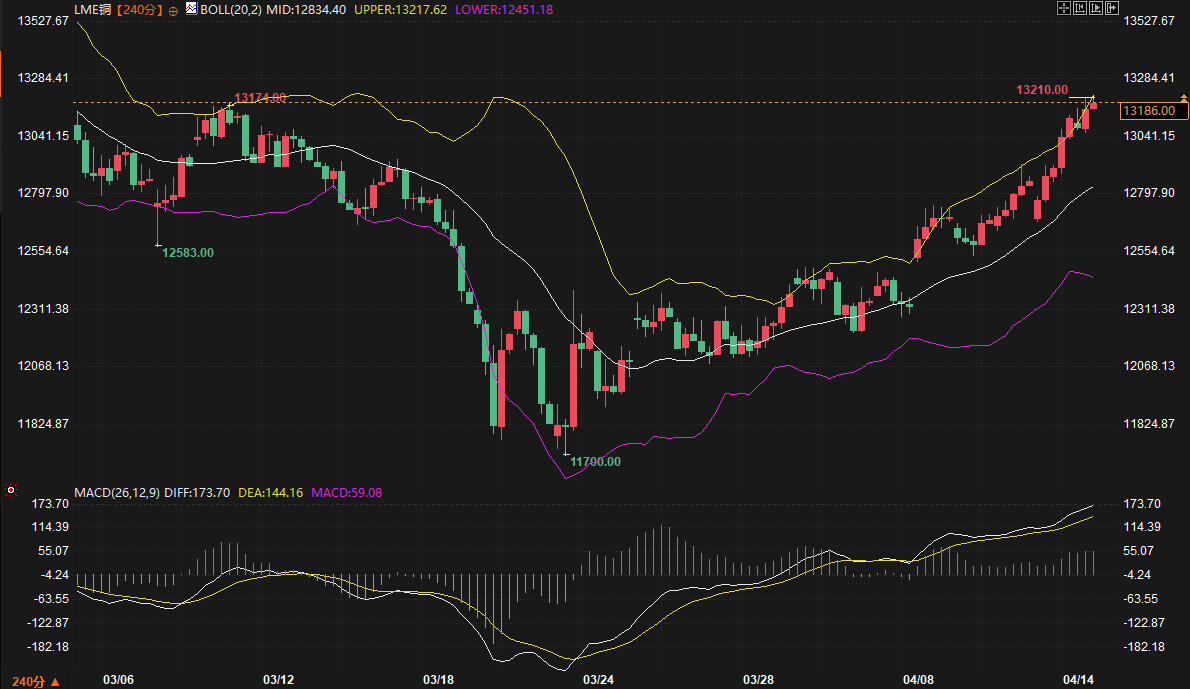
From a technical perspective, LME copper has shown a strong willingness to break out. The price has currently reached a short-term high of $13,210.50, successfully breaking through the previous high of $13,174. Looking at the 240-minute chart, the price is closely following the upper Bollinger Band, indicating strong bullish momentum. Although the MACD histogram has narrowed slightly compared to the previous period, suggesting a potential technical pullback risk due to the rapid short-term gains, the upward trend of both the DIFF and DEA lines indicates that the overall trend has not reversed. The current support zone for LME copper is around the previous low of $12,583, while the resistance zone is locked at the cycle high of $13,210 and the upper Bollinger Band at $13,217. Intraday focus should be on whether the price can hold above the high after breaking through; if it can continue to trade above $13,186, further upside potential is expected.
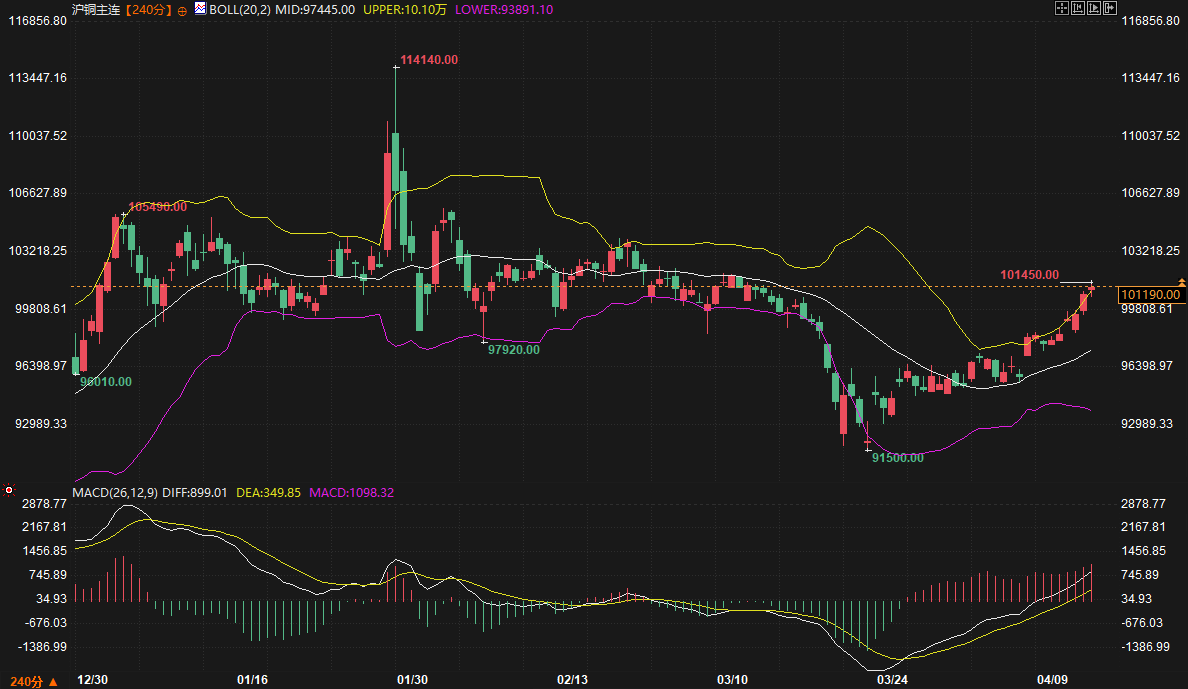
The Shanghai copper market also showed strength. The main Shanghai copper contract rose 2.1% in a single day, closing at 101,190 yuan/ton. Technically, Shanghai copper is currently trading near the upper Bollinger Band, facing some resistance. However, the MACD indicator shows that both the DIFF and DEA are positive and trending upwards, with the red bars expanding continuously, indicating stronger bullish momentum compared to LME copper. This rebound, which began after bottoming out at 91,500 yuan in late March, has followed a clear path and is approaching the previous resistance zone of 105,490 yuan. For Shanghai copper, the support zone is located near the middle Bollinger Band at 97,445 yuan and the previous low of 97,920 yuan; the resistance zone is between 105,490 yuan and the upper Bollinger Band at 101,010 yuan. Intraday trading should closely monitor trading volume to determine if there is enough momentum to break through the 105,000 yuan level.
In summary, the current copper price surge is driven by a combination of macroeconomic sentiment premium and tight supply fundamentals. While the market remains highly reliant on news-driven factors, and geopolitical tensions or renewed energy price volatility could trigger a reversal in sentiment, the bullish trend is currently established. Investors need to closely monitor the progress of peace negotiations and the release of the May export policy for chemical auxiliary materials. Given the tight supply environment, copper price corrections are often accompanied by strong buying support. While short-term technical resistance levels may present a need for adjustment, the overall rebound logic remains valid.
1. Why does news of peace talks have such a direct impact on copper prices?
Expectations of peace negotiations primarily influence market sentiment through two channels: risk appetite and cost expectations. Previously, market concerns about uncontrolled energy prices due to heightened tensions increased the operational difficulties of global industries. The resumption of negotiations reduced risk aversion and alleviated market fears that inflationary pressures would force monetary policy tightening. For copper, this not only signifies improved macro liquidity but also a recovery in downstream manufacturing confidence in future economic growth, thereby boosting confidence in entering long positions.
2. Why would the export restrictions on sulfuric acid be a significant positive factor for copper prices on the supply side?
Sulfuric acid is a key catalyst and auxiliary material in hydrometallurgical processes. If major producing countries cease exports, it will disrupt the global sulfuric acid supply chain, directly limiting hydrometallurgical copper production. Given the current poor performance of Chilean mines, this anticipated raw material shortage at the smelting end will undoubtedly exacerbate market panic regarding a physical copper shortage, thus reflecting a premium in the futures market.
3. How should we view the impact of the current weakening US dollar index on copper prices?
As a commodity priced in US dollars, copper typically exhibits a negative correlation with the US dollar index. A weaker dollar reduces the cost of purchasing copper for holders of non-US dollar currencies (such as the RMB and the euro), thereby stimulating global demand. Currently, the US dollar is at its lowest level since early March, providing a favorable financial environment for this surge in copper prices.
4. How will the continued low copper production in Chile affect the copper price trend for the whole of 2026?
As the world's largest copper supplier, Chile's production performance serves as a market bellwether. Weak output since 2026 indicates limited increases in mining activity, providing long-term fundamental support for copper prices. Even with short-term fluctuations in macroeconomic sentiment, as long as the tight supply at the mining end remains unchanged, a deep, trend-driven decline in copper prices is unlikely.
5. Given the current technical pressures, what market details should investors pay attention to?
Although both LME copper and SHFE copper are currently in a bullish phase, prices are approaching the upper Bollinger Band and previous resistance levels. Investors should pay attention to whether a divergence signal of "high volume without price increase" appears during the trading session. If prices rise with high volume at high levels but the candlestick shows a long upper shadow, it indicates heavy selling pressure in the resistance zone. Conversely, if the price breaks through the resistance level with consecutive solid bullish candlesticks, it indicates the start of a new round of one-sided market movement.
From a macro perspective, the potential turning point in the geopolitical situation is the biggest positive factor for today's market. According to reports from well-known institutions, peace talks between relevant countries may resume later this week in Islamabad. This news effectively offset the pressure previously accumulated in the market due to soaring energy costs and expectations of weak growth. Commodity strategists from well-known institutions pointed out that the expectation of the resumption of peace talks is reversing the previous sluggish sentiment in the metals market. At the same time, the US dollar index fell to its lowest level since early March, enhancing the premium of dollar-denominated metal assets and attracting more buying inflows from holders of non-US currencies, further consolidating the upward price trend.
In terms of fundamentals, supply-side "production cut anxiety" is spreading from the mining sector to the smelting process. First, mine supply constraints persist. As a top global copper producer, Chile's copper production has consistently fallen short of expectations since 2026. More impactful news comes from the chemical auxiliary materials sector: reports indicate that major supplying countries may halt sulfuric acid exports starting in May. Since sulfuric acid is an indispensable auxiliary material in the hydrometallurgical copper smelting process, disruptions to its supply have raised market concerns about potential reductions in global copper and nickel production. Cost pressures are also rising significantly. Energy price volatility driven by the Middle East situation has increased production costs for top global copper miners such as Codelco by 10 cents per pound, and mining companies like Antofagasta have also expressed concern about soaring fuel and input costs. This bottom-up cost-push logic provides a solid valuation foundation for the market.
From a technical perspective, LME copper has shown a strong willingness to break out. The price has currently reached a short-term high of $13,210.50, successfully breaking through the previous high of $13,174. Looking at the 240-minute chart, the price is closely following the upper Bollinger Band, indicating strong bullish momentum. Although the MACD histogram has narrowed slightly compared to the previous period, suggesting a potential technical pullback risk due to the rapid short-term gains, the upward trend of both the DIFF and DEA lines indicates that the overall trend has not reversed. The current support zone for LME copper is around the previous low of $12,583, while the resistance zone is locked at the cycle high of $13,210 and the upper Bollinger Band at $13,217. Intraday focus should be on whether the price can hold above the high after breaking through; if it can continue to trade above $13,186, further upside potential is expected.
The Shanghai copper market also showed strength. The main Shanghai copper contract rose 2.1% in a single day, closing at 101,190 yuan/ton. Technically, Shanghai copper is currently trading near the upper Bollinger Band, facing some resistance. However, the MACD indicator shows that both the DIFF and DEA are positive and trending upwards, with the red bars expanding continuously, indicating stronger bullish momentum compared to LME copper. This rebound, which began after bottoming out at 91,500 yuan in late March, has followed a clear path and is approaching the previous resistance zone of 105,490 yuan. For Shanghai copper, the support zone is located near the middle Bollinger Band at 97,445 yuan and the previous low of 97,920 yuan; the resistance zone is between 105,490 yuan and the upper Bollinger Band at 101,010 yuan. Intraday trading should closely monitor trading volume to determine if there is enough momentum to break through the 105,000 yuan level.
In summary, the current copper price surge is driven by a combination of macroeconomic sentiment premium and tight supply fundamentals. While the market remains highly reliant on news-driven factors, and geopolitical tensions or renewed energy price volatility could trigger a reversal in sentiment, the bullish trend is currently established. Investors need to closely monitor the progress of peace negotiations and the release of the May export policy for chemical auxiliary materials. Given the tight supply environment, copper price corrections are often accompanied by strong buying support. While short-term technical resistance levels may present a need for adjustment, the overall rebound logic remains valid.
Frequently Asked Questions
1. Why does news of peace talks have such a direct impact on copper prices?
Expectations of peace negotiations primarily influence market sentiment through two channels: risk appetite and cost expectations. Previously, market concerns about uncontrolled energy prices due to heightened tensions increased the operational difficulties of global industries. The resumption of negotiations reduced risk aversion and alleviated market fears that inflationary pressures would force monetary policy tightening. For copper, this not only signifies improved macro liquidity but also a recovery in downstream manufacturing confidence in future economic growth, thereby boosting confidence in entering long positions.
2. Why would the export restrictions on sulfuric acid be a significant positive factor for copper prices on the supply side?
Sulfuric acid is a key catalyst and auxiliary material in hydrometallurgical processes. If major producing countries cease exports, it will disrupt the global sulfuric acid supply chain, directly limiting hydrometallurgical copper production. Given the current poor performance of Chilean mines, this anticipated raw material shortage at the smelting end will undoubtedly exacerbate market panic regarding a physical copper shortage, thus reflecting a premium in the futures market.
3. How should we view the impact of the current weakening US dollar index on copper prices?
As a commodity priced in US dollars, copper typically exhibits a negative correlation with the US dollar index. A weaker dollar reduces the cost of purchasing copper for holders of non-US dollar currencies (such as the RMB and the euro), thereby stimulating global demand. Currently, the US dollar is at its lowest level since early March, providing a favorable financial environment for this surge in copper prices.
4. How will the continued low copper production in Chile affect the copper price trend for the whole of 2026?
As the world's largest copper supplier, Chile's production performance serves as a market bellwether. Weak output since 2026 indicates limited increases in mining activity, providing long-term fundamental support for copper prices. Even with short-term fluctuations in macroeconomic sentiment, as long as the tight supply at the mining end remains unchanged, a deep, trend-driven decline in copper prices is unlikely.
5. Given the current technical pressures, what market details should investors pay attention to?
Although both LME copper and SHFE copper are currently in a bullish phase, prices are approaching the upper Bollinger Band and previous resistance levels. Investors should pay attention to whether a divergence signal of "high volume without price increase" appears during the trading session. If prices rise with high volume at high levels but the candlestick shows a long upper shadow, it indicates heavy selling pressure in the resistance zone. Conversely, if the price breaks through the resistance level with consecutive solid bullish candlesticks, it indicates the start of a new round of one-sided market movement.
- Risk Warning and Disclaimer
- The market involves risk, and trading may not be suitable for all investors. This article is for reference only and does not constitute personal investment advice, nor does it take into account certain users’ specific investment objectives, financial situation, or other needs. Any investment decisions made based on this information are at your own risk.