Why did crude oil prices fall instead of rise after the Hormuz blockade took effect?
2026-04-14 20:23:54
On Tuesday (April 14), during the Asian and European sessions, international crude oil prices showed a weak and volatile trend. Although the United States has implemented a blockade against Iranian vessels in the Strait of Hormuz, the marginal impact of the blockade on Hormuz shipping capacity is limited, and the news that the US-Iran peace talks will enter a second phase has prevented a significant rebound in international oil prices. Currently, the WTI futures contract has fallen slightly by about 2% and is trading around $96.96.
The latest round of negotiations between the US and Iran continues to advance. An official from the Iranian embassy in Pakistan revealed that the next round of talks may be held this week or early next week. Earlier reports indicated that US and Iranian delegations were expected to hold consultations in Islamabad, Pakistan, later this week.
At 10 PM Beijing time on April 13, the US blockade of Iranian ports officially took effect, with the US deploying more than 15 warships to support the operation; Trump claimed that 158 Iranian naval vessels had been completely destroyed and warned that Iranian fast attack craft would be immediately destroyed if they approached the blockade zone;
US Vice President Vance clearly stated the US red lines in negotiations, demanding that Iran hand over enriched uranium, and said that blocking Iranian oil exports strengthened the US's bargaining power, while the issue of navigation in the Strait of Hormuz would directly determine the direction of the negotiations.
The current standoff between the US and Iran is essentially about "using pressure to force talks": the US port blockade is not intended to completely cut off shipping in the Strait of Hormuz, but rather to use it as a core bargaining chip to promote peace talks. One of the core conditions for the US negotiations is that Iran opens the Strait of Hormuz, and the core objective of the blockade is to put pressure on Iran and accelerate the negotiation process.
In fact, the Strait of Hormuz had already been effectively shut down due to the conflict, with most merchant ships actively avoiding the risks. The US blockade did not further impact the existing navigation situation.
Judging from the outcome of the game, it is almost a foregone conclusion that Iran will ultimately have to give a clear answer to the United States on the issue of enriched uranium, unless the United States concedes defeat on the military level. This core trend determines the controllability of geopolitical risks and also avoids the market falling into extreme panic.
For crude oil trading, the logic of "blockade to promote talks" directly dominates the pricing direction: the blockade did not exacerbate the risk of supply disruption, but instead accelerated the negotiations. Global market risk appetite did not deteriorate significantly, and the geopolitical premium that oil prices obtained was therefore limited.
Although the Strait of Hormuz carries about 20% of global seaborne oil trade, and previous conflicts have already driven up oil prices, the current blockade's "negotiation tool" nature has shifted market focus from "supply panic" to "progress in peace talks."
On the one hand, the US blockade is focused on Iranian ports rather than completely blocking the strait, and the oil tanker "Fuxing" has already broken through the blockade and sailed through, indicating that there is room for easing in strait shipping and that there has been no substantial deterioration on the supply side;
On the other hand, both the US and Iran have expressed their willingness to negotiate, and Pakistan has actively mediated, leading to a continued rise in expectations for the negotiations, which has further suppressed the extreme upward momentum of oil prices.
Current crude oil pricing has shifted from being "conflict escalation-driven" to "negotiation progress-driven," and trading strategies need to be dynamically adjusted around the peace talks.
If a breakthrough is achieved in the negotiations (Iran opens the Strait of Hormuz + consensus is reached on the issue of uranium enrichment), the geopolitical premium for oil prices will fall rapidly, and the risk of a correction should be noted.
If negotiations remain deadlocked, oil prices will remain high and volatile, but will lack the momentum for a sustained surge, as the market has fully recognized the "pressure attribute" of the blockade.
A new surge in oil prices could only be triggered if negotiations completely break down and the conflict escalates again, but given the current state of the game, the probability of this scenario is low.
Overall, the US strategy of using blockades to promote peace talks has kept Middle East geopolitical risks within a "controllable pressure" range, and the crude oil market does not need to over-price extreme supply risks.
In the short term, oil prices are more likely to fluctuate around the current range. The key to trading should be the timing of the US-Iran negotiations and breakthroughs in key issues (cross-strait navigation + uranium enrichment).
It is worth noting that Israel and Lebanon are scheduled to begin their first direct talks in decades in Washington on Tuesday. While Israel has suspended its airstrikes on Beirut, it is still maintaining its military operations in Lebanon, while Hezbollah has explicitly rejected the outcome of the negotiations.
However, the direct impact of this conflict on the crude oil market is limited and is unlikely to change the core pricing logic of the US-Iran negotiations and the opening of the Strait of Hormuz. We only need to be wary of short-term disturbances caused by unexpected spillovers from the conflict, and there is no need to adjust the core trading strategy.
The crude oil market is still mainly based on the marginal improvement of navigation in the Strait of Hormuz and the progress of the US-Iran negotiations. At present, there are not many marginal changes in the market, but the progress of the negotiations has taken a new turn.
Meanwhile, I have been consistently optimistic about the easing of geopolitical risks since the middle of last week, and have written articles arguing about this. The overall logic is consistent, and you can read my previous articles if you are interested.
Technically, WTI crude oil has slightly broken below the upward trend line, but found support near the 30-day moving average. The current resistance level is around 98, near the 5-day moving average and the upward trend line, while the support level is at the 30-day moving average.
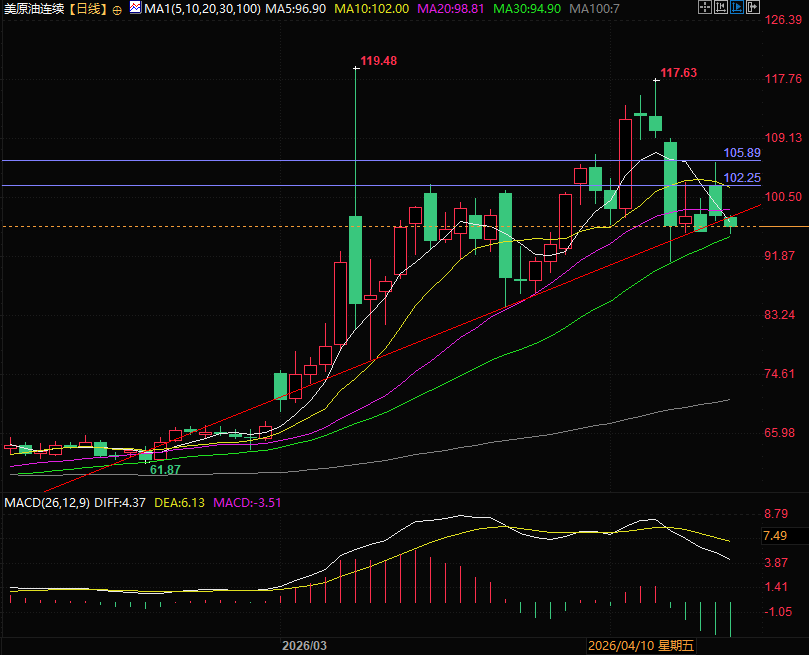
(WTI crude oil futures contract daily chart, source: EasyForex)
At 20:22 Beijing time, WTI crude oil futures contracts were trading at $96.37 per barrel.
The latest round of negotiations between the US and Iran continues to advance. An official from the Iranian embassy in Pakistan revealed that the next round of talks may be held this week or early next week. Earlier reports indicated that US and Iranian delegations were expected to hold consultations in Islamabad, Pakistan, later this week.
At 10 PM Beijing time on April 13, the US blockade of Iranian ports officially took effect, with the US deploying more than 15 warships to support the operation; Trump claimed that 158 Iranian naval vessels had been completely destroyed and warned that Iranian fast attack craft would be immediately destroyed if they approached the blockade zone;
US Vice President Vance clearly stated the US red lines in negotiations, demanding that Iran hand over enriched uranium, and said that blocking Iranian oil exports strengthened the US's bargaining power, while the issue of navigation in the Strait of Hormuz would directly determine the direction of the negotiations.
Core logic: Blockades are "bargaining chips," not "supply cuts."
The current standoff between the US and Iran is essentially about "using pressure to force talks": the US port blockade is not intended to completely cut off shipping in the Strait of Hormuz, but rather to use it as a core bargaining chip to promote peace talks. One of the core conditions for the US negotiations is that Iran opens the Strait of Hormuz, and the core objective of the blockade is to put pressure on Iran and accelerate the negotiation process.
In fact, the Strait of Hormuz had already been effectively shut down due to the conflict, with most merchant ships actively avoiding the risks. The US blockade did not further impact the existing navigation situation.
Judging from the outcome of the game, it is almost a foregone conclusion that Iran will ultimately have to give a clear answer to the United States on the issue of enriched uranium, unless the United States concedes defeat on the military level. This core trend determines the controllability of geopolitical risks and also avoids the market falling into extreme panic.
Market Impact: Risk appetite has not deteriorated, and geopolitical support for oil prices is limited.
For crude oil trading, the logic of "blockade to promote talks" directly dominates the pricing direction: the blockade did not exacerbate the risk of supply disruption, but instead accelerated the negotiations. Global market risk appetite did not deteriorate significantly, and the geopolitical premium that oil prices obtained was therefore limited.
Although the Strait of Hormuz carries about 20% of global seaborne oil trade, and previous conflicts have already driven up oil prices, the current blockade's "negotiation tool" nature has shifted market focus from "supply panic" to "progress in peace talks."
On the one hand, the US blockade is focused on Iranian ports rather than completely blocking the strait, and the oil tanker "Fuxing" has already broken through the blockade and sailed through, indicating that there is room for easing in strait shipping and that there has been no substantial deterioration on the supply side;
On the other hand, both the US and Iran have expressed their willingness to negotiate, and Pakistan has actively mediated, leading to a continued rise in expectations for the negotiations, which has further suppressed the extreme upward momentum of oil prices.
Transaction Perspective: Anchoring to "Negotiation Progress," Geopolitical Premium Gradually Converging
Current crude oil pricing has shifted from being "conflict escalation-driven" to "negotiation progress-driven," and trading strategies need to be dynamically adjusted around the peace talks.
If a breakthrough is achieved in the negotiations (Iran opens the Strait of Hormuz + consensus is reached on the issue of uranium enrichment), the geopolitical premium for oil prices will fall rapidly, and the risk of a correction should be noted.
If negotiations remain deadlocked, oil prices will remain high and volatile, but will lack the momentum for a sustained surge, as the market has fully recognized the "pressure attribute" of the blockade.
A new surge in oil prices could only be triggered if negotiations completely break down and the conflict escalates again, but given the current state of the game, the probability of this scenario is low.
Overall, the US strategy of using blockades to promote peace talks has kept Middle East geopolitical risks within a "controllable pressure" range, and the crude oil market does not need to over-price extreme supply risks.
In the short term, oil prices are more likely to fluctuate around the current range. The key to trading should be the timing of the US-Iran negotiations and breakthroughs in key issues (cross-strait navigation + uranium enrichment).
Secondary variable: The impact of the Israel-Lebanon negotiations is limited and does not shake the core logic.
It is worth noting that Israel and Lebanon are scheduled to begin their first direct talks in decades in Washington on Tuesday. While Israel has suspended its airstrikes on Beirut, it is still maintaining its military operations in Lebanon, while Hezbollah has explicitly rejected the outcome of the negotiations.
However, the direct impact of this conflict on the crude oil market is limited and is unlikely to change the core pricing logic of the US-Iran negotiations and the opening of the Strait of Hormuz. We only need to be wary of short-term disturbances caused by unexpected spillovers from the conflict, and there is no need to adjust the core trading strategy.
Summary and Technical Analysis:
The crude oil market is still mainly based on the marginal improvement of navigation in the Strait of Hormuz and the progress of the US-Iran negotiations. At present, there are not many marginal changes in the market, but the progress of the negotiations has taken a new turn.
Meanwhile, I have been consistently optimistic about the easing of geopolitical risks since the middle of last week, and have written articles arguing about this. The overall logic is consistent, and you can read my previous articles if you are interested.
Technically, WTI crude oil has slightly broken below the upward trend line, but found support near the 30-day moving average. The current resistance level is around 98, near the 5-day moving average and the upward trend line, while the support level is at the 30-day moving average.
(WTI crude oil futures contract daily chart, source: EasyForex)
At 20:22 Beijing time, WTI crude oil futures contracts were trading at $96.37 per barrel.
- Risk Warning and Disclaimer
- The market involves risk, and trading may not be suitable for all investors. This article is for reference only and does not constitute personal investment advice, nor does it take into account certain users’ specific investment objectives, financial situation, or other needs. Any investment decisions made based on this information are at your own risk.