The US is still expected to implement another interest rate cut by the end of the year, while inflationary pressures will test the Federal Reserve's course of action.
2026-04-15 13:33:41
According to APP, former US Treasury Secretary Janet Yellen stated that she still believes a US interest rate cut is possible later this year, although oil price volatility triggered by the Iran war has cast a shadow over the outlook. Yellen noted, "This is actually a broad-based supply shock, spreading from gasoline prices to liquefied natural gas, fertilizers, food, shipping costs, and semiconductors." She stated that while the possibility of raising interest rates cannot be ruled out, stable long-term inflation expectations suggest that this is unlikely at present. "I think my guess is that there might be an interest rate cut by the end of the year. I think that's entirely possible, and the most likely scenario. However, many things can happen." This statement highlights the complex balance the Federal Reserve currently faces between supply shocks and growth resilience.
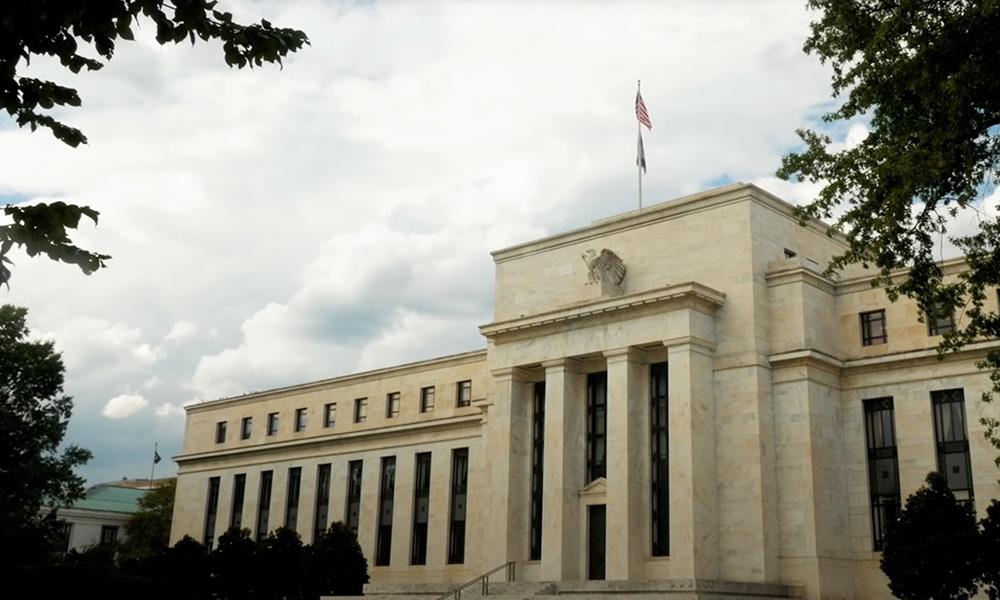
As of April 15, 2026, Brent crude oil prices rose to $95.57 per barrel, rebounding from recent lows, with the ongoing conflict in Iran continuing to push up global energy costs. As a core variable in the widespread supply shock, high oil prices have quickly spread to gasoline, chemical raw materials, and logistics, directly increasing production costs for businesses and consumer costs for residents. The Federal Reserve maintained its benchmark interest rate in the 3.5%-3.75% range, holding steady for the second consecutive month at its March meeting, while signaling a potential rate cut this year. The latest February PCE price index rose 2.8% year-on-year, with core PCE at 3.0%. The March CPI is projected to rise to 3.3% year-on-year, indicating a moderate increase in inflationary pressures, but one that is not yet out of control.
Yellen 's analysis emphasizes that this shock differs from demand-driven inflation, with long-term inflation expectations remaining stable. Therefore, the Federal Reserve does not need to rush to raise interest rates, but it must closely monitor the spillover effects of oil prices on the supply chain. Her assessment is consistent with her previous public statements, highlighting a cautiously optimistic approach based on data.
Regarding economic growth, the US real GDP growth rate is projected to remain stable at around 2.2% in 2026, benefiting from previous fiscal support and AI investment. However, high energy costs are weakening consumption and investment willingness, creating short-term downward pressure. If oil prices remain high, manufacturing profits and real household income will be squeezed, thus testing the Federal Reserve's "soft landing" strategy.
To provide a clear comparison between current economic indicators and potential risk scenarios, the following table displays key variables:
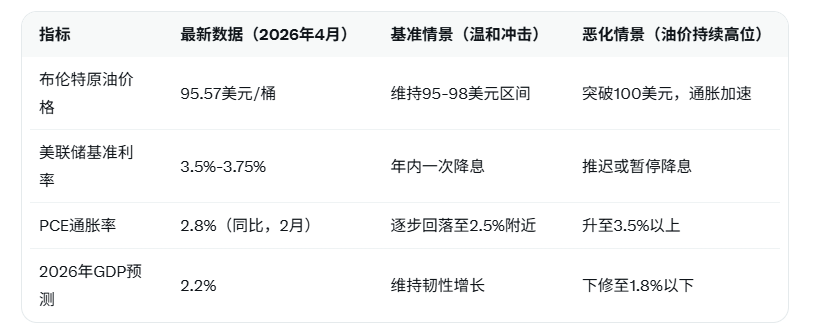
The above comparison shows that Yellen 's judgment is based on the anchoring of long-term inflation expectations. If the supply shock does not evolve into a persistent spiral, there is still a high probability of an interest rate cut at the end of the year.
Editor's Summary
Yellen 's latest remarks provide pragmatic guidance for the Fed's monetary policy path: Given the oil price supply shock driven by the Iranian conflict, stabilizing long-term inflation expectations remains a key support for a rate cut this year. This assessment aligns with current oil prices of $95.57, PCE inflation at 2.8%, and GDP forecasts at 2.2%, while also reminding the market to be wary of the potential drag on growth from external shocks, making it a valuable reference for global financial asset pricing.
As of April 15, 2026, Brent crude oil prices rose to $95.57 per barrel, rebounding from recent lows, with the ongoing conflict in Iran continuing to push up global energy costs. As a core variable in the widespread supply shock, high oil prices have quickly spread to gasoline, chemical raw materials, and logistics, directly increasing production costs for businesses and consumer costs for residents. The Federal Reserve maintained its benchmark interest rate in the 3.5%-3.75% range, holding steady for the second consecutive month at its March meeting, while signaling a potential rate cut this year. The latest February PCE price index rose 2.8% year-on-year, with core PCE at 3.0%. The March CPI is projected to rise to 3.3% year-on-year, indicating a moderate increase in inflationary pressures, but one that is not yet out of control.
Yellen 's analysis emphasizes that this shock differs from demand-driven inflation, with long-term inflation expectations remaining stable. Therefore, the Federal Reserve does not need to rush to raise interest rates, but it must closely monitor the spillover effects of oil prices on the supply chain. Her assessment is consistent with her previous public statements, highlighting a cautiously optimistic approach based on data.
Regarding economic growth, the US real GDP growth rate is projected to remain stable at around 2.2% in 2026, benefiting from previous fiscal support and AI investment. However, high energy costs are weakening consumption and investment willingness, creating short-term downward pressure. If oil prices remain high, manufacturing profits and real household income will be squeezed, thus testing the Federal Reserve's "soft landing" strategy.
To provide a clear comparison between current economic indicators and potential risk scenarios, the following table displays key variables:
The above comparison shows that Yellen 's judgment is based on the anchoring of long-term inflation expectations. If the supply shock does not evolve into a persistent spiral, there is still a high probability of an interest rate cut at the end of the year.
Editor's Summary
Yellen 's latest remarks provide pragmatic guidance for the Fed's monetary policy path: Given the oil price supply shock driven by the Iranian conflict, stabilizing long-term inflation expectations remains a key support for a rate cut this year. This assessment aligns with current oil prices of $95.57, PCE inflation at 2.8%, and GDP forecasts at 2.2%, while also reminding the market to be wary of the potential drag on growth from external shocks, making it a valuable reference for global financial asset pricing.
- Risk Warning and Disclaimer
- The market involves risk, and trading may not be suitable for all investors. This article is for reference only and does not constitute personal investment advice, nor does it take into account certain users’ specific investment objectives, financial situation, or other needs. Any investment decisions made based on this information are at your own risk.