Gold Trading Alert: Gold Prices Trapped in a "War Desensitization" Cycle; Failed Interest Rate Cut Dreams Dampen Bullish Momentum? Focus on Three Key Variables
2026-04-16 07:43:14
On Wednesday (April 15), spot gold prices fell sharply after hitting a one-month high of $4,871.28, eventually closing near $4,790, a daily drop of nearly 1%. US gold futures also fell 0.5%, settling at $4,823.60. In just 24 hours, gold transformed from a safe haven into a battleground for profit-taking, all stemming from the complex chain reaction triggered by Trump's statement that "the war with Iran is nearing its end." On Thursday (April 16) in early Asian trading, spot gold rose slightly, currently trading around $4,820 per ounce, up about 0.6%, with the continued weakening of the US dollar providing support for gold prices.
Trump's optimistic remarks acted as a shot in the arm, but also instantly punctured the safe-haven bubble of gold. He explicitly stated that the joint military operation with Israel against Iran was nearing its end, while the Pakistani Army Chief of Staff urgently traveled to Tehran to try to prevent the conflict from reigniting. White House Press Secretary Levitt further revealed that US and Iranian officials were considering returning to Pakistan for face-to-face negotiations, and that Israel and the United States shared highly aligned strategic goals: demanding that Iran remove its uranium enrichment program, cancel its uranium enrichment capabilities, and fully open the Strait of Hormuz, a "critical shipping lane."
However, reality is far harsher than the rhetoric suggests. The Iranian Revolutionary Guard continues its 45-day blockade of the Strait of Hormuz. Despite a two-week ceasefire agreement, the strait's navigation status remains uncertain. Daily crossings are currently only a fraction of the pre-war 130-odd trips, effectively paralyzing one-fifth of global oil and gas transport. This has directly resulted in a cumulative supply loss of 496 million barrels of crude oil and condensate from the Middle East. US Treasury Secretary Bessenter further announced the termination of waivers for oil purchases from Iran and Russia, and the imposition of sanctions on over 20 individuals, companies, and vessels, effectively cutting off Iran's maritime trade. Israeli Prime Minister Netanyahu warned in a video statement that Israel is prepared for renewed conflict with Iran, continuing its attacks on Hezbollah in Lebanon, and launching large-scale airstrikes in southern Lebanon. The 98th Division has completed the encirclement of Hezbollah's stronghold, Bint Jubail, and has killed over 1,700 Hezbollah fighters in the past six weeks.
This contradictory situation of "peace negotiations underway while military operations continue" has put gold investors in a dilemma. Traditionally, escalating geopolitical conflicts drive up demand for gold as a safe haven, but this time, gold prices saw profit-taking after Trump's pronouncements that the conflict was "nearing its end." Jim Wyckoff, senior analyst at Kitco Metals, pointed out that gold's recent rise in risk appetite coupled with its fall in risk aversion completely contradicts its traditional safe-haven attributes. Traders are no longer truly focused on the simple risk of war, but rather on the long-term impact of tightening monetary policy and inflationary pressures.
The continued obstruction of the Strait of Hormuz has become the most stubborn support for oil prices. Brent crude rose slightly by 0.1% to $94.93 per barrel, while US crude closed at $91.39 per barrel, a drop of about 0.7%. Despite market expectations for a US-Iran reconciliation, the reality of supply disruptions makes it difficult for energy prices to fall quickly. Chicago Fed President Goolsby stated bluntly on Tuesday that if a war with Iran leads to prolonged high oil prices, delaying the process of inflation falling back to the 2% target, the Fed may need to wait until 2027 to cut interest rates. This statement instantly extinguished market hopes for significant easing this year. Currently, the market expects only a 32% probability of a US interest rate cut in 2026, a 98.4% probability that the Fed will keep interest rates unchanged in April, and only a 33.7% probability of a cumulative 25 basis point rate cut by December.
The specter of rising interest rates has directly impacted gold's appeal as a non-interest-bearing asset. The opportunity cost of holding gold has increased dramatically, leading investors to favor higher-yielding bonds or stocks. While the US dollar index dipped slightly by 0.01% to 98.08, strong demand for US assets and a weakening prospect of interest rate cuts continued to provide support. European Central Bank policymakers also remained cautious; Nagel emphasized that the situation in the Strait of Hormuz would have a key impact on the next policy decision, while another policymaker believed that the short-term effects of the war with Iran were gradually materializing in the energy market.
Meanwhile, US stocks bucked the trend and hit new highs. The S&P 500 rose 0.80% to 7022.95 points, and the Nasdaq surged 1.60% to 24016.02 points, marking its first 11-day winning streak since November 2021. Technology and financial stocks led the gains, with better-than-expected earnings reports from Bank of America and Morgan Stanley further boosting market sentiment. The Treasury market, however, showed a "bearish steepening," with the 10-year yield rising to 4.282% and the two-year yield slightly declining to 3.766%, widening the yield curve spread to 51.1 basis points, reflecting rising investor concerns about inflation expectations.
A deeper turmoil stems from the power struggle between the White House and the Federal Reserve. On Wednesday, Trump threatened to fire Fed Chairman Jerome Powell if he did not resign from his post on the board of governor when his term ends on May 15. This not only complicates the confirmation process for his successor, Warsh, but also highlights unprecedented pressure on the Fed's independence. The ongoing criminal investigation into Powell by the Trump administration, coupled with questions about the Fed building renovation project, has further amplified market concerns about monetary policy uncertainty.
Against this backdrop, the pricing logic for gold has quietly shifted. Over the past two years, geopolitical conflicts, inflation expectations, and anticipation of interest rate cuts jointly fueled a super bull market for gold; now, the glimmer of hope for peace talks and the Federal Reserve's "belated easing" are creating a double drag. Analysts generally believe that gold prices will remain in a weak and volatile pattern in the short term, with the high of $4871 potentially becoming a temporary ceiling, while the area around $4790 forms significant support. Investors are closely watching the substantive progress of the US-Iran negotiations next week, as well as further confirmation from macroeconomic indicators such as EIA crude oil inventory data and US import prices.
In summary, this gold price correction is not a simple technical adjustment, but an inevitable result of the deep interplay between global macroeconomics and geopolitics. The window of opportunity for the US-Iran conflict to transition from "hot war" to "peace talks" has, while reducing extreme safe-haven premiums, also exposed the fragility of the energy supply chain and the stubbornness of inflation. The Federal Reserve's hints at a rate cut in 2027 have further strengthened expectations of a high-interest-rate environment, and gold's traditional protective aura—safe haven and inflation hedge—is undergoing an unprecedented test.
However, crises often breed opportunities. If the Strait of Hormuz blockade continues beyond expectations, or if the conflict between Israel and Hezbollah escalates again, gold could quickly return to its safe-haven status; conversely, if the US and Iran reach a substantial agreement, oil prices fall, and inflationary pressures ease, gold may face a longer period of adjustment. In any case,
The gold market is never an isolated battlefield; it is a concentrated reflection of global risk appetite, inflation expectations, monetary policy, and geopolitics. Trump's "two amazing days" are approaching, and every development in the US-Iran negotiations, every fluctuation in oil prices, and every statement from Federal Reserve officials will determine the fate of gold in the next phase.
Looking ahead, whether gold can escape its current predicament depends on the evolution of several key variables. The primary variable is the substantial progress of US-Iran negotiations—if the two sides can reach a comprehensive agreement that not only covers a ceasefire but also freedom of navigation in the Strait of Hormuz and restrictions on Iran's nuclear capabilities, then the geopolitical risk premium will significantly diminish, and gold prices may face a deeper correction. Conversely, if negotiations break down, conflict reignites, and spreads to a wider area of the Middle East, gold's safe-haven appeal will be reactivated. The second variable is oil price trends and inflation data—if energy prices remain high and begin to transmit to core inflation, the Federal Reserve may be forced to shift course earlier than expected, which would be a catalyst for a gold price breakout; if oil prices gradually decline and inflation falls as expected, then high interest rates will continue to suppress gold. The third variable is the change in leadership at the Federal Reserve—whether Powell can leave gracefully, whether Warsh can smoothly take over, and whether the monetary policy stance will change under the new power structure will all profoundly affect market expectations regarding the interest rate path.
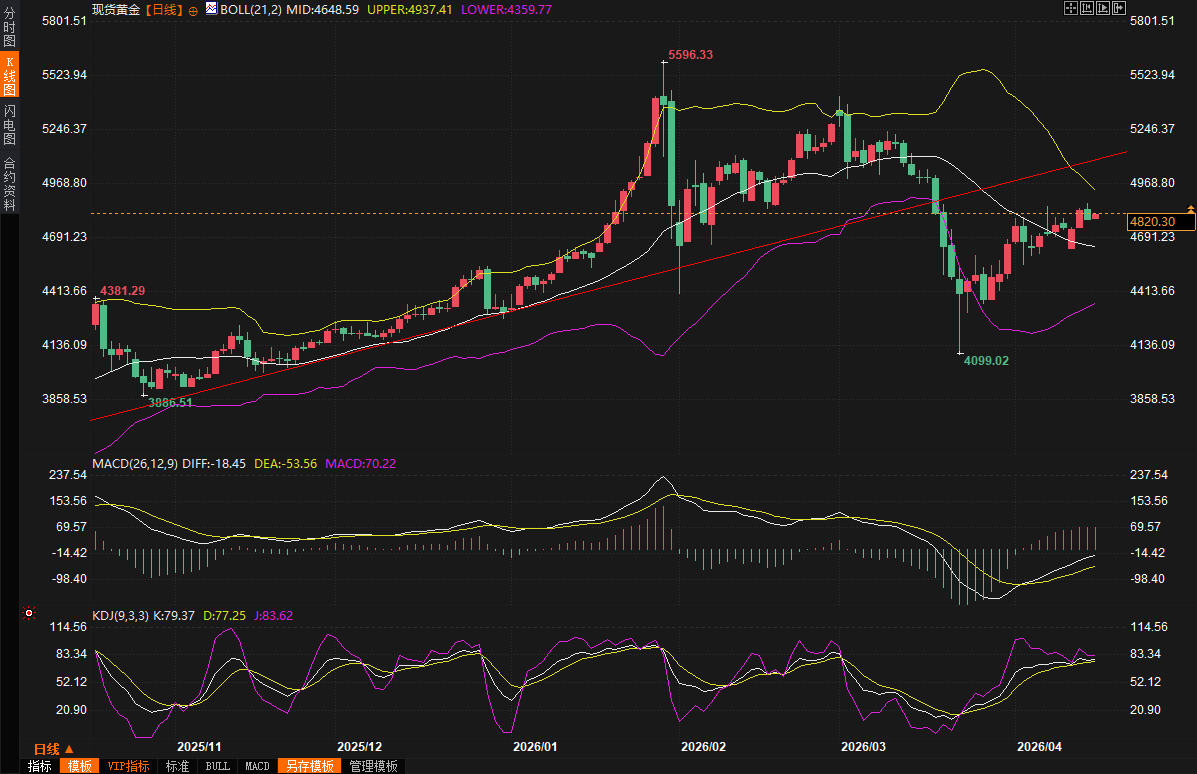
(Spot gold daily chart, source: FX678)
At 07:40 Beijing time, spot gold is trading at $4,821.90 per ounce.
Undercurrents beneath the “nearing end” of US-Iran ceasefire negotiations
Trump's optimistic remarks acted as a shot in the arm, but also instantly punctured the safe-haven bubble of gold. He explicitly stated that the joint military operation with Israel against Iran was nearing its end, while the Pakistani Army Chief of Staff urgently traveled to Tehran to try to prevent the conflict from reigniting. White House Press Secretary Levitt further revealed that US and Iranian officials were considering returning to Pakistan for face-to-face negotiations, and that Israel and the United States shared highly aligned strategic goals: demanding that Iran remove its uranium enrichment program, cancel its uranium enrichment capabilities, and fully open the Strait of Hormuz, a "critical shipping lane."
However, reality is far harsher than the rhetoric suggests. The Iranian Revolutionary Guard continues its 45-day blockade of the Strait of Hormuz. Despite a two-week ceasefire agreement, the strait's navigation status remains uncertain. Daily crossings are currently only a fraction of the pre-war 130-odd trips, effectively paralyzing one-fifth of global oil and gas transport. This has directly resulted in a cumulative supply loss of 496 million barrels of crude oil and condensate from the Middle East. US Treasury Secretary Bessenter further announced the termination of waivers for oil purchases from Iran and Russia, and the imposition of sanctions on over 20 individuals, companies, and vessels, effectively cutting off Iran's maritime trade. Israeli Prime Minister Netanyahu warned in a video statement that Israel is prepared for renewed conflict with Iran, continuing its attacks on Hezbollah in Lebanon, and launching large-scale airstrikes in southern Lebanon. The 98th Division has completed the encirclement of Hezbollah's stronghold, Bint Jubail, and has killed over 1,700 Hezbollah fighters in the past six weeks.
This contradictory situation of "peace negotiations underway while military operations continue" has put gold investors in a dilemma. Traditionally, escalating geopolitical conflicts drive up demand for gold as a safe haven, but this time, gold prices saw profit-taking after Trump's pronouncements that the conflict was "nearing its end." Jim Wyckoff, senior analyst at Kitco Metals, pointed out that gold's recent rise in risk appetite coupled with its fall in risk aversion completely contradicts its traditional safe-haven attributes. Traders are no longer truly focused on the simple risk of war, but rather on the long-term impact of tightening monetary policy and inflationary pressures.
Oil prices fluctuate at high levels: the specter of inflation reappears, and gold's inflation hedging aura dims.
The continued obstruction of the Strait of Hormuz has become the most stubborn support for oil prices. Brent crude rose slightly by 0.1% to $94.93 per barrel, while US crude closed at $91.39 per barrel, a drop of about 0.7%. Despite market expectations for a US-Iran reconciliation, the reality of supply disruptions makes it difficult for energy prices to fall quickly. Chicago Fed President Goolsby stated bluntly on Tuesday that if a war with Iran leads to prolonged high oil prices, delaying the process of inflation falling back to the 2% target, the Fed may need to wait until 2027 to cut interest rates. This statement instantly extinguished market hopes for significant easing this year. Currently, the market expects only a 32% probability of a US interest rate cut in 2026, a 98.4% probability that the Fed will keep interest rates unchanged in April, and only a 33.7% probability of a cumulative 25 basis point rate cut by December.
The specter of rising interest rates has directly impacted gold's appeal as a non-interest-bearing asset. The opportunity cost of holding gold has increased dramatically, leading investors to favor higher-yielding bonds or stocks. While the US dollar index dipped slightly by 0.01% to 98.08, strong demand for US assets and a weakening prospect of interest rate cuts continued to provide support. European Central Bank policymakers also remained cautious; Nagel emphasized that the situation in the Strait of Hormuz would have a key impact on the next policy decision, while another policymaker believed that the short-term effects of the war with Iran were gradually materializing in the energy market.
Meanwhile, US stocks bucked the trend and hit new highs. The S&P 500 rose 0.80% to 7022.95 points, and the Nasdaq surged 1.60% to 24016.02 points, marking its first 11-day winning streak since November 2021. Technology and financial stocks led the gains, with better-than-expected earnings reports from Bank of America and Morgan Stanley further boosting market sentiment. The Treasury market, however, showed a "bearish steepening," with the 10-year yield rising to 4.282% and the two-year yield slightly declining to 3.766%, widening the yield curve spread to 51.1 basis points, reflecting rising investor concerns about inflation expectations.
Trump's "Firing Powell" Controversy: The Power Transition at the Federal Reserve Adds Chaos, Changing the Long-Term Logic for Gold
A deeper turmoil stems from the power struggle between the White House and the Federal Reserve. On Wednesday, Trump threatened to fire Fed Chairman Jerome Powell if he did not resign from his post on the board of governor when his term ends on May 15. This not only complicates the confirmation process for his successor, Warsh, but also highlights unprecedented pressure on the Fed's independence. The ongoing criminal investigation into Powell by the Trump administration, coupled with questions about the Fed building renovation project, has further amplified market concerns about monetary policy uncertainty.
Against this backdrop, the pricing logic for gold has quietly shifted. Over the past two years, geopolitical conflicts, inflation expectations, and anticipation of interest rate cuts jointly fueled a super bull market for gold; now, the glimmer of hope for peace talks and the Federal Reserve's "belated easing" are creating a double drag. Analysts generally believe that gold prices will remain in a weak and volatile pattern in the short term, with the high of $4871 potentially becoming a temporary ceiling, while the area around $4790 forms significant support. Investors are closely watching the substantive progress of the US-Iran negotiations next week, as well as further confirmation from macroeconomic indicators such as EIA crude oil inventory data and US import prices.
Where is gold headed? A crossroads of risk and opportunity.
In summary, this gold price correction is not a simple technical adjustment, but an inevitable result of the deep interplay between global macroeconomics and geopolitics. The window of opportunity for the US-Iran conflict to transition from "hot war" to "peace talks" has, while reducing extreme safe-haven premiums, also exposed the fragility of the energy supply chain and the stubbornness of inflation. The Federal Reserve's hints at a rate cut in 2027 have further strengthened expectations of a high-interest-rate environment, and gold's traditional protective aura—safe haven and inflation hedge—is undergoing an unprecedented test.
However, crises often breed opportunities. If the Strait of Hormuz blockade continues beyond expectations, or if the conflict between Israel and Hezbollah escalates again, gold could quickly return to its safe-haven status; conversely, if the US and Iran reach a substantial agreement, oil prices fall, and inflationary pressures ease, gold may face a longer period of adjustment. In any case,
The gold market is never an isolated battlefield; it is a concentrated reflection of global risk appetite, inflation expectations, monetary policy, and geopolitics. Trump's "two amazing days" are approaching, and every development in the US-Iran negotiations, every fluctuation in oil prices, and every statement from Federal Reserve officials will determine the fate of gold in the next phase.
Looking ahead, whether gold can escape its current predicament depends on the evolution of several key variables. The primary variable is the substantial progress of US-Iran negotiations—if the two sides can reach a comprehensive agreement that not only covers a ceasefire but also freedom of navigation in the Strait of Hormuz and restrictions on Iran's nuclear capabilities, then the geopolitical risk premium will significantly diminish, and gold prices may face a deeper correction. Conversely, if negotiations break down, conflict reignites, and spreads to a wider area of the Middle East, gold's safe-haven appeal will be reactivated. The second variable is oil price trends and inflation data—if energy prices remain high and begin to transmit to core inflation, the Federal Reserve may be forced to shift course earlier than expected, which would be a catalyst for a gold price breakout; if oil prices gradually decline and inflation falls as expected, then high interest rates will continue to suppress gold. The third variable is the change in leadership at the Federal Reserve—whether Powell can leave gracefully, whether Warsh can smoothly take over, and whether the monetary policy stance will change under the new power structure will all profoundly affect market expectations regarding the interest rate path.
(Spot gold daily chart, source: FX678)
At 07:40 Beijing time, spot gold is trading at $4,821.90 per ounce.
- Risk Warning and Disclaimer
- The market involves risk, and trading may not be suitable for all investors. This article is for reference only and does not constitute personal investment advice, nor does it take into account certain users’ specific investment objectives, financial situation, or other needs. Any investment decisions made based on this information are at your own risk.