The escalating tensions in the Middle East, coupled with soaring oil prices pushing up interest rate expectations, have caused gold to fluctuate at high levels.
2026-04-16 10:27:14
Gold prices fell sharply in early Asian trading on Thursday, dropping to around $4,800 , ending a two-day winning streak. While continued tensions in the Middle East initially boosted safe-haven demand, rising oil prices reignited concerns about inflation, weakening gold's upward momentum.

The United States and Iran are considering extending the current ceasefire by about two weeks to buy time for a longer-term agreement. This news has somewhat eased market concerns about an escalation of the conflict, but geopolitical risks have not completely subsided as the Strait of Hormuz, a key energy route, remains restricted. The strait handles approximately 20% of global seaborne crude oil transport; disruptions to its operation continue to push up energy prices and have a wide-ranging impact on global markets.
The continued rise in oil prices is one of the core factors currently putting pressure on gold. Rising energy prices directly push up inflation expectations, significantly cooling market expectations for interest rate cuts by major central banks. With interest rates remaining high or even potentially tightening further, gold, as an asset that does not generate interest, has become relatively less attractive, leading to some funds flowing out of the gold market.
From a macroeconomic perspective, the gold market is currently in a typical "interest rate suppression" phase. Although geopolitical risks remain, changes in interest rate expectations are dominating short-term price movements. When the market expects interest rates to remain high, the opportunity cost of holding gold increases, thus limiting its upside potential.
However, in the medium to long term, gold still enjoys certain fundamental support. The continued increase in gold reserves by Asian central banks is one of the important supporting factors. Data shows that central banks of major Asian countries have increased their gold holdings for 18 consecutive months. This trend reflects a change in the global reserve structure, with institutional investors placing greater emphasis on asset diversification and the ability to hedge against global uncertainties.
This trend of "de-dollarization" and asset diversification is providing structural buying support for gold, meaning that even if it faces short-term pressure, the downside potential for gold in the medium to long term may be relatively limited. Especially against the backdrop of rising global economic uncertainty, gold remains an important risk hedging tool.
From a market sentiment perspective, gold is currently in a phase of mixed bullish and bearish factors. On one hand, geopolitical risks and central bank gold purchases provide support; on the other hand, interest rate expectations and a strong US dollar exert downward pressure. Funds are repeatedly switching between different drivers, causing gold prices to exhibit a high-level consolidation pattern.
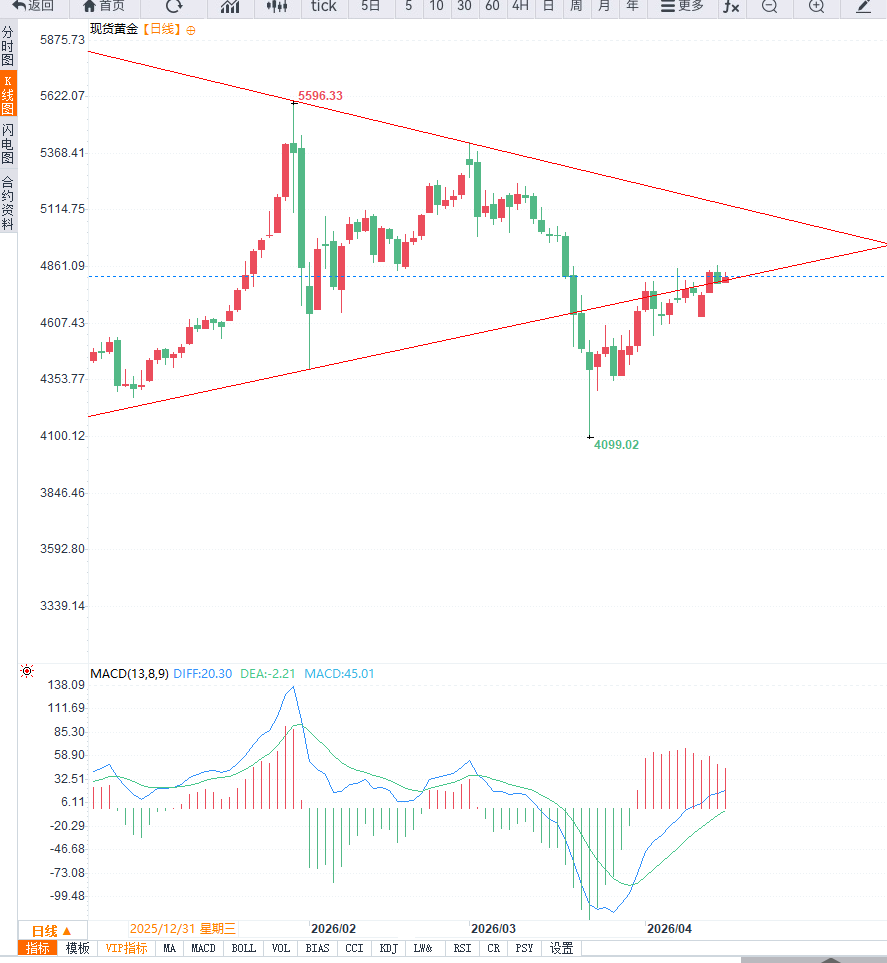
From a technical perspective, on the daily chart, gold prices have pulled back from their highs, indicating a slight weakening of short-term momentum, but the overall structure remains within a slightly bullish consolidation range. The key resistance level is currently around $4900 , near the previous high and a crucial juncture for the bulls to continue their upward trend. The important support level is around $4700 , forming a temporary defensive zone. A break below this level could trigger a deeper correction. Looking at momentum indicators, the RSI has fallen from its highs to neutral territory, suggesting a slowdown in upward momentum.
The 4-hour chart shows that gold prices have entered a consolidation phase after a surge, with the MACD indicator showing a death cross and continuing downwards, indicating that short-term bearish momentum is dominant. If prices fail to regain a foothold above $4850 , there is still a risk of testing the support area in the short term; conversely, if prices break through $4900 again, the upward trend is expected to resume.
Editor's Summary : Overall, gold's current price movement reflects a fierce interplay between "safe-haven demand" and "interest rate expectations." While the situation in the Middle East has not fully eased, inflationary pressures from rising oil prices are altering market expectations for monetary policy, thus putting downward pressure on gold. At the same time, continued gold purchases by global central banks provide medium- to long-term support, making a sustained downward trend in gold prices unlikely. The future direction of gold hinges on two factors: whether oil prices and inflation continue to rise, and whether major central banks shift their policies. Against this backdrop, gold may maintain a high-level consolidation pattern in the short term, and investors should pay close attention to key technical levels and changes in macroeconomic variables.
The United States and Iran are considering extending the current ceasefire by about two weeks to buy time for a longer-term agreement. This news has somewhat eased market concerns about an escalation of the conflict, but geopolitical risks have not completely subsided as the Strait of Hormuz, a key energy route, remains restricted. The strait handles approximately 20% of global seaborne crude oil transport; disruptions to its operation continue to push up energy prices and have a wide-ranging impact on global markets.
The continued rise in oil prices is one of the core factors currently putting pressure on gold. Rising energy prices directly push up inflation expectations, significantly cooling market expectations for interest rate cuts by major central banks. With interest rates remaining high or even potentially tightening further, gold, as an asset that does not generate interest, has become relatively less attractive, leading to some funds flowing out of the gold market.
From a macroeconomic perspective, the gold market is currently in a typical "interest rate suppression" phase. Although geopolitical risks remain, changes in interest rate expectations are dominating short-term price movements. When the market expects interest rates to remain high, the opportunity cost of holding gold increases, thus limiting its upside potential.
However, in the medium to long term, gold still enjoys certain fundamental support. The continued increase in gold reserves by Asian central banks is one of the important supporting factors. Data shows that central banks of major Asian countries have increased their gold holdings for 18 consecutive months. This trend reflects a change in the global reserve structure, with institutional investors placing greater emphasis on asset diversification and the ability to hedge against global uncertainties.
This trend of "de-dollarization" and asset diversification is providing structural buying support for gold, meaning that even if it faces short-term pressure, the downside potential for gold in the medium to long term may be relatively limited. Especially against the backdrop of rising global economic uncertainty, gold remains an important risk hedging tool.
From a market sentiment perspective, gold is currently in a phase of mixed bullish and bearish factors. On one hand, geopolitical risks and central bank gold purchases provide support; on the other hand, interest rate expectations and a strong US dollar exert downward pressure. Funds are repeatedly switching between different drivers, causing gold prices to exhibit a high-level consolidation pattern.
From a technical perspective, on the daily chart, gold prices have pulled back from their highs, indicating a slight weakening of short-term momentum, but the overall structure remains within a slightly bullish consolidation range. The key resistance level is currently around $4900 , near the previous high and a crucial juncture for the bulls to continue their upward trend. The important support level is around $4700 , forming a temporary defensive zone. A break below this level could trigger a deeper correction. Looking at momentum indicators, the RSI has fallen from its highs to neutral territory, suggesting a slowdown in upward momentum.
The 4-hour chart shows that gold prices have entered a consolidation phase after a surge, with the MACD indicator showing a death cross and continuing downwards, indicating that short-term bearish momentum is dominant. If prices fail to regain a foothold above $4850 , there is still a risk of testing the support area in the short term; conversely, if prices break through $4900 again, the upward trend is expected to resume.
Editor's Summary : Overall, gold's current price movement reflects a fierce interplay between "safe-haven demand" and "interest rate expectations." While the situation in the Middle East has not fully eased, inflationary pressures from rising oil prices are altering market expectations for monetary policy, thus putting downward pressure on gold. At the same time, continued gold purchases by global central banks provide medium- to long-term support, making a sustained downward trend in gold prices unlikely. The future direction of gold hinges on two factors: whether oil prices and inflation continue to rise, and whether major central banks shift their policies. Against this backdrop, gold may maintain a high-level consolidation pattern in the short term, and investors should pay close attention to key technical levels and changes in macroeconomic variables.
- Risk Warning and Disclaimer
- The market involves risk, and trading may not be suitable for all investors. This article is for reference only and does not constitute personal investment advice, nor does it take into account certain users’ specific investment objectives, financial situation, or other needs. Any investment decisions made based on this information are at your own risk.