Pakistan shuttles between Tehran and Lebanon in a countdown of golden life-or-death speed.
2026-04-16 20:42:34
On Thursday (April 16), during the Asian and European sessions, New York gold rose slightly throughout the day, maintaining its rebound trend. Recently, the global interest rate center has shifted rapidly due to the US-Iran ceasefire, and the overall decline in US Treasury yields has led to a significant rebound in long-duration bonds. However, compared to the violent rebound in the equity market, gold still appears relatively restrained.
The Pakistani Army Chief of Staff's visit to Tehran is a key diplomatic move in the current stalemate in the US-Iran war, with its core mission being to push for an extension of the current ceasefire agreement.
The ceasefire has temporarily ended nearly seven weeks of brutal fighting between Israel, the United States, and Iran. The conflict has not only killed thousands of people but also caused severe disruption to global financial and commodity markets due to the disruption of the oil supply chain.
Now that the ceasefire has entered the latter half of the originally planned two-week window, whether this intensive diplomatic effort will ultimately result in a substantive agreement remains shrouded in uncertainty.

Just as the Palestinian mediation efforts were underway, US President Trump announced that Israeli and Lebanese leaders planned to hold talks on a ceasefire later on Thursday.
If the talks take place, it will be the first direct contact between the two heads of state in more than 30 years. However, neither the Israeli nor the Lebanese government has confirmed the news. Meanwhile, Hezbollah and the Israeli military continued to exchange fire at the border on Thursday, and the situation remains tense.
The White House has indicated that the next round of US-Iran negotiations will most likely be held in Islamabad, the capital of Pakistan, but no final decision has yet been made on restarting the talks.
Although the ceasefire agreement that took effect a week ago has been temporarily maintained, the US maritime blockade of Iranian ports and Iran's retaliatory threats to strike ports along the Red Sea coast have made the already fragile ceasefire foundation even more precarious.
Pakistan was able to become a key mediator because it had previously successfully hosted direct talks between the US and Iran in Islamabad. According to official sources, the talks effectively narrowed the differences between the two sides. Currently, the mediators are making every effort to start a new round of negotiations before the ceasefire expires next week in order to avoid a renewed war.
This conflict, which broke out in the Middle East, has long been a core source of disruption to global markets: shipping routes have been blocked, and military and civilian infrastructure in the region has been damaged by airstrikes, directly impacting the global economy.
However, as expectations for a ceasefire rose, international oil prices began to decline, while the US stock market broke through the historical high set in January of this year on Wednesday, showing a temporary recovery in market risk appetite.
Ceasefire negotiations between Israel and Lebanon remain unresolved, with border clashes continuing.
Trump said the two countries planned to discuss a ceasefire later Thursday, but did not specify which leaders would be involved. Both Netanyahu’s office and the Lebanese government declined to confirm the authenticity of the talks.
It wasn't until Israeli Science and Technology Minister and Security Cabinet member Gila Gamlir confirmed to military radio on Thursday morning that Netanyahu would speak with Lebanese President Joseph Aoun that day—the first dialogue between the two heads of state since the two countries severed diplomatic ties years ago—that the conversation was expected to bring "prosperity and development" to bilateral relations.
It is worth noting that the two sides had just held their first direct diplomatic talks in decades in Washington on Tuesday, against the backdrop of more than a month of fighting between them and Hezbollah, which is backed by Iran.
Despite frequent diplomatic maneuvers, border clashes continued on Thursday: Hezbollah used rockets and drones to strike towns in northern Israel, while Israel intensified its attacks on southern Lebanon, focusing on Tyre, Nabatia, and the strategic border town of Bint Jubail.
In fact, since the establishment of Israel in 1948, Israel and Lebanon have been legally at war, and there are still serious differences within Lebanon regarding diplomatic contact with Israel, which adds more uncertainty to the ceasefire negotiations.
The US-Iran negotiations have shown some signs of progress amid the deadlock, but the ceasefire negotiations have also intensified.
Data released by the U.S. Central Command on Wednesday showed that no ships have successfully broken through the blockade of Iran in the two days since it was imposed, and all 10 merchant ships have returned to Iranian waters in accordance with U.S. military orders.
Despite continued pressure on the ceasefire agreement from the US blockade of Iranian ports and Iran's threats of retaliation, an anonymous regional official told the Associated Press that the US and Iran have reached a consensus on "extending the ceasefire in principle to buy more time for diplomatic negotiations."
However, while peace negotiations are progressing, geopolitical tensions are still brewing in the shadows: Ali Abdullahhi, commander of Iran's Joint Military Command, warned that if the United States does not lift the blockade, Iran will cut off regional trade.
Meanwhile, Iran's Supreme Leader and military advisor, Mojtaba Khamenei, explicitly stated his opposition to extending the ceasefire, and the opposing positions added considerable obstacles to the negotiations.
The mediators are currently focusing on three core disagreements in an effort to break the deadlock. According to regional officials involved in the mediation, the key sticking points for the breakdown of the US-Iran negotiations last weekend are Iran's nuclear program, control of the Strait of Hormuz, and war damage compensation, which have now become the core breakthrough points for the current mediation work.
Iranian Foreign Ministry spokesman Bagay stated through state media that Iran is willing to discuss the type and level of uranium enrichment, but "will continue to advance uranium enrichment activities based on its own energy needs," demonstrating a tough stance on its core interests.
The war has resulted in heavy casualties: more than 3,000 Iranians, more than 2,100 Lebanese, 23 Israelis, more than ten Gulf states, and 13 American soldiers killed.
The US has further intensified its pressure, with Treasury Secretary Bessenter announcing that the Trump administration will impose a new round of sanctions on countries that trade with Iran, using a "financial bombardment" approach to increase economic pressure on Iran.
Meanwhile, Pakistani Prime Minister Sharif arrived in Qatar on Thursday to begin regional shuttle diplomacy, with the core objective remaining to promote US-Iran peace talks and maintain geopolitical stability in the Middle East.
US Defense Secretary Hergsays' latest statement has once again pushed the maximum pressure campaign against Iran to a climax: on the one hand, he said that Iran has a strong desire to maintain the ceasefire, and on the other hand, he simultaneously disclosed that Treasury Secretary Bessant has launched the "economic rage" campaign against Iran to maximize economic pressure.
He stated bluntly that Iran "has no navy at all" and is powerless to control the Strait of Hormuz, emphasizing that the United States is "replenishing its strength at an unprecedented pace," closely monitoring Iran's military movements, and clearly declaring "we are watching you."
At the same time, it made a strong statement that Iran's energy sector has not been destroyed, but the US blockade is continuing to close its export channels and "will maintain the blockade for as long as necessary." It also warned that if Iran makes a wrong decision and refuses to reach an agreement, the US military is ready to restart combat operations under Trump's command at any time, using "military + economic" dual pressure to force Iran to make a "wise choice" at the negotiating table.
This geopolitical conflict has shifted the pricing logic of gold from the traditional single theme of geopolitical safe-haven demand to a multi-faceted resonance of "inflation expectations + interest rate games + safe-haven demand".
The ceasefire agreement between the US and Iran began on April 8, and there are still 6 days left until the two-week deadline. Market concerns may fluctuate recently, but if the ceasefire can be extended over the weekend, the market may have a window of opportunity to realize the positive news. As mentioned in previous articles, Iran will most likely enter a new ceasefire period with the United States, accompanied by new progress in negotiations.
Technically, New York gold futures have consistently shown a recent rise in gold prices with decreasing volume, indicating limited new capital inflows and no significant outflow of funds from the bottom. However, the lack of turnover suggests that the rebound is limited. Currently, gold prices are continuously constrained by the upper rail of the upward channel. If global inflation rebounds and government bond yields rise, gold may undergo a correction. Alternatively, if the US-Iran ceasefire is extended, gold prices may continue to rebound, creating a window for profit-taking.
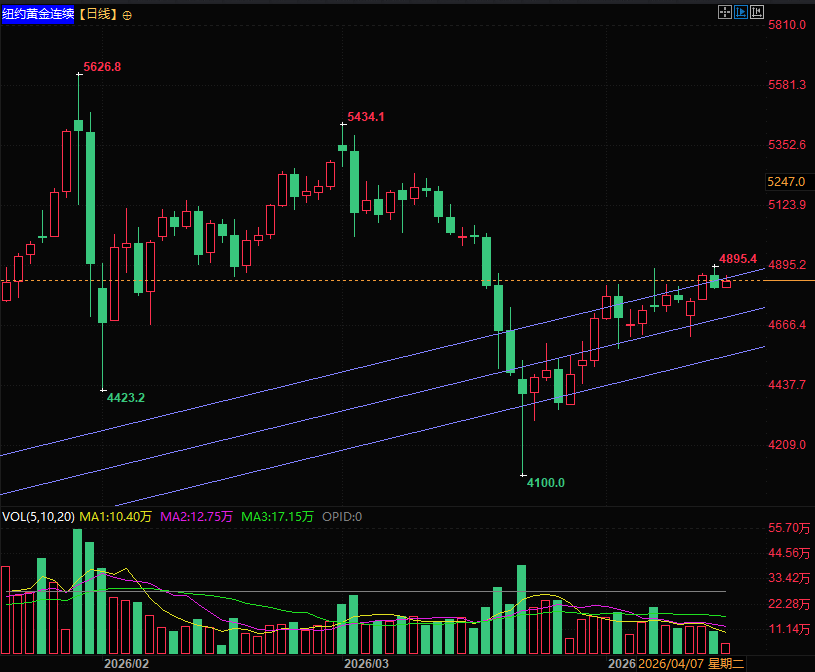
(Daily chart of New York gold futures, source: EasyForex)
At 20:38 Beijing time, New York gold futures were trading at $4,835 per ounce.
The Pakistani Army Chief of Staff's visit to Tehran is a key diplomatic move in the current stalemate in the US-Iran war, with its core mission being to push for an extension of the current ceasefire agreement.
The ceasefire has temporarily ended nearly seven weeks of brutal fighting between Israel, the United States, and Iran. The conflict has not only killed thousands of people but also caused severe disruption to global financial and commodity markets due to the disruption of the oil supply chain.
Now that the ceasefire has entered the latter half of the originally planned two-week window, whether this intensive diplomatic effort will ultimately result in a substantive agreement remains shrouded in uncertainty.
Just as the Palestinian mediation efforts were underway, US President Trump announced that Israeli and Lebanese leaders planned to hold talks on a ceasefire later on Thursday.
If the talks take place, it will be the first direct contact between the two heads of state in more than 30 years. However, neither the Israeli nor the Lebanese government has confirmed the news. Meanwhile, Hezbollah and the Israeli military continued to exchange fire at the border on Thursday, and the situation remains tense.
US-Iran negotiations in preparation: Islamabad emerges as a potential location, ceasefire foundation fragile.
The White House has indicated that the next round of US-Iran negotiations will most likely be held in Islamabad, the capital of Pakistan, but no final decision has yet been made on restarting the talks.
Although the ceasefire agreement that took effect a week ago has been temporarily maintained, the US maritime blockade of Iranian ports and Iran's retaliatory threats to strike ports along the Red Sea coast have made the already fragile ceasefire foundation even more precarious.
Pakistan was able to become a key mediator because it had previously successfully hosted direct talks between the US and Iran in Islamabad. According to official sources, the talks effectively narrowed the differences between the two sides. Currently, the mediators are making every effort to start a new round of negotiations before the ceasefire expires next week in order to avoid a renewed war.
This conflict, which broke out in the Middle East, has long been a core source of disruption to global markets: shipping routes have been blocked, and military and civilian infrastructure in the region has been damaged by airstrikes, directly impacting the global economy.
However, as expectations for a ceasefire rose, international oil prices began to decline, while the US stock market broke through the historical high set in January of this year on Wednesday, showing a temporary recovery in market risk appetite.
Situation in Lebanon: Rumors of talks and border clashes occur simultaneously.
Ceasefire negotiations between Israel and Lebanon remain unresolved, with border clashes continuing.
Trump said the two countries planned to discuss a ceasefire later Thursday, but did not specify which leaders would be involved. Both Netanyahu’s office and the Lebanese government declined to confirm the authenticity of the talks.
It wasn't until Israeli Science and Technology Minister and Security Cabinet member Gila Gamlir confirmed to military radio on Thursday morning that Netanyahu would speak with Lebanese President Joseph Aoun that day—the first dialogue between the two heads of state since the two countries severed diplomatic ties years ago—that the conversation was expected to bring "prosperity and development" to bilateral relations.
It is worth noting that the two sides had just held their first direct diplomatic talks in decades in Washington on Tuesday, against the backdrop of more than a month of fighting between them and Hezbollah, which is backed by Iran.
Despite frequent diplomatic maneuvers, border clashes continued on Thursday: Hezbollah used rockets and drones to strike towns in northern Israel, while Israel intensified its attacks on southern Lebanon, focusing on Tyre, Nabatia, and the strategic border town of Bint Jubail.
In fact, since the establishment of Israel in 1948, Israel and Lebanon have been legally at war, and there are still serious differences within Lebanon regarding diplomatic contact with Israel, which adds more uncertainty to the ceasefire negotiations.
US-Iran rivalry: Initial progress but obstacles remain
The US-Iran negotiations have shown some signs of progress amid the deadlock, but the ceasefire negotiations have also intensified.
Data released by the U.S. Central Command on Wednesday showed that no ships have successfully broken through the blockade of Iran in the two days since it was imposed, and all 10 merchant ships have returned to Iranian waters in accordance with U.S. military orders.
Despite continued pressure on the ceasefire agreement from the US blockade of Iranian ports and Iran's threats of retaliation, an anonymous regional official told the Associated Press that the US and Iran have reached a consensus on "extending the ceasefire in principle to buy more time for diplomatic negotiations."
However, while peace negotiations are progressing, geopolitical tensions are still brewing in the shadows: Ali Abdullahhi, commander of Iran's Joint Military Command, warned that if the United States does not lift the blockade, Iran will cut off regional trade.
Meanwhile, Iran's Supreme Leader and military advisor, Mojtaba Khamenei, explicitly stated his opposition to extending the ceasefire, and the opposing positions added considerable obstacles to the negotiations.
Three core points of contention: The mediator focuses on key points to break the deadlock.
The mediators are currently focusing on three core disagreements in an effort to break the deadlock. According to regional officials involved in the mediation, the key sticking points for the breakdown of the US-Iran negotiations last weekend are Iran's nuclear program, control of the Strait of Hormuz, and war damage compensation, which have now become the core breakthrough points for the current mediation work.
Iranian Foreign Ministry spokesman Bagay stated through state media that Iran is willing to discuss the type and level of uranium enrichment, but "will continue to advance uranium enrichment activities based on its own energy needs," demonstrating a tough stance on its core interests.
The war has resulted in heavy casualties: more than 3,000 Iranians, more than 2,100 Lebanese, 23 Israelis, more than ten Gulf states, and 13 American soldiers killed.
The US has further intensified its pressure, with Treasury Secretary Bessenter announcing that the Trump administration will impose a new round of sanctions on countries that trade with Iran, using a "financial bombardment" approach to increase economic pressure on Iran.
Meanwhile, Pakistani Prime Minister Sharif arrived in Qatar on Thursday to begin regional shuttle diplomacy, with the core objective remaining to promote US-Iran peace talks and maintain geopolitical stability in the Middle East.
The US is again applying maximum pressure.
US Defense Secretary Hergsays' latest statement has once again pushed the maximum pressure campaign against Iran to a climax: on the one hand, he said that Iran has a strong desire to maintain the ceasefire, and on the other hand, he simultaneously disclosed that Treasury Secretary Bessant has launched the "economic rage" campaign against Iran to maximize economic pressure.
He stated bluntly that Iran "has no navy at all" and is powerless to control the Strait of Hormuz, emphasizing that the United States is "replenishing its strength at an unprecedented pace," closely monitoring Iran's military movements, and clearly declaring "we are watching you."
At the same time, it made a strong statement that Iran's energy sector has not been destroyed, but the US blockade is continuing to close its export channels and "will maintain the blockade for as long as necessary." It also warned that if Iran makes a wrong decision and refuses to reach an agreement, the US military is ready to restart combat operations under Trump's command at any time, using "military + economic" dual pressure to force Iran to make a "wise choice" at the negotiating table.
Summary and Technical Analysis:
This geopolitical conflict has shifted the pricing logic of gold from the traditional single theme of geopolitical safe-haven demand to a multi-faceted resonance of "inflation expectations + interest rate games + safe-haven demand".
The ceasefire agreement between the US and Iran began on April 8, and there are still 6 days left until the two-week deadline. Market concerns may fluctuate recently, but if the ceasefire can be extended over the weekend, the market may have a window of opportunity to realize the positive news. As mentioned in previous articles, Iran will most likely enter a new ceasefire period with the United States, accompanied by new progress in negotiations.
Technically, New York gold futures have consistently shown a recent rise in gold prices with decreasing volume, indicating limited new capital inflows and no significant outflow of funds from the bottom. However, the lack of turnover suggests that the rebound is limited. Currently, gold prices are continuously constrained by the upper rail of the upward channel. If global inflation rebounds and government bond yields rise, gold may undergo a correction. Alternatively, if the US-Iran ceasefire is extended, gold prices may continue to rebound, creating a window for profit-taking.
(Daily chart of New York gold futures, source: EasyForex)
At 20:38 Beijing time, New York gold futures were trading at $4,835 per ounce.
- Risk Warning and Disclaimer
- The market involves risk, and trading may not be suitable for all investors. This article is for reference only and does not constitute personal investment advice, nor does it take into account certain users’ specific investment objectives, financial situation, or other needs. Any investment decisions made based on this information are at your own risk.