Gold Analysis: Technical buying at the open on Thursday fueled a modest rebound.
2026-04-16 23:31:27
Gold prices rebounded after the US market opened on Thursday (April 16), but the gains were relatively modest, exhibiting overall technical correction characteristics. June gold futures rose $3.10 to $4826, while May silver futures fell $0.653 to $78.975. Gold briefly touched a high of around $4845, up about 0.32% from the previous trading day's settlement price. The previous trading day had already seen gold prices reach a one-month high, indicating that bullish momentum is continuing to accumulate near the $4800 level.
This rise was primarily driven by technical buying, with futures traders actively entering the market and pushing prices out of their short-term trading range. On the daily charts, both gold and silver are showing initial signs of an upward trend, with short-term moving averages beginning to turn upwards, providing some support for prices. Overall, the market has not experienced a panic sell-off, but rather a cautious, corrective rebound, reflecting investors' continued structural demand for precious metals while awaiting clearer geopolitical and policy signals.
Based on the latest market developments, the moderate rise in gold prices is the result of a confluence of factors, which can be summarized as a quadruple resonance of "expectations of easing geopolitical risks + central bank uncertainty + global inflationary pressures + recovery in commodity transportation." Pakistan is actively mediating negotiations to extend the US-Iran ceasefire, attempting to buy more time for both sides; the Federal Reserve's Beige Book directly points to the increased uncertainty in business decisions due to the Middle East conflict, leading to a surge in energy costs across the board; China's first-quarter GDP grew by 5% more than expected; the Eurozone's March inflation rate was revised upward to 2.6%, exceeding the European Central Bank's 2% target for the first time, mainly attributed to energy price pressures; the Baltic Dry Index rose for the ninth consecutive day, reaching a four-month high, reflecting strong demand for commodity transportation.
Meanwhile, New York crude oil hovered around $89.91 per barrel, the US dollar index rebounded slightly, and the 10-year US Treasury yield rose to 4.28%. These factors combined to create the current market environment of "recovering risk appetite but still having safe-haven demand," driving gold to maintain a positive bias above $4,800.
Geopolitical Context: The US-Iran Ceasefire Mediated by Pakistan Extends the Suspense
The current short-term rebound in gold prices is closely related to subtle changes in the Middle East geopolitical situation. According to sources, Pakistan is intensifying its efforts to extend the ceasefire agreement between the US and Iran, which expires this weekend, for another two weeks, allowing more time for negotiations to reach a permanent peace. Both Washington and Tehran have stated that they have not yet reached an agreement beyond Tuesday night's US time, but neither side wants to return to a full-blown conflict—the war has severely damaged Iranian infrastructure and caused a sharp rise in energy prices in many countries, including the US.
The core unresolved issues include the reopening of the Strait of Hormuz, Iran's nuclear program and missile development, and the lifting of sanctions. These uncertainties directly support gold's safe-haven appeal: if the ceasefire extension fails or negotiations break down, the risk of energy supply chain disruptions will further fuel inflation expectations, driving funds into precious metals. However, current market optimism regarding an extension of the agreement has limited a surge in gold prices, resulting in mostly technical corrections. This also explains the moderate rise in gold prices—investors, following the logic of "bad news is good news," are choosing to buy on dips rather than chase highs.
Central bank factors: The Federal Reserve's Beige Book signals uncertainty about war.
The Federal Reserve's latest Beige Book provided additional policy support for gold. The report explicitly stated that the Middle East conflict is a major source of uncertainty for businesses, leading to more cautious decisions regarding hiring, pricing, and capital investment. Most companies opted for a "wait and see" strategy, postponing long-term commitments and instead increasing demand for temporary or contract workers. Economic activity in most parts of the United States continued to expand at a slow to moderate pace, with overall price increases being modest, but energy and fuel costs rose sharply in all 12 federal districts, and while the labor market remained stable, structural tensions were evident.
This signal has a dual significance for gold: on the one hand, rising energy costs due to war have strengthened inflation expectations, increasing the attractiveness of gold as a traditional hedge against inflation; on the other hand, uncertainty surrounding the Federal Reserve's future policy path (whether it will accelerate interest rate cuts or maintain a cautious approach) further boosts safe-haven demand. Combined with the backdrop of a slight rebound in the US dollar index and the 10-year US Treasury yield rising to 4.28%, gold did not experience a significant pullback due to the stronger dollar. Instead, it held its ground above $4,800, reflecting the indirect supporting effect of central bank factors on gold prices.
Currently, traders believe there is a 36% chance of a US interest rate cut this year.
Global fundamental data: China's growth exceeds expectations while inflationary pressures coexist in the Eurozone.
From a fundamental perspective, the latest data from China and the Eurozone provided structural support for gold. China's first-quarter GDP grew by 5% year-on-year, exceeding market expectations, and industrial output in March increased by 5.7% year-on-year, mainly due to strong performance in manufacturing and exports. However, retail sales grew by only 1.7%, lower than the 2.8% in the previous two months, indicating a slowdown in consumer spending and private investment, and an increased risk of structural imbalances in the economy. This pattern of "strong production and weak consumption" has boosted demand for commodities (benefiting industrial metals such as silver) on the one hand, and on the other hand, it has also made global investors worry about potential downside risks, thereby increasing demand for gold.
In the Eurozone, data released by Eurostat on Thursday showed that March's inflation rate was revised upward to 2.6% from the initial estimate of 2.5%, with core inflation at 2.3% and services at 3.2%. This marks the first time this year that inflation has exceeded the European Central Bank's 2% target, primarily driven by rising energy costs due to the Middle East conflict. France, Italy, and Spain also revised their data upwards, further confirming the upward pressure of war on global prices. In this high-inflation environment, gold's safe-haven appeal has been further strengthened, echoing the trend of crude oil prices remaining at $92.50 per barrel.
Funding and Position Dynamics: Technical Buying Dominates Futures Market Recovery
From a funding perspective, the current rise in gold prices is primarily driven by technical buying rather than a large influx of funds. Recent active buying by futures traders has fueled an initial upward trend on the daily chart. From a positioning perspective, although the specific COT report has not yet been updated, the market shows that long positions are gradually being covered around $4800, while short positions are showing clear signs of profit-taking. This "light position correction" characteristic limits the price increase but also provides room for a subsequent breakout. Combined with the backdrop of a slight rebound in the US dollar, there has been no significant outflow of funds from precious metals; instead, funds are choosing to maintain a strategic allocation amidst uncertainty.
Expert Opinions
Multiple institutions remain optimistic about gold's performance in 2026. Natasha Kaneva, Global Head of Commodity Strategy at JPMorgan Chase, stated that the trend of official reserve diversification and investor allocation is far from over, predicting that gold prices will approach $5,000 per ounce in the fourth quarter of 2026, and may even reach $6,000 in the long term. Goldman Sachs, Wells Fargo, Deutsche Bank, and other institutions have also raised their forecasts, with target prices for 2026 concentrated in the $5,400-$6,300 range. A survey of 30 analysts shows that the median average gold price in 2026 is $4,746.50 per ounce, the highest annual forecast ever, with key drivers including geopolitical risks, continued central bank gold purchases, concerns about US debt, and the de-dollarization process.
Experts generally believe that while the current ceasefire negotiations between the US and Iran have brought short-term relief, fundamental issues remain unresolved. Coupled with uncertainty surrounding Federal Reserve policy, this will continue to support gold as the "ultimate safe-haven asset." Some analysts point out that if the ceasefire extension fails or energy prices surge again, gold prices could quickly break through the $4,900 mark. Overall, expert opinions resonate with the current technical correction around $4,800, reinforcing the medium- to long-term bullish logic.
Technical Analysis
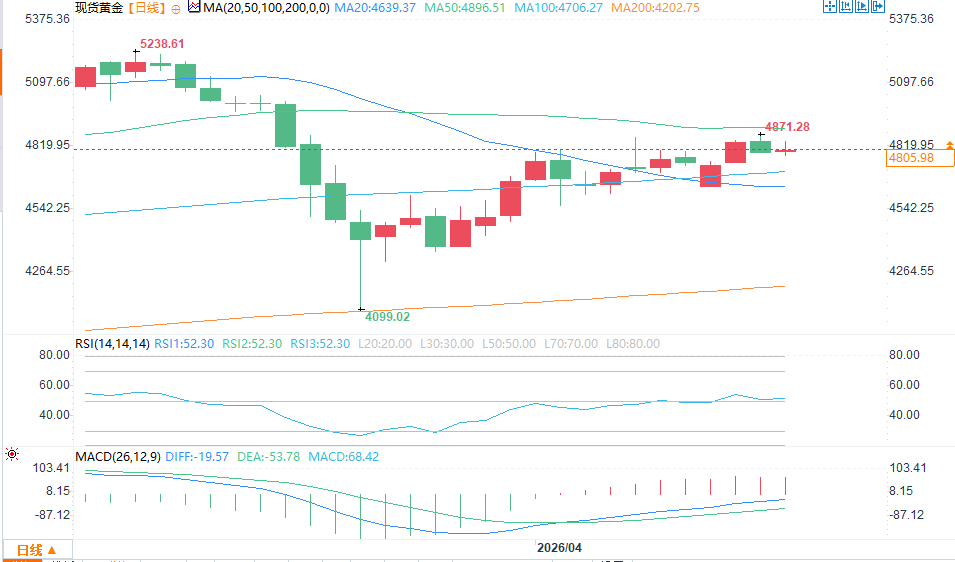
(Spot gold daily chart source: FX678)
Spot gold is currently maintaining a neutral to bullish bias around $4,800. On the daily chart, the price remains below the 200-period simple moving average (SMA) at $4,831.22, which acts as immediate resistance, limiting the upside potential. However, the MACD has turned positive, and the RSI is hovering around 60, indicating that bullish momentum is solid but not yet overheated.
If gold prices can maintain their position and break through the 200-SMA, the next target will be $4916.20 (the 61.8% Fibonacci retracement level of the March decline). A further break above this level would open up potential to $5136 and even the cycle high of $5416. On the downside, the first support level is at $4761.81 (50% Fibonacci retracement), with further support at $4607 (38.2% Fibonacci retracement) and $4416 (23.6% Fibonacci retracement).
The 4-hour chart also presents a neutral to bullish pattern, with gold prices holding above the 20-period SMA ($4770.80) and the 100-period SMA ($4641.39), but facing resistance from the 200-period SMA ($4835.59). The RSI is flat at 56, and the momentum indicator is slightly rising, suggesting limited downside momentum, and any pullback could attract bargain hunters. Overall, the technicals support the current positive bias, but a clear breakout signal is needed to confirm a trend continuation.
This rise was primarily driven by technical buying, with futures traders actively entering the market and pushing prices out of their short-term trading range. On the daily charts, both gold and silver are showing initial signs of an upward trend, with short-term moving averages beginning to turn upwards, providing some support for prices. Overall, the market has not experienced a panic sell-off, but rather a cautious, corrective rebound, reflecting investors' continued structural demand for precious metals while awaiting clearer geopolitical and policy signals.
Based on the latest market developments, the moderate rise in gold prices is the result of a confluence of factors, which can be summarized as a quadruple resonance of "expectations of easing geopolitical risks + central bank uncertainty + global inflationary pressures + recovery in commodity transportation." Pakistan is actively mediating negotiations to extend the US-Iran ceasefire, attempting to buy more time for both sides; the Federal Reserve's Beige Book directly points to the increased uncertainty in business decisions due to the Middle East conflict, leading to a surge in energy costs across the board; China's first-quarter GDP grew by 5% more than expected; the Eurozone's March inflation rate was revised upward to 2.6%, exceeding the European Central Bank's 2% target for the first time, mainly attributed to energy price pressures; the Baltic Dry Index rose for the ninth consecutive day, reaching a four-month high, reflecting strong demand for commodity transportation.
Meanwhile, New York crude oil hovered around $89.91 per barrel, the US dollar index rebounded slightly, and the 10-year US Treasury yield rose to 4.28%. These factors combined to create the current market environment of "recovering risk appetite but still having safe-haven demand," driving gold to maintain a positive bias above $4,800.
Geopolitical Context: The US-Iran Ceasefire Mediated by Pakistan Extends the Suspense
The current short-term rebound in gold prices is closely related to subtle changes in the Middle East geopolitical situation. According to sources, Pakistan is intensifying its efforts to extend the ceasefire agreement between the US and Iran, which expires this weekend, for another two weeks, allowing more time for negotiations to reach a permanent peace. Both Washington and Tehran have stated that they have not yet reached an agreement beyond Tuesday night's US time, but neither side wants to return to a full-blown conflict—the war has severely damaged Iranian infrastructure and caused a sharp rise in energy prices in many countries, including the US.
The core unresolved issues include the reopening of the Strait of Hormuz, Iran's nuclear program and missile development, and the lifting of sanctions. These uncertainties directly support gold's safe-haven appeal: if the ceasefire extension fails or negotiations break down, the risk of energy supply chain disruptions will further fuel inflation expectations, driving funds into precious metals. However, current market optimism regarding an extension of the agreement has limited a surge in gold prices, resulting in mostly technical corrections. This also explains the moderate rise in gold prices—investors, following the logic of "bad news is good news," are choosing to buy on dips rather than chase highs.
Central bank factors: The Federal Reserve's Beige Book signals uncertainty about war.
The Federal Reserve's latest Beige Book provided additional policy support for gold. The report explicitly stated that the Middle East conflict is a major source of uncertainty for businesses, leading to more cautious decisions regarding hiring, pricing, and capital investment. Most companies opted for a "wait and see" strategy, postponing long-term commitments and instead increasing demand for temporary or contract workers. Economic activity in most parts of the United States continued to expand at a slow to moderate pace, with overall price increases being modest, but energy and fuel costs rose sharply in all 12 federal districts, and while the labor market remained stable, structural tensions were evident.
This signal has a dual significance for gold: on the one hand, rising energy costs due to war have strengthened inflation expectations, increasing the attractiveness of gold as a traditional hedge against inflation; on the other hand, uncertainty surrounding the Federal Reserve's future policy path (whether it will accelerate interest rate cuts or maintain a cautious approach) further boosts safe-haven demand. Combined with the backdrop of a slight rebound in the US dollar index and the 10-year US Treasury yield rising to 4.28%, gold did not experience a significant pullback due to the stronger dollar. Instead, it held its ground above $4,800, reflecting the indirect supporting effect of central bank factors on gold prices.
Currently, traders believe there is a 36% chance of a US interest rate cut this year.
Global fundamental data: China's growth exceeds expectations while inflationary pressures coexist in the Eurozone.
From a fundamental perspective, the latest data from China and the Eurozone provided structural support for gold. China's first-quarter GDP grew by 5% year-on-year, exceeding market expectations, and industrial output in March increased by 5.7% year-on-year, mainly due to strong performance in manufacturing and exports. However, retail sales grew by only 1.7%, lower than the 2.8% in the previous two months, indicating a slowdown in consumer spending and private investment, and an increased risk of structural imbalances in the economy. This pattern of "strong production and weak consumption" has boosted demand for commodities (benefiting industrial metals such as silver) on the one hand, and on the other hand, it has also made global investors worry about potential downside risks, thereby increasing demand for gold.
In the Eurozone, data released by Eurostat on Thursday showed that March's inflation rate was revised upward to 2.6% from the initial estimate of 2.5%, with core inflation at 2.3% and services at 3.2%. This marks the first time this year that inflation has exceeded the European Central Bank's 2% target, primarily driven by rising energy costs due to the Middle East conflict. France, Italy, and Spain also revised their data upwards, further confirming the upward pressure of war on global prices. In this high-inflation environment, gold's safe-haven appeal has been further strengthened, echoing the trend of crude oil prices remaining at $92.50 per barrel.
Funding and Position Dynamics: Technical Buying Dominates Futures Market Recovery
From a funding perspective, the current rise in gold prices is primarily driven by technical buying rather than a large influx of funds. Recent active buying by futures traders has fueled an initial upward trend on the daily chart. From a positioning perspective, although the specific COT report has not yet been updated, the market shows that long positions are gradually being covered around $4800, while short positions are showing clear signs of profit-taking. This "light position correction" characteristic limits the price increase but also provides room for a subsequent breakout. Combined with the backdrop of a slight rebound in the US dollar, there has been no significant outflow of funds from precious metals; instead, funds are choosing to maintain a strategic allocation amidst uncertainty.
Expert Opinions
Multiple institutions remain optimistic about gold's performance in 2026. Natasha Kaneva, Global Head of Commodity Strategy at JPMorgan Chase, stated that the trend of official reserve diversification and investor allocation is far from over, predicting that gold prices will approach $5,000 per ounce in the fourth quarter of 2026, and may even reach $6,000 in the long term. Goldman Sachs, Wells Fargo, Deutsche Bank, and other institutions have also raised their forecasts, with target prices for 2026 concentrated in the $5,400-$6,300 range. A survey of 30 analysts shows that the median average gold price in 2026 is $4,746.50 per ounce, the highest annual forecast ever, with key drivers including geopolitical risks, continued central bank gold purchases, concerns about US debt, and the de-dollarization process.
Experts generally believe that while the current ceasefire negotiations between the US and Iran have brought short-term relief, fundamental issues remain unresolved. Coupled with uncertainty surrounding Federal Reserve policy, this will continue to support gold as the "ultimate safe-haven asset." Some analysts point out that if the ceasefire extension fails or energy prices surge again, gold prices could quickly break through the $4,900 mark. Overall, expert opinions resonate with the current technical correction around $4,800, reinforcing the medium- to long-term bullish logic.
Technical Analysis
(Spot gold daily chart source: FX678)
Spot gold is currently maintaining a neutral to bullish bias around $4,800. On the daily chart, the price remains below the 200-period simple moving average (SMA) at $4,831.22, which acts as immediate resistance, limiting the upside potential. However, the MACD has turned positive, and the RSI is hovering around 60, indicating that bullish momentum is solid but not yet overheated.
If gold prices can maintain their position and break through the 200-SMA, the next target will be $4916.20 (the 61.8% Fibonacci retracement level of the March decline). A further break above this level would open up potential to $5136 and even the cycle high of $5416. On the downside, the first support level is at $4761.81 (50% Fibonacci retracement), with further support at $4607 (38.2% Fibonacci retracement) and $4416 (23.6% Fibonacci retracement).
The 4-hour chart also presents a neutral to bullish pattern, with gold prices holding above the 20-period SMA ($4770.80) and the 100-period SMA ($4641.39), but facing resistance from the 200-period SMA ($4835.59). The RSI is flat at 56, and the momentum indicator is slightly rising, suggesting limited downside momentum, and any pullback could attract bargain hunters. Overall, the technicals support the current positive bias, but a clear breakout signal is needed to confirm a trend continuation.
- Risk Warning and Disclaimer
- The market involves risk, and trading may not be suitable for all investors. This article is for reference only and does not constitute personal investment advice, nor does it take into account certain users’ specific investment objectives, financial situation, or other needs. Any investment decisions made based on this information are at your own risk.