The suspense is high! With only 6 days left in the US-Iran ceasefire, the dollar's rebound is not simply a matter of safe-haven demand.
2026-04-16 21:51:01
On Thursday (April 16), the US dollar index rebounded sharply after hitting a low, currently trading around 98.20. It once fell to 97.83 during the session. The strong rebound of the US dollar indicates that safe-haven funds have begun to flow in again. Does this mean that global equity assets are about to start to adjust? Not entirely. Recent solid economic data from the United States and the statements of the third-ranking official of the Federal Reserve have also provided fundamental support for the dollar's performance.
With the temporary ceasefire agreement between the US and Iran set to expire on April 22 (only 6 days left), the uncertainty surrounding the situation in the Middle East has become the core variable influencing the dollar's trajectory.
Despite US President Trump's statement that the conflict is "nearly over" and both sides' confirmation that they will restart negotiations to end the conflict, both the US and Iran denied reaching a consensus on extending the ceasefire. The specific date for the next round of talks has not yet been set, and the pace of the war remains highly uncertain.
The market had speculated that the ceasefire might be extended for two weeks, but Trump downplayed the necessity of this and emphasized that negotiations were progressing steadily. This ambiguous signal caused safe-haven funds to remain on the sidelines.
The Strait of Hormuz remains under double blockade. As a vital transportation route for approximately 20% of the world's oil and liquefied natural gas, the restricted passage continues to drive up risk premiums in the energy market.
Analysts at the Commonwealth Bank of Australia pointed out that U.S. military assets are still accumulating in the region, and the possibility of a ground offensive has not been completely ruled out. This lingering geopolitical risk serves as a short-term "safety net" for the U.S. dollar.
However, if the US-Iran negotiations achieve a breakthrough and reach an agreement to avoid escalation of the conflict, Iran may allow ships to pass through the Omani side. At that time, the demand for safe-haven assets will further subside, and the US dollar will face a new round of depreciation pressure.
In stark contrast to the uncertainties in the geopolitical situation, the resilience of the US economy and job market continues to exceed expectations, becoming a key force supporting the dollar and curbing one-sided short-selling sentiment.
The latest data shows that the number of weekly initial jobless claims plummeted to 207,000 from a revised 218,000 in the previous week, significantly exceeding market expectations, confirming that the large-scale wave of layoffs has not yet become apparent in the job market.
The Philadelphia Fed's business activity index also rose month-over-month, with manufacturing activity and employment data working in tandem to create a buffer for the US economy against geopolitical shocks.
The latest remarks by Williams, the Federal Reserve's "number three" official and president of the New York Fed, further confirm the robust nature of the US economy and financial system, clearly supporting the Fed's policy stance that it does not need to actively adjust interest rates.
Williams pointed out that the current U.S. Treasury market is functioning "extremely well," with the overall market in good condition. Despite geopolitical uncertainties, market liquidity is better than expected and remains ample. This robust liquidity environment is crucial for financial stability and broader economic development.
At the regional economic level, the New York area is experiencing a vibrant economy, with a large number of office buildings being converted into residential properties. The improvement in commercial real estate has exceeded expectations, and related risks have decreased significantly, demonstrating the strong resilience of economic restructuring.
The controllability of financial system risks is also evident: the housing loan banking system plays a key role as a unique source of liquidity, and even though a large number of investors are observed to want to exit the private credit market, the related issues will not trigger broader financial stability risks, and systemic risks have been effectively contained.
Regarding the job market, he clarified that the current slight weakness is unrelated to artificial intelligence. The core reason is that employers are becoming more cautious in their hiring, rather than a fundamental deterioration in the job market. This complements the strong initial jobless claims data, confirming that the overall resilience of the labor market remains.
In summary, the robust economic vitality, sound financial system, and ample liquidity provide multiple supports, meaning that the Federal Reserve does not currently need to actively adjust interest rates to stabilize the economy, and its existing policy stance is already well-suited to the fundamental situation.
The robust economic fundamentals directly influence the Federal Reserve's policy path. The ING foreign exchange research team points out that the resilience of the US economy means that the Fed is "comfortable" with the 3.75% policy interest rate level—neither worried about deteriorating employment nor wary of the risk of secondary transmission of inflation.
The current market consensus is that the Federal Reserve will keep interest rates unchanged this month and for the remainder of the year. Against this backdrop, the interest rate spread, a core driver of interest rate differentials, will not negatively impact the US dollar.
St. Louis Fed President Alberto Musshalam further pointed out that the oil price shock caused by the Middle East conflict is gradually being transmitted to core inflation, which is expected to remain at around 3% for the whole year. This also limits the Fed's room for easing and indirectly supports the dollar's valuation.
The “schizophrenic” pricing in the US Treasury market has further amplified the divergence between bulls and bears on the US dollar.
The current US Treasury yield is stuck in a very narrow range of consolidation. The core contradiction lies in the balance of power between the two sides: on the one hand, Wall Street's optimism about the prospects of a Middle East peace agreement continues to rise, suppressing the rise in yields.
On the other hand, robust US economic data weakened recession pricing, which in turn pulled yields downward. This tug-of-war resulted in the dollar losing a clear direction in terms of interest rate drivers, leading to a balance between bullish and bearish forces.
ING emphasizes that, in terms of capital flows, there is no clear evidence that overseas funds are reducing their holdings of long-term US assets or increasing their dollar hedging ratios, which means that the attractiveness of dollar assets has not declined significantly.
Even with the recent across-the-board strengthening of global risk assets and a recovery in market risk appetite, the US dollar index has managed to stabilize and rise slightly above the 98.00 level, highlighting its support level.
Federal Reserve official Williams also stated that the current Treasury market is functioning well, with liquidity levels better than expected. Ample liquidity is beneficial to financial stability and the overall economy. This statement alleviated market concerns about the liquidity of US Treasury bonds and indirectly strengthened the asset attributes of the US dollar.
In summary, the US dollar is currently caught in a dual struggle between geopolitical risks and economic fundamentals, with bullish and bearish forces evenly matched, and the conditions for a trend of weakening have not yet been met.
The core logic of the short sellers lies in the retreat of safe-haven demand brought about by the easing of conflicts in the Middle East, and the decline in energy prices easing inflationary pressures and weakening expectations of Fed tightening.
The bulls' confidence stems from the resilience of the US economy and employment, the Federal Reserve's policy stance of maintaining stable interest rates, and the residual support from unresolved geopolitical uncertainties.
Chris Turner, chief foreign exchange analyst at ING, explicitly warned that it is not advisable to blindly short the dollar at this time, based on a comprehensive assessment of key variables such as the Fed's policy path, global growth prospects, whether overseas funds are withdrawing from the US Treasury market, and whether the demand for dollar hedging is increasing.
The core contradiction in the market lies in the fact that if the job market continues to show unexpected resilience, the window for the Federal Reserve to cut interest rates this year will be further squeezed; while if the situation in the Middle East fluctuates again, a second surge in energy prices will force the term premium to be repriced, and the current fragile balance is very easy to be broken by either catalytic variable.
For investors, closely monitoring the progress of US-Iran negotiations, the movement of people in the Strait of Hormuz, and key US economic data will be crucial for understanding the short-term trend of the US dollar.
From a technical perspective, the US dollar index has reached near the end of its trading range.
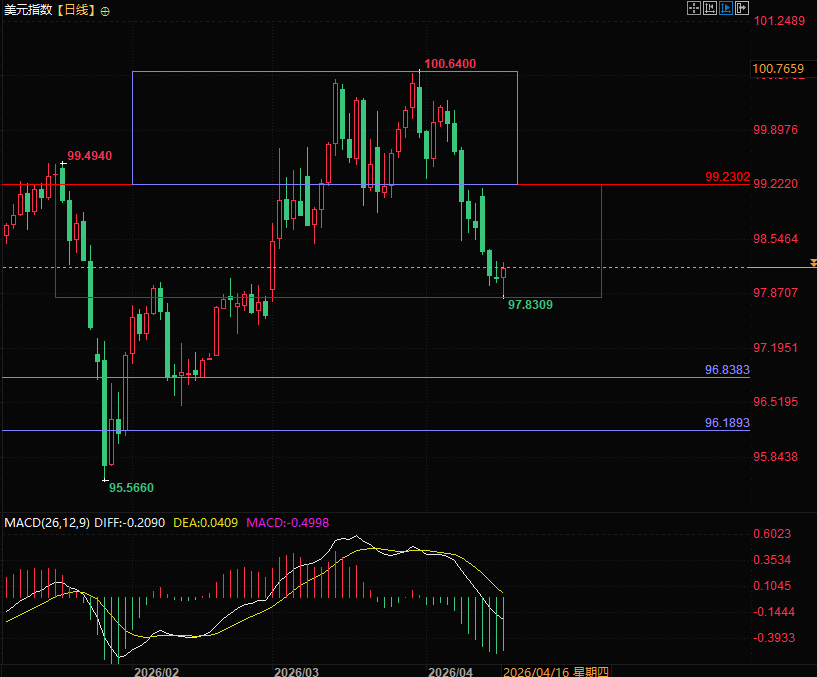
(US Dollar Index Daily Chart, Source: EasyForex)
At 21:49 Beijing time, the US dollar index is currently at 98.20.
With the temporary ceasefire agreement between the US and Iran set to expire on April 22 (only 6 days left), the uncertainty surrounding the situation in the Middle East has become the core variable influencing the dollar's trajectory.
Despite US President Trump's statement that the conflict is "nearly over" and both sides' confirmation that they will restart negotiations to end the conflict, both the US and Iran denied reaching a consensus on extending the ceasefire. The specific date for the next round of talks has not yet been set, and the pace of the war remains highly uncertain.
The market had speculated that the ceasefire might be extended for two weeks, but Trump downplayed the necessity of this and emphasized that negotiations were progressing steadily. This ambiguous signal caused safe-haven funds to remain on the sidelines.
The complexity of the geopolitical situation has provided temporary support for the US dollar.
The Strait of Hormuz remains under double blockade. As a vital transportation route for approximately 20% of the world's oil and liquefied natural gas, the restricted passage continues to drive up risk premiums in the energy market.
Analysts at the Commonwealth Bank of Australia pointed out that U.S. military assets are still accumulating in the region, and the possibility of a ground offensive has not been completely ruled out. This lingering geopolitical risk serves as a short-term "safety net" for the U.S. dollar.
However, if the US-Iran negotiations achieve a breakthrough and reach an agreement to avoid escalation of the conflict, Iran may allow ships to pass through the Omani side. At that time, the demand for safe-haven assets will further subside, and the US dollar will face a new round of depreciation pressure.
Stronger-than-expected US economic data bolstered the dollar's bullish momentum.
In stark contrast to the uncertainties in the geopolitical situation, the resilience of the US economy and job market continues to exceed expectations, becoming a key force supporting the dollar and curbing one-sided short-selling sentiment.
The latest data shows that the number of weekly initial jobless claims plummeted to 207,000 from a revised 218,000 in the previous week, significantly exceeding market expectations, confirming that the large-scale wave of layoffs has not yet become apparent in the job market.
The Philadelphia Fed's business activity index also rose month-over-month, with manufacturing activity and employment data working in tandem to create a buffer for the US economy against geopolitical shocks.
The latest remarks by Williams, the Federal Reserve's "number three" official and president of the New York Fed, further confirm the robust nature of the US economy and financial system, clearly supporting the Fed's policy stance that it does not need to actively adjust interest rates.
Williams pointed out that the current U.S. Treasury market is functioning "extremely well," with the overall market in good condition. Despite geopolitical uncertainties, market liquidity is better than expected and remains ample. This robust liquidity environment is crucial for financial stability and broader economic development.
At the regional economic level, the New York area is experiencing a vibrant economy, with a large number of office buildings being converted into residential properties. The improvement in commercial real estate has exceeded expectations, and related risks have decreased significantly, demonstrating the strong resilience of economic restructuring.
The controllability of financial system risks is also evident: the housing loan banking system plays a key role as a unique source of liquidity, and even though a large number of investors are observed to want to exit the private credit market, the related issues will not trigger broader financial stability risks, and systemic risks have been effectively contained.
Regarding the job market, he clarified that the current slight weakness is unrelated to artificial intelligence. The core reason is that employers are becoming more cautious in their hiring, rather than a fundamental deterioration in the job market. This complements the strong initial jobless claims data, confirming that the overall resilience of the labor market remains.
In summary, the robust economic vitality, sound financial system, and ample liquidity provide multiple supports, meaning that the Federal Reserve does not currently need to actively adjust interest rates to stabilize the economy, and its existing policy stance is already well-suited to the fundamental situation.
The robust economic fundamentals directly influence the Federal Reserve's policy path. The ING foreign exchange research team points out that the resilience of the US economy means that the Fed is "comfortable" with the 3.75% policy interest rate level—neither worried about deteriorating employment nor wary of the risk of secondary transmission of inflation.
The current market consensus is that the Federal Reserve will keep interest rates unchanged this month and for the remainder of the year. Against this backdrop, the interest rate spread, a core driver of interest rate differentials, will not negatively impact the US dollar.
St. Louis Fed President Alberto Musshalam further pointed out that the oil price shock caused by the Middle East conflict is gradually being transmitted to core inflation, which is expected to remain at around 3% for the whole year. This also limits the Fed's room for easing and indirectly supports the dollar's valuation.
The back-and-forth fluctuations in US Treasury yields have intensified the battle between bulls and bears for the US dollar.
The “schizophrenic” pricing in the US Treasury market has further amplified the divergence between bulls and bears on the US dollar.
The current US Treasury yield is stuck in a very narrow range of consolidation. The core contradiction lies in the balance of power between the two sides: on the one hand, Wall Street's optimism about the prospects of a Middle East peace agreement continues to rise, suppressing the rise in yields.
On the other hand, robust US economic data weakened recession pricing, which in turn pulled yields downward. This tug-of-war resulted in the dollar losing a clear direction in terms of interest rate drivers, leading to a balance between bullish and bearish forces.
ING emphasizes that, in terms of capital flows, there is no clear evidence that overseas funds are reducing their holdings of long-term US assets or increasing their dollar hedging ratios, which means that the attractiveness of dollar assets has not declined significantly.
Even with the recent across-the-board strengthening of global risk assets and a recovery in market risk appetite, the US dollar index has managed to stabilize and rise slightly above the 98.00 level, highlighting its support level.
Federal Reserve official Williams also stated that the current Treasury market is functioning well, with liquidity levels better than expected. Ample liquidity is beneficial to financial stability and the overall economy. This statement alleviated market concerns about the liquidity of US Treasury bonds and indirectly strengthened the asset attributes of the US dollar.
With both bullish and bearish factors at play, the market warns against blindly shorting the US dollar.
In summary, the US dollar is currently caught in a dual struggle between geopolitical risks and economic fundamentals, with bullish and bearish forces evenly matched, and the conditions for a trend of weakening have not yet been met.
The core logic of the short sellers lies in the retreat of safe-haven demand brought about by the easing of conflicts in the Middle East, and the decline in energy prices easing inflationary pressures and weakening expectations of Fed tightening.
The bulls' confidence stems from the resilience of the US economy and employment, the Federal Reserve's policy stance of maintaining stable interest rates, and the residual support from unresolved geopolitical uncertainties.
Chris Turner, chief foreign exchange analyst at ING, explicitly warned that it is not advisable to blindly short the dollar at this time, based on a comprehensive assessment of key variables such as the Fed's policy path, global growth prospects, whether overseas funds are withdrawing from the US Treasury market, and whether the demand for dollar hedging is increasing.
The core contradiction in the market lies in the fact that if the job market continues to show unexpected resilience, the window for the Federal Reserve to cut interest rates this year will be further squeezed; while if the situation in the Middle East fluctuates again, a second surge in energy prices will force the term premium to be repriced, and the current fragile balance is very easy to be broken by either catalytic variable.
For investors, closely monitoring the progress of US-Iran negotiations, the movement of people in the Strait of Hormuz, and key US economic data will be crucial for understanding the short-term trend of the US dollar.
From a technical perspective, the US dollar index has reached near the end of its trading range.
(US Dollar Index Daily Chart, Source: EasyForex)
At 21:49 Beijing time, the US dollar index is currently at 98.20.
- Risk Warning and Disclaimer
- The market involves risk, and trading may not be suitable for all investors. This article is for reference only and does not constitute personal investment advice, nor does it take into account certain users’ specific investment objectives, financial situation, or other needs. Any investment decisions made based on this information are at your own risk.