Breaking News! Taiwan Strait Opening + US-Iran Talks on Sunday Cause Crude Oil to Plunge 6% and Gold to Surge, Market in a Frenzy
2026-04-17 21:10:56
On Friday (April 17), during the Asian and European sessions, the Nasdaq achieved its 12th consecutive day of gains, and the electronic trading session continued to rise by 0.6% in the evening, potentially leading to a 13th consecutive day of gains. Overly optimistic sentiment still pervades the market.
International oil futures prices both plunged, with Brent crude oil June contracts falling more than 6%, erasing all of yesterday's gains. New York gold also shook off its weakness and rose sharply, currently trading up 1.15% around 4863.
In terms of news, Iranian Foreign Minister Araqchi stated that commercial vessels can now pass through the Strait of Hormuz, and news platform Axios reported that US-Iran talks are expected to be held in Islamabad, possibly on Sunday.
Meanwhile, Russian Presidential Press Secretary Dmitry Peskov stated at a briefing that Russia remains open to receiving enriched uranium from Iran, but this proposal was not adopted by the United States.
Commenting on the ceasefire between Israel and Lebanon, Peskov stated that Russia welcomes the ceasefire and hopes that both sides can reach an agreement within the 10-day ceasefire period to avoid military conflict. Peskov also pointed out that some European countries are increasingly involved in the conflict in Ukraine.
It was as if all the elements for ending the war had been gathered in an instant.
This morning, US President Trump has been sending a series of signals that the war with Iran is "about to end," and his enthusiasm for a ceasefire is highly linked to his political demands in the midterm elections.
In his public speech, Trump not only claimed that "the war in Iran is progressing very well and should end soon," but also emphasized that even though the United States has launched a "small-scale expedition" in Iran, the domestic economy remains the strongest in the world. The key demand to win the midterm elections has further strengthened his determination to push for the implementation of the ceasefire agreement.
Previously, Trump stated that he would personally attend the signing of the agreement to end the war between the US and Iran in Islamabad, and also hinted that the two-week ceasefire expiring next week would not need to be extended, as Tehran had shown a clear willingness to enter into a treaty. These statements injected peace expectations into the market.
Meanwhile, Iran maintained a tough military stance on the eve of negotiations, aiming to gain more leverage in the nuclear issue talks. On the 17th, the Iranian Islamic Revolutionary Guard Corps issued a series of strong signals: on the one hand, it issued an "unprecedentedly stern warning" to all commercial and military vessels in the Bab el-Mandeb Strait, stating that from noon the following day, any vessel passing through the strait should maintain the highest level of vigilance, signaling a new phase of military tension in the strait;
On the other hand, it clearly stated that the US attack on the Iranian destroyer "Dina" was a "criminal act," and that the Army and Revolutionary Guard Navy would launch targeted retaliation. It also emphasized that it had successfully thwarted the enemy's land and sea aggression plans, such as occupying islands in the Persian Gulf, and that if the enemy made any further rash moves, it would suffer a "humiliating strategic defeat."
This strategy of "flexing its muscles outside the negotiating table" is essentially an attempt to gain the initiative in core disagreements such as the duration of the nuclear activity suspension period. The US insists on a 20-year suspension period, while Iran is only willing to commit to 3 to 5 years. Technical details beyond the consensus of principles still need to be finalized within the next 60 days.
The market reacted very directly to the expectation of peace, with equity markets experiencing a frenzied rally and global stock markets soaring to record highs during the week, as funds voted with their feet, demonstrating optimism about a ceasefire.
In the crude oil market, Brent crude oil prices were suppressed below the $100 mark, and the supply panic previously triggered by the blockade of the Strait of Hormuz has cooled significantly. As a vital transportation route for one-fifth of the world's oil, the daily traffic volume of the strait has plummeted from more than 130 ships before the war to almost zero. Although Britain and France plan to convene a 40-nation conference to plan the post-war navigation order, the arrangement excluding belligerent countries and Iran's position that "external countries have no right to interfere" still cast a shadow over the resumption of navigation in the strait.
It is worth noting that Goldman Sachs points out that the current market rally lacks fundamental support, with quantitative buying and fund replenishment being the core drivers, and a dangerous temperature difference has emerged between market euphoria pricing and geopolitical realities.
Despite progress in Pakistan-led behind-the-scenes diplomacy and the potential signing of a memorandum of understanding between the US and Iran, the Iranian nuclear impasse remains unresolved, and the dual deadlock of the Strait of Hormuz escort mechanism lacking Tehran's endorsement persists.
Furthermore, although the ceasefire between Israel and Lebanon was generally stable on its first day, sporadic violations by Israel and the difficulty for residents of the southern buffer zone in returning home highlighted the fragility of the ceasefire agreement.
The International Monetary Fund has lowered its global growth forecast, warning that a prolonged conflict could trigger a recession. If weekend negotiations show signs of breaking down, risk assets may face concentrated downward pressure.
For the gold market, the previous pattern of being suppressed by energy inflation and interest rate hike expectations is expected to change.
As the ceasefire negotiations between the US and Iran progress, the risk of short-term overvaluation in oil prices has eased, and expectations for a Fed rate cut may continue to emerge. Coupled with the safe-haven demand that may be triggered by repeated geopolitical conflicts, the cyclical investment value of gold is expected to gradually emerge.
The crude oil market needs to pay close attention to oversold rebound opportunities: even with optimistic sentiment, the reality remains constrained by whether the Strait of Hormuz can be substantially reopened, as well as the progress of crude oil production recovery in Gulf countries—OPEC production in March had fallen to its lowest level since June 2020, with Saudi Arabia, Iraq, and other countries making significant production cuts. Even if a ceasefire is implemented, the recovery of production will still take time, which will limit the further downside potential of oil prices, and the high volatility in the short term may continue.
From a technical perspective, Brent crude oil has fallen to a key support level for bulls, and a rebound is possible once the downward momentum stops.
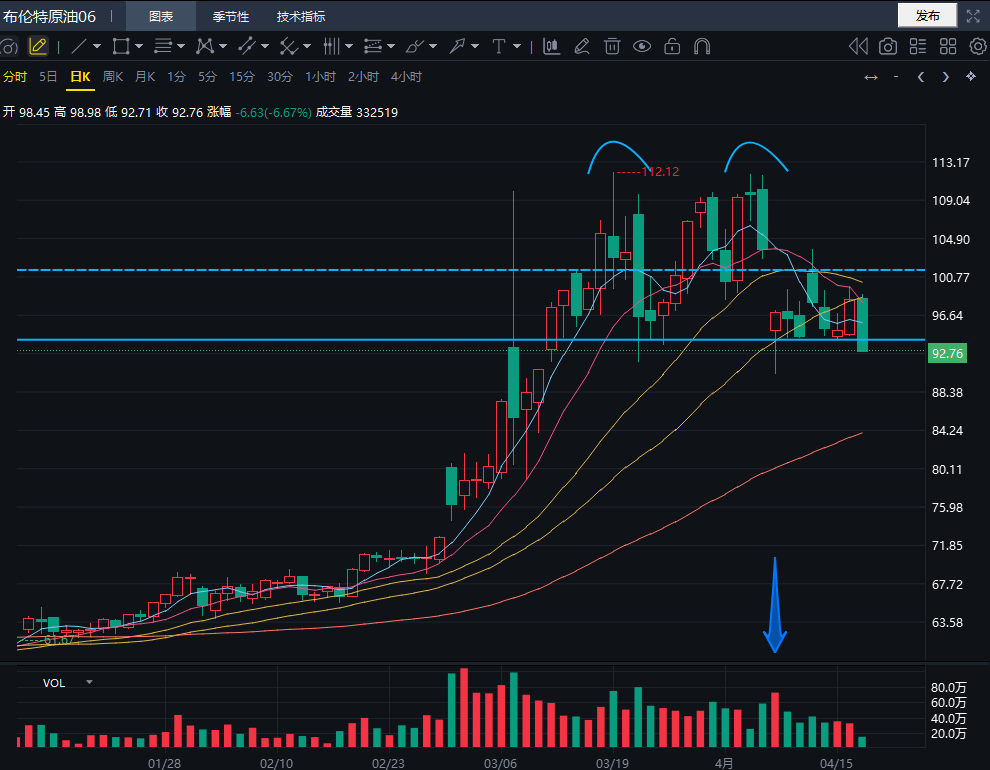
(Brent crude oil June futures daily chart, source: EasyForex)
New York gold futures are currently continuing their upward trend within a channel.
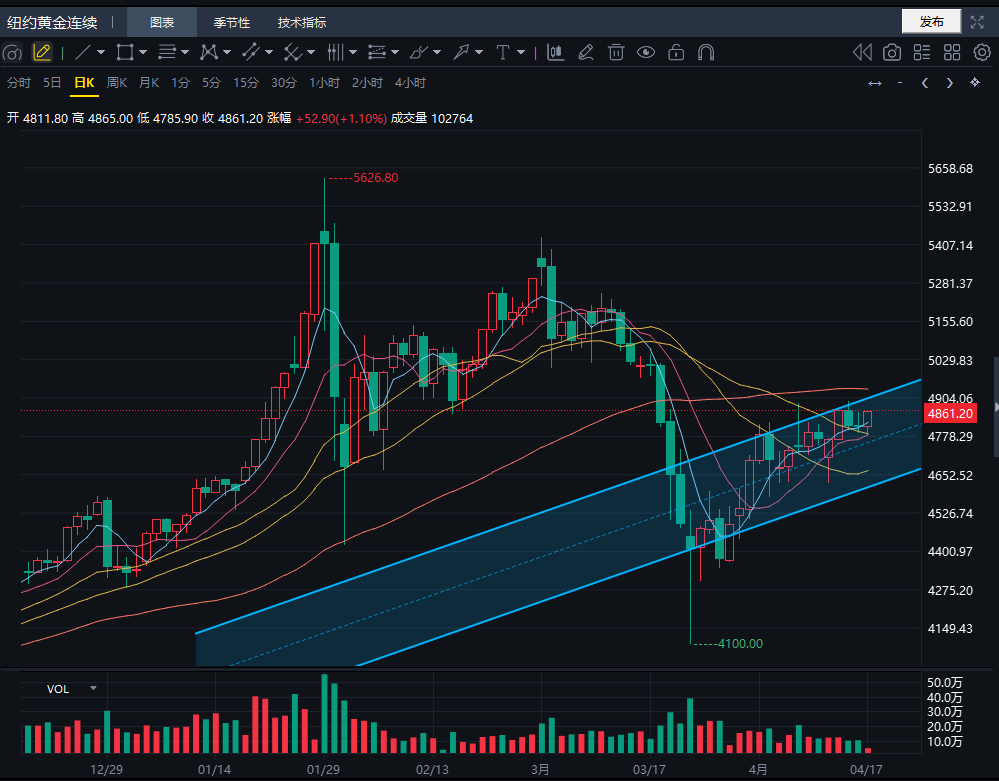
(Daily chart of New York gold futures, source: FX678's subsidiary, EasyForex)
At 21:08 Beijing time, Brent crude oil futures for June were trading at $90.80 per barrel, while New York gold futures were trading at $4,880 per ounce.
International oil futures prices both plunged, with Brent crude oil June contracts falling more than 6%, erasing all of yesterday's gains. New York gold also shook off its weakness and rose sharply, currently trading up 1.15% around 4863.
In terms of news, Iranian Foreign Minister Araqchi stated that commercial vessels can now pass through the Strait of Hormuz, and news platform Axios reported that US-Iran talks are expected to be held in Islamabad, possibly on Sunday.
Meanwhile, Russian Presidential Press Secretary Dmitry Peskov stated at a briefing that Russia remains open to receiving enriched uranium from Iran, but this proposal was not adopted by the United States.
Commenting on the ceasefire between Israel and Lebanon, Peskov stated that Russia welcomes the ceasefire and hopes that both sides can reach an agreement within the 10-day ceasefire period to avoid military conflict. Peskov also pointed out that some European countries are increasingly involved in the conflict in Ukraine.
It was as if all the elements for ending the war had been gathered in an instant.
This morning, US President Trump has been sending a series of signals that the war with Iran is "about to end," and his enthusiasm for a ceasefire is highly linked to his political demands in the midterm elections.
In his public speech, Trump not only claimed that "the war in Iran is progressing very well and should end soon," but also emphasized that even though the United States has launched a "small-scale expedition" in Iran, the domestic economy remains the strongest in the world. The key demand to win the midterm elections has further strengthened his determination to push for the implementation of the ceasefire agreement.
Previously, Trump stated that he would personally attend the signing of the agreement to end the war between the US and Iran in Islamabad, and also hinted that the two-week ceasefire expiring next week would not need to be extended, as Tehran had shown a clear willingness to enter into a treaty. These statements injected peace expectations into the market.
Iran flexes its muscles ahead of negotiations, adopting a tough stance to gain leverage in the talks.
Meanwhile, Iran maintained a tough military stance on the eve of negotiations, aiming to gain more leverage in the nuclear issue talks. On the 17th, the Iranian Islamic Revolutionary Guard Corps issued a series of strong signals: on the one hand, it issued an "unprecedentedly stern warning" to all commercial and military vessels in the Bab el-Mandeb Strait, stating that from noon the following day, any vessel passing through the strait should maintain the highest level of vigilance, signaling a new phase of military tension in the strait;
On the other hand, it clearly stated that the US attack on the Iranian destroyer "Dina" was a "criminal act," and that the Army and Revolutionary Guard Navy would launch targeted retaliation. It also emphasized that it had successfully thwarted the enemy's land and sea aggression plans, such as occupying islands in the Persian Gulf, and that if the enemy made any further rash moves, it would suffer a "humiliating strategic defeat."
This strategy of "flexing its muscles outside the negotiating table" is essentially an attempt to gain the initiative in core disagreements such as the duration of the nuclear activity suspension period. The US insists on a 20-year suspension period, while Iran is only willing to commit to 3 to 5 years. Technical details beyond the consensus of principles still need to be finalized within the next 60 days.
Peace expectations ignited market euphoria, with equity stocks and crude oil prices moving in tandem.
The market reacted very directly to the expectation of peace, with equity markets experiencing a frenzied rally and global stock markets soaring to record highs during the week, as funds voted with their feet, demonstrating optimism about a ceasefire.
In the crude oil market, Brent crude oil prices were suppressed below the $100 mark, and the supply panic previously triggered by the blockade of the Strait of Hormuz has cooled significantly. As a vital transportation route for one-fifth of the world's oil, the daily traffic volume of the strait has plummeted from more than 130 ships before the war to almost zero. Although Britain and France plan to convene a 40-nation conference to plan the post-war navigation order, the arrangement excluding belligerent countries and Iran's position that "external countries have no right to interfere" still cast a shadow over the resumption of navigation in the strait.
Goldman Sachs warns of fundamental weakness and potential correction risks due to geopolitical tensions.
It is worth noting that Goldman Sachs points out that the current market rally lacks fundamental support, with quantitative buying and fund replenishment being the core drivers, and a dangerous temperature difference has emerged between market euphoria pricing and geopolitical realities.
Despite progress in Pakistan-led behind-the-scenes diplomacy and the potential signing of a memorandum of understanding between the US and Iran, the Iranian nuclear impasse remains unresolved, and the dual deadlock of the Strait of Hormuz escort mechanism lacking Tehran's endorsement persists.
Furthermore, although the ceasefire between Israel and Lebanon was generally stable on its first day, sporadic violations by Israel and the difficulty for residents of the southern buffer zone in returning home highlighted the fragility of the ceasefire agreement.
The International Monetary Fund has lowered its global growth forecast, warning that a prolonged conflict could trigger a recession. If weekend negotiations show signs of breaking down, risk assets may face concentrated downward pressure.
Summary and Technical Analysis:
For the gold market, the previous pattern of being suppressed by energy inflation and interest rate hike expectations is expected to change.
As the ceasefire negotiations between the US and Iran progress, the risk of short-term overvaluation in oil prices has eased, and expectations for a Fed rate cut may continue to emerge. Coupled with the safe-haven demand that may be triggered by repeated geopolitical conflicts, the cyclical investment value of gold is expected to gradually emerge.
The crude oil market needs to pay close attention to oversold rebound opportunities: even with optimistic sentiment, the reality remains constrained by whether the Strait of Hormuz can be substantially reopened, as well as the progress of crude oil production recovery in Gulf countries—OPEC production in March had fallen to its lowest level since June 2020, with Saudi Arabia, Iraq, and other countries making significant production cuts. Even if a ceasefire is implemented, the recovery of production will still take time, which will limit the further downside potential of oil prices, and the high volatility in the short term may continue.
From a technical perspective, Brent crude oil has fallen to a key support level for bulls, and a rebound is possible once the downward momentum stops.
(Brent crude oil June futures daily chart, source: EasyForex)
New York gold futures are currently continuing their upward trend within a channel.
(Daily chart of New York gold futures, source: FX678's subsidiary, EasyForex)
At 21:08 Beijing time, Brent crude oil futures for June were trading at $90.80 per barrel, while New York gold futures were trading at $4,880 per ounce.
- Risk Warning and Disclaimer
- The market involves risk, and trading may not be suitable for all investors. This article is for reference only and does not constitute personal investment advice, nor does it take into account certain users’ specific investment objectives, financial situation, or other needs. Any investment decisions made based on this information are at your own risk.