Gold Trading Alert: The situation in the Middle East took a sudden turn over the weekend, with Iran refusing a second round of negotiations, causing gold prices to gap down sharply at the open.
2026-04-20 07:44:56
International gold prices opened sharply lower on Monday (April 20), falling by more than $60 at one point by 7:30 AM, a drop of 1.5%, reaching a low of around $4760. This sharp correction completely reversed Friday's strong performance, mainly due to the sudden deterioration of the situation in the Middle East over the weekend: the Strait of Hormuz was closed again, the US military fired on and seized Iranian merchant ships in the Gulf of Oman, and Iran explicitly refused to participate in the second round of US-Iran negotiations, vowing to respond and retaliate. This series of events not only increased global energy risks but also exacerbated market concerns about inflation, significantly dampening expectations of a Federal Reserve rate cut, causing the US dollar index to rise rapidly to a one-week high, which exerted significant downward pressure on gold.

Multiple Iranian media outlets reported on the 19th that Iran has fully prepared for a possible resurgence of hostilities and has explicitly refused to participate in a second round of negotiations with the United States. On the same day, the US military took military action in the Gulf of Oman, intercepting and seizing an Iranian cargo ship. The Iranian military quickly accused the US of a blatant violation of the ceasefire agreement, calling it an act of "maritime plunder," and stated that it would respond soon.
Earlier, US media, citing White House officials, reported that US Vice President Vance would lead a delegation to Islamabad, the capital of Pakistan, to participate in a new round of US-Iran negotiations. President Trump also confirmed on social media that the US delegation would arrive in Islamabad on the evening of the 20th, and even said that if an agreement was reached, he himself would "very likely" go there in person.
However, the Islamic Republic of Iran Broadcasting (IRNA) and its news agency immediately denied the reports, emphasizing that Iran currently has no plans to participate in the next round of negotiations and that the news about a second round of talks in Islamabad is untrue. Iranian President Pezechzian further pointed out in a phone call with the Pakistani Prime Minister on the 19th that the United States' continued treacherous behavior during the negotiations and ceasefire phase exposed its true intention to abandon diplomatic channels.
Another core element of the tensions lies in the Strait of Hormuz, a vital global oil shipping route. The Iranian Islamic Revolutionary Guard Corps Navy has officially designated a new shipping route from south of Hormuz Island to south of Larak Island, naming it the "Larak Corridor," and explicitly stipulates that no vessel may pass through without the Revolutionary Guard Navy's permission.
Iran's First Vice President Ariff publicly stated that security in the Strait of Hormuz is not a free lunch. He warned that while restricting Iranian oil exports, other countries should not be expected to obtain "free security." He further emphasized that there are only two choices: either achieve a truly free oil market for everyone, or everyone shares the risk of significant costs.
Aref specifically pointed out that the stability of global fuel prices depends on whether economic and military pressure on Iran and its allies can be guaranteed and permanently eliminated. This statement is seen as the most direct response to the United States' continued blockade of Iranian ports and sanctions on its oil exports.
Amid the aforementioned geopolitical shocks, the US dollar index rose as much as 0.3% in Asian trading on Monday, reaching a high of 98.485, a new high since April 13. Previously, boosted by hopes of a peace agreement, the dollar had fallen to its lowest level since the outbreak of the war on Friday; this rebound quickly reversed the previous sell-off.
Westpac analysts pointed out that the latest developments in the Middle East over the weekend could significantly dampen market optimism.
Barclays analysts further analyzed that current market sentiment shows investors still favor the US dollar, and even if the situation in the Middle East normalizes, the dollar still has room to fall further. The current volatile market may be a good opportunity to re-establish short positions in the dollar.
In stark contrast to the sharp fluctuations on Monday, last week saw a period of optimism in the market. At that time, Iran announced the reopening of the Strait of Hormuz, leading to a significant rise in market risk appetite and high expectations of an impending end to the Middle East conflict.
Iranian Foreign Minister Araqchi announced on social media last week that the Strait of Hormuz would be open to all merchant ships for the remainder of the 10-day ceasefire agreement brokered by the United States between Israel and Lebanon, in an effort to halt fighting between Israel and Hezbollah, which is backed by Iran. President Trump subsequently confirmed this on his own social media, stating that as part of any agreement, the United States would cooperate with Iran to recover enriched uranium and repatriate it to the United States.
Against this backdrop, oil prices plummeted last week, Wall Street stocks surged, U.S. Treasury prices soared, yields fell, and the dollar index fell as much as 0.58% to 97.93 on Friday, a seven-week low, with a weekly decline of 0.49% and a cumulative drop of about 2.1% over the past two weeks, the largest two-week decline since late January.
George Vessey, chief foreign exchange and macro strategist at Convera in London, believes that the weakening of the US dollar is mainly due to the market digesting geopolitical risk premiums, rather than a comprehensive deterioration in fundamentals.
Interest rate futures at the time indicated that the market expected a greater than 50% probability of a Fed rate cut in December. Driven by a decline in both the dollar and oil prices, spot gold rose 0.91% to around $4,834 on Friday, reaching a high of $4,889.24 per ounce during the session, a new high since March 18.
On the 20th local time, a spokesperson for the Hatem Anbia Central Command of the Iranian Armed Forces issued a statement condemning the United States for violating the ceasefire agreement by firing on Iranian merchant ships in the Gulf of Oman and sending soldiers to board the ships, causing the ships' navigation systems to malfunction, which constituted the crime of "maritime robbery".
The spokesperson warned that the Iranian armed forces would soon respond and retaliate against this act of piracy and armed robbery by the US military. Earlier that day, President Trump confirmed on social media that a US guided-missile destroyer intercepted the Iranian cargo ship "TOUSKA" attempting to break through a blockade, opened fire, breached its engine room, and was subsequently taken into custody by Marines.
As we enter this week, investors will continue to closely monitor the latest developments in the Middle East. Meanwhile, a series of US economic data will be released.
Tuesday will see the release of March retail sales data, with many analysts predicting a potential decline after unexpectedly strong performance earlier in the month. Following this, March pending home sales data will reveal the state of the interest rate-sensitive housing market. On the same day, the Senate will hold confirmation hearings for Kevin Warsh as the new Federal Reserve Chairman, although some Democratic senators are pushing for a delay, citing the Justice Department's investigation of current Fed officials. If Warsh is confirmed, his dovish signals on monetary policy could provide some support for gold prices.
Thursday's weekly jobless claims report will be the only labor market window this week, with analysts generally believing the current job market is in a stable phase of "low hiring, low layoffs," and claims remaining at historically low levels. Before the weekend, traders will also focus on the April U.S. Composite Purchasing Managers' Index (PMI), a real-time indicator that will provide crucial insights into overall economic activity.
In conclusion, escalating geopolitical risks in the Middle East and adjustments in macroeconomic expectations have jointly influenced gold price performance. The renewed blockade of the Strait of Hormuz, the breakdown of US-Iran negotiations, and US military action have not only driven up oil prices and inflation expectations but also reshaped the safe-haven appeal of the US dollar. In the coming days, any new developments in the Middle East situation will directly determine the direction of market risk appetite, while US economic data and personnel changes at the Federal Reserve will also be other important variables affecting gold price movements. Investors need to remain highly vigilant and prudently seize every opportunity presented by volatility in this complex environment of intertwined geopolitical risks and policy uncertainties.
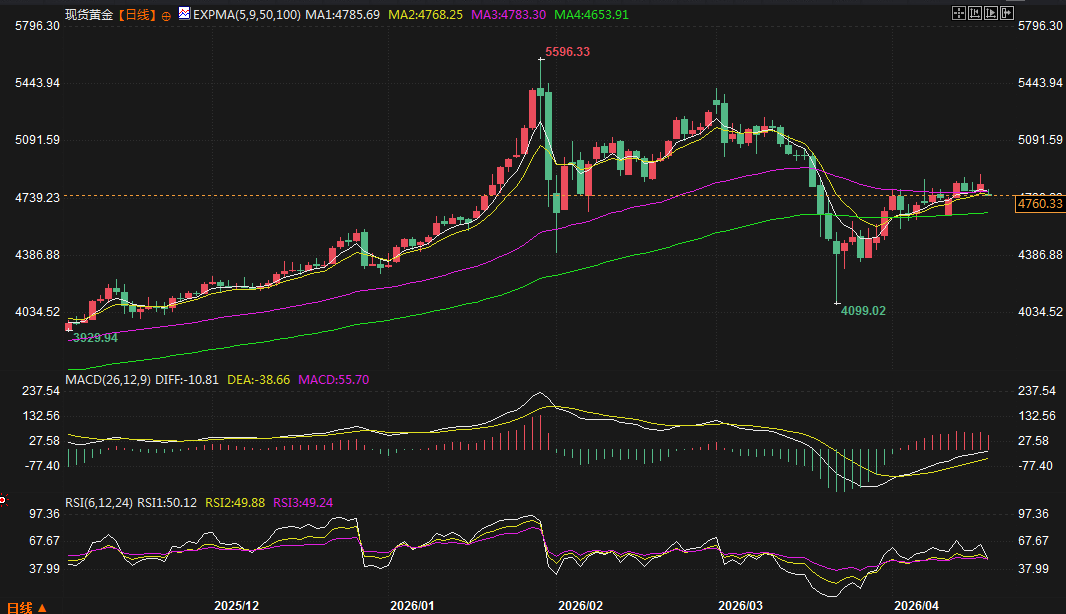
(Spot gold daily chart, source: FX678)
At 07:42 Beijing time, spot gold was trading at $4760.58 per ounce.
The situation in the Middle East has suddenly escalated: Iran's refusal to hold a second round of negotiations and the US military's interception incident.
Multiple Iranian media outlets reported on the 19th that Iran has fully prepared for a possible resurgence of hostilities and has explicitly refused to participate in a second round of negotiations with the United States. On the same day, the US military took military action in the Gulf of Oman, intercepting and seizing an Iranian cargo ship. The Iranian military quickly accused the US of a blatant violation of the ceasefire agreement, calling it an act of "maritime plunder," and stated that it would respond soon.
Earlier, US media, citing White House officials, reported that US Vice President Vance would lead a delegation to Islamabad, the capital of Pakistan, to participate in a new round of US-Iran negotiations. President Trump also confirmed on social media that the US delegation would arrive in Islamabad on the evening of the 20th, and even said that if an agreement was reached, he himself would "very likely" go there in person.
However, the Islamic Republic of Iran Broadcasting (IRNA) and its news agency immediately denied the reports, emphasizing that Iran currently has no plans to participate in the next round of negotiations and that the news about a second round of talks in Islamabad is untrue. Iranian President Pezechzian further pointed out in a phone call with the Pakistani Prime Minister on the 19th that the United States' continued treacherous behavior during the negotiations and ceasefire phase exposed its true intention to abandon diplomatic channels.
The Strait of Hormuz is once again in focus: Iran designates new shipping routes and emphasizes the security costs.
Another core element of the tensions lies in the Strait of Hormuz, a vital global oil shipping route. The Iranian Islamic Revolutionary Guard Corps Navy has officially designated a new shipping route from south of Hormuz Island to south of Larak Island, naming it the "Larak Corridor," and explicitly stipulates that no vessel may pass through without the Revolutionary Guard Navy's permission.
Iran's First Vice President Ariff publicly stated that security in the Strait of Hormuz is not a free lunch. He warned that while restricting Iranian oil exports, other countries should not be expected to obtain "free security." He further emphasized that there are only two choices: either achieve a truly free oil market for everyone, or everyone shares the risk of significant costs.
Aref specifically pointed out that the stability of global fuel prices depends on whether economic and military pressure on Iran and its allies can be guaranteed and permanently eliminated. This statement is seen as the most direct response to the United States' continued blockade of Iranian ports and sanctions on its oil exports.
US Dollar Index Rebounds Strongly: Renewed Safe-Haven Demand Suppresses Gold Prices
Amid the aforementioned geopolitical shocks, the US dollar index rose as much as 0.3% in Asian trading on Monday, reaching a high of 98.485, a new high since April 13. Previously, boosted by hopes of a peace agreement, the dollar had fallen to its lowest level since the outbreak of the war on Friday; this rebound quickly reversed the previous sell-off.
Westpac analysts pointed out that the latest developments in the Middle East over the weekend could significantly dampen market optimism.
Barclays analysts further analyzed that current market sentiment shows investors still favor the US dollar, and even if the situation in the Middle East normalizes, the dollar still has room to fall further. The current volatile market may be a good opportunity to re-establish short positions in the dollar.
Last week, optimism reversed rapidly: the brief reopening of the Strait of Hormuz had boosted risk appetite.
In stark contrast to the sharp fluctuations on Monday, last week saw a period of optimism in the market. At that time, Iran announced the reopening of the Strait of Hormuz, leading to a significant rise in market risk appetite and high expectations of an impending end to the Middle East conflict.
Iranian Foreign Minister Araqchi announced on social media last week that the Strait of Hormuz would be open to all merchant ships for the remainder of the 10-day ceasefire agreement brokered by the United States between Israel and Lebanon, in an effort to halt fighting between Israel and Hezbollah, which is backed by Iran. President Trump subsequently confirmed this on his own social media, stating that as part of any agreement, the United States would cooperate with Iran to recover enriched uranium and repatriate it to the United States.
Against this backdrop, oil prices plummeted last week, Wall Street stocks surged, U.S. Treasury prices soared, yields fell, and the dollar index fell as much as 0.58% to 97.93 on Friday, a seven-week low, with a weekly decline of 0.49% and a cumulative drop of about 2.1% over the past two weeks, the largest two-week decline since late January.
George Vessey, chief foreign exchange and macro strategist at Convera in London, believes that the weakening of the US dollar is mainly due to the market digesting geopolitical risk premiums, rather than a comprehensive deterioration in fundamentals.
Interest rate futures at the time indicated that the market expected a greater than 50% probability of a Fed rate cut in December. Driven by a decline in both the dollar and oil prices, spot gold rose 0.91% to around $4,834 on Friday, reaching a high of $4,889.24 per ounce during the session, a new high since March 18.
US military's seizure of the ship has triggered a chain reaction: Iran vows immediate retaliation.
On the 20th local time, a spokesperson for the Hatem Anbia Central Command of the Iranian Armed Forces issued a statement condemning the United States for violating the ceasefire agreement by firing on Iranian merchant ships in the Gulf of Oman and sending soldiers to board the ships, causing the ships' navigation systems to malfunction, which constituted the crime of "maritime robbery".
The spokesperson warned that the Iranian armed forces would soon respond and retaliate against this act of piracy and armed robbery by the US military. Earlier that day, President Trump confirmed on social media that a US guided-missile destroyer intercepted the Iranian cargo ship "TOUSKA" attempting to break through a blockade, opened fire, breached its engine room, and was subsequently taken into custody by Marines.
This Week's Market Focus Preview: Geopolitical Risks Continue to Exacerbate the Test for US Economic Data
As we enter this week, investors will continue to closely monitor the latest developments in the Middle East. Meanwhile, a series of US economic data will be released.
Tuesday will see the release of March retail sales data, with many analysts predicting a potential decline after unexpectedly strong performance earlier in the month. Following this, March pending home sales data will reveal the state of the interest rate-sensitive housing market. On the same day, the Senate will hold confirmation hearings for Kevin Warsh as the new Federal Reserve Chairman, although some Democratic senators are pushing for a delay, citing the Justice Department's investigation of current Fed officials. If Warsh is confirmed, his dovish signals on monetary policy could provide some support for gold prices.
Thursday's weekly jobless claims report will be the only labor market window this week, with analysts generally believing the current job market is in a stable phase of "low hiring, low layoffs," and claims remaining at historically low levels. Before the weekend, traders will also focus on the April U.S. Composite Purchasing Managers' Index (PMI), a real-time indicator that will provide crucial insights into overall economic activity.
In conclusion, escalating geopolitical risks in the Middle East and adjustments in macroeconomic expectations have jointly influenced gold price performance. The renewed blockade of the Strait of Hormuz, the breakdown of US-Iran negotiations, and US military action have not only driven up oil prices and inflation expectations but also reshaped the safe-haven appeal of the US dollar. In the coming days, any new developments in the Middle East situation will directly determine the direction of market risk appetite, while US economic data and personnel changes at the Federal Reserve will also be other important variables affecting gold price movements. Investors need to remain highly vigilant and prudently seize every opportunity presented by volatility in this complex environment of intertwined geopolitical risks and policy uncertainties.
(Spot gold daily chart, source: FX678)
At 07:42 Beijing time, spot gold was trading at $4760.58 per ounce.
- Risk Warning and Disclaimer
- The market involves risk, and trading may not be suitable for all investors. This article is for reference only and does not constitute personal investment advice, nor does it take into account certain users’ specific investment objectives, financial situation, or other needs. Any investment decisions made based on this information are at your own risk.