With the shadow of the US-Iran conflict looming, the probability of a June interest rate hike by the Bank of Japan continues to rise.
2026-04-20 13:39:41
According to APP, Bank of Japan Governor Kazuo Ueda , after attending an International Monetary Fund meeting, did not commit to a rate hike this month, but still released hawkish policy signals, suggesting that a rate hike in June is still possible if not in April. While market focus was on his lack of explicit indication of action in April, Ueda did not downplay the possibility of an April rate hike, and specifically emphasized the need to closely monitor the situation in the Middle East and its potential impact on the Japanese economy.
Three sources familiar with the Bank of Japan's decision-making process revealed that, with both possibilities remaining unresolved, policymakers may hesitate until the last minute before making a final decision on whether to raise interest rates at the April 27-28 policy meeting. This decision largely depends on the progress of negotiations between the US and Iran to end the conflict. The sources stated, "Given the high degree of uncertainty, it is too early to make a decision for the policy meeting in just over a week."
Kazuo Ueda 's recent remarks following IMF and G20 meetings further confirm this cautious stance. He pointed out that Japan's real interest rates remain low, while corporate profits are robust, factors that the central bank must fully consider when formulating policy. He also explicitly stated, "The developments in the Middle East remain highly uncertain, and we will closely monitor their impact on economic activity, prices, and financial conditions." This statement is consistent with the decision made after the March meeting to keep the policy rate unchanged at around 0.75%, when the Iran war had begun to significantly push up oil prices.
The current conflict between the US and Iran has placed multiple pressures on the Japanese economy. As a major energy importer, Japan faces the risk of continued rising oil prices, which could further increase domestic inflationary pressures and weaken corporate real profits and real wage growth. Recent data shows that every 10% increase in oil prices could raise Japan's consumer price index by an additional 0.3 percentage points within a year. On the other hand, if the conflict eases quickly and inflation expectations stabilize, the Bank of Japan may have room to raise interest rates in June to avoid excessive monetary easing.
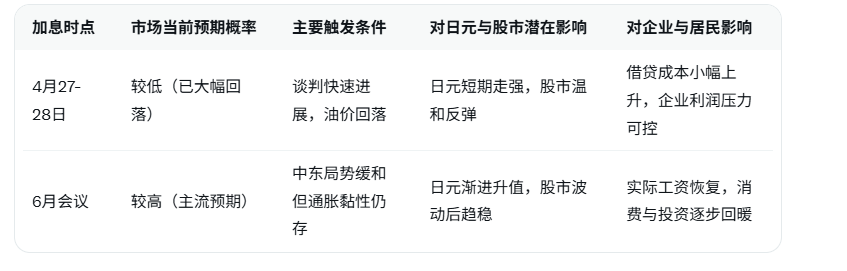
To clearly compare interest rate hike scenarios at different points in time, the following table summarizes the two main paths that the market and the central bank may currently face:
A deeper analysis reveals that the Bank of Japan faces a classic dilemma: on the one hand, the supply shock from the US-Iran conflict could exacerbate imported inflation, weakening the recovery momentum achieved through the wage-price spiral; on the other hand, raising interest rates too early could amplify the drag on domestic demand from external uncertainties. Kazuo Ueda has repeatedly emphasized that policy adjustments will adhere to the principle of "data dependence" and will not pre-determine a path, which explains why policymakers tend to wait until the last minute before the meeting to obtain more information on negotiation progress and economic data.
Furthermore, at the global level, the IMF has lowered its 2026 global growth forecast, partly due to the disruption of energy and food prices caused by the Middle East conflict. As an export-oriented economy, Japan's manufacturing and shipping industries are already feeling the pressure of rising freight and insurance costs, and some large companies' investment projects in the Middle East are facing delays. These factors combined amplified the Bank of Japan's wait-and-see approach at its April meeting.
Editor's Summary:
Geopolitical uncertainty stemming from the US-Iran conflict is significantly narrowing the policy space of major central banks worldwide. The Bank of Japan's choice between April and June essentially represents a trade-off between short-term shocks and its medium- to long-term inflation target. Regardless of the final decision, continuous monitoring of oil price trends, negotiation progress, and domestic wage dynamics will be key variables for subsequent policy adjustments.
Three sources familiar with the Bank of Japan's decision-making process revealed that, with both possibilities remaining unresolved, policymakers may hesitate until the last minute before making a final decision on whether to raise interest rates at the April 27-28 policy meeting. This decision largely depends on the progress of negotiations between the US and Iran to end the conflict. The sources stated, "Given the high degree of uncertainty, it is too early to make a decision for the policy meeting in just over a week."
Kazuo Ueda 's recent remarks following IMF and G20 meetings further confirm this cautious stance. He pointed out that Japan's real interest rates remain low, while corporate profits are robust, factors that the central bank must fully consider when formulating policy. He also explicitly stated, "The developments in the Middle East remain highly uncertain, and we will closely monitor their impact on economic activity, prices, and financial conditions." This statement is consistent with the decision made after the March meeting to keep the policy rate unchanged at around 0.75%, when the Iran war had begun to significantly push up oil prices.
The current conflict between the US and Iran has placed multiple pressures on the Japanese economy. As a major energy importer, Japan faces the risk of continued rising oil prices, which could further increase domestic inflationary pressures and weaken corporate real profits and real wage growth. Recent data shows that every 10% increase in oil prices could raise Japan's consumer price index by an additional 0.3 percentage points within a year. On the other hand, if the conflict eases quickly and inflation expectations stabilize, the Bank of Japan may have room to raise interest rates in June to avoid excessive monetary easing.
To clearly compare interest rate hike scenarios at different points in time, the following table summarizes the two main paths that the market and the central bank may currently face:
A deeper analysis reveals that the Bank of Japan faces a classic dilemma: on the one hand, the supply shock from the US-Iran conflict could exacerbate imported inflation, weakening the recovery momentum achieved through the wage-price spiral; on the other hand, raising interest rates too early could amplify the drag on domestic demand from external uncertainties. Kazuo Ueda has repeatedly emphasized that policy adjustments will adhere to the principle of "data dependence" and will not pre-determine a path, which explains why policymakers tend to wait until the last minute before the meeting to obtain more information on negotiation progress and economic data.
Furthermore, at the global level, the IMF has lowered its 2026 global growth forecast, partly due to the disruption of energy and food prices caused by the Middle East conflict. As an export-oriented economy, Japan's manufacturing and shipping industries are already feeling the pressure of rising freight and insurance costs, and some large companies' investment projects in the Middle East are facing delays. These factors combined amplified the Bank of Japan's wait-and-see approach at its April meeting.
Editor's Summary:
Geopolitical uncertainty stemming from the US-Iran conflict is significantly narrowing the policy space of major central banks worldwide. The Bank of Japan's choice between April and June essentially represents a trade-off between short-term shocks and its medium- to long-term inflation target. Regardless of the final decision, continuous monitoring of oil price trends, negotiation progress, and domestic wage dynamics will be key variables for subsequent policy adjustments.
- Risk Warning and Disclaimer
- The market involves risk, and trading may not be suitable for all investors. This article is for reference only and does not constitute personal investment advice, nor does it take into account certain users’ specific investment objectives, financial situation, or other needs. Any investment decisions made based on this information are at your own risk.