Gold Trading Alert: Gold Prices Experience a Sharp V-Shaped Reversal! Tensions between the US and Iran are escalating, yet the US dollar has suddenly weakened – is it time to buy the dip?
2026-04-21 07:10:55
In today's highly tense global financial markets, gold, as the most classic safe-haven asset, has never seen its price fluctuations so captivating. Just this past Monday (April 19th), spot gold staged a dramatic "V-shaped" reversal—falling to a one-week low before rebounding strongly. Behind this was not merely the fluctuation of numbers, but also the result of a complex interplay of geopolitical storms, a shift in the US dollar's trajectory, and severe volatility in the global energy market. On Tuesday (April 20th) in early Asian trading, spot gold traded in a narrow range, currently hovering around $4825 per ounce.

Monday saw a rollercoaster ride in the gold market. Spot gold prices briefly dipped to $4,737.04 per ounce, a significant drop not seen since April 13th. However, the market sentiment didn't allow the bears much of a boost, and gold prices gradually recovered, eventually closing at $4,820.63, with the daily decline narrowing to approximately 0.28%. Meanwhile, the US gold futures market also exhibited a similar cautious atmosphere, with June gold futures closing down 1%, settling at $4,828.8.
This initial decline followed by a rise clearly reflects the current dilemma and contradiction among gold traders. On one hand, forces are pushing gold prices lower; on the other hand, the fundamental support for gold prices remains unshaken, and the bulls are ready to launch a counterattack at any time.
The primary trigger for the day's gold price decline was the movement of the US dollar index. Earlier on Monday, the dollar index surged to its highest level in nearly a week. A strong dollar typically puts direct pressure on dollar-denominated gold, as it means higher costs for investors holding other currencies to purchase gold. This was one of the core reasons why gold prices were pressured and fell to a one-week low during the session.
However, the market is always unpredictable. As the trading session progressed, the dollar index failed to hold onto its gains, eventually giving back some and turning negative. This "inverted V" shaped movement of the dollar provided a much-needed respite for gold's rebound. As the dollar weakened, gold's appeal increased, attracting bargain hunters and pushing gold prices away from their intraday lows.
If the fluctuations in the US dollar are the surface-level trigger, then the renewed tensions in the Middle East geopolitical situation are the raging fire buried deep beneath the surface of gold price volatility. Just this past weekend, the already fragile ceasefire agreement between the US and Iran appeared to be on the verge of collapse. The trigger was the seizure of an Iranian cargo ship by the US, to which Iran immediately vowed retaliation. This move instantly cooled global market expectations for the prospects of peace in the Middle East.
A senior Iranian official revealed on Monday that Iran is "actively considering" participating in peace talks with the United States in Pakistan, but this is a softening of the stance compared to Tehran's previous hardline statement that it had ruled out participation and vowed retaliation; however, the preconditions remain thorny.
Iranian Foreign Minister Araqchi explicitly stated that the United States' "continued violations of the ceasefire agreement" are the main obstacle to advancing the diplomatic process. On the same day, Iran's Supreme Leader Mojtaba Khamenei also reiterated his three basic positions, including demanding "war reparations," emphasizing that he would never relinquish the country's legitimate rights. Iranian Parliament Speaker Ghalibaf went even further, making a strong statement in the early hours of the 21st, saying that "Iran will not accept negotiations under the shadow of threats," and accusing the United States of attempting to turn the negotiating table into a "surrender table."
The eight-week-long conflict has claimed thousands of lives and severely destabilized the global economy, particularly energy markets. The two-week ceasefire is set to expire this week, and the fact that US Vice President Vance is reportedly still in the US and has not yet traveled to Pakistan as expected further exacerbates the uncertainty surrounding the negotiations. While President Trump has expressed optimism about reaching a new nuclear agreement on social media, Iran is clearly unconvinced, viewing the US's threatening stance as contradictory to its willingness to negotiate.
The most direct and dramatic spillover effects of the US-Iran tensions are reflected in the global energy market. International oil prices surged by about 5% on Monday due to concerns about a potential collapse of the ceasefire agreement and the de facto standstill of shipping in the Strait of Hormuz. US crude futures closed up 6.87% at $89.61 per barrel, while Brent crude rose 5.64% to $95.48 per barrel.
The passage through the Strait of Hormuz, a global energy chokepoint, has become a "thermometer" for measuring the intensity of the US-Iran conflict. Shipping data shows that ship traffic in the strait has almost come to a standstill, with only three vessels passing through in 12 hours. Iran had briefly lifted its blockade of the strait but subsequently reimposed it. The United States, on the other hand, maintained its blockade of Iranian ports and directly took military action in this incident, boarding and seizing cargo ships. Videos released by the US Central Command showed Marines rappelling from helicopters onto Iranian cargo ships, a posture of direct confrontation that has undoubtedly fueled market concerns about an escalation of the conflict.
Amid renewed tensions in the Middle East, the reactions of various financial markets reveal the complex sentiments of investors. U.S. stocks closed slightly lower across the board on Monday, with the Dow Jones Industrial Average, S&P 500, and Nasdaq Composite falling 0.01%, 0.24%, and 0.26%, respectively. The previous upward trend was interrupted, and the CBOE Volatility Index (VIX), often referred to as Wall Street's "fear gauge," rebounded after eight consecutive days of declines, briefly hitting a one-week high. The communication services sector performed the worst, with Meta's stock price falling more than 2% after a nine-day winning streak.
However, somewhat surprisingly, the U.S. Treasury market remained remarkably calm. Bond investors largely downplayed the weekend's turmoil in the Middle East, with Treasury prices virtually unchanged on Monday and trading volume subdued. The 10-year Treasury yield rose only slightly to 4.25%, while the 30-year yield remained flat. This suggests that many investors are still on the sidelines, believing any escalation in the region is likely to be controlled, or they prefer to wait for further clarity on peace talks. As one strategist put it, "I think we can get through this period, but the process could be a bit bumpy."
In summary, the gold market is currently at a critical crossroads. The bears' logic is clear and straightforward: rising US Treasury yields increase the opportunity cost of holding gold, a non-interest-bearing asset. Market analysts at City Index and FOREX point out that escalating tensions in the Middle East could lead to a surge in oil prices, which in turn pushes up the dollar and bond yields, slightly tilting expectations for gold prices downwards. From a technical perspective, the next upside target for gold futures bulls is a close above the strong resistance level of $5,000, while bears hope to establish a top at the current price level.
However, the support from the bulls should not be underestimated. The real existence of geopolitical risks and the threat of the ceasefire agreement breaking at any time provide solid safe-haven demand support for gold. The tough statements from Iran's Supreme Leader and Speaker of Parliament, as well as the continued military and economic pressure from the United States, mean that any miscalculation of the situation could lead to a renewed outbreak of conflict. In addition, market expectations for the Federal Reserve's monetary policy are also changing. With inflation concerns exacerbated by rising oil prices, the interest rate futures market currently expects a 14 basis point rate cut this year. Although this is far lower than the 55 basis point expected before the war, the direction of the rate cut itself is a long-term positive for gold.
In conclusion, the future direction of gold will largely depend on the progress of US-Iran negotiations and when shipping in the Strait of Hormuz can truly return to normal. Investors are closely watching the upcoming US March retail sales data, the Federal Reserve Chair nomination hearings, and earnings reports from numerous tech giants , trying to glean more clues about economic resilience and the path of monetary policy. In this grand drama jointly directed by geopolitics, dollar volatility, and risk aversion, every fluctuation in gold prices will be a direct vote on global market risk appetite.
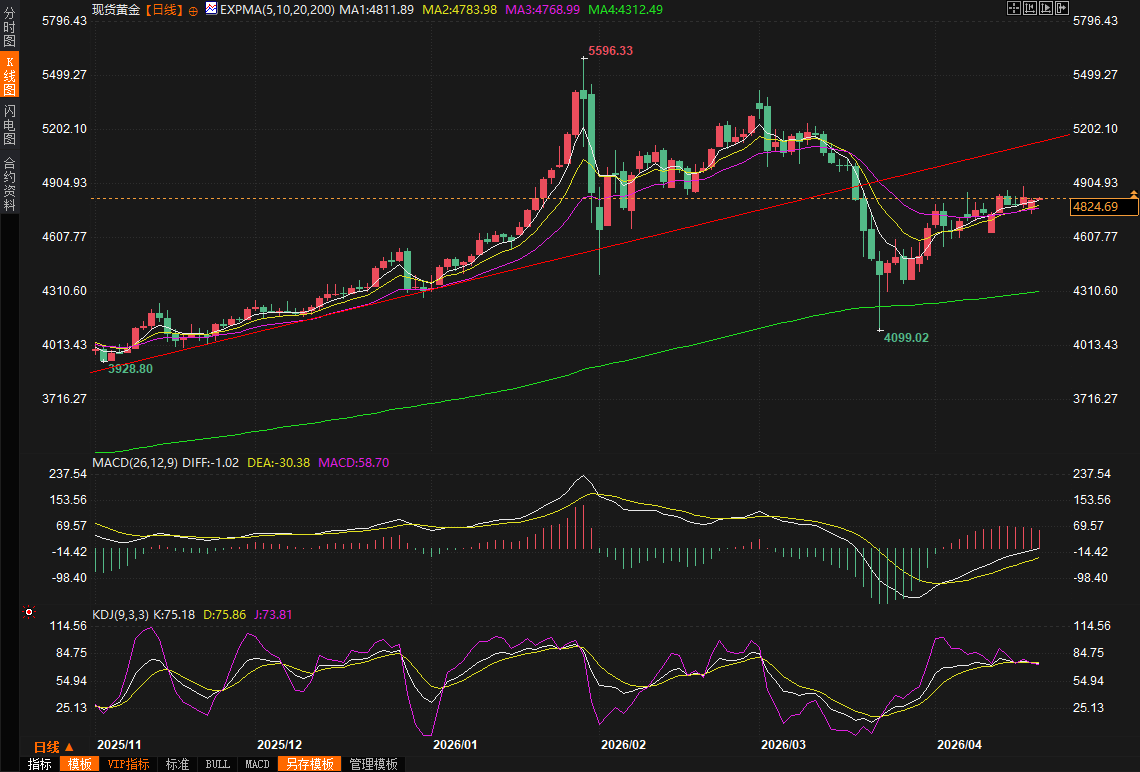
(Spot gold daily chart, source: FX678)
At 07:09 Beijing time, spot gold was trading at $4,826.12 per ounce.
Gold prices staged a "V"-shaped reversal, with a fierce battle between bulls and bears in full swing.
Monday saw a rollercoaster ride in the gold market. Spot gold prices briefly dipped to $4,737.04 per ounce, a significant drop not seen since April 13th. However, the market sentiment didn't allow the bears much of a boost, and gold prices gradually recovered, eventually closing at $4,820.63, with the daily decline narrowing to approximately 0.28%. Meanwhile, the US gold futures market also exhibited a similar cautious atmosphere, with June gold futures closing down 1%, settling at $4,828.8.
This initial decline followed by a rise clearly reflects the current dilemma and contradiction among gold traders. On one hand, forces are pushing gold prices lower; on the other hand, the fundamental support for gold prices remains unshaken, and the bulls are ready to launch a counterattack at any time.
The US dollar's initial rise followed by a decline directly drove gold price fluctuations.
The primary trigger for the day's gold price decline was the movement of the US dollar index. Earlier on Monday, the dollar index surged to its highest level in nearly a week. A strong dollar typically puts direct pressure on dollar-denominated gold, as it means higher costs for investors holding other currencies to purchase gold. This was one of the core reasons why gold prices were pressured and fell to a one-week low during the session.
However, the market is always unpredictable. As the trading session progressed, the dollar index failed to hold onto its gains, eventually giving back some and turning negative. This "inverted V" shaped movement of the dollar provided a much-needed respite for gold's rebound. As the dollar weakened, gold's appeal increased, attracting bargain hunters and pushing gold prices away from their intraday lows.
Tensions between the US and Iran have escalated sharply, putting the ceasefire agreement in jeopardy.
If the fluctuations in the US dollar are the surface-level trigger, then the renewed tensions in the Middle East geopolitical situation are the raging fire buried deep beneath the surface of gold price volatility. Just this past weekend, the already fragile ceasefire agreement between the US and Iran appeared to be on the verge of collapse. The trigger was the seizure of an Iranian cargo ship by the US, to which Iran immediately vowed retaliation. This move instantly cooled global market expectations for the prospects of peace in the Middle East.
A senior Iranian official revealed on Monday that Iran is "actively considering" participating in peace talks with the United States in Pakistan, but this is a softening of the stance compared to Tehran's previous hardline statement that it had ruled out participation and vowed retaliation; however, the preconditions remain thorny.
Iranian Foreign Minister Araqchi explicitly stated that the United States' "continued violations of the ceasefire agreement" are the main obstacle to advancing the diplomatic process. On the same day, Iran's Supreme Leader Mojtaba Khamenei also reiterated his three basic positions, including demanding "war reparations," emphasizing that he would never relinquish the country's legitimate rights. Iranian Parliament Speaker Ghalibaf went even further, making a strong statement in the early hours of the 21st, saying that "Iran will not accept negotiations under the shadow of threats," and accusing the United States of attempting to turn the negotiating table into a "surrender table."
The eight-week-long conflict has claimed thousands of lives and severely destabilized the global economy, particularly energy markets. The two-week ceasefire is set to expire this week, and the fact that US Vice President Vance is reportedly still in the US and has not yet traveled to Pakistan as expected further exacerbates the uncertainty surrounding the negotiations. While President Trump has expressed optimism about reaching a new nuclear agreement on social media, Iran is clearly unconvinced, viewing the US's threatening stance as contradictory to its willingness to negotiate.
Oil prices surge 5%, Strait of Hormuz becomes the focus of the game.
The most direct and dramatic spillover effects of the US-Iran tensions are reflected in the global energy market. International oil prices surged by about 5% on Monday due to concerns about a potential collapse of the ceasefire agreement and the de facto standstill of shipping in the Strait of Hormuz. US crude futures closed up 6.87% at $89.61 per barrel, while Brent crude rose 5.64% to $95.48 per barrel.
The passage through the Strait of Hormuz, a global energy chokepoint, has become a "thermometer" for measuring the intensity of the US-Iran conflict. Shipping data shows that ship traffic in the strait has almost come to a standstill, with only three vessels passing through in 12 hours. Iran had briefly lifted its blockade of the strait but subsequently reimposed it. The United States, on the other hand, maintained its blockade of Iranian ports and directly took military action in this incident, boarding and seizing cargo ships. Videos released by the US Central Command showed Marines rappelling from helicopters onto Iranian cargo ships, a posture of direct confrontation that has undoubtedly fueled market concerns about an escalation of the conflict.
Market reactions were mixed: the stock market was under pressure, while the bond market remained calm, indicating that risk aversion had not spiraled out of control.
Amid renewed tensions in the Middle East, the reactions of various financial markets reveal the complex sentiments of investors. U.S. stocks closed slightly lower across the board on Monday, with the Dow Jones Industrial Average, S&P 500, and Nasdaq Composite falling 0.01%, 0.24%, and 0.26%, respectively. The previous upward trend was interrupted, and the CBOE Volatility Index (VIX), often referred to as Wall Street's "fear gauge," rebounded after eight consecutive days of declines, briefly hitting a one-week high. The communication services sector performed the worst, with Meta's stock price falling more than 2% after a nine-day winning streak.
However, somewhat surprisingly, the U.S. Treasury market remained remarkably calm. Bond investors largely downplayed the weekend's turmoil in the Middle East, with Treasury prices virtually unchanged on Monday and trading volume subdued. The 10-year Treasury yield rose only slightly to 4.25%, while the 30-year yield remained flat. This suggests that many investors are still on the sidelines, believing any escalation in the region is likely to be controlled, or they prefer to wait for further clarity on peace talks. As one strategist put it, "I think we can get through this period, but the process could be a bit bumpy."
Gold Market Outlook
In summary, the gold market is currently at a critical crossroads. The bears' logic is clear and straightforward: rising US Treasury yields increase the opportunity cost of holding gold, a non-interest-bearing asset. Market analysts at City Index and FOREX point out that escalating tensions in the Middle East could lead to a surge in oil prices, which in turn pushes up the dollar and bond yields, slightly tilting expectations for gold prices downwards. From a technical perspective, the next upside target for gold futures bulls is a close above the strong resistance level of $5,000, while bears hope to establish a top at the current price level.
However, the support from the bulls should not be underestimated. The real existence of geopolitical risks and the threat of the ceasefire agreement breaking at any time provide solid safe-haven demand support for gold. The tough statements from Iran's Supreme Leader and Speaker of Parliament, as well as the continued military and economic pressure from the United States, mean that any miscalculation of the situation could lead to a renewed outbreak of conflict. In addition, market expectations for the Federal Reserve's monetary policy are also changing. With inflation concerns exacerbated by rising oil prices, the interest rate futures market currently expects a 14 basis point rate cut this year. Although this is far lower than the 55 basis point expected before the war, the direction of the rate cut itself is a long-term positive for gold.
In conclusion, the future direction of gold will largely depend on the progress of US-Iran negotiations and when shipping in the Strait of Hormuz can truly return to normal. Investors are closely watching the upcoming US March retail sales data, the Federal Reserve Chair nomination hearings, and earnings reports from numerous tech giants , trying to glean more clues about economic resilience and the path of monetary policy. In this grand drama jointly directed by geopolitics, dollar volatility, and risk aversion, every fluctuation in gold prices will be a direct vote on global market risk appetite.
(Spot gold daily chart, source: FX678)
At 07:09 Beijing time, spot gold was trading at $4,826.12 per ounce.
- Risk Warning and Disclaimer
- The market involves risk, and trading may not be suitable for all investors. This article is for reference only and does not constitute personal investment advice, nor does it take into account certain users’ specific investment objectives, financial situation, or other needs. Any investment decisions made based on this information are at your own risk.