As risk aversion subsided, gold prices remained range-bound, awaiting directional guidance.
2026-04-21 10:00:50
On Tuesday during the Asian trading session, spot gold (XAU/USD) remained in a narrow range around $4810 , exhibiting an overall high-level consolidation trend. After recent continuous gains, the market has entered a brief consolidation phase, with bullish and bearish forces tending to balance, awaiting new macroeconomic catalysts to guide the direction.

From a fundamental perspective, the uncertainty surrounding the situation in the Middle East continues to support gold. Despite signals of a resumption of negotiations, significant uncertainty remains regarding progress, and the inconsistent implementation of the ceasefire makes it difficult for safe-haven demand to completely subside. Against this backdrop, gold, as a traditional safe-haven asset, continues to attract some capital allocation, keeping its price within a high range.
However, while supporting gold prices, another factor is emerging as a constraint. As crude oil prices rise due to increased supply risks, rising energy costs are reigniting inflation expectations. This shift impacts monetary policy—rising inflationary pressures mean less room for interest rate cuts, thus putting pressure on gold, a non-interest-bearing asset. In other words, gold is currently caught in a tug-of-war between "safe-haven demand" and "interest rate constraints."
Furthermore, gold is priced in US dollars, and its price movement is closely related to the strength of the dollar. The market is closely watching the upcoming US retail sales data, which is considered a key indicator of consumer spending strength. The market expects March retail sales to grow by approximately 1.4% month-on-month , higher than the previous value of 0.6% . Strong data would reinforce expectations of economic resilience, potentially supporting a stronger dollar and thus putting downward pressure on gold prices; conversely, weaker-than-expected data could weaken the dollar, providing upward momentum for gold.
From a market sentiment perspective, investors are currently adopting a wait-and-see strategy. On the one hand, geopolitical risks have not yet subsided; on the other hand, macroeconomic data is yet to be released, making funds unwilling to chase high prices on a large scale. This sentiment has narrowed gold price fluctuations, but potential volatility risks are accumulating. Once data or events exceed expectations, it could trigger a rapid breakout.
From a technical perspective, the daily chart shows that gold is still in a clear upward trend, but the recent gains have slowed, and the price has entered a consolidation phase at higher levels. The $4850 level forms short-term resistance , and multiple tests have failed to break through effectively, indicating strong selling pressure above. On the downside, $4780 provides initial support ; a break below this level could lead to a further pullback to the $4720 area . In terms of momentum indicators, the MACD is showing overbought conditions, indicating weakening upward momentum, but a reversal signal has not yet formed.
From a 4-hour chart perspective, the short-term trend shows a sideways consolidation structure, with prices fluctuating around $4820. The moving average system is converging, indicating an unclear market direction. The RSI remains in the neutral range, without obvious overbought or oversold signals, meaning that prices still have room to choose a direction. If the price breaks through the $4850 resistance zone, it is expected to continue the upward trend; if it falls below $4780, it may enter a deeper correction phase.
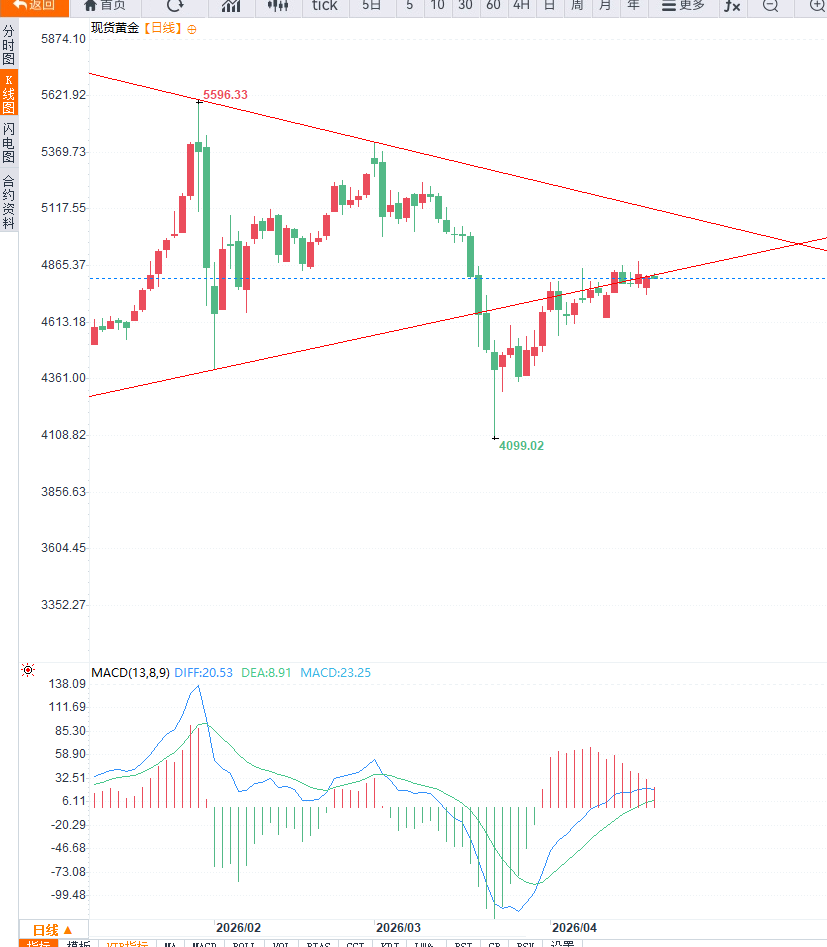
Overall, gold is currently at a critical juncture, with neither fundamentals nor technical indicators providing a clear directional signal. Amidst a confluence of factors, the market is awaiting a new driving force to break the current equilibrium.
Editor's Summary:
Gold prices remained range-bound at high levels, reflecting the market's ongoing balancing act between safe-haven demand and interest rate expectations. The Middle East situation provided a floor for gold prices, but inflationary pressures from rising oil prices limited upside potential. In the short term, US economic data will be a key variable, determining the dollar's trajectory and gold price direction. In the medium term, if inflation remains high, gold's upside potential may be limited; however, if economic data weakens and strengthens expectations of interest rate cuts, gold prices still have further upside potential. Investors should pay close attention to key technical levels and changes in macroeconomic data, and cautiously manage the risks of high-level volatility.
From a fundamental perspective, the uncertainty surrounding the situation in the Middle East continues to support gold. Despite signals of a resumption of negotiations, significant uncertainty remains regarding progress, and the inconsistent implementation of the ceasefire makes it difficult for safe-haven demand to completely subside. Against this backdrop, gold, as a traditional safe-haven asset, continues to attract some capital allocation, keeping its price within a high range.
However, while supporting gold prices, another factor is emerging as a constraint. As crude oil prices rise due to increased supply risks, rising energy costs are reigniting inflation expectations. This shift impacts monetary policy—rising inflationary pressures mean less room for interest rate cuts, thus putting pressure on gold, a non-interest-bearing asset. In other words, gold is currently caught in a tug-of-war between "safe-haven demand" and "interest rate constraints."
Furthermore, gold is priced in US dollars, and its price movement is closely related to the strength of the dollar. The market is closely watching the upcoming US retail sales data, which is considered a key indicator of consumer spending strength. The market expects March retail sales to grow by approximately 1.4% month-on-month , higher than the previous value of 0.6% . Strong data would reinforce expectations of economic resilience, potentially supporting a stronger dollar and thus putting downward pressure on gold prices; conversely, weaker-than-expected data could weaken the dollar, providing upward momentum for gold.
From a market sentiment perspective, investors are currently adopting a wait-and-see strategy. On the one hand, geopolitical risks have not yet subsided; on the other hand, macroeconomic data is yet to be released, making funds unwilling to chase high prices on a large scale. This sentiment has narrowed gold price fluctuations, but potential volatility risks are accumulating. Once data or events exceed expectations, it could trigger a rapid breakout.
From a technical perspective, the daily chart shows that gold is still in a clear upward trend, but the recent gains have slowed, and the price has entered a consolidation phase at higher levels. The $4850 level forms short-term resistance , and multiple tests have failed to break through effectively, indicating strong selling pressure above. On the downside, $4780 provides initial support ; a break below this level could lead to a further pullback to the $4720 area . In terms of momentum indicators, the MACD is showing overbought conditions, indicating weakening upward momentum, but a reversal signal has not yet formed.
From a 4-hour chart perspective, the short-term trend shows a sideways consolidation structure, with prices fluctuating around $4820. The moving average system is converging, indicating an unclear market direction. The RSI remains in the neutral range, without obvious overbought or oversold signals, meaning that prices still have room to choose a direction. If the price breaks through the $4850 resistance zone, it is expected to continue the upward trend; if it falls below $4780, it may enter a deeper correction phase.
Overall, gold is currently at a critical juncture, with neither fundamentals nor technical indicators providing a clear directional signal. Amidst a confluence of factors, the market is awaiting a new driving force to break the current equilibrium.
Editor's Summary:
Gold prices remained range-bound at high levels, reflecting the market's ongoing balancing act between safe-haven demand and interest rate expectations. The Middle East situation provided a floor for gold prices, but inflationary pressures from rising oil prices limited upside potential. In the short term, US economic data will be a key variable, determining the dollar's trajectory and gold price direction. In the medium term, if inflation remains high, gold's upside potential may be limited; however, if economic data weakens and strengthens expectations of interest rate cuts, gold prices still have further upside potential. Investors should pay close attention to key technical levels and changes in macroeconomic data, and cautiously manage the risks of high-level volatility.
- Risk Warning and Disclaimer
- The market involves risk, and trading may not be suitable for all investors. This article is for reference only and does not constitute personal investment advice, nor does it take into account certain users’ specific investment objectives, financial situation, or other needs. Any investment decisions made based on this information are at your own risk.