Soaring oil prices exacerbate inflationary pressures; Bank of Korea pledges cautious and flexible policy.
2026-04-21 14:29:35
According to APP, Shin Hyun-song, the newly appointed governor of the Bank of Korea, stated in his inaugural address that he will adopt a cautious and flexible monetary policy strategy to address inflationary pressures from rising oil prices while mitigating uncertainty about the economic growth outlook. He emphasized the need to re-examine the central bank's role from a long-term perspective, incorporating structural issues such as demographic changes, inequality, and the real estate market into the framework of monetary policy considerations.

Currently, rising global energy prices have significantly increased the risk of upward inflation, while economic growth faces significant downward pressure. Shin Hyun-song pointed out that the continued supply shocks triggered by the Middle East crisis have greatly increased the uncertainty surrounding the paths of inflation and economic growth. He pledged to implement monetary policy in a prudent and flexible manner to ensure price stability and the sound operation of the financial system. This statement signifies that, against the backdrop of escalating external shocks, the Bank of Korea's policy orientation has shifted from a traditional focus on inflation to a more adaptive and comprehensive balance.
Latest data shows that South Korea's consumer price index (CPI) rose 2.2% year-on-year in March, lower than the market's expectation of 2.4%, but higher than the central bank's medium-term target of 2%, and a slight rebound from the 2.0% level of the previous two months. Transportation prices surged 5.0% year-on-year, driven by rising oil prices, becoming the main driver, while food price increases slowed to 0.5%. Meanwhile, the Bank of Korea kept its benchmark interest rate unchanged at 2.5% at its April 10 meeting, indicating that policymakers are still taking a wait-and-see approach as the impact of oil prices begins to emerge, awaiting more data to verify the persistence of the impact.
To visually present the current inflation situation and risk comparison, the following table summarizes key indicators:
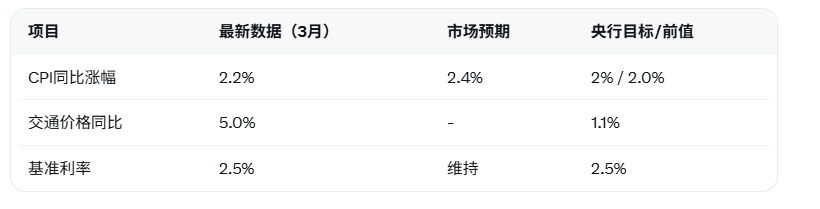
The data clearly reflects that the cost shock driven by oil prices has begun to emerge, but government measures such as fuel price controls have temporarily alleviated some of the pressure. If the situation in the Middle East does not ease, inflation is expected to accelerate further in April and thereafter, and the risk of upward pressure on core inflation is also increasing.
A deeper analysis reveals that Shin Hyun-song's inclusion of structural issues in his policy framework reflects the evolving role of monetary policy. Population aging leads to a contraction in labor supply, exacerbating inequality and consumer divergence, while high leverage in the real estate market amplifies financial vulnerabilities. These factors, combined with short-term supply shocks, could create long-term risks of sticky inflation or stagnant growth. If the central bank relies solely on traditional interest rate tools, it may struggle to simultaneously maintain price and financial stability. Therefore, a "prudent and flexible" strategy aims to dynamically adjust based on data, avoiding excessive tightening that could hinder recovery or allow inflation to spiral out of control.
Shin Hyun-song recently stated at his confirmation hearing that if the Middle East crisis drags on and leads to persistent price pressures, monetary policy will play a necessary role, but there is no need to overreact to short-term shocks. This statement leaves room for future policy direction, and the market expects its first policy meeting to be held on May 28, at which time the response strategy will be further clarified.
Overall, rising oil prices are being passed on to residents and businesses through increased import costs. Coupled with domestic structural bottlenecks, the South Korean economy faces the risk of stagflation. The central bank's policy shift will directly impact the pricing of interest-rate-sensitive assets, exchange rate trends, and the real estate financing environment. Investors need to closely monitor geopolitical developments and monthly inflation data.
Editor's Summary : The latest inflation data and the new governor's statements indicate that the Bank of Korea is addressing the oil price shock and structural challenges with a more forward-looking framework. While the 2.2% CPI figure is currently within expectations, the upward trend is clear, and maintaining the benchmark interest rate at 2.5% leaves room for future adjustments. The policy's effectiveness will depend on the evolution of the Middle East situation and the resilience of domestic demand; balancing inflation control and growth support remains the core challenge.
Currently, rising global energy prices have significantly increased the risk of upward inflation, while economic growth faces significant downward pressure. Shin Hyun-song pointed out that the continued supply shocks triggered by the Middle East crisis have greatly increased the uncertainty surrounding the paths of inflation and economic growth. He pledged to implement monetary policy in a prudent and flexible manner to ensure price stability and the sound operation of the financial system. This statement signifies that, against the backdrop of escalating external shocks, the Bank of Korea's policy orientation has shifted from a traditional focus on inflation to a more adaptive and comprehensive balance.
Latest data shows that South Korea's consumer price index (CPI) rose 2.2% year-on-year in March, lower than the market's expectation of 2.4%, but higher than the central bank's medium-term target of 2%, and a slight rebound from the 2.0% level of the previous two months. Transportation prices surged 5.0% year-on-year, driven by rising oil prices, becoming the main driver, while food price increases slowed to 0.5%. Meanwhile, the Bank of Korea kept its benchmark interest rate unchanged at 2.5% at its April 10 meeting, indicating that policymakers are still taking a wait-and-see approach as the impact of oil prices begins to emerge, awaiting more data to verify the persistence of the impact.
To visually present the current inflation situation and risk comparison, the following table summarizes key indicators:
The data clearly reflects that the cost shock driven by oil prices has begun to emerge, but government measures such as fuel price controls have temporarily alleviated some of the pressure. If the situation in the Middle East does not ease, inflation is expected to accelerate further in April and thereafter, and the risk of upward pressure on core inflation is also increasing.
A deeper analysis reveals that Shin Hyun-song's inclusion of structural issues in his policy framework reflects the evolving role of monetary policy. Population aging leads to a contraction in labor supply, exacerbating inequality and consumer divergence, while high leverage in the real estate market amplifies financial vulnerabilities. These factors, combined with short-term supply shocks, could create long-term risks of sticky inflation or stagnant growth. If the central bank relies solely on traditional interest rate tools, it may struggle to simultaneously maintain price and financial stability. Therefore, a "prudent and flexible" strategy aims to dynamically adjust based on data, avoiding excessive tightening that could hinder recovery or allow inflation to spiral out of control.
Shin Hyun-song recently stated at his confirmation hearing that if the Middle East crisis drags on and leads to persistent price pressures, monetary policy will play a necessary role, but there is no need to overreact to short-term shocks. This statement leaves room for future policy direction, and the market expects its first policy meeting to be held on May 28, at which time the response strategy will be further clarified.
Overall, rising oil prices are being passed on to residents and businesses through increased import costs. Coupled with domestic structural bottlenecks, the South Korean economy faces the risk of stagflation. The central bank's policy shift will directly impact the pricing of interest-rate-sensitive assets, exchange rate trends, and the real estate financing environment. Investors need to closely monitor geopolitical developments and monthly inflation data.
Editor's Summary : The latest inflation data and the new governor's statements indicate that the Bank of Korea is addressing the oil price shock and structural challenges with a more forward-looking framework. While the 2.2% CPI figure is currently within expectations, the upward trend is clear, and maintaining the benchmark interest rate at 2.5% leaves room for future adjustments. The policy's effectiveness will depend on the evolution of the Middle East situation and the resilience of domestic demand; balancing inflation control and growth support remains the core challenge.
- Risk Warning and Disclaimer
- The market involves risk, and trading may not be suitable for all investors. This article is for reference only and does not constitute personal investment advice, nor does it take into account certain users’ specific investment objectives, financial situation, or other needs. Any investment decisions made based on this information are at your own risk.