













Kevin Warsh's nomination hearing for Federal Reserve Chairman is being held today, with the market focusing on the shift in the policy response function and the impact of long-term Treasury yields.
2026-04-21 17:00:30
According to APP, a strategist at an international financial institution pointed out that Kevin Warsh's confirmation hearing will be a key turning point for the Federal Reserve's policy shift. The market is closely watching for potential adjustments to the central bank's reaction function and its impact on the long-term Treasury yield curve. Currently, rising oil prices are driving up inflationary pressures, while economic growth faces more downside risks. Investors are concerned that past policy choices have made the economy more vulnerable to shocks and could push up term premiums.
Latest data shows that the U.S. Consumer Price Index (CPI) rose 3.3% year-on-year in March, a significant rebound from 2.4% in February, reaching its highest level since May 2024. Month-on-month, it rose 0.9%, primarily driven by a 12.5% surge in energy prices, with gasoline prices rising 18.9%. Core inflation rose to 2.6% year-on-year, indicating that while energy factors dominated price pressures, the underlying factors remained solid. This data closely aligns with the structural vulnerabilities emphasized by Kevin Warsh in a speech a year ago, where he pointed out that past policy choices had made it more difficult for the U.S. economy to adjust organically, requiring larger-scale interventions during each crisis.
In his IMF speech on April 25, 2025, Kevin Warsh stated explicitly, "I strongly believe that the independence of monetary policy operations is a wise political and economic decision, and the independence of the Federal Reserve depends primarily on the Federal Reserve itself." In his prepared remarks for this hearing, he further pledged to ensure strict independence of monetary policy while cooperating with the government and Congress on non-monetary matters. This statement provides an important signal to the market: the Federal Reserve may moderately respond to the administration's demands for lower interest rates while maintaining its independence, but it will not easily abandon its data-dependent principles.
The current money market has reduced the probability of a Federal Reserve rate cut in 2026 to about 30%, a significant drop from the previous 50%. Some traders believe that if energy prices continue to push up inflation, the policy path may shift to "no rate cuts" or be postponed until the end of the year. After Kevin Warsh takes office (expected in June), he will face the dual challenges of accelerating inflation (due to energy prices and global events) and fiscal expansion. Investors are assessing the possibility of a bear flattening or steepening of the yield curve.
To provide a clear comparison of key data, the following table shows the latest inflation performance, interest rate cut expectations, and historical references:
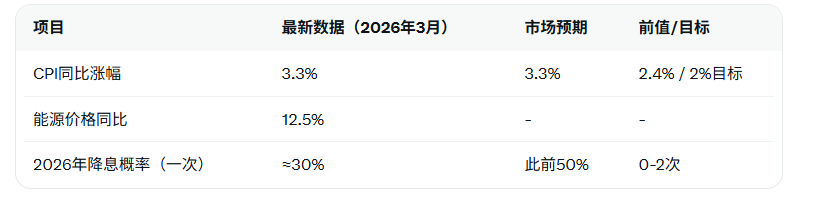
The above comparison shows that the rebound in inflation has exceeded earlier expectations, and interest rate cut expectations have been revised downwards accordingly, highlighting the risk of rising term premiums. Long-term government bond investors are demanding higher compensation to address policy uncertainty and concerns about fiscal sustainability.
From a deeper analysis, Kevin Warsh emphasized the need to re-examine the role of central banks in the long term, incorporating structural issues such as fiscal discipline and institutional accountability into the policy framework. This shift could change the market's interpretation of the Fed's "data dependence" and "forward guidance," avoiding the accumulation of vulnerabilities caused by past excessive easing. If the hearing strengthens independence while hinting at flexible responses, short-term yields may face downward pressure, but long-term yields will remain relatively firm due to rising term premiums, signaling a steepening yield curve. Conversely, if the stance leans towards aggressive easing, the market may quickly price in more rate cuts, pushing down overall yield levels.
Overall, this hearing was not only a personnel confirmation but also a window for the market to test the Federal Reserve's future policy framework. The energy price shock coupled with fiscal expansion is testing the central bank's ability to balance price stability and growth support. Investors need to closely monitor the hearing's statements in advance to position themselves for interest rate-sensitive assets and curve trading strategies.
Editor's Summary : The latest inflation data and Kevin Warsh's prepared remarks indicate that the Federal Reserve is at a policy crossroads. The 3.3% CPI rebound highlights short-term pressures driven by energy, while the rising term premium reflects market pricing adjustments for long-term vulnerabilities. The hearing outcome will directly impact the shape of the yield curve and the path of monetary policy. Balancing independence and flexibility remains a core challenge, and future trends will be highly dependent on the inflation trajectory and the dynamic evolution of fiscal policy.
Latest data shows that the U.S. Consumer Price Index (CPI) rose 3.3% year-on-year in March, a significant rebound from 2.4% in February, reaching its highest level since May 2024. Month-on-month, it rose 0.9%, primarily driven by a 12.5% surge in energy prices, with gasoline prices rising 18.9%. Core inflation rose to 2.6% year-on-year, indicating that while energy factors dominated price pressures, the underlying factors remained solid. This data closely aligns with the structural vulnerabilities emphasized by Kevin Warsh in a speech a year ago, where he pointed out that past policy choices had made it more difficult for the U.S. economy to adjust organically, requiring larger-scale interventions during each crisis.
In his IMF speech on April 25, 2025, Kevin Warsh stated explicitly, "I strongly believe that the independence of monetary policy operations is a wise political and economic decision, and the independence of the Federal Reserve depends primarily on the Federal Reserve itself." In his prepared remarks for this hearing, he further pledged to ensure strict independence of monetary policy while cooperating with the government and Congress on non-monetary matters. This statement provides an important signal to the market: the Federal Reserve may moderately respond to the administration's demands for lower interest rates while maintaining its independence, but it will not easily abandon its data-dependent principles.
The current money market has reduced the probability of a Federal Reserve rate cut in 2026 to about 30%, a significant drop from the previous 50%. Some traders believe that if energy prices continue to push up inflation, the policy path may shift to "no rate cuts" or be postponed until the end of the year. After Kevin Warsh takes office (expected in June), he will face the dual challenges of accelerating inflation (due to energy prices and global events) and fiscal expansion. Investors are assessing the possibility of a bear flattening or steepening of the yield curve.
To provide a clear comparison of key data, the following table shows the latest inflation performance, interest rate cut expectations, and historical references:
The above comparison shows that the rebound in inflation has exceeded earlier expectations, and interest rate cut expectations have been revised downwards accordingly, highlighting the risk of rising term premiums. Long-term government bond investors are demanding higher compensation to address policy uncertainty and concerns about fiscal sustainability.
From a deeper analysis, Kevin Warsh emphasized the need to re-examine the role of central banks in the long term, incorporating structural issues such as fiscal discipline and institutional accountability into the policy framework. This shift could change the market's interpretation of the Fed's "data dependence" and "forward guidance," avoiding the accumulation of vulnerabilities caused by past excessive easing. If the hearing strengthens independence while hinting at flexible responses, short-term yields may face downward pressure, but long-term yields will remain relatively firm due to rising term premiums, signaling a steepening yield curve. Conversely, if the stance leans towards aggressive easing, the market may quickly price in more rate cuts, pushing down overall yield levels.
Overall, this hearing was not only a personnel confirmation but also a window for the market to test the Federal Reserve's future policy framework. The energy price shock coupled with fiscal expansion is testing the central bank's ability to balance price stability and growth support. Investors need to closely monitor the hearing's statements in advance to position themselves for interest rate-sensitive assets and curve trading strategies.
Editor's Summary : The latest inflation data and Kevin Warsh's prepared remarks indicate that the Federal Reserve is at a policy crossroads. The 3.3% CPI rebound highlights short-term pressures driven by energy, while the rising term premium reflects market pricing adjustments for long-term vulnerabilities. The hearing outcome will directly impact the shape of the yield curve and the path of monetary policy. Balancing independence and flexibility remains a core challenge, and future trends will be highly dependent on the inflation trajectory and the dynamic evolution of fiscal policy.
- Risk Warning and Disclaimer
- The market involves risk, and trading may not be suitable for all investors. This article is for reference only and does not constitute personal investment advice, nor does it take into account certain users’ specific investment objectives, financial situation, or other needs. Any investment decisions made based on this information are at your own risk.

