US data and risk aversion sentiment combine to maximize the risk of yen depreciation both domestically and internationally.
2026-04-21 20:57:04
On Tuesday (April 21), the US-Iran negotiations remained shrouded in uncertainty, and safe-haven funds continued to flow into the US dollar, causing the USD/JPY pair to rise by about 30 points during the session. After a slight pullback, the US released strong fundamental data, and the USD/JPY pair further extended its gains. Currently, the USD/JPY pair is up 55 points from the opening, trading at 159.21.
Trump stated that the United States has complete control of the Strait of Hormuz, the blockade has been a huge success, and he believes we will eventually reach a great agreement.
Iran had no choice but to send representatives to the negotiations. We were in a very advantageous position in our negotiations with Iran, while simultaneously claiming it was a regime change. Our negotiations with them were very successful. I anticipated bombing of Iran; the US military was prepared to enter Iran, and attacks on infrastructure could cause military damage. Iran was attempting to relocate its missiles. We now have significantly more equipment than we did a few weeks ago.
The US-Iran peace talks have become a core disruptive factor in the current global financial markets. The Iranian government has not stated that it will send a delegation to Pakistan to participate in the consultations , but in the face of Trump's remarks, the market has shown resilience and still hopes for phased progress in the negotiations.
Meanwhile, the Strait of Hormuz was closed again over the weekend, directly boosting market risk aversion and prompting global investors to adopt a wait-and-see attitude.

US retail sales data for March were strong, with both key indicators significantly exceeding market expectations, providing robust support for the US dollar. Overall retail sales rose 1.7% month-over-month, compared to 0.6% in the previous month and market expectations of only 1.4%.
Core retail sales surged 1.9% month-over-month, compared to 0.5% previously and an expected 1.4%, both exceeding expectations.
TD Securities points out that rising gasoline prices are the core driver of the increase in retail sales data. Car sales remain flat and volatile. Catering sales, the only service sector item in the report, showed a steady increase of 0.7% month-on-month. Inflation of core commodities also supported core retail sales.
The job market is also sending strong signals, with the ADP employment report showing a five-day winning streak and weekly average new jobs exceeding 50,000, reaching a new peak.
The ADP National Employment Report's weekly leading indicator, released Tuesday, showed that U.S. private sector employers added an average of 54,750 jobs per week in the four weeks ending April 4, marking the fifth consecutive week of improvement.
This data is a preliminary estimate and may be subject to revision as new data is incorporated.
The 4-week moving average started at 10,000 in the week of March 7th, steadily climbing to the latest reading after reaching 15,250 on March 14th, 26,000 on March 21st, and 40,250 on March 28th. Looking back at the low point at the beginning of the year, the 4-week moving average was only 5,500 in the week of January 17th; the current level represents nearly ten times that. As a high-frequency leading indicator of the monthly non-farm payroll report, the ADP employment impulse's five-week upward trend suggests that the labor market is regaining momentum after the disruption caused by the severe weather at the beginning of the year.
In addition, Federal Reserve Chair nominee Kevin Warsh defended the Fed's policy independence during his nomination hearings and adopted a hawkish stance on inflation.
The resilience of the job market, coupled with the skepticism of Warsh's Fed colleagues at his nomination hearing regarding the AI's rate-cutting argument, creates a subtle tension. If the job market continues to be robust, any arguments for rate cuts based on economic weakness will appear weaker, unless the inflationary shock caused by the Middle East conflict can suppress actual consumer demand. The market is focusing on the subsequent interest rate path and balance sheet policy statements. Multiple positive factors pushed the dollar index slightly higher on Tuesday.
The yen is facing significant downward pressure from policy factors. Sources indicate that multiple sources within the Bank of Japan (BOJ) have revealed that the BOJ is highly likely to maintain its benchmark interest rate at its monetary policy meeting next week. Policymakers will await further economic data to assess the spillover effects of the Middle East conflict on the Japanese economy.
Market rumors that the Bank of Japan would hold rates steady continued to circulate, directly putting downward pressure on the yen.
Meanwhile, Japan is currently experiencing rampant inflation, with affordable goods either increasing in price or decreasing in quantity. In addition, rising oil prices have led to higher airfares, resulting in a sharp decline in domestic tourism revenue. The yen faces the risk of depreciation both domestically and internationally.
Driven by a combination of geopolitical tensions and divergent expectations regarding US and Japanese economic data and monetary policy, the USD/JPY exchange rate rebounded and climbed above the 159.00 level. However, the exchange rate remains within its previous trading range, facing significant resistance at the 160.00 level.
The market is currently awaiting further guidance from the final outcome of the US-Iran negotiations and Warsh's testimony, and the short-term range-bound trading pattern of USD/JPY remains unchanged.
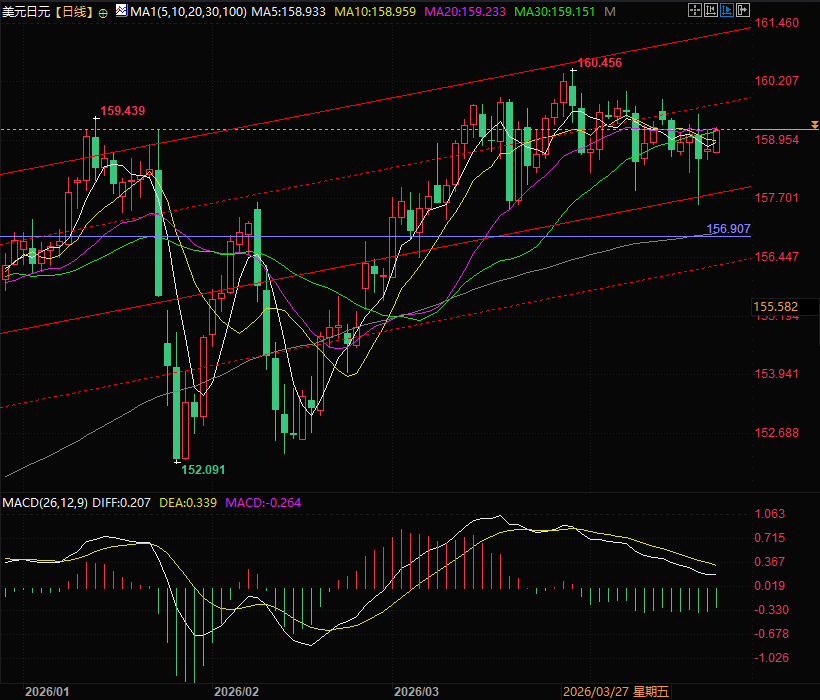
(USD/JPY daily chart, source: EasyForex)
At 20:52 Beijing time, the USD/JPY exchange rate is currently at 159.16/17.
Trump stated that the United States has complete control of the Strait of Hormuz, the blockade has been a huge success, and he believes we will eventually reach a great agreement.
Iran had no choice but to send representatives to the negotiations. We were in a very advantageous position in our negotiations with Iran, while simultaneously claiming it was a regime change. Our negotiations with them were very successful. I anticipated bombing of Iran; the US military was prepared to enter Iran, and attacks on infrastructure could cause military damage. Iran was attempting to relocate its missiles. We now have significantly more equipment than we did a few weeks ago.
The US-Iran peace talks have become a core disruptive factor in the current global financial markets. The Iranian government has not stated that it will send a delegation to Pakistan to participate in the consultations , but in the face of Trump's remarks, the market has shown resilience and still hopes for phased progress in the negotiations.
Meanwhile, the Strait of Hormuz was closed again over the weekend, directly boosting market risk aversion and prompting global investors to adopt a wait-and-see attitude.
Strong US economic data reinforces dollar support.
US retail sales data for March were strong, with both key indicators significantly exceeding market expectations, providing robust support for the US dollar. Overall retail sales rose 1.7% month-over-month, compared to 0.6% in the previous month and market expectations of only 1.4%.
Core retail sales surged 1.9% month-over-month, compared to 0.5% previously and an expected 1.4%, both exceeding expectations.
TD Securities points out that rising gasoline prices are the core driver of the increase in retail sales data. Car sales remain flat and volatile. Catering sales, the only service sector item in the report, showed a steady increase of 0.7% month-on-month. Inflation of core commodities also supported core retail sales.
The job market is also sending strong signals, with the ADP employment report showing a five-day winning streak and weekly average new jobs exceeding 50,000, reaching a new peak.
The ADP National Employment Report's weekly leading indicator, released Tuesday, showed that U.S. private sector employers added an average of 54,750 jobs per week in the four weeks ending April 4, marking the fifth consecutive week of improvement.
This data is a preliminary estimate and may be subject to revision as new data is incorporated.
The 4-week moving average started at 10,000 in the week of March 7th, steadily climbing to the latest reading after reaching 15,250 on March 14th, 26,000 on March 21st, and 40,250 on March 28th. Looking back at the low point at the beginning of the year, the 4-week moving average was only 5,500 in the week of January 17th; the current level represents nearly ten times that. As a high-frequency leading indicator of the monthly non-farm payroll report, the ADP employment impulse's five-week upward trend suggests that the labor market is regaining momentum after the disruption caused by the severe weather at the beginning of the year.
In addition, Federal Reserve Chair nominee Kevin Warsh defended the Fed's policy independence during his nomination hearings and adopted a hawkish stance on inflation.
The resilience of the job market, coupled with the skepticism of Warsh's Fed colleagues at his nomination hearing regarding the AI's rate-cutting argument, creates a subtle tension. If the job market continues to be robust, any arguments for rate cuts based on economic weakness will appear weaker, unless the inflationary shock caused by the Middle East conflict can suppress actual consumer demand. The market is focusing on the subsequent interest rate path and balance sheet policy statements. Multiple positive factors pushed the dollar index slightly higher on Tuesday.
Expectations of the Bank of Japan maintaining its policy stance are building, putting continued downward pressure on the yen.
The yen is facing significant downward pressure from policy factors. Sources indicate that multiple sources within the Bank of Japan (BOJ) have revealed that the BOJ is highly likely to maintain its benchmark interest rate at its monetary policy meeting next week. Policymakers will await further economic data to assess the spillover effects of the Middle East conflict on the Japanese economy.
Market rumors that the Bank of Japan would hold rates steady continued to circulate, directly putting downward pressure on the yen.
Meanwhile, Japan is currently experiencing rampant inflation, with affordable goods either increasing in price or decreasing in quantity. In addition, rising oil prices have led to higher airfares, resulting in a sharp decline in domestic tourism revenue. The yen faces the risk of depreciation both domestically and internationally.
Summary and Technical Analysis:
Driven by a combination of geopolitical tensions and divergent expectations regarding US and Japanese economic data and monetary policy, the USD/JPY exchange rate rebounded and climbed above the 159.00 level. However, the exchange rate remains within its previous trading range, facing significant resistance at the 160.00 level.
The market is currently awaiting further guidance from the final outcome of the US-Iran negotiations and Warsh's testimony, and the short-term range-bound trading pattern of USD/JPY remains unchanged.
(USD/JPY daily chart, source: EasyForex)
At 20:52 Beijing time, the USD/JPY exchange rate is currently at 159.16/17.
- Risk Warning and Disclaimer
- The market involves risk, and trading may not be suitable for all investors. This article is for reference only and does not constitute personal investment advice, nor does it take into account certain users’ specific investment objectives, financial situation, or other needs. Any investment decisions made based on this information are at your own risk.