The US dollar index held steady between 98.00 and 98.50; today's hearing and retail sales data will determine its direction.
2026-04-21 19:04:41
On Tuesday (April 21), during the early European session, the US Dollar Index (DXY) showed a generally stable but slightly bullish trend. After opening, it briefly rose to around 98.50, then fluctuated within the core range of 98.00-98.40, and is currently hovering around 98.11-98.395. The US Dollar Index has maintained a narrow range for several consecutive trading days, with the maximum daily fluctuation controlled at around 0.4%-0.6%, a significant slowdown compared to the rapid rebound driven by safe-haven demand at the end of last week.
Tensions between the United States and Iran have escalated again (the Strait of Hormuz has been closed again, ships have been seized, and negotiations, originally scheduled to end on April 22, have stalled), coupled with the "biggest energy crisis in history" triggered by the Iranian war pushing up oil prices and short-term inflation expectations, creating short-term safe-haven buying support. However, optimistic expectations in the market that the ceasefire agreement may be extended, record financing in Asian private equity and strong semiconductor exports from South Korea are signs of a recovery in risk appetite, which together limit the further upside potential of the US dollar, forming a typical "safe-haven tug-of-war" pattern.
Fundamental analysis
Geopolitical factors and the energy crisis are driving safe-haven premiums : The Strait of Hormuz's temporary reopening followed by its rapid re-closure, the US seizure of Iranian vessels, and related incidents have led to a sustained rise in oil prices. The International Energy Agency (IEA) stated today that "the war with Iran is triggering the biggest energy crisis in history," directly pushing up global inflation expectations. Market concerns about the Federal Reserve's "higher and longer" interest rate path are providing strong safe-haven support for the US dollar in the short term. However, once the ceasefire signal on April 22nd is implemented or negotiations are extended, safe-haven sentiment will quickly subside, resulting in a classic "buy the rumor, sell the fact" market scenario.
The Senate hearing for Federal Reserve Chair nominee Kevin Warsh will begin around 10:00 PM Beijing time. The market widely expects Warsh to take a dovish stance on policy rates but a hardline approach on the Fed's balance sheet adjustment—discussions will focus on technical issues such as "gradual balance sheet reduction versus proactive sales of Treasury bonds/MBS" and whether the repurchase market will repeat the 2019 crisis. The nomination process remains uncertain due to Republican senators blocking the formal vote due to the Justice Department's investigation into the Fed's restructuring. If Warsh's remarks suggest a decline in real interest rates or an overly aggressive balance sheet reduction, it will directly weaken the dollar; conversely, it will strengthen expectations of "higher and longer" interest rates.
The US economy faces a double test with its economic data : March retail sales (MoM) (to be released around 8:30 PM Beijing time, with market expectations of +1.3%, the strongest monthly increase in a year) and ADP weekly employment data are about to be released. If the data matches the Fed's Beige Book description of "not declining sharply," the downward pressure on the dollar will be limited; however, any unexpected weakness (such as retail sales falling short of expectations) will exacerbate concerns about an economic slowdown, strengthen bets on interest rate cuts, and the dollar will face further correction.
Risk appetite recovery provides a hedge : Positive news from Asian markets, such as EQTAB private equity fund raising a record $16 billion and South Korea's semiconductor exports increasing by 50% year-on-year, has significantly reduced the demand for safe-haven assets, thus compressing the upside potential of the US dollar.
Yield curve steepening expectations : With oil prices and short-term inflation expectations high, investors remain inclined to take risks. The loose monetary environment and Fed balance sheet discussions will jointly affect long-term yields. If the Warsh hearing does not trigger sharp fluctuations, the US dollar may remain range-bound in the short term.
mainstream view
Reuters reported today that the dollar rose slightly as the deadline for the Iranian ceasefire approached, with markets reassessing the risks of the Iranian conflict while also focusing on the Warsh nomination process.
Another Reuters analysis published at the same time pointed out that Warsh's path to the top position at the Federal Reserve was already fraught with difficulties before his Senate hearing, and his "small balance sheet" framework concept was becoming a focal point, impacting the economic outlook along with the Iranian energy crisis.
FXEmpire's latest analysis suggests that the US dollar index is facing resistance from its 50-day and 200-day moving averages, indicating weak upward momentum in the short term. A decline in oil prices would further drag down the index.
FXStreet notes that the DXY held steady in the 98.30-98.50 range during the Asian session, supported by tensions in the Middle East and expectations of "higher and longer" interest rates from the Federal Reserve. Today's retail sales data will be a key catalyst.
Technical Analysis
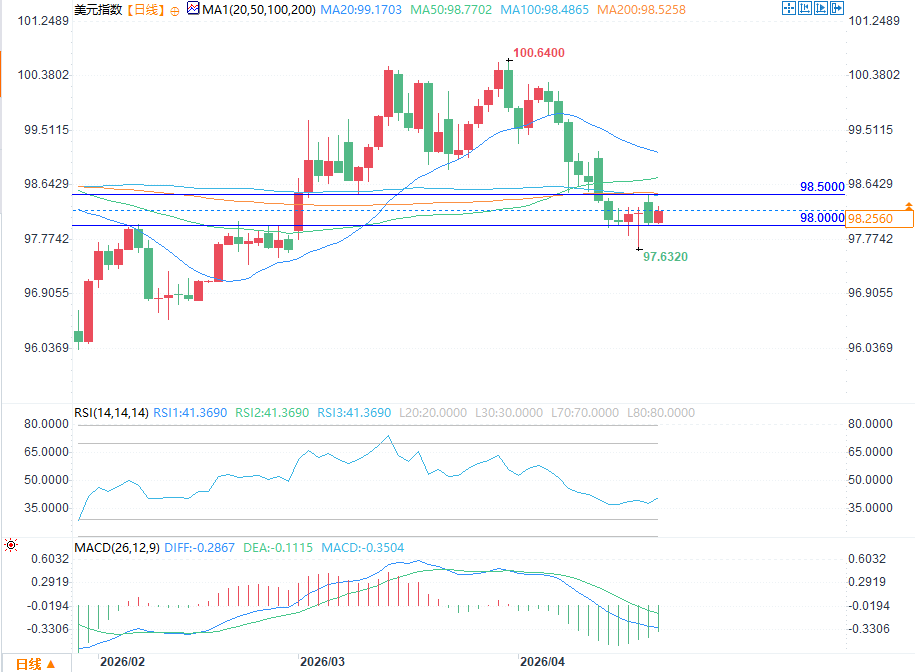
(US Dollar Index Daily Chart Source: FX678)
Moving average system: The 50-day moving average is around 98.73, and the 200-day moving average is around 98.52. Currently, the DXY is below both moving averages, showing a short-term strong sell signal, but the long-term trend remains strong buy. Only a decisive break above 98.524-98.732 can restart the upward trend.
Key support and resistance levels: Support at 97.80-98.097 (50% retracement level and recent multiple rebound zone), resistance at 98.395-98.524 (dense area of moving averages + this week's high); the area around 98.50 is the short-term bullish defense line, a break below 97.96 would confirm the downtrend, while a rise above 98.52 would turn the short-term outlook bullish.
Trend and oscillation chart analysis: The daily chart shows a continued downward trend, but the 98 level has repeatedly provided support. In the short term, it is likely to fluctuate within the 97.50-98.60 range, awaiting retail sales data and the outcome of the Warsh hearing to break the current equilibrium. The MACD indicates moderate upward momentum; attention should be paid to its correlation with oil prices.
Financial Calendar (Beijing Time)
20:30: US March Retail Sales MoM (expected +1.3%) and Retail Sales (excluding automobiles) – Key data; better-than-expected or weaker figures will directly impact the US dollar.
Around 22:00: Senate confirmation hearing for Federal Reserve nominee Kevin Warsh (watch all day, key period starts at 16:00 Central European Time)
Other: API crude oil inventories (around early the next morning) and sporadic speeches by Fed officials.
Note: If retail sales significantly exceed expectations or Warsh's comments are hawkish, the US dollar may rise rapidly; conversely, weak data coupled with a dovish hearing will exacerbate downward pressure, and volatility is expected to increase significantly.
Frequently Asked Questions
Q1: Why are tensions with Iran and the energy crisis continuing to drive the dollar higher?
A1: Geopolitical conflicts typically increase global demand for safe-haven assets, and as the primary reserve currency and safe-haven asset, the US dollar naturally attracts capital inflows. Meanwhile, the closure of the Strait of Hormuz directly pushed up oil prices, with the IEA calling it the "biggest energy crisis in history," further exacerbating inflation concerns. The market is repricing the Fed's slower rate-cutting path, thus supporting dollar yields and exchange rates, creating a multi-faceted positive synergy.
Q2: What is the logic behind the direct impact of the April 22nd negotiation deadline and ceasefire signal on the US dollar's performance?
A2: Negative news such as a deadlock in negotiations or the seizure of ships will immediately ignite risk aversion, giving the US dollar a short-term boost; conversely, if the ceasefire agreement is extended or optimistic signals emerge, risk appetite will quickly recover, and the safe-haven premium for the US dollar will subside, a typical "buy the rumor, sell the fact" scenario. The market has already priced in the optimistic expectation of a "possible extension," therefore, a one-sided upward surge in the US dollar is unlikely.
Q3: Why has the Kevin Walsh hearing become the focus of the market today, and what is its potential impact?
A3: As Trump's nominee for Federal Reserve Chair, Warsh's first public statement will directly shape market expectations regarding the future policy path. He anticipates a moderate stance on interest rates but may take a hard line on balance sheet reduction (discussing gradual reduction versus proactive sales of Treasury bonds/MBS, and whether this will trigger a 2019-style repo crisis). Any remarks suggesting a decline in real interest rates or increased policy uncertainty will have a significant short-term impact on the US dollar. Republican obstruction of the vote has further amplified this uncertainty.
Q4: Where are the potential pressure points for the US dollar from the March retail sales and ADP employment data?
A4: The market expects strong retail sales (+1.3%). If the data meets or exceeds expectations, it will validate economic resilience, support "higher and longer" interest rates, and benefit the US dollar. However, if the data is unexpectedly weak, it will reinforce the signal of an economic slowdown, contradicting the Fed's Beige Book, and the market will increase its bets on interest rate cuts, leading to pressure on the US dollar or even a faster decline. ADP employment data also serves as a leading indicator, amplifying or mitigating the impact of retail sales.
Q5: How are the current risk aversion effect and the recovery in risk appetite creating a tug-of-war at the 98 mark, and what is the overall background?
A5: The market is currently in a typical tug-of-war between escalating geopolitical risks and easing policies coupled with the attractiveness of risk assets. The Iranian energy crisis and the ongoing negotiation stalemate provide safe-haven support, but record-breaking fundraising by Asian private equity funds and strong semiconductor exports boosted the stock market, while the rise in the technology sector weakened the dollar's appeal. Meanwhile, the Warsh hearings and retail sales data are key catalysts for disrupting this balance. The overall backdrop is a triple game of oil prices, inflation, and expectations of Fed policy, causing the DXY to fluctuate repeatedly within the 98 range, awaiting a clear signal.
Tensions between the United States and Iran have escalated again (the Strait of Hormuz has been closed again, ships have been seized, and negotiations, originally scheduled to end on April 22, have stalled), coupled with the "biggest energy crisis in history" triggered by the Iranian war pushing up oil prices and short-term inflation expectations, creating short-term safe-haven buying support. However, optimistic expectations in the market that the ceasefire agreement may be extended, record financing in Asian private equity and strong semiconductor exports from South Korea are signs of a recovery in risk appetite, which together limit the further upside potential of the US dollar, forming a typical "safe-haven tug-of-war" pattern.
Fundamental analysis
Geopolitical factors and the energy crisis are driving safe-haven premiums : The Strait of Hormuz's temporary reopening followed by its rapid re-closure, the US seizure of Iranian vessels, and related incidents have led to a sustained rise in oil prices. The International Energy Agency (IEA) stated today that "the war with Iran is triggering the biggest energy crisis in history," directly pushing up global inflation expectations. Market concerns about the Federal Reserve's "higher and longer" interest rate path are providing strong safe-haven support for the US dollar in the short term. However, once the ceasefire signal on April 22nd is implemented or negotiations are extended, safe-haven sentiment will quickly subside, resulting in a classic "buy the rumor, sell the fact" market scenario.
The Senate hearing for Federal Reserve Chair nominee Kevin Warsh will begin around 10:00 PM Beijing time. The market widely expects Warsh to take a dovish stance on policy rates but a hardline approach on the Fed's balance sheet adjustment—discussions will focus on technical issues such as "gradual balance sheet reduction versus proactive sales of Treasury bonds/MBS" and whether the repurchase market will repeat the 2019 crisis. The nomination process remains uncertain due to Republican senators blocking the formal vote due to the Justice Department's investigation into the Fed's restructuring. If Warsh's remarks suggest a decline in real interest rates or an overly aggressive balance sheet reduction, it will directly weaken the dollar; conversely, it will strengthen expectations of "higher and longer" interest rates.
The US economy faces a double test with its economic data : March retail sales (MoM) (to be released around 8:30 PM Beijing time, with market expectations of +1.3%, the strongest monthly increase in a year) and ADP weekly employment data are about to be released. If the data matches the Fed's Beige Book description of "not declining sharply," the downward pressure on the dollar will be limited; however, any unexpected weakness (such as retail sales falling short of expectations) will exacerbate concerns about an economic slowdown, strengthen bets on interest rate cuts, and the dollar will face further correction.
Risk appetite recovery provides a hedge : Positive news from Asian markets, such as EQTAB private equity fund raising a record $16 billion and South Korea's semiconductor exports increasing by 50% year-on-year, has significantly reduced the demand for safe-haven assets, thus compressing the upside potential of the US dollar.
Yield curve steepening expectations : With oil prices and short-term inflation expectations high, investors remain inclined to take risks. The loose monetary environment and Fed balance sheet discussions will jointly affect long-term yields. If the Warsh hearing does not trigger sharp fluctuations, the US dollar may remain range-bound in the short term.
mainstream view
Reuters reported today that the dollar rose slightly as the deadline for the Iranian ceasefire approached, with markets reassessing the risks of the Iranian conflict while also focusing on the Warsh nomination process.
Another Reuters analysis published at the same time pointed out that Warsh's path to the top position at the Federal Reserve was already fraught with difficulties before his Senate hearing, and his "small balance sheet" framework concept was becoming a focal point, impacting the economic outlook along with the Iranian energy crisis.
FXEmpire's latest analysis suggests that the US dollar index is facing resistance from its 50-day and 200-day moving averages, indicating weak upward momentum in the short term. A decline in oil prices would further drag down the index.
FXStreet notes that the DXY held steady in the 98.30-98.50 range during the Asian session, supported by tensions in the Middle East and expectations of "higher and longer" interest rates from the Federal Reserve. Today's retail sales data will be a key catalyst.
Technical Analysis
(US Dollar Index Daily Chart Source: FX678)
Moving average system: The 50-day moving average is around 98.73, and the 200-day moving average is around 98.52. Currently, the DXY is below both moving averages, showing a short-term strong sell signal, but the long-term trend remains strong buy. Only a decisive break above 98.524-98.732 can restart the upward trend.
Key support and resistance levels: Support at 97.80-98.097 (50% retracement level and recent multiple rebound zone), resistance at 98.395-98.524 (dense area of moving averages + this week's high); the area around 98.50 is the short-term bullish defense line, a break below 97.96 would confirm the downtrend, while a rise above 98.52 would turn the short-term outlook bullish.
Trend and oscillation chart analysis: The daily chart shows a continued downward trend, but the 98 level has repeatedly provided support. In the short term, it is likely to fluctuate within the 97.50-98.60 range, awaiting retail sales data and the outcome of the Warsh hearing to break the current equilibrium. The MACD indicates moderate upward momentum; attention should be paid to its correlation with oil prices.
Financial Calendar (Beijing Time)
20:30: US March Retail Sales MoM (expected +1.3%) and Retail Sales (excluding automobiles) – Key data; better-than-expected or weaker figures will directly impact the US dollar.
Around 22:00: Senate confirmation hearing for Federal Reserve nominee Kevin Warsh (watch all day, key period starts at 16:00 Central European Time)
Other: API crude oil inventories (around early the next morning) and sporadic speeches by Fed officials.
Note: If retail sales significantly exceed expectations or Warsh's comments are hawkish, the US dollar may rise rapidly; conversely, weak data coupled with a dovish hearing will exacerbate downward pressure, and volatility is expected to increase significantly.
Frequently Asked Questions
Q1: Why are tensions with Iran and the energy crisis continuing to drive the dollar higher?
A1: Geopolitical conflicts typically increase global demand for safe-haven assets, and as the primary reserve currency and safe-haven asset, the US dollar naturally attracts capital inflows. Meanwhile, the closure of the Strait of Hormuz directly pushed up oil prices, with the IEA calling it the "biggest energy crisis in history," further exacerbating inflation concerns. The market is repricing the Fed's slower rate-cutting path, thus supporting dollar yields and exchange rates, creating a multi-faceted positive synergy.
Q2: What is the logic behind the direct impact of the April 22nd negotiation deadline and ceasefire signal on the US dollar's performance?
A2: Negative news such as a deadlock in negotiations or the seizure of ships will immediately ignite risk aversion, giving the US dollar a short-term boost; conversely, if the ceasefire agreement is extended or optimistic signals emerge, risk appetite will quickly recover, and the safe-haven premium for the US dollar will subside, a typical "buy the rumor, sell the fact" scenario. The market has already priced in the optimistic expectation of a "possible extension," therefore, a one-sided upward surge in the US dollar is unlikely.
Q3: Why has the Kevin Walsh hearing become the focus of the market today, and what is its potential impact?
A3: As Trump's nominee for Federal Reserve Chair, Warsh's first public statement will directly shape market expectations regarding the future policy path. He anticipates a moderate stance on interest rates but may take a hard line on balance sheet reduction (discussing gradual reduction versus proactive sales of Treasury bonds/MBS, and whether this will trigger a 2019-style repo crisis). Any remarks suggesting a decline in real interest rates or increased policy uncertainty will have a significant short-term impact on the US dollar. Republican obstruction of the vote has further amplified this uncertainty.
Q4: Where are the potential pressure points for the US dollar from the March retail sales and ADP employment data?
A4: The market expects strong retail sales (+1.3%). If the data meets or exceeds expectations, it will validate economic resilience, support "higher and longer" interest rates, and benefit the US dollar. However, if the data is unexpectedly weak, it will reinforce the signal of an economic slowdown, contradicting the Fed's Beige Book, and the market will increase its bets on interest rate cuts, leading to pressure on the US dollar or even a faster decline. ADP employment data also serves as a leading indicator, amplifying or mitigating the impact of retail sales.
Q5: How are the current risk aversion effect and the recovery in risk appetite creating a tug-of-war at the 98 mark, and what is the overall background?
A5: The market is currently in a typical tug-of-war between escalating geopolitical risks and easing policies coupled with the attractiveness of risk assets. The Iranian energy crisis and the ongoing negotiation stalemate provide safe-haven support, but record-breaking fundraising by Asian private equity funds and strong semiconductor exports boosted the stock market, while the rise in the technology sector weakened the dollar's appeal. Meanwhile, the Warsh hearings and retail sales data are key catalysts for disrupting this balance. The overall backdrop is a triple game of oil prices, inflation, and expectations of Fed policy, causing the DXY to fluctuate repeatedly within the 98 range, awaiting a clear signal.
- Risk Warning and Disclaimer
- The market involves risk, and trading may not be suitable for all investors. This article is for reference only and does not constitute personal investment advice, nor does it take into account certain users’ specific investment objectives, financial situation, or other needs. Any investment decisions made based on this information are at your own risk.