













13 Hours Until the US-Iran Ceasefire! Oil Price Trends Hold the Key to the Situation
2026-04-21 19:31:17
On Tuesday (April 21), during the Asian and European sessions, international oil prices remained volatile at a key juncture in the US-Iran negotiations. With the ceasefire deadline approaching on April 22, oil prices experienced several impulsive upward surges but failed to establish a trend, suggesting that the market is still in a tug-of-war between bulls and bears. Meanwhile, most investors are still betting that the peace talks will proceed as scheduled, even with 13 hours remaining, as the market believes that Iran will still attend the meeting.
Pakistan is still pushing forward with preparations for the second round of talks between Iran and the United States in Islamabad, although it remains uncertain whether Tehran will send a delegation, which puts the already fragile ceasefire agreement in jeopardy.
On Tuesday local time, Islamabad continued to lay the groundwork for a new round of talks between the US and Iran.
The two-week ceasefire took effect on April 8, and the market had expected it to be extended if negotiations resumed smoothly.
The White House has confirmed that Vice President Vance will lead the U.S. delegation to the meeting, but Iran has not announced its delegation members, and its state television has stated that no Iranian delegation has traveled to Islamabad so far.
Given that Iranian state television is controlled by hardliners, this statement also reflects the intense internal power struggle within Iran over the US Navy's seizure of an Iranian container ship over the weekend.

Both sides remain firm in their stances and refuse to back down in the public discourse: US President Trump warned that if an agreement is not reached by Wednesday, the ceasefire deadline he set, there will be a large-scale military strike;
Iran's chief negotiator stated that Tehran still holds untold cards on the battlefield .
The previous round of negotiations broke down due to issues such as Iran's nuclear enrichment program, the presence of proxy forces in the region, and the control of the Strait of Hormuz. Although Iran claims to have received a new proposal from the United States, the differences between the two sides remain significant.
Iranian Parliament Speaker and chief negotiator Ghalibaf accused the United States of attempting to force Iran to surrender, emphasizing that Iran would not accept negotiations under threat.
Although Iran did not announce its attendance at the meeting, as the media is controlled by hardliners, there are still many details worth noting. Iranian media reported that Iran is worried that the US negotiations are a pretense and that it is really going to use force again. This actually implies that Iran hopes for a ceasefire and peace talks. At the same time, according to Iranian sources, Iran Air announced that its domestic flights will resume operations from tomorrow (Wednesday) after a 50-day suspension. These are all positive hints for peace talks.
Meanwhile, looking at spot prices, on Tuesday, the Dubai spot premium for Middle Eastern benchmark crude oil continued its decline, falling below the $10 mark per barrel and hitting a seven-week low since early March, as the supply outlook improved significantly due to renewed hopes for US-Iran peace talks.
The United States has expressed confidence in holding peace talks in Pakistan, and a senior Iranian official has also revealed that Tehran is considering joining. Although Iran had earlier ruled out the possibility of a second round of talks this week, according to sources in Pakistan involved in the consultations, momentum is building for a resumption of dialogue on Wednesday.
In a similar manner, the premium for Omani and Murban crude oil has also plummeted in recent pricing, a stark contrast to the surge last month caused by supply disruptions due to the war. Murban and Omani futures prices have both suffered heavy losses.
Demand-side data also provides corroboration, with India's crude oil imports in March falling by 13 percent compared to pre-war February levels.
Citigroup researchers pointed out on Monday that even if the US and Iran agree to extend the ceasefire this week and traffic and production in the Hormuz zone return to normal by the end of June, global crude oil and refined product inventories could still decrease by about 900 million barrels.
Control of the Strait of Hormuz has become the core sticking point in the US-Iran negotiations.
The United States has imposed a blockade on Iranian ports in an attempt to force Iran to relinquish control of this crucial shipping route, through which 20% of the world's natural gas and crude oil trade passes during peacetime.
Iran's tight control over the Strait of Hormuz has directly driven up international oil prices and made the US demand for Iran to restore freedom of navigation in the Strait increasingly difficult to resolve.
To facilitate the negotiations, Pakistan has engaged in multi-party diplomatic efforts. Foreign Minister Dar met separately with the Egyptian Foreign Minister and the Chinese Ambassador to Pakistan. The Chinese Foreign Ministry stated that the current conflict is in a transitional phase between war and peace.
At this critical juncture, the US called on all parties to maintain sincerity and uphold the momentum of the ceasefire and negotiations. Meanwhile, security has been upgraded throughout Islamabad, with security measures far exceeding those implemented during the first round of negotiations in April. It is speculated that if a breakthrough is achieved in the negotiations, high-ranking officials from the US and Iran may be directly involved.
In addition, historic talks between Israel and Lebanon will resume in Washington on Thursday, following the 10-day ceasefire that took effect in Lebanon last Friday.
This round of conflict in the Middle East has caused heavy casualties, with more than 3,300 people killed in Iran, more than 2,290 deaths in the Lebanese conflict, and varying degrees of casualties among Israeli, Gulf state, and US and Israeli military personnel.
The core driver of this round of premium collapse is that speculative premiums are being cleared out in a concentrated manner following diplomatic dialogue signals. The trading logic has shifted from panic pricing of the physical blockade of the Taiwan Strait to a revaluation of the quantity and price of supply recovery after a potential agreement.
The market needs to closely monitor any substantial progress in the Islamabad talks – this is not only a key indicator of whether the Brent-Dubai price spread can stabilize, but will also directly influence crude oil supply and demand expectations and market risk appetite: if the negotiations break down and the ceasefire ends, oil prices will likely see a new round of surges; if the two sides reach a compromise and the geopolitical premium fades, oil prices will face significant downward pressure.
From a technical perspective, Brent crude oil is still holding at the massive volume level of the ceasefire on April 8th. This level implies that the ceasefire will bring about a one-step adjustment in oil prices, but the long-term oil price center will continue to shift upward due to the supply gap caused by the war.
Support is around 89.5-90.
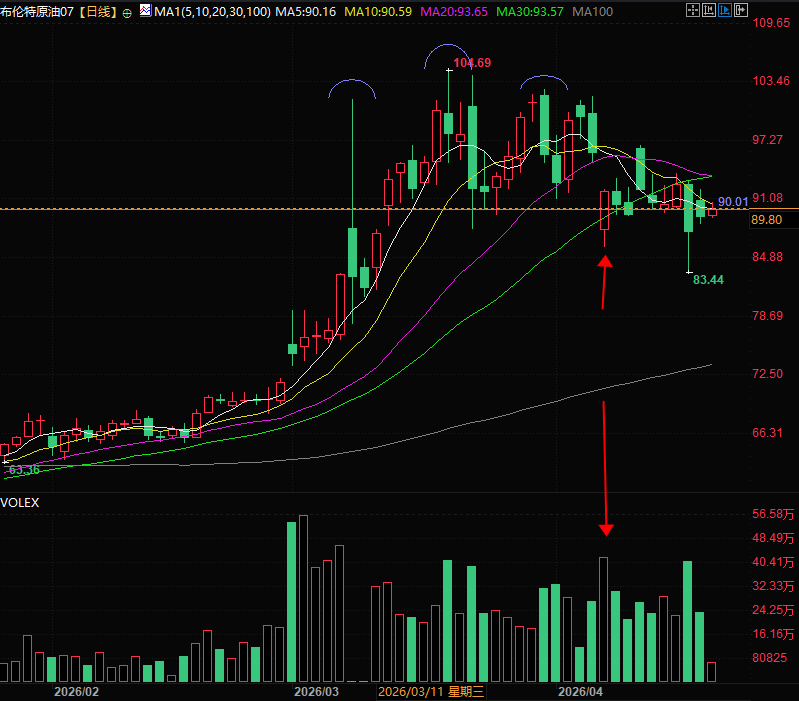
(Brent crude oil July contract daily chart, source: EasyForex)
At 19:30 Beijing time, the Brent crude oil July contract was trading at $90.59 per barrel.
Pakistan is still pushing forward with preparations for the second round of talks between Iran and the United States in Islamabad, although it remains uncertain whether Tehran will send a delegation, which puts the already fragile ceasefire agreement in jeopardy.
On Tuesday local time, Islamabad continued to lay the groundwork for a new round of talks between the US and Iran.
The two-week ceasefire took effect on April 8, and the market had expected it to be extended if negotiations resumed smoothly.
The White House has confirmed that Vice President Vance will lead the U.S. delegation to the meeting, but Iran has not announced its delegation members, and its state television has stated that no Iranian delegation has traveled to Islamabad so far.
Given that Iranian state television is controlled by hardliners, this statement also reflects the intense internal power struggle within Iran over the US Navy's seizure of an Iranian container ship over the weekend.
With both sides adopting a hardline stance and the ceasefire deadline fast approaching, public opinion is turning tough.
Both sides remain firm in their stances and refuse to back down in the public discourse: US President Trump warned that if an agreement is not reached by Wednesday, the ceasefire deadline he set, there will be a large-scale military strike;
Iran's chief negotiator stated that Tehran still holds untold cards on the battlefield .
The previous round of negotiations broke down due to issues such as Iran's nuclear enrichment program, the presence of proxy forces in the region, and the control of the Strait of Hormuz. Although Iran claims to have received a new proposal from the United States, the differences between the two sides remain significant.
Iranian Parliament Speaker and chief negotiator Ghalibaf accused the United States of attempting to force Iran to surrender, emphasizing that Iran would not accept negotiations under threat.
Market details suggest negotiations may proceed smoothly.
Although Iran did not announce its attendance at the meeting, as the media is controlled by hardliners, there are still many details worth noting. Iranian media reported that Iran is worried that the US negotiations are a pretense and that it is really going to use force again. This actually implies that Iran hopes for a ceasefire and peace talks. At the same time, according to Iranian sources, Iran Air announced that its domestic flights will resume operations from tomorrow (Wednesday) after a 50-day suspension. These are all positive hints for peace talks.
Meanwhile, looking at spot prices, on Tuesday, the Dubai spot premium for Middle Eastern benchmark crude oil continued its decline, falling below the $10 mark per barrel and hitting a seven-week low since early March, as the supply outlook improved significantly due to renewed hopes for US-Iran peace talks.
The United States has expressed confidence in holding peace talks in Pakistan, and a senior Iranian official has also revealed that Tehran is considering joining. Although Iran had earlier ruled out the possibility of a second round of talks this week, according to sources in Pakistan involved in the consultations, momentum is building for a resumption of dialogue on Wednesday.
In a similar manner, the premium for Omani and Murban crude oil has also plummeted in recent pricing, a stark contrast to the surge last month caused by supply disruptions due to the war. Murban and Omani futures prices have both suffered heavy losses.
Demand-side data also provides corroboration, with India's crude oil imports in March falling by 13 percent compared to pre-war February levels.
Citigroup researchers pointed out on Monday that even if the US and Iran agree to extend the ceasefire this week and traffic and production in the Hormuz zone return to normal by the end of June, global crude oil and refined product inventories could still decrease by about 900 million barrels.
The core issue: Control of the Strait of Hormuz
Control of the Strait of Hormuz has become the core sticking point in the US-Iran negotiations.
The United States has imposed a blockade on Iranian ports in an attempt to force Iran to relinquish control of this crucial shipping route, through which 20% of the world's natural gas and crude oil trade passes during peacetime.
Iran's tight control over the Strait of Hormuz has directly driven up international oil prices and made the US demand for Iran to restore freedom of navigation in the Strait increasingly difficult to resolve.
Multi-party diplomatic efforts to upgrade security in Islamabad
To facilitate the negotiations, Pakistan has engaged in multi-party diplomatic efforts. Foreign Minister Dar met separately with the Egyptian Foreign Minister and the Chinese Ambassador to Pakistan. The Chinese Foreign Ministry stated that the current conflict is in a transitional phase between war and peace.
At this critical juncture, the US called on all parties to maintain sincerity and uphold the momentum of the ceasefire and negotiations. Meanwhile, security has been upgraded throughout Islamabad, with security measures far exceeding those implemented during the first round of negotiations in April. It is speculated that if a breakthrough is achieved in the negotiations, high-ranking officials from the US and Iran may be directly involved.
Multi-point ceasefire negotiations in the Middle East are progressing simultaneously.
In addition, historic talks between Israel and Lebanon will resume in Washington on Thursday, following the 10-day ceasefire that took effect in Lebanon last Friday.
This round of conflict in the Middle East has caused heavy casualties, with more than 3,300 people killed in Iran, more than 2,290 deaths in the Lebanese conflict, and varying degrees of casualties among Israeli, Gulf state, and US and Israeli military personnel.
Summary and Technical Analysis:
The core driver of this round of premium collapse is that speculative premiums are being cleared out in a concentrated manner following diplomatic dialogue signals. The trading logic has shifted from panic pricing of the physical blockade of the Taiwan Strait to a revaluation of the quantity and price of supply recovery after a potential agreement.
The market needs to closely monitor any substantial progress in the Islamabad talks – this is not only a key indicator of whether the Brent-Dubai price spread can stabilize, but will also directly influence crude oil supply and demand expectations and market risk appetite: if the negotiations break down and the ceasefire ends, oil prices will likely see a new round of surges; if the two sides reach a compromise and the geopolitical premium fades, oil prices will face significant downward pressure.
From a technical perspective, Brent crude oil is still holding at the massive volume level of the ceasefire on April 8th. This level implies that the ceasefire will bring about a one-step adjustment in oil prices, but the long-term oil price center will continue to shift upward due to the supply gap caused by the war.
Support is around 89.5-90.
(Brent crude oil July contract daily chart, source: EasyForex)
At 19:30 Beijing time, the Brent crude oil July contract was trading at $90.59 per barrel.
- Risk Warning and Disclaimer
- The market involves risk, and trading may not be suitable for all investors. This article is for reference only and does not constitute personal investment advice, nor does it take into account certain users’ specific investment objectives, financial situation, or other needs. Any investment decisions made based on this information are at your own risk.

