Gold prices plummeted, pressured by both the ongoing negotiation stalemate and strong economic data.
2026-04-22 02:51:13
Gold prices fell sharply during the US session on Tuesday (April 21), dropping approximately 2.5% intraday. A slight rebound in the US dollar, strong US economic data, uncertainty surrounding the US-Iran ceasefire negotiations, and inflation concerns stemming from rising oil prices were the core factors suppressing gold prices. Although geopolitical risks provided some support, gold still faces significant downward pressure in the short term.
The uncertainty surrounding US-Iran negotiations exacerbates market caution.
The uncertainty surrounding the US-Iran negotiations was a key variable influencing market sentiment that day. The current two-week ceasefire agreement between the two sides expires on Wednesday, and conflicting signals from both sides regarding a second round of peace talks further exacerbated market caution. Some media outlets reported that Iran would send a delegation to Pakistan to participate in the negotiations, but Iranian state television explicitly denied this via Telegram, stating that "so far, no Iranian delegation has gone to Islamabad, neither the initial delegation nor a follow-up delegation." Meanwhile, White House officials stated that US Vice President Vance has not yet departed for the negotiation location, while US President Trump had previously signaled a hardline stance, stating that an extension of the ceasefire agreement was "extremely unlikely" and that "we will not open the Strait of Hormuz until an agreement is reached," while also warning that fighting could break out again if negotiations break down.
On the Iranian side, Mohammad Bagher Ghalibaf stated that Tehran "has always been prepared to offer new bargaining chips in negotiations" and "will not negotiate under the shadow of threats." Furthermore, tensions in the Strait of Hormuz escalated again over the weekend, dashing hopes for peace talks between the US and Iran and further impacting market sentiment. The strait remains under joint blockade by the US Navy and Iran, and the ongoing instability continues to push up oil prices, exacerbating inflation concerns.
Strong US economic data adds further downward pressure
Strong US economic data further pressured gold prices. Earlier in the day, US retail sales data for March were impressive, with a month-on-month increase of 1.7%, far exceeding market expectations of 1.4% and also higher than February's 0.7% growth rate. This is the strongest growth rate since March 2025. This growth was mainly driven by rising fuel prices due to escalating tensions with Iran, leading to a 15.5% year-on-year surge in gas station revenue. Furthermore, the four-week moving average of ADP employment change data rose from 39,000 to 54,800, further confirming the robust state of the US economy. However, it's worth noting that the metals market did not react significantly to the retail sales data; market focus remained more on US-Iran negotiations and expectations regarding Federal Reserve policy.
The US dollar, US Treasury yields, and oil prices are all exerting downward pressure.
A stronger dollar and rising US Treasury yields further weighed on gold prices. The dollar index rose 0.2% that day, making dollar-denominated gold more expensive for investors holding other currencies, reducing its attractiveness; meanwhile, the benchmark 10-year US Treasury yield rose in tandem, further exacerbating the pressure on gold prices.
Bob Haberkorn, senior market strategist at RJO Futures, said that rising yields and the dollar are putting pressure on gold prices, while conflicting signals regarding the situation in Iran are driving up energy prices, also weighing on the precious metals market. Furthermore, oil prices rose more than 3% on Tuesday, partly due to tensions between the US and Iran, and partly due to heightened market concerns about a sharp rise in inflation, which weakened market expectations for a Federal Reserve rate cut. Although gold is generally seen as a hedge against inflation, higher borrowing costs increase the opportunity cost of holding this non-yielding precious metal, further diminishing its appeal.
Federal Reserve policy developments draw market attention
The market is also closely watching developments regarding Federal Reserve policy. During his confirmation hearing before the Senate Banking Committee, Federal Reserve Chair nominee Warsh called for "systemic reforms" within the Fed, including establishing a new framework for addressing inflation, adopting new methods for controlling inflation, and thoroughly overhauling communication mechanisms. This could potentially prevent his colleagues from discussing the direction of monetary policy too much. Warsh clearly stated that the Fed needs a new framework to address persistent inflation, and while he did not provide further details, he emphasized that high prices continue to put pressure on the American public. Haberkorn noted that traders will be closely watching Warsh's remarks, and market volatility is expected to increase significantly during the hearing.
Technical Analysis: Short-term trend is downward with clear signs of bottoming out.
(4-hour chart of spot gold source: EasyForex)
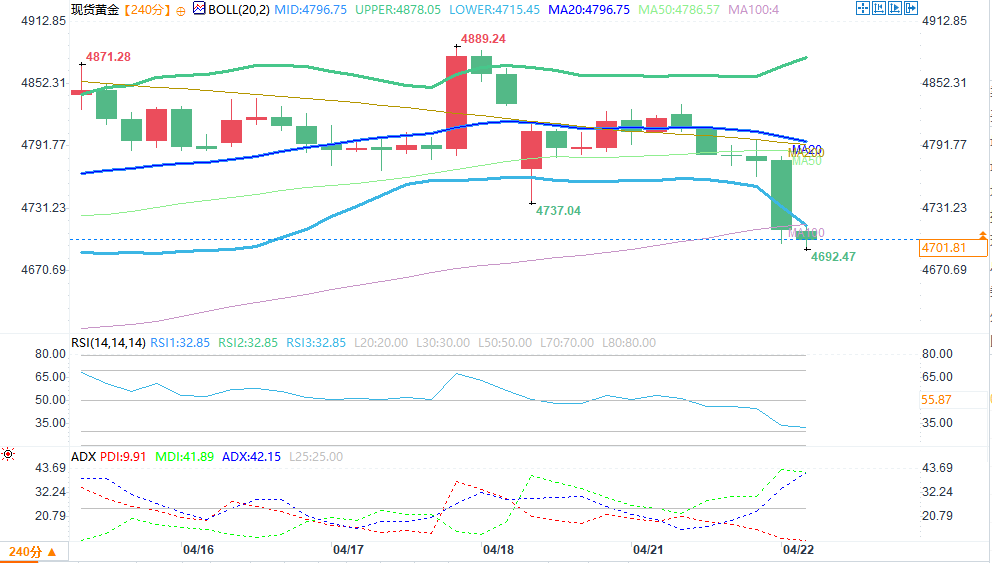
Gold prices are showing a clear short-term downtrend on the 4-hour timeframe, and are generally in a consolidation phase after a breakout, searching for a bottom. Since the previous surge and subsequent pullback, prices have been consistently trading below the 20-period Bollinger Band simple moving average, currently around $4,796.75. The Bollinger Bands are widening downwards, and prices briefly broke below the lower band to $4,692.47, currently still fluctuating around the lower band. Bullish rebounds are weak, failing to form a valid breakout. In terms of indicators, the 14-period Relative Strength Index (RSI) has fallen back to around 32.85, approaching the oversold threshold of 30, suggesting that the market may be in oversold territory, but there has been no clear signal of a bottoming out, indicating insufficient rebound momentum. The Average Directional Index (ADX) is currently at 42.15, having broken through the trend strength threshold of 25, indicating that the current downward trend has strong momentum. Furthermore, the MDI (41.89) is significantly higher than the PDI (9.91), clearly indicating the dominance of the bears. The market is more of a bear-led downward search for a bottom, which aligns with the technical correction needed after the recent sharp decline in gold prices. Combined with the technical charts, gold prices have previously broken through key support levels such as 4,750 and 4,730, and are currently testing the $4,700 level, further reinforcing the short-term bearish bias.
Support and Resistance: Key Price Levels as Watersheds for Price Movements
In terms of support and resistance, combining chart signals and recent technical trends, the primary short-term resistance level is around $4,725 near the lower Bollinger Band. This level, which was previously a support level, has now become strong resistance, exerting significant downward pressure on prices. Failure to break through this level will continue to constrain gold price rebounds. Further resistance levels are around $4,796 near the middle Bollinger Band, followed by the key resistance level of the previous consolidation range around $4,867. Both of these levels represent important defensive zones for the bulls in the past. If prices rebound to these areas, they are likely to encounter strong selling pressure, consistent with the recent technical characteristic of weak gold price rebounds. From a support perspective, the Bollinger Bands indicator and corresponding charts show no clear and effective support level below $4,725. Support can be referenced at the previous lows in the $4,670-$4,650 range. If the price continues to break below $4,725 and holds above it, XAU/USD will likely begin a further downward trend, moving closer to the previous lows. However, if the RSI indicator remains in oversold territory and shows a turning signal, the price may experience a phase of rebound, with an initial target of the Bollinger Band middle line area. The strength of the rebound will depend on whether it breaks through resistance levels.
Future Outlook: Multiple Factors Intertwined, Focus on Three Core Clues
Looking ahead, traders will focus on three key themes: first, the progress of negotiations after the expiration of the US-Iran ceasefire agreement, as any news regarding an extension of the ceasefire or a breakdown in negotiations could trigger sharp fluctuations in gold prices; second, the trends of the US dollar and oil prices, which directly affect the attractiveness of gold and market inflation expectations; and third, the Fed's policy dynamics, especially Warsh's testimony and the specific details of the subsequent inflation response framework, which will further clarify interest rate policy expectations and thus influence gold price trends.
The uncertainty surrounding US-Iran negotiations exacerbates market caution.
The uncertainty surrounding the US-Iran negotiations was a key variable influencing market sentiment that day. The current two-week ceasefire agreement between the two sides expires on Wednesday, and conflicting signals from both sides regarding a second round of peace talks further exacerbated market caution. Some media outlets reported that Iran would send a delegation to Pakistan to participate in the negotiations, but Iranian state television explicitly denied this via Telegram, stating that "so far, no Iranian delegation has gone to Islamabad, neither the initial delegation nor a follow-up delegation." Meanwhile, White House officials stated that US Vice President Vance has not yet departed for the negotiation location, while US President Trump had previously signaled a hardline stance, stating that an extension of the ceasefire agreement was "extremely unlikely" and that "we will not open the Strait of Hormuz until an agreement is reached," while also warning that fighting could break out again if negotiations break down.
On the Iranian side, Mohammad Bagher Ghalibaf stated that Tehran "has always been prepared to offer new bargaining chips in negotiations" and "will not negotiate under the shadow of threats." Furthermore, tensions in the Strait of Hormuz escalated again over the weekend, dashing hopes for peace talks between the US and Iran and further impacting market sentiment. The strait remains under joint blockade by the US Navy and Iran, and the ongoing instability continues to push up oil prices, exacerbating inflation concerns.
Strong US economic data adds further downward pressure
Strong US economic data further pressured gold prices. Earlier in the day, US retail sales data for March were impressive, with a month-on-month increase of 1.7%, far exceeding market expectations of 1.4% and also higher than February's 0.7% growth rate. This is the strongest growth rate since March 2025. This growth was mainly driven by rising fuel prices due to escalating tensions with Iran, leading to a 15.5% year-on-year surge in gas station revenue. Furthermore, the four-week moving average of ADP employment change data rose from 39,000 to 54,800, further confirming the robust state of the US economy. However, it's worth noting that the metals market did not react significantly to the retail sales data; market focus remained more on US-Iran negotiations and expectations regarding Federal Reserve policy.
The US dollar, US Treasury yields, and oil prices are all exerting downward pressure.
A stronger dollar and rising US Treasury yields further weighed on gold prices. The dollar index rose 0.2% that day, making dollar-denominated gold more expensive for investors holding other currencies, reducing its attractiveness; meanwhile, the benchmark 10-year US Treasury yield rose in tandem, further exacerbating the pressure on gold prices.
Bob Haberkorn, senior market strategist at RJO Futures, said that rising yields and the dollar are putting pressure on gold prices, while conflicting signals regarding the situation in Iran are driving up energy prices, also weighing on the precious metals market. Furthermore, oil prices rose more than 3% on Tuesday, partly due to tensions between the US and Iran, and partly due to heightened market concerns about a sharp rise in inflation, which weakened market expectations for a Federal Reserve rate cut. Although gold is generally seen as a hedge against inflation, higher borrowing costs increase the opportunity cost of holding this non-yielding precious metal, further diminishing its appeal.
Federal Reserve policy developments draw market attention
The market is also closely watching developments regarding Federal Reserve policy. During his confirmation hearing before the Senate Banking Committee, Federal Reserve Chair nominee Warsh called for "systemic reforms" within the Fed, including establishing a new framework for addressing inflation, adopting new methods for controlling inflation, and thoroughly overhauling communication mechanisms. This could potentially prevent his colleagues from discussing the direction of monetary policy too much. Warsh clearly stated that the Fed needs a new framework to address persistent inflation, and while he did not provide further details, he emphasized that high prices continue to put pressure on the American public. Haberkorn noted that traders will be closely watching Warsh's remarks, and market volatility is expected to increase significantly during the hearing.
Technical Analysis: Short-term trend is downward with clear signs of bottoming out.
(4-hour chart of spot gold source: EasyForex)
Gold prices are showing a clear short-term downtrend on the 4-hour timeframe, and are generally in a consolidation phase after a breakout, searching for a bottom. Since the previous surge and subsequent pullback, prices have been consistently trading below the 20-period Bollinger Band simple moving average, currently around $4,796.75. The Bollinger Bands are widening downwards, and prices briefly broke below the lower band to $4,692.47, currently still fluctuating around the lower band. Bullish rebounds are weak, failing to form a valid breakout. In terms of indicators, the 14-period Relative Strength Index (RSI) has fallen back to around 32.85, approaching the oversold threshold of 30, suggesting that the market may be in oversold territory, but there has been no clear signal of a bottoming out, indicating insufficient rebound momentum. The Average Directional Index (ADX) is currently at 42.15, having broken through the trend strength threshold of 25, indicating that the current downward trend has strong momentum. Furthermore, the MDI (41.89) is significantly higher than the PDI (9.91), clearly indicating the dominance of the bears. The market is more of a bear-led downward search for a bottom, which aligns with the technical correction needed after the recent sharp decline in gold prices. Combined with the technical charts, gold prices have previously broken through key support levels such as 4,750 and 4,730, and are currently testing the $4,700 level, further reinforcing the short-term bearish bias.
Support and Resistance: Key Price Levels as Watersheds for Price Movements
In terms of support and resistance, combining chart signals and recent technical trends, the primary short-term resistance level is around $4,725 near the lower Bollinger Band. This level, which was previously a support level, has now become strong resistance, exerting significant downward pressure on prices. Failure to break through this level will continue to constrain gold price rebounds. Further resistance levels are around $4,796 near the middle Bollinger Band, followed by the key resistance level of the previous consolidation range around $4,867. Both of these levels represent important defensive zones for the bulls in the past. If prices rebound to these areas, they are likely to encounter strong selling pressure, consistent with the recent technical characteristic of weak gold price rebounds. From a support perspective, the Bollinger Bands indicator and corresponding charts show no clear and effective support level below $4,725. Support can be referenced at the previous lows in the $4,670-$4,650 range. If the price continues to break below $4,725 and holds above it, XAU/USD will likely begin a further downward trend, moving closer to the previous lows. However, if the RSI indicator remains in oversold territory and shows a turning signal, the price may experience a phase of rebound, with an initial target of the Bollinger Band middle line area. The strength of the rebound will depend on whether it breaks through resistance levels.
Future Outlook: Multiple Factors Intertwined, Focus on Three Core Clues
Looking ahead, traders will focus on three key themes: first, the progress of negotiations after the expiration of the US-Iran ceasefire agreement, as any news regarding an extension of the ceasefire or a breakdown in negotiations could trigger sharp fluctuations in gold prices; second, the trends of the US dollar and oil prices, which directly affect the attractiveness of gold and market inflation expectations; and third, the Fed's policy dynamics, especially Warsh's testimony and the specific details of the subsequent inflation response framework, which will further clarify interest rate policy expectations and thus influence gold price trends.
- Risk Warning and Disclaimer
- The market involves risk, and trading may not be suitable for all investors. This article is for reference only and does not constitute personal investment advice, nor does it take into account certain users’ specific investment objectives, financial situation, or other needs. Any investment decisions made based on this information are at your own risk.