Crude oil trading alert: After a slight rebound following the failure of US-Iran negotiations, oil prices returned to range-bound trading.
2026-04-22 09:14:02
WTI crude oil failed to maintain the strong upward momentum of the previous trading day during Wednesday's Asian session, with prices experiencing a mild pullback and currently fluctuating around the mid-$88 area. In terms of market performance, oil prices fell by about 1% during the day, but the overall decline remains limited, reflecting the current market's tug-of-war between technical adjustments and fundamental support.

In the context of this event, the United States announced an extension of the ceasefire with Iran while maintaining its maritime blockade of Iranian ports. This statement eased the risk of a full-blown conflict in the short term, but did not truly eliminate geopolitical uncertainty. Meanwhile, Iran made it clear that it would not restart negotiations unless the blockade was lifted, causing the situation to once again reach a stalemate.
More noteworthy are the military statements. Iran warned of potential strikes against designated targets and emphasized that normal navigation through the Strait of Hormuz would not be restored as long as the blockade continues. This signal directly triggered market concerns about disruptions to energy transport. The Strait of Hormuz handles approximately 20% of global seaborne crude oil transport; a substantial disruption would significantly impact the global energy supply chain.
Against this backdrop, despite a short-term pullback in oil prices, market sentiment has not turned significantly bearish. Instead, investors view the current decline more as a technical correction than a trend reversal. WTI crude oil is currently holding firmly above the $85 mark , indicating that the bullish forces remain resilient.
From a global market perspective, uncertainty surrounding energy prices is being transmitted to inflation expectations. Some market participants are beginning to reassess the impact of future energy costs on the economy, especially given the potential tightening of supply; volatility in oil prices could further amplify macroeconomic uncertainty.
From a technical perspective, the daily chart shows that WTI crude oil remains within an upward channel structure. The previous break above $85 formed a new support area, which has now become a key defensive level. Resistance is concentrated at the $90 psychological level; a break above this level could open up further upside potential. Momentum indicators suggest that although there has been a short-term pullback, overall momentum remains strong, with no clear signs of weakening.
From a 4-hour chart perspective, oil prices have pulled back after reaching highs and entered a short-term consolidation phase. Technically, the RSI has fallen from overbought territory to near neutral territory, indicating some release of short-term overheating sentiment. The MACD indicator shows signs of overbought consolidation, suggesting that while bullish momentum has weakened, it has not completely disappeared. If prices can stabilize above $87, they may retest the $90-$92 range; conversely, a break below key support could trigger a further pullback to the $85 area.
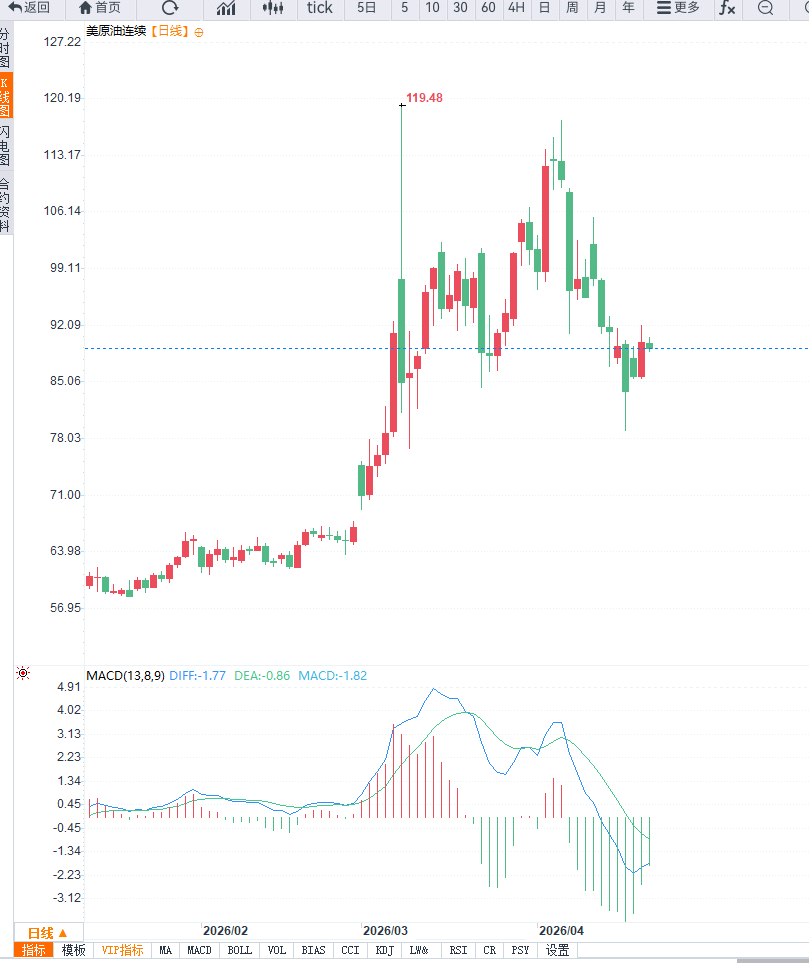
Overall, the current market is driven by a combination of "geopolitical support and technical adjustments." On the one hand, the uncertainty surrounding the Middle East situation continues to provide bottom support for oil prices; on the other hand, the rapid short-term gains have prompted some funds to take profits.
Editor's Summary : The current WTI crude oil price trend exhibits a typical "high-level consolidation" pattern. Geopolitical risks provide solid support for prices, while technical corrections limit short-term gains. Before a substantial easing of the Middle East situation, the downside for oil prices is expected to be limited. Future price movements will depend on two key variables: whether there will be actual supply disruptions in the Strait of Hormuz, and whether relevant parties release signals of de-escalation. From an investment perspective, short-term caution is warranted against increased volatility, while medium-term attention can still be paid to upward opportunities driven by geopolitical factors.
In the context of this event, the United States announced an extension of the ceasefire with Iran while maintaining its maritime blockade of Iranian ports. This statement eased the risk of a full-blown conflict in the short term, but did not truly eliminate geopolitical uncertainty. Meanwhile, Iran made it clear that it would not restart negotiations unless the blockade was lifted, causing the situation to once again reach a stalemate.
More noteworthy are the military statements. Iran warned of potential strikes against designated targets and emphasized that normal navigation through the Strait of Hormuz would not be restored as long as the blockade continues. This signal directly triggered market concerns about disruptions to energy transport. The Strait of Hormuz handles approximately 20% of global seaborne crude oil transport; a substantial disruption would significantly impact the global energy supply chain.
Against this backdrop, despite a short-term pullback in oil prices, market sentiment has not turned significantly bearish. Instead, investors view the current decline more as a technical correction than a trend reversal. WTI crude oil is currently holding firmly above the $85 mark , indicating that the bullish forces remain resilient.
From a global market perspective, uncertainty surrounding energy prices is being transmitted to inflation expectations. Some market participants are beginning to reassess the impact of future energy costs on the economy, especially given the potential tightening of supply; volatility in oil prices could further amplify macroeconomic uncertainty.
From a technical perspective, the daily chart shows that WTI crude oil remains within an upward channel structure. The previous break above $85 formed a new support area, which has now become a key defensive level. Resistance is concentrated at the $90 psychological level; a break above this level could open up further upside potential. Momentum indicators suggest that although there has been a short-term pullback, overall momentum remains strong, with no clear signs of weakening.
From a 4-hour chart perspective, oil prices have pulled back after reaching highs and entered a short-term consolidation phase. Technically, the RSI has fallen from overbought territory to near neutral territory, indicating some release of short-term overheating sentiment. The MACD indicator shows signs of overbought consolidation, suggesting that while bullish momentum has weakened, it has not completely disappeared. If prices can stabilize above $87, they may retest the $90-$92 range; conversely, a break below key support could trigger a further pullback to the $85 area.
Overall, the current market is driven by a combination of "geopolitical support and technical adjustments." On the one hand, the uncertainty surrounding the Middle East situation continues to provide bottom support for oil prices; on the other hand, the rapid short-term gains have prompted some funds to take profits.
Editor's Summary : The current WTI crude oil price trend exhibits a typical "high-level consolidation" pattern. Geopolitical risks provide solid support for prices, while technical corrections limit short-term gains. Before a substantial easing of the Middle East situation, the downside for oil prices is expected to be limited. Future price movements will depend on two key variables: whether there will be actual supply disruptions in the Strait of Hormuz, and whether relevant parties release signals of de-escalation. From an investment perspective, short-term caution is warranted against increased volatility, while medium-term attention can still be paid to upward opportunities driven by geopolitical factors.
- Risk Warning and Disclaimer
- The market involves risk, and trading may not be suitable for all investors. This article is for reference only and does not constitute personal investment advice, nor does it take into account certain users’ specific investment objectives, financial situation, or other needs. Any investment decisions made based on this information are at your own risk.