Geopolitical tensions fueled inflation expectations, while strong US retail sales data caused gold prices to fluctuate and decline.
2026-04-22 09:28:50
Gold prices retreated somewhat during Wednesday's Asian trading session, with XAU/USD trading under pressure around $4740. Market sentiment suggests that despite previous gains driven by geopolitical uncertainty, the bullish momentum in gold has clearly slowed, with short-term funds beginning to take profits.

From the perspective of the event's context, the situation in the Middle East remains complex. The United States indicated it would extend the ceasefire with Iran to buy more time for negotiations. However, policy statements have shifted significantly in a short period, moving from strong threats to conciliatory signals, leaving the market lacking clear expectations for the future direction of the situation. This uncertainty should have supported gold's safe-haven appeal, but its actual performance has been suppressed by macroeconomic factors.
A more crucial driver comes from the energy market. Increased shipping risks in the Strait of Hormuz and escalating concerns about oil supply disruptions are pushing up energy prices. Rising energy costs are reinforcing inflation expectations , a shift that has a dual impact on gold. On the one hand, rising inflation is generally bullish for gold; but on the other hand, higher inflation means central banks are likely to maintain higher interest rates, thus diminishing the attractiveness of gold as a non-interest-bearing asset.
On the macroeconomic front, strong US economic performance further fueled market expectations that interest rates would remain high. Market surveys showed that US retail sales rose 1.7% month-on-month in March, significantly higher than the market expectation of 1.4% and also higher than the revised previous figure of 0.7%. Year-on-year, retail sales grew by 4.0% , indicating that consumer demand remains robust. This data directly boosted the US dollar, putting pressure on gold priced in US dollars. A stronger dollar typically suppresses gold prices because it increases the purchasing costs for holders of other currencies.
From a market sentiment perspective, investors are currently caught in a tug-of-war between safe-haven demand and interest rate pressures. On the one hand, the uncertainty surrounding the situation in the Middle East continues, providing a floor for gold; on the other hand, strong economic data and rising inflation expectations have cast doubt on the path of interest rate cuts, thus limiting the upside potential for gold.
From a technical perspective, the daily chart shows that gold had been in an upward trend, but recently encountered resistance and fell back near $4800, forming a temporary top. Currently, the price has fallen to the $4720 area, close to a short-term support zone. The $4700 level has become a key defense level ; a break below this level could open up further downside potential to around $4650. Resistance is concentrated in the $4780-$4800 range.
From a 4-hour chart perspective, gold's short-term trend has turned bearish with a break below the short-term moving average system, indicating weakening bullish momentum. Technically, the RSI has fallen from overbought territory to below the neutral zone, reflecting reduced buying pressure; the MACD shows signs of a death cross, suggesting continued downward pressure in the short term. However, if the price can stabilize above $4700, it may attract bargain hunters again and test the area above $4750.
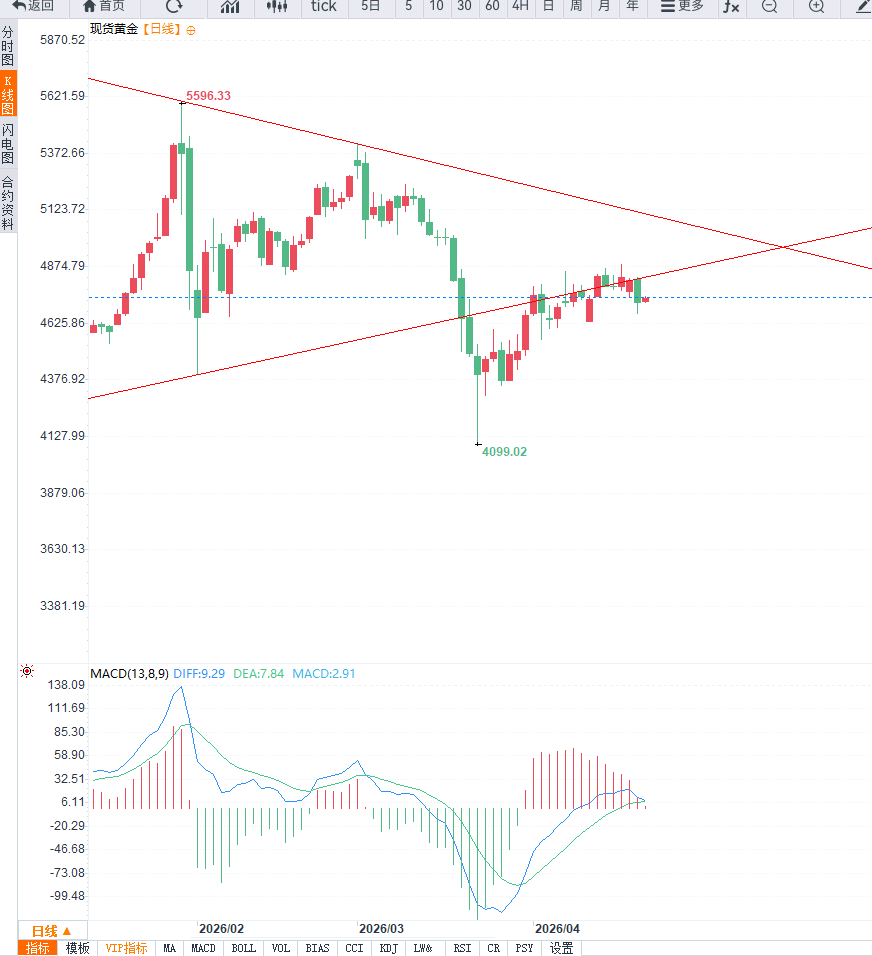
Overall, gold's current price movement is influenced by a confluence of factors. Geopolitical risks are providing support, but macroeconomic data and interest rate expectations are dominating the short-term direction, causing gold prices to enter a consolidation phase.
Editor's Summary : The gold market is currently at a critical turning point. Geopolitical uncertainty continues to provide a floor for prices, but rising inflation expectations and strong economic data are reinforcing market expectations of "high interest rates lasting longer," thus exerting sustained downward pressure on gold. In the short term, gold prices may maintain a range-bound trading pattern, and investors should pay close attention to the movement of the US dollar and changes in interest rate expectations. In the medium to long term, if inflation continues to rise and policy space is limited, gold still has the potential to strengthen again, but the path may be more tortuous.
From the perspective of the event's context, the situation in the Middle East remains complex. The United States indicated it would extend the ceasefire with Iran to buy more time for negotiations. However, policy statements have shifted significantly in a short period, moving from strong threats to conciliatory signals, leaving the market lacking clear expectations for the future direction of the situation. This uncertainty should have supported gold's safe-haven appeal, but its actual performance has been suppressed by macroeconomic factors.
A more crucial driver comes from the energy market. Increased shipping risks in the Strait of Hormuz and escalating concerns about oil supply disruptions are pushing up energy prices. Rising energy costs are reinforcing inflation expectations , a shift that has a dual impact on gold. On the one hand, rising inflation is generally bullish for gold; but on the other hand, higher inflation means central banks are likely to maintain higher interest rates, thus diminishing the attractiveness of gold as a non-interest-bearing asset.
On the macroeconomic front, strong US economic performance further fueled market expectations that interest rates would remain high. Market surveys showed that US retail sales rose 1.7% month-on-month in March, significantly higher than the market expectation of 1.4% and also higher than the revised previous figure of 0.7%. Year-on-year, retail sales grew by 4.0% , indicating that consumer demand remains robust. This data directly boosted the US dollar, putting pressure on gold priced in US dollars. A stronger dollar typically suppresses gold prices because it increases the purchasing costs for holders of other currencies.
From a market sentiment perspective, investors are currently caught in a tug-of-war between safe-haven demand and interest rate pressures. On the one hand, the uncertainty surrounding the situation in the Middle East continues, providing a floor for gold; on the other hand, strong economic data and rising inflation expectations have cast doubt on the path of interest rate cuts, thus limiting the upside potential for gold.
From a technical perspective, the daily chart shows that gold had been in an upward trend, but recently encountered resistance and fell back near $4800, forming a temporary top. Currently, the price has fallen to the $4720 area, close to a short-term support zone. The $4700 level has become a key defense level ; a break below this level could open up further downside potential to around $4650. Resistance is concentrated in the $4780-$4800 range.
From a 4-hour chart perspective, gold's short-term trend has turned bearish with a break below the short-term moving average system, indicating weakening bullish momentum. Technically, the RSI has fallen from overbought territory to below the neutral zone, reflecting reduced buying pressure; the MACD shows signs of a death cross, suggesting continued downward pressure in the short term. However, if the price can stabilize above $4700, it may attract bargain hunters again and test the area above $4750.
Overall, gold's current price movement is influenced by a confluence of factors. Geopolitical risks are providing support, but macroeconomic data and interest rate expectations are dominating the short-term direction, causing gold prices to enter a consolidation phase.
Editor's Summary : The gold market is currently at a critical turning point. Geopolitical uncertainty continues to provide a floor for prices, but rising inflation expectations and strong economic data are reinforcing market expectations of "high interest rates lasting longer," thus exerting sustained downward pressure on gold. In the short term, gold prices may maintain a range-bound trading pattern, and investors should pay close attention to the movement of the US dollar and changes in interest rate expectations. In the medium to long term, if inflation continues to rise and policy space is limited, gold still has the potential to strengthen again, but the path may be more tortuous.
- Risk Warning and Disclaimer
- The market involves risk, and trading may not be suitable for all investors. This article is for reference only and does not constitute personal investment advice, nor does it take into account certain users’ specific investment objectives, financial situation, or other needs. Any investment decisions made based on this information are at your own risk.