Reactions to the US-Iran ceasefire extension varied.
2026-04-22 19:09:10
On Wednesday (April 22), the ceasefire agreement between the US and Iran in the Middle East was extended. Despite US President Trump's earlier repeated statements that an extension was "highly unlikely" and threats of stronger military action if an agreement could not be reached, he suddenly announced on TruthSocial yesterday that the ceasefire would be extended indefinitely at the request of Pakistani mediators until Iranian leaders submit a "unified proposal" and discussions are completed. At the same time, he explicitly instructed the US military to maintain the naval blockade of Iranian ports and to remain "ready and capable" of action in other areas. Trump attributed this move to the "serious division" within the Iranian government, arguing that time was needed to form a unified position.
Trump's statement
Trump emphasized that the extension was to allow diplomatic space, stating that it was at the request of Pakistani Prime Minister Sheikh Baz Sharif and Field Marshal Asim Munir, with the aim of getting Iran to propose an end to the war. He also reiterated that the United States would not ease pressure, that the blockade would continue to be used as leverage, and stated, "Iran has no choice. We have destroyed their navy, air force, and part of their leadership, and ultimately a great deal will be reached."
Trump also pointed out that the Iranian government is "deeply divided," which provides justification for the extension, while emphasizing in social media and related statements that the United States is in a strong negotiating position and will not rush into a "bad deal." This statement is seen as an attempt by the United States to maintain a strong stance while avoiding an immediate resumption of conflict.
Iran's statement
Iran's reaction was noticeably negative and skeptical. In response to Trump's statement extending the ceasefire, Iranian state television swiftly declared in the early hours of April 22nd that "Iran has become the victor on the battlefield." Iran emphasized that control of the Strait of Hormuz was an "extremely valuable bargaining chip" it had gained in the war, and that even with the agreed-upon truce, "the war is not over." Iran pointed out that they did not demand an extension of the ceasefire, but rather viewed it as a manifestation of forced compromise by the United States.
Iranian officials, including Mahdi Mohammadi, a senior advisor to the Iranian parliamentary speaker, had previously stated that Trump's announcement was "meaningless" and merely a "tactic to buy time for a surprise attack." Media affiliated with the Iranian Revolutionary Guard reiterated that Iran would break the US blockade by force, and that negotiations could only resume if the US lifted the blockade. Currently, Iran has not formally confirmed acceptance of the extension, with some officials viewing it as a delaying tactic by the US. Iran has even held military parades and victory celebrations to demonstrate its tough stance. Even after the extension was announced, attacks on cargo ships continued in the Strait of Hormuz, further highlighting the fragility of the situation.
UN Secretary-General Guterres welcomed the move, calling it "an important step towards de-escalation," while Israel, as a US ally, remained cautious. The situation in the Strait of Hormuz remains highly uncertain, with commercial shipping hampered and energy supply risks persisting. Both sides' narratives of victory have further fueled market skepticism about the stability of the agreement.
Asset performance
Market reactions to the ceasefire extension were mixed, with caution and volatility prevailing. Following the announcement of the extension, US stock index futures rebounded slightly, recovering some of yesterday's losses; European stock futures opened with expectations of modestly lower prices, while Asian markets remained relatively weak due to ongoing concerns about the conflict.
Despite increased risks, energy prices reacted relatively mildly to the ceasefire extension. Reports indicate that Iran did not request an extension, and attacks are still expected in the Strait of Hormuz even after the extension, further increasing market uncertainty. US crude oil prices, which had surged by over 5% during the height of the conflict, briefly touched a key technical resistance level, but saw a significant pullback this morning following the announcement of the extension. Currently, WTI crude is hovering around $89-91 per barrel (real-time prices may fluctuate slightly), while Brent crude is oscillating between $97 and $100. The tight supply situation has been partially offset by slowing global demand – high oil prices have begun to dampen consumption, limiting further price increases.
From a technical perspective, the current price level is close to a key Fibonacci retracement level for oil price fluctuations this year (for example, the area around $94 has served as a reference point for the 38.2% retracement level). This level could be a crucial turning point between consolidation and continued upward movement in oil prices. If oil prices break through this level, $100 is expected to become a strong psychological resistance level, and may even test higher levels. However, overall, oil price volatility is likely to persist, and oil prices will remain significantly higher than pre-conflict levels. Nevertheless, due to the fact that high oil prices can accelerate demand destruction, the potential for further price increases is relatively limited. The market appears to be experiencing significant volatility, with an initial cautious optimism regarding the extension of the lockdown, but the continued lockdown and the risk of potential attacks quickly pulled back the gains.
Recent developments support this view: due to persistently high oil prices, European refineries have begun to reduce processing volumes, with some even experiencing negative refining margins. European refiners face fierce competition from Asian buyers for crude oil, leading to rising costs while refined product prices remain high but profits are squeezed. Some analysts point out that if margin pressures persist, European refinery utilization rates could fall by hundreds of thousands of barrels per day, which would further alleviate some supply shortages but also exacerbate the risk of energy shortages in Europe, including potential flight cancellations and restrictions on industrial production.
Therefore, the yield on the 2-year U.S. Treasury note rose slightly yesterday to around 3.80%. This change is due to data such as retail sales indicating strong economic resilience, and rising inflation expectations caused by energy prices, which has reduced the need for a significant interest rate cut in the short term.
In the early stages of the Iranian conflict, the US dollar strengthened, supported by safe-haven demand and rising inflation expectations driven by energy prices. However, its upward momentum weakened significantly after the ceasefire extension was announced, returning to near pre-conflict levels. The euro rebounded against the dollar after hitting a key technical resistance level, keeping the pair within its overall upward trend since Trump's inauguration, reflecting concerns about European economic growth and energy vulnerability. As a net energy importer, the Eurozone is more sensitive to disruptions in the Strait of Hormuz, putting pressure on the euro but stabilizing somewhat with diplomatic progress. The dollar/yen exchange rate hovered below the 160 level, with limited room for further dollar appreciation due to the risk of intervention from the Bank of Japan. High oil prices also put additional pressure on the yen, as Japan is highly dependent on energy imports.
Market Commentary
Analysts have offered a pragmatic interpretation of the ceasefire extension, generally believing it provides valuable breathing room for negotiations. However, they also emphasize that uncertainty is far from over, and geopolitical risks could still rebound at any time. Both sides declared a "victory," with Trump emphasizing that the US has achieved its military objectives and maintained leverage in the blockade, while Iran loudly proclaimed its control of the Strait of Hormuz as a "valuable bargaining chip" and viewed the extension as a battlefield victory, further amplifying market concerns about the fragility of the agreement.
JPcMorgan's energy research team pointed out that although the US-maintained naval blockade will put pressure on Iranian crude oil exports in the short term, Iran still has a large amount of crude oil in transit and inventory buffers, so the actual impact of the supply disruption may be smaller than the market initially expected. They predict that if the blockade continues for several weeks, the oil price risk premium will remain at a high level, but if negotiations make substantial progress, oil prices are expected to gradually fall back to below $90 in the second quarter.
The agency also warned that continued compression of European refining margins could lead to lower refinery utilization rates, exacerbating regional energy shortages, but this also alleviates some pressure on global crude oil demand. While Iran's "victory" claim is primarily for propaganda purposes, increased actual control of the Strait of Hormuz could provide Iran with more leverage in future negotiations, increasing the complexity of reaching an agreement.
Goldman Sachs revised its second-quarter oil price forecasts in its latest report, lowering its average expectation for Brent crude from $99 to around $90, and for WTI to around $87. They believe the extended ceasefire has reduced frontline risk premiums, and there are signs of some recovery in oil flow through the Strait of Hormuz. Goldman Sachs also cautioned that if Iran's subsequent proposals fail to meet US demands, or if the blockade becomes prolonged, energy-driven inflationary pressures could still delay the Federal Reserve's policy normalization process.
The bank noted that the market is currently pricing in a "post-conflict scenario," but the short term (the next month or two) remains the riskiest window, as any renewed escalation could quickly push up oil prices and impact global growth expectations. Analysts specifically mentioned that while the "victorious" pronouncements on Iranian state television had a strong domestic mobilization flavor, they also reflected Tehran's unwillingness to easily concede on core interests such as missile capabilities and nuclear technology, which could prolong the negotiation process and maintain oil price volatility.
Geopolitical analysts point out that while Trump's decision to extend the blockade shows some flexibility, the continued blockade means that negotiations remain in a "high-risk balance." They believe that the market's current optimism about the prospects for peace may be somewhat excessive, as Iran's tough response and domestic political divisions (coupled with a "victory" narrative) make reaching a "unified proposal" far more difficult than it appears.
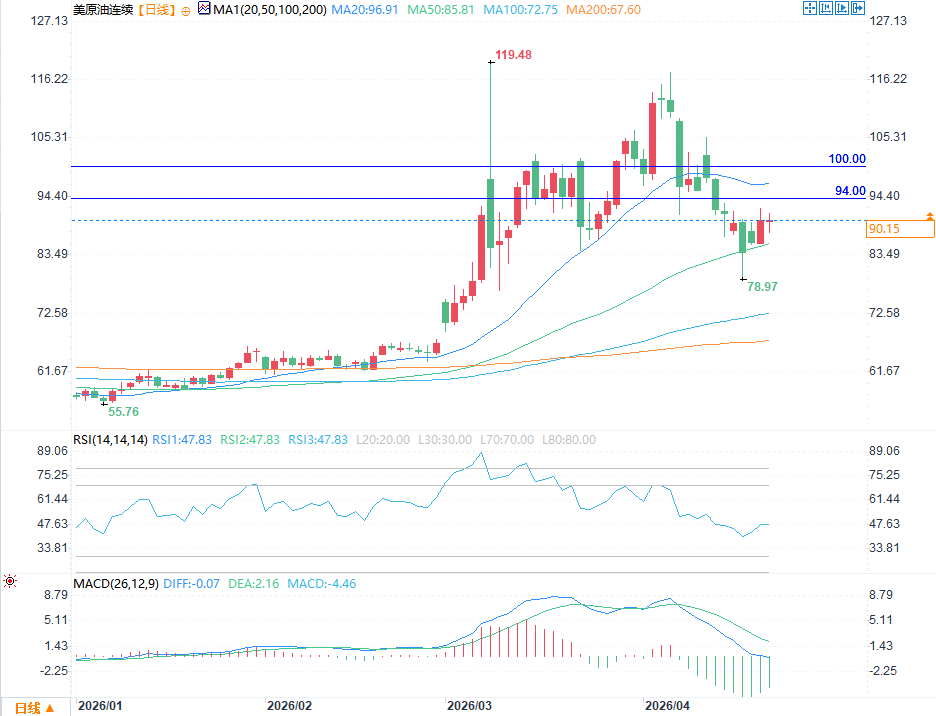
(WTI crude oil daily chart source: FX678)
While the extension opens a window for diplomacy, the continued blockade casts uncertainty over the prospects for negotiations. Investors should not view this extension as a signal of the end of the conflict, but rather as a tactical move to "buy time." The contrast between the victory claims of both sides further highlights the uncertainty that may arise from the differing narratives.
Some macro analysts further pointed out that the market's relatively mild reaction to geopolitical events was not surprising, reflecting that investors have gradually adapted to a highly volatile environment, while the resilience of US domestic consumption has provided a buffer; however, if oil prices remain high for an extended period, rising inflation expectations will limit the Federal Reserve's room for interest rate cuts and may lead to a further steepening of the yield curve.
Overall, a highly volatile environment is expected to continue to dominate short-term trends, while the long-term direction will depend on whether diplomacy can translate into substantial de-escalation, rather than each side's narrative of "victory." Against this backdrop, market focus is gradually shifting from short-term geopolitical events to long-term economic resilience.
Trump's statement
Trump emphasized that the extension was to allow diplomatic space, stating that it was at the request of Pakistani Prime Minister Sheikh Baz Sharif and Field Marshal Asim Munir, with the aim of getting Iran to propose an end to the war. He also reiterated that the United States would not ease pressure, that the blockade would continue to be used as leverage, and stated, "Iran has no choice. We have destroyed their navy, air force, and part of their leadership, and ultimately a great deal will be reached."
Trump also pointed out that the Iranian government is "deeply divided," which provides justification for the extension, while emphasizing in social media and related statements that the United States is in a strong negotiating position and will not rush into a "bad deal." This statement is seen as an attempt by the United States to maintain a strong stance while avoiding an immediate resumption of conflict.
Iran's statement
Iran's reaction was noticeably negative and skeptical. In response to Trump's statement extending the ceasefire, Iranian state television swiftly declared in the early hours of April 22nd that "Iran has become the victor on the battlefield." Iran emphasized that control of the Strait of Hormuz was an "extremely valuable bargaining chip" it had gained in the war, and that even with the agreed-upon truce, "the war is not over." Iran pointed out that they did not demand an extension of the ceasefire, but rather viewed it as a manifestation of forced compromise by the United States.
Iranian officials, including Mahdi Mohammadi, a senior advisor to the Iranian parliamentary speaker, had previously stated that Trump's announcement was "meaningless" and merely a "tactic to buy time for a surprise attack." Media affiliated with the Iranian Revolutionary Guard reiterated that Iran would break the US blockade by force, and that negotiations could only resume if the US lifted the blockade. Currently, Iran has not formally confirmed acceptance of the extension, with some officials viewing it as a delaying tactic by the US. Iran has even held military parades and victory celebrations to demonstrate its tough stance. Even after the extension was announced, attacks on cargo ships continued in the Strait of Hormuz, further highlighting the fragility of the situation.
UN Secretary-General Guterres welcomed the move, calling it "an important step towards de-escalation," while Israel, as a US ally, remained cautious. The situation in the Strait of Hormuz remains highly uncertain, with commercial shipping hampered and energy supply risks persisting. Both sides' narratives of victory have further fueled market skepticism about the stability of the agreement.
Asset performance
Market reactions to the ceasefire extension were mixed, with caution and volatility prevailing. Following the announcement of the extension, US stock index futures rebounded slightly, recovering some of yesterday's losses; European stock futures opened with expectations of modestly lower prices, while Asian markets remained relatively weak due to ongoing concerns about the conflict.
Despite increased risks, energy prices reacted relatively mildly to the ceasefire extension. Reports indicate that Iran did not request an extension, and attacks are still expected in the Strait of Hormuz even after the extension, further increasing market uncertainty. US crude oil prices, which had surged by over 5% during the height of the conflict, briefly touched a key technical resistance level, but saw a significant pullback this morning following the announcement of the extension. Currently, WTI crude is hovering around $89-91 per barrel (real-time prices may fluctuate slightly), while Brent crude is oscillating between $97 and $100. The tight supply situation has been partially offset by slowing global demand – high oil prices have begun to dampen consumption, limiting further price increases.
From a technical perspective, the current price level is close to a key Fibonacci retracement level for oil price fluctuations this year (for example, the area around $94 has served as a reference point for the 38.2% retracement level). This level could be a crucial turning point between consolidation and continued upward movement in oil prices. If oil prices break through this level, $100 is expected to become a strong psychological resistance level, and may even test higher levels. However, overall, oil price volatility is likely to persist, and oil prices will remain significantly higher than pre-conflict levels. Nevertheless, due to the fact that high oil prices can accelerate demand destruction, the potential for further price increases is relatively limited. The market appears to be experiencing significant volatility, with an initial cautious optimism regarding the extension of the lockdown, but the continued lockdown and the risk of potential attacks quickly pulled back the gains.
Recent developments support this view: due to persistently high oil prices, European refineries have begun to reduce processing volumes, with some even experiencing negative refining margins. European refiners face fierce competition from Asian buyers for crude oil, leading to rising costs while refined product prices remain high but profits are squeezed. Some analysts point out that if margin pressures persist, European refinery utilization rates could fall by hundreds of thousands of barrels per day, which would further alleviate some supply shortages but also exacerbate the risk of energy shortages in Europe, including potential flight cancellations and restrictions on industrial production.
Therefore, the yield on the 2-year U.S. Treasury note rose slightly yesterday to around 3.80%. This change is due to data such as retail sales indicating strong economic resilience, and rising inflation expectations caused by energy prices, which has reduced the need for a significant interest rate cut in the short term.
In the early stages of the Iranian conflict, the US dollar strengthened, supported by safe-haven demand and rising inflation expectations driven by energy prices. However, its upward momentum weakened significantly after the ceasefire extension was announced, returning to near pre-conflict levels. The euro rebounded against the dollar after hitting a key technical resistance level, keeping the pair within its overall upward trend since Trump's inauguration, reflecting concerns about European economic growth and energy vulnerability. As a net energy importer, the Eurozone is more sensitive to disruptions in the Strait of Hormuz, putting pressure on the euro but stabilizing somewhat with diplomatic progress. The dollar/yen exchange rate hovered below the 160 level, with limited room for further dollar appreciation due to the risk of intervention from the Bank of Japan. High oil prices also put additional pressure on the yen, as Japan is highly dependent on energy imports.
Market Commentary
Analysts have offered a pragmatic interpretation of the ceasefire extension, generally believing it provides valuable breathing room for negotiations. However, they also emphasize that uncertainty is far from over, and geopolitical risks could still rebound at any time. Both sides declared a "victory," with Trump emphasizing that the US has achieved its military objectives and maintained leverage in the blockade, while Iran loudly proclaimed its control of the Strait of Hormuz as a "valuable bargaining chip" and viewed the extension as a battlefield victory, further amplifying market concerns about the fragility of the agreement.
JPcMorgan's energy research team pointed out that although the US-maintained naval blockade will put pressure on Iranian crude oil exports in the short term, Iran still has a large amount of crude oil in transit and inventory buffers, so the actual impact of the supply disruption may be smaller than the market initially expected. They predict that if the blockade continues for several weeks, the oil price risk premium will remain at a high level, but if negotiations make substantial progress, oil prices are expected to gradually fall back to below $90 in the second quarter.
The agency also warned that continued compression of European refining margins could lead to lower refinery utilization rates, exacerbating regional energy shortages, but this also alleviates some pressure on global crude oil demand. While Iran's "victory" claim is primarily for propaganda purposes, increased actual control of the Strait of Hormuz could provide Iran with more leverage in future negotiations, increasing the complexity of reaching an agreement.
Goldman Sachs revised its second-quarter oil price forecasts in its latest report, lowering its average expectation for Brent crude from $99 to around $90, and for WTI to around $87. They believe the extended ceasefire has reduced frontline risk premiums, and there are signs of some recovery in oil flow through the Strait of Hormuz. Goldman Sachs also cautioned that if Iran's subsequent proposals fail to meet US demands, or if the blockade becomes prolonged, energy-driven inflationary pressures could still delay the Federal Reserve's policy normalization process.
The bank noted that the market is currently pricing in a "post-conflict scenario," but the short term (the next month or two) remains the riskiest window, as any renewed escalation could quickly push up oil prices and impact global growth expectations. Analysts specifically mentioned that while the "victorious" pronouncements on Iranian state television had a strong domestic mobilization flavor, they also reflected Tehran's unwillingness to easily concede on core interests such as missile capabilities and nuclear technology, which could prolong the negotiation process and maintain oil price volatility.
Geopolitical analysts point out that while Trump's decision to extend the blockade shows some flexibility, the continued blockade means that negotiations remain in a "high-risk balance." They believe that the market's current optimism about the prospects for peace may be somewhat excessive, as Iran's tough response and domestic political divisions (coupled with a "victory" narrative) make reaching a "unified proposal" far more difficult than it appears.
(WTI crude oil daily chart source: FX678)
While the extension opens a window for diplomacy, the continued blockade casts uncertainty over the prospects for negotiations. Investors should not view this extension as a signal of the end of the conflict, but rather as a tactical move to "buy time." The contrast between the victory claims of both sides further highlights the uncertainty that may arise from the differing narratives.
Some macro analysts further pointed out that the market's relatively mild reaction to geopolitical events was not surprising, reflecting that investors have gradually adapted to a highly volatile environment, while the resilience of US domestic consumption has provided a buffer; however, if oil prices remain high for an extended period, rising inflation expectations will limit the Federal Reserve's room for interest rate cuts and may lead to a further steepening of the yield curve.
Overall, a highly volatile environment is expected to continue to dominate short-term trends, while the long-term direction will depend on whether diplomacy can translate into substantial de-escalation, rather than each side's narrative of "victory." Against this backdrop, market focus is gradually shifting from short-term geopolitical events to long-term economic resilience.
- Risk Warning and Disclaimer
- The market involves risk, and trading may not be suitable for all investors. This article is for reference only and does not constitute personal investment advice, nor does it take into account certain users’ specific investment objectives, financial situation, or other needs. Any investment decisions made based on this information are at your own risk.