Why is the euro still trembling despite Trump's call for a ceasefire?
2026-04-22 21:49:27
On Wednesday, April 22, US President Trump announced an extension of the ceasefire agreement to facilitate continued negotiations, but the blockade of the Strait of Hormuz remained in effect. This news slightly narrowed the euro's earlier losses against the dollar, but it remained largely capped around 1.1760.
The euro is currently hovering between 1.173 and 1.176 against the dollar, failing to break through key resistance. Meanwhile, Brent crude oil prices have returned to around $100 per barrel, with continued uncertainty in the Middle East pushing up energy costs and risk aversion rising. Despite an intraday rebound in stocks, a flurry of earnings data releases is expected to further amplify volatility. Today's economic data is relatively sparse, with market attention focused on Thursday's Purchasing Managers' Index report, which will reveal the activity of major economies amid current geopolitical tensions.
While Trump's announcement of a ceasefire extension provided a brief respite for financial markets, the continued blockade has led to mutual accusations of breach of the agreement between Iran and the United States, and a UK Maritime Trade Action Report also indicated that a container ship was attacked off the coast of Oman. Mueller analyst Derek Halpenney pointed out that the president's ceasefire extension offered only limited relief, with oil prices remaining near $100 per barrel and risk sentiment deteriorating. He emphasized that failure to resolve the dispute between the US blockade and Iran's demands could trigger a new round of oil price increases and lead to a more significant risk aversion trend, which could likely support further strengthening of the US dollar. The market is currently in a wait-and-see mode, awaiting progress in negotiations or a resurgence of military conflict. This uncertainty directly limits the upside potential of the euro against the dollar, and traders are wary of the immediate impact of unforeseen events on the exchange rate.
Brent crude oil prices hovering around the $100 per barrel mark directly reflect the risk of disruption to shipping through the Strait of Hormuz. This strait handles approximately 21% of global oil shipments; a continued blockade would drive up supply chain costs and amplify energy price volatility. Amid rising risk aversion, while the stock market reversed some losses, its overall resilience weakened. The euro, as a risk-sensitive currency, is under significant pressure against the US dollar. Recent data shows a certain negative correlation between rising oil prices and a weakening euro against the dollar.
In a high oil price environment, safe-haven funds tend to flow into US dollar assets, further highlighting the euro's role as a funding currency. Traders are focused on whether oil prices can stably break through $100 per barrel, which could amplify the transmission effect of risk aversion on the foreign exchange market.
As a major energy importer, the Eurozone is directly experiencing imported inflationary pressures due to high oil prices, constraining its economic growth potential. The European Central Bank (ECB) faces a dilemma: if oil prices remain high, inflation expectations may reignite, but signals of slowing economic growth could necessitate policy easing. Recent UK inflation data has already shown signs of energy cost transmission, and similar pressures in the Eurozone are expected to spread through the supply chain. Traders should pay attention to subsequent communications from the ECB; if it emphasizes data dependence, the euro may face additional downside risks. Meanwhile, the relative strength of the US dollar in a risk-averse environment further widens the euro-dollar interest rate differential. Overall, high oil prices are not an isolated event but are intertwined with geopolitical uncertainties, amplifying the Eurozone's vulnerability. The market expects that if negotiations fail to make substantial progress, Eurozone economic activity indicators may show signs of slowing in the PMI report, which will test the euro's defensive capabilities.
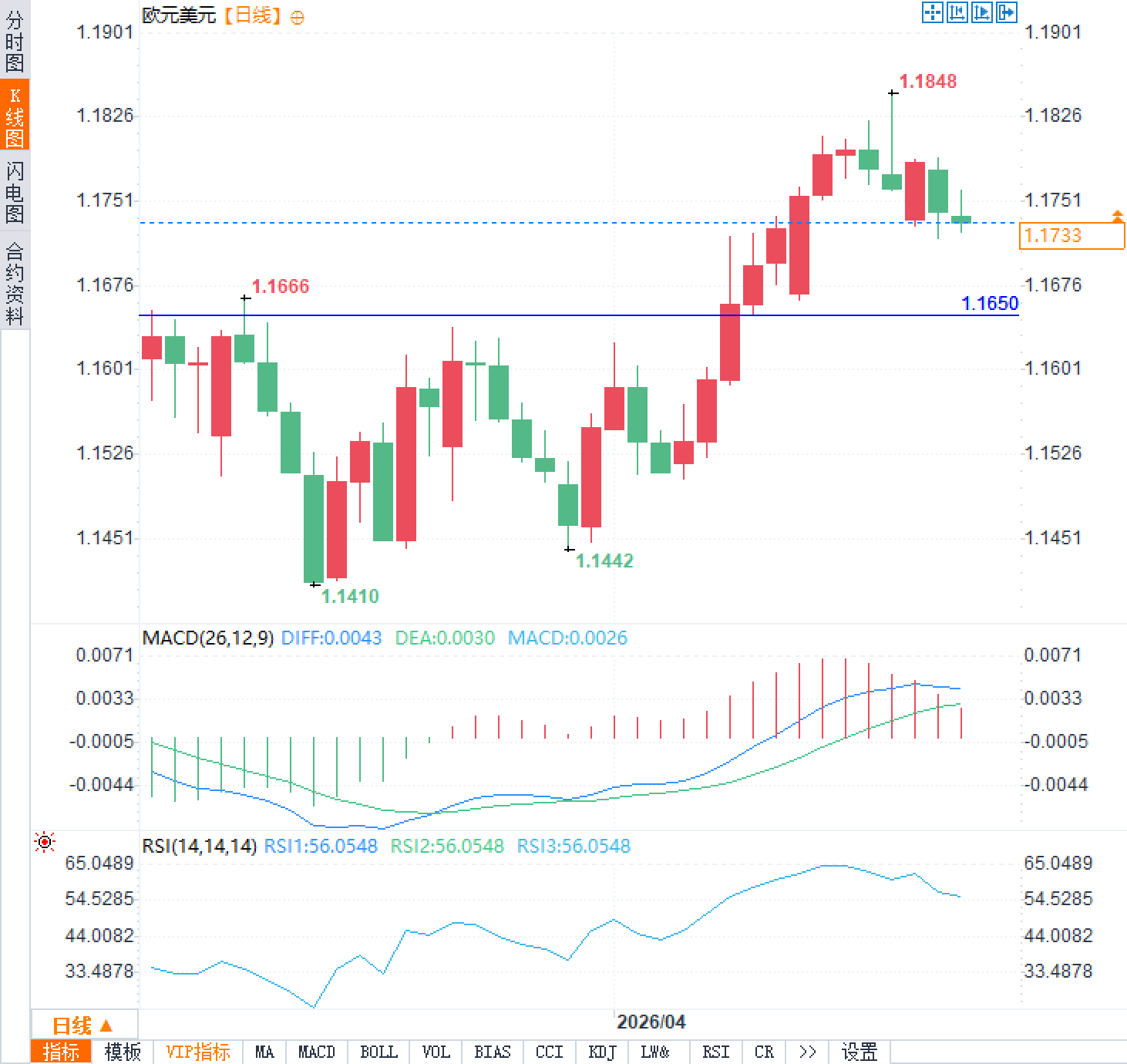
From a technical perspective, the euro/dollar pair is currently facing strong resistance around 1.1760, a level close to the 50-day moving average, which has been tested multiple times without success in the short term. Intraday support lies around 1.172; a break below this level could open up further downside potential. Fundamentally, geopolitical risks are dominating, giving the dollar a safe-haven appeal, and expectations of weak Eurozone data are further suppressing the exchange rate. Combined with the upcoming PMI data, if it shows weaker-than-expected economic activity, the euro/dollar pair may continue its range-bound, slightly bearish pattern. Overall, the current environment requires traders to simultaneously monitor oil price movements and geopolitical news; any breakout could trigger a trend reversal.
The euro is currently hovering between 1.173 and 1.176 against the dollar, failing to break through key resistance. Meanwhile, Brent crude oil prices have returned to around $100 per barrel, with continued uncertainty in the Middle East pushing up energy costs and risk aversion rising. Despite an intraday rebound in stocks, a flurry of earnings data releases is expected to further amplify volatility. Today's economic data is relatively sparse, with market attention focused on Thursday's Purchasing Managers' Index report, which will reveal the activity of major economies amid current geopolitical tensions.
The extension of the ceasefire has failed to fully ease geopolitical tensions.
While Trump's announcement of a ceasefire extension provided a brief respite for financial markets, the continued blockade has led to mutual accusations of breach of the agreement between Iran and the United States, and a UK Maritime Trade Action Report also indicated that a container ship was attacked off the coast of Oman. Mueller analyst Derek Halpenney pointed out that the president's ceasefire extension offered only limited relief, with oil prices remaining near $100 per barrel and risk sentiment deteriorating. He emphasized that failure to resolve the dispute between the US blockade and Iran's demands could trigger a new round of oil price increases and lead to a more significant risk aversion trend, which could likely support further strengthening of the US dollar. The market is currently in a wait-and-see mode, awaiting progress in negotiations or a resurgence of military conflict. This uncertainty directly limits the upside potential of the euro against the dollar, and traders are wary of the immediate impact of unforeseen events on the exchange rate.
Soaring oil prices exacerbate global risk aversion pressures
Brent crude oil prices hovering around the $100 per barrel mark directly reflect the risk of disruption to shipping through the Strait of Hormuz. This strait handles approximately 21% of global oil shipments; a continued blockade would drive up supply chain costs and amplify energy price volatility. Amid rising risk aversion, while the stock market reversed some losses, its overall resilience weakened. The euro, as a risk-sensitive currency, is under significant pressure against the US dollar. Recent data shows a certain negative correlation between rising oil prices and a weakening euro against the dollar.
In a high oil price environment, safe-haven funds tend to flow into US dollar assets, further highlighting the euro's role as a funding currency. Traders are focused on whether oil prices can stably break through $100 per barrel, which could amplify the transmission effect of risk aversion on the foreign exchange market.
Policy Dilemmas Under Eurozone Energy Dependence
As a major energy importer, the Eurozone is directly experiencing imported inflationary pressures due to high oil prices, constraining its economic growth potential. The European Central Bank (ECB) faces a dilemma: if oil prices remain high, inflation expectations may reignite, but signals of slowing economic growth could necessitate policy easing. Recent UK inflation data has already shown signs of energy cost transmission, and similar pressures in the Eurozone are expected to spread through the supply chain. Traders should pay attention to subsequent communications from the ECB; if it emphasizes data dependence, the euro may face additional downside risks. Meanwhile, the relative strength of the US dollar in a risk-averse environment further widens the euro-dollar interest rate differential. Overall, high oil prices are not an isolated event but are intertwined with geopolitical uncertainties, amplifying the Eurozone's vulnerability. The market expects that if negotiations fail to make substantial progress, Eurozone economic activity indicators may show signs of slowing in the PMI report, which will test the euro's defensive capabilities.
Technical and fundamental factors in the euro/dollar exchange rate game
From a technical perspective, the euro/dollar pair is currently facing strong resistance around 1.1760, a level close to the 50-day moving average, which has been tested multiple times without success in the short term. Intraday support lies around 1.172; a break below this level could open up further downside potential. Fundamentally, geopolitical risks are dominating, giving the dollar a safe-haven appeal, and expectations of weak Eurozone data are further suppressing the exchange rate. Combined with the upcoming PMI data, if it shows weaker-than-expected economic activity, the euro/dollar pair may continue its range-bound, slightly bearish pattern. Overall, the current environment requires traders to simultaneously monitor oil price movements and geopolitical news; any breakout could trigger a trend reversal.
Frequently Asked Questions
Question 1: What is the actual impact of Trump's extension of the ceasefire on the euro against the dollar?
A: While the extended ceasefire has alleviated some immediate military risks, the continued blockade has kept oil prices high, and risk aversion has not been fundamentally eliminated. This has led to continued strong demand for the US dollar as a safe haven, making it difficult for the euro to break through the 1.1760 resistance level against the dollar.
Question 2: Why do high oil prices pose a greater challenge to the Eurozone?
A: The Eurozone is highly dependent on energy imports, and high oil prices directly increase production and consumption costs, amplifying both inflationary and growth pressures. This forces the European Central Bank to be more cautious in its policy choices, and PMI data will be a key window for examining the transmission effect.
- Risk Warning and Disclaimer
- The market involves risk, and trading may not be suitable for all investors. This article is for reference only and does not constitute personal investment advice, nor does it take into account certain users’ specific investment objectives, financial situation, or other needs. Any investment decisions made based on this information are at your own risk.