Gold Trading Alert: Iran's "ship seizure" in Hormuz and Trump's "fake ceasefire" hinder gold price rebound, with prices now targeting $4400?
2026-04-23 07:51:08
Spot gold's rebound stalled on Wednesday (April 22). Despite Trump's unilateral announcement of an extension of the ceasefire and reports that the US might lift its blockade of Iran, market optimism initially fueled a rapid rebound in gold prices to around $4772. However, the Iranian Revolutionary Guard's subsequent seizure of two ships in the Strait of Hormuz, a show of strength, instantly ignited the Middle East's geopolitical tensions. International oil prices resumed their upward trend and broke through the $100 mark, while inflation expectations and global central bank interest rate hikes rose simultaneously, and the US dollar index rebounded strongly, ultimately causing gold prices to give up all their gains, closing at around $4740 per ounce, a gain of only about 0.4% for the day. Entering early Asian trading on Thursday (April 23), gold prices continued to fluctuate slightly lower, currently trading around $4725, down about 0.3%. This seemingly short-lived rebound once again highlights the predicament gold faces in the current complex macroeconomic and geopolitical environment.
The latest developments in the Middle East were the key trigger for the stalled rebound in gold prices on Wednesday. Iran seized two container ships in the Strait of Hormuz on Wednesday—the Epaminondas, flying the Liberian flag, and the MSC Francesca, flying the Panamanian flag—on the grounds of "maritime violations," and escorted them to the Iranian coast. This is Iran's first action to seize ships since the start of the US-Israel war against Iran in late February. The Revolutionary Guard further warned that any actions disrupting order in the Strait would cross a "red line," while the display of ballistic missiles at the Tehran military parade and the banner reading "Under Iranian Control indefinitely" sent a strong signal to Trump.
Meanwhile, although US President Trump announced on social media a "suspension of attacks on Iran" in response to Pakistan's mediation request, the White House made it clear that no new ceasefire deadline had been set, nor were there any substantial signs of restarting peace negotiations.
Iranian Parliament Speaker and Chief Negotiator Mohammad Ghalibaf stated bluntly that a comprehensive ceasefire would only be meaningful if the blockade were lifted; otherwise, the Strait of Hormuz could not be reopened. The ceasefire agreement between Israel and Lebanon also faces new pressure, with an Israeli drone strike killing at least three people and further exacerbating regional instability. This contradictory situation—a ceasefire extended without substantial progress, while ship seizures actually occur—has rapidly fueled market concerns about a prolonged Middle East conflict. Gold, as a traditional safe-haven asset, should have benefited, but the reality has been the opposite—geopolitical risks have driven up energy prices, but this has failed to directly translate into sustained buying of gold.
The Strait of Hormuz, a vital waterway for one-fifth of the world's oil and gas transport, has seen its continued blockade directly ignite the international oil market. On Wednesday, Brent crude futures rose 3.48% to $101.91 per barrel, while U.S. crude futures climbed 3.67% to $92.96 per barrel, both reaching two-week highs. Data from the U.S. Energy Information Administration (EIA) showed a surprisingly large drop in U.S. gasoline and distillate fuel inventories during the week, while crude oil inventories increased slightly, but the overall tight supply situation remained unchanged. Major global economies have begun depleting their strategic reserves and restricting consumption, significantly increasing cost pressures on businesses.
Since the outbreak of war on February 28, gold prices have fallen by approximately 11%, seemingly contradicting the logic of "inflation hedging." In reality, while rising oil prices have indeed pushed up inflation expectations, this has been accompanied by a strong suppression of non-interest-bearing assets due to rising interest rates. Gold does not generate interest, and its holding costs increase significantly in a high-interest-rate environment, leading investors to favor higher-yielding bonds or cash. The market is currently caught in a delicate dilemma: on the one hand, there are concerns that a protracted conflict could prolong the energy crisis; on the other hand, there are worries that short-term inflationary pressures will force central banks to maintain a tight stance. This dynamic of "safe-haven demand being suppressed by interest rate expectations" is the fundamental reason why gold prices have struggled to escape their downward trend.
The dollar index rose 0.24% on Wednesday to 98.61, having earlier hit a seven-day high of 98.64, directly putting downward pressure on gold prices. Federal Reserve Chairman nominee Warsh stated clearly at his Senate hearing on Tuesday that he had not committed to interest rate cuts to Trump and emphasized that he would remain independent of the White House while advancing reforms. This statement further dampened market hopes for significant easing this year. Federal funds futures indicate that the probability of only one rate cut by the end of 2026 has fallen to 28%, far lower than previously expected. Next week, the Federal Reserve, the European Central Bank, the Bank of Japan, the Bank of England, and the Bank of Canada will hold a series of meetings, and the market widely expects all five central banks to hold rates steady at current levels.
While the European Central Bank demonstrated flexibility in March, its current focus has shifted to the impact on economic growth and medium-term core inflation, reducing the urgency of a June rate hike. The Bank of Japan and the Bank of England face similar dilemmas. US Treasury Secretary Bessant earlier also urged the Federal Reserve to "wait and see," noting the strong performance of the US economy in January and February. In this environment of "global central banks collectively waiting and seeing, while inflation expectations rise due to oil prices," the US dollar is supported, further diminishing the appeal of gold. The bond market also confirms this logic: the 10-year US Treasury yield rose slightly to 4.294%, and the yield curve flattened in a bearish pattern, reflecting market concerns about short-term high inflation.
Despite a brief rebound after gold prices recorded their biggest one-day drop since March 26, bargain hunting provided some momentum. Jim Wyckoff, senior analyst at Kitco Metals, noted clear bottom-fishing activity in both the gold and silver markets. However, this short-term technical rebound proved fragile in the face of macroeconomic pressures. While geopolitical conflicts have fueled safe-haven demand, rising oil prices and the resulting inflationary and interest rate squeeze, coupled with a strong rebound in the US dollar, have created a more significant downward pressure. Gold remains within its overall downward channel since the outbreak of the conflict and is unlikely to break out of the $4670-$4770 trading range in the short term.
Iran's seizure of ships in the Strait of Hormuz, the stalemate of Trump's "indefinite ceasefire" without any substantial progress in negotiations, and the inflationary chain reaction triggered by oil prices breaking through $100 have all contributed to the current dilemma facing gold.
In the short term, a stronger dollar, central bank caution, and a high-interest-rate environment will continue to suppress gold price gains, and the slight decline in early Asian trading on Thursday may simply be a continuation of the current consolidation. However, from a medium- to long-term perspective, the ongoing tensions in the Strait of Hormuz, structural disruptions to global energy supplies, and the potential for prolonged geopolitical conflicts still provide gold with an important safe-haven narrative. If ceasefire negotiations completely break down or oil prices spiral further out of control, gold's anti-inflationary properties are expected to be reawakened by the market.
Currently, gold prices are in a unique window where geopolitical benefits are being offset by macroeconomic headwinds. Investors need to closely monitor the tone of next week's central bank meetings, oil price trends, and any substantial progress in US-Iran negotiations. If the conflict escalates further and oil prices spiral out of control, gold prices will likely face even stronger policy tightening pressure, and may even test support near the $4400 level in the coming week.
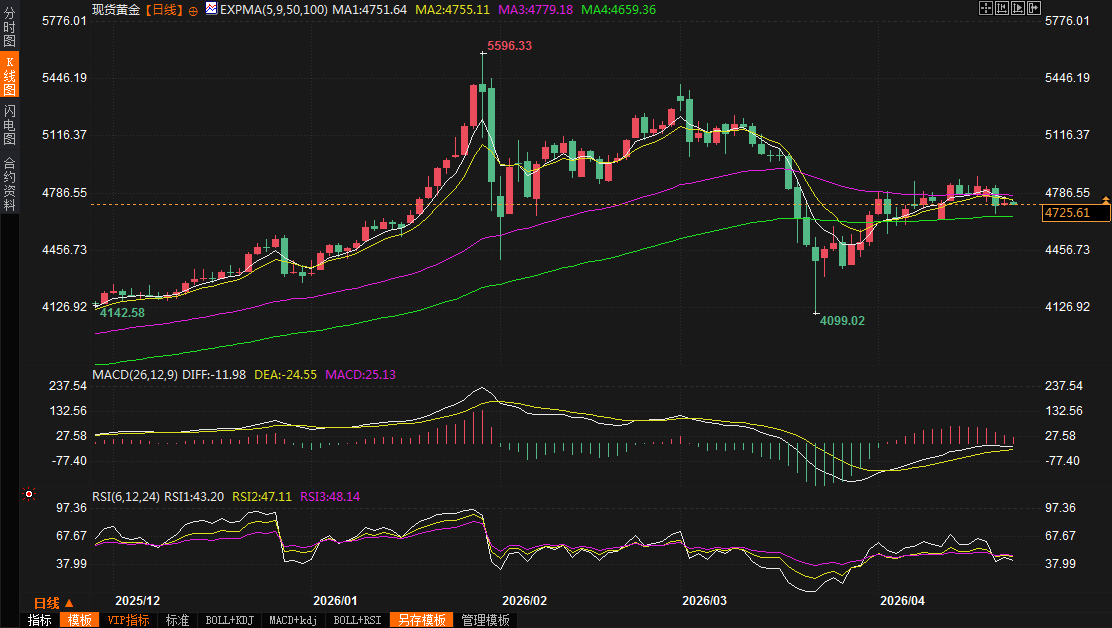
(Spot gold daily chart, source: FX678)
At 07:48 Beijing time, spot gold was trading at $4727.24 per ounce.
Geopolitical tensions escalate abruptly: Iran's seizure of the ship and the stalemate over Trump's "indefinite ceasefire."
The latest developments in the Middle East were the key trigger for the stalled rebound in gold prices on Wednesday. Iran seized two container ships in the Strait of Hormuz on Wednesday—the Epaminondas, flying the Liberian flag, and the MSC Francesca, flying the Panamanian flag—on the grounds of "maritime violations," and escorted them to the Iranian coast. This is Iran's first action to seize ships since the start of the US-Israel war against Iran in late February. The Revolutionary Guard further warned that any actions disrupting order in the Strait would cross a "red line," while the display of ballistic missiles at the Tehran military parade and the banner reading "Under Iranian Control indefinitely" sent a strong signal to Trump.
Meanwhile, although US President Trump announced on social media a "suspension of attacks on Iran" in response to Pakistan's mediation request, the White House made it clear that no new ceasefire deadline had been set, nor were there any substantial signs of restarting peace negotiations.
Iranian Parliament Speaker and Chief Negotiator Mohammad Ghalibaf stated bluntly that a comprehensive ceasefire would only be meaningful if the blockade were lifted; otherwise, the Strait of Hormuz could not be reopened. The ceasefire agreement between Israel and Lebanon also faces new pressure, with an Israeli drone strike killing at least three people and further exacerbating regional instability. This contradictory situation—a ceasefire extended without substantial progress, while ship seizures actually occur—has rapidly fueled market concerns about a prolonged Middle East conflict. Gold, as a traditional safe-haven asset, should have benefited, but the reality has been the opposite—geopolitical risks have driven up energy prices, but this has failed to directly translate into sustained buying of gold.
Soaring oil prices coupled with inflationary pressures: Gold's dual attributes as a "safe haven" and "anti-inflation" are being tested.
The Strait of Hormuz, a vital waterway for one-fifth of the world's oil and gas transport, has seen its continued blockade directly ignite the international oil market. On Wednesday, Brent crude futures rose 3.48% to $101.91 per barrel, while U.S. crude futures climbed 3.67% to $92.96 per barrel, both reaching two-week highs. Data from the U.S. Energy Information Administration (EIA) showed a surprisingly large drop in U.S. gasoline and distillate fuel inventories during the week, while crude oil inventories increased slightly, but the overall tight supply situation remained unchanged. Major global economies have begun depleting their strategic reserves and restricting consumption, significantly increasing cost pressures on businesses.
Since the outbreak of war on February 28, gold prices have fallen by approximately 11%, seemingly contradicting the logic of "inflation hedging." In reality, while rising oil prices have indeed pushed up inflation expectations, this has been accompanied by a strong suppression of non-interest-bearing assets due to rising interest rates. Gold does not generate interest, and its holding costs increase significantly in a high-interest-rate environment, leading investors to favor higher-yielding bonds or cash. The market is currently caught in a delicate dilemma: on the one hand, there are concerns that a protracted conflict could prolong the energy crisis; on the other hand, there are worries that short-term inflationary pressures will force central banks to maintain a tight stance. This dynamic of "safe-haven demand being suppressed by interest rate expectations" is the fundamental reason why gold prices have struggled to escape their downward trend.
A stronger dollar and a wait-and-see attitude from central banks: Interest rate expectations become the biggest "killer" of gold.
The dollar index rose 0.24% on Wednesday to 98.61, having earlier hit a seven-day high of 98.64, directly putting downward pressure on gold prices. Federal Reserve Chairman nominee Warsh stated clearly at his Senate hearing on Tuesday that he had not committed to interest rate cuts to Trump and emphasized that he would remain independent of the White House while advancing reforms. This statement further dampened market hopes for significant easing this year. Federal funds futures indicate that the probability of only one rate cut by the end of 2026 has fallen to 28%, far lower than previously expected. Next week, the Federal Reserve, the European Central Bank, the Bank of Japan, the Bank of England, and the Bank of Canada will hold a series of meetings, and the market widely expects all five central banks to hold rates steady at current levels.
While the European Central Bank demonstrated flexibility in March, its current focus has shifted to the impact on economic growth and medium-term core inflation, reducing the urgency of a June rate hike. The Bank of Japan and the Bank of England face similar dilemmas. US Treasury Secretary Bessant earlier also urged the Federal Reserve to "wait and see," noting the strong performance of the US economy in January and February. In this environment of "global central banks collectively waiting and seeing, while inflation expectations rise due to oil prices," the US dollar is supported, further diminishing the appeal of gold. The bond market also confirms this logic: the 10-year US Treasury yield rose slightly to 4.294%, and the yield curve flattened in a bearish pattern, reflecting market concerns about short-term high inflation.
While bargain hunters have emerged, long-term downward pressure remains.
Despite a brief rebound after gold prices recorded their biggest one-day drop since March 26, bargain hunting provided some momentum. Jim Wyckoff, senior analyst at Kitco Metals, noted clear bottom-fishing activity in both the gold and silver markets. However, this short-term technical rebound proved fragile in the face of macroeconomic pressures. While geopolitical conflicts have fueled safe-haven demand, rising oil prices and the resulting inflationary and interest rate squeeze, coupled with a strong rebound in the US dollar, have created a more significant downward pressure. Gold remains within its overall downward channel since the outbreak of the conflict and is unlikely to break out of the $4670-$4770 trading range in the short term.
Market Outlook: Gold's "Darkest Hour" or "Eve of Dawn"?
Iran's seizure of ships in the Strait of Hormuz, the stalemate of Trump's "indefinite ceasefire" without any substantial progress in negotiations, and the inflationary chain reaction triggered by oil prices breaking through $100 have all contributed to the current dilemma facing gold.
In the short term, a stronger dollar, central bank caution, and a high-interest-rate environment will continue to suppress gold price gains, and the slight decline in early Asian trading on Thursday may simply be a continuation of the current consolidation. However, from a medium- to long-term perspective, the ongoing tensions in the Strait of Hormuz, structural disruptions to global energy supplies, and the potential for prolonged geopolitical conflicts still provide gold with an important safe-haven narrative. If ceasefire negotiations completely break down or oil prices spiral further out of control, gold's anti-inflationary properties are expected to be reawakened by the market.
Currently, gold prices are in a unique window where geopolitical benefits are being offset by macroeconomic headwinds. Investors need to closely monitor the tone of next week's central bank meetings, oil price trends, and any substantial progress in US-Iran negotiations. If the conflict escalates further and oil prices spiral out of control, gold prices will likely face even stronger policy tightening pressure, and may even test support near the $4400 level in the coming week.
(Spot gold daily chart, source: FX678)
At 07:48 Beijing time, spot gold was trading at $4727.24 per ounce.
- Risk Warning and Disclaimer
- The market involves risk, and trading may not be suitable for all investors. This article is for reference only and does not constitute personal investment advice, nor does it take into account certain users’ specific investment objectives, financial situation, or other needs. Any investment decisions made based on this information are at your own risk.