The US-Iran tensions and rising oil prices acted as a hedge, causing the USD/CAD pair to rise and then fall.
2026-04-23 10:40:36
On Thursday during Asian trading hours, the USD/CAD pair retreated slightly after hitting a three-day high, lacking overall momentum and indicating a wait-and-see approach amid mixed bullish and bearish factors. Although the US dollar had previously strengthened due to safe-haven demand, the Canadian dollar benefited from rising oil prices, which exerted significant downward pressure on the exchange rate.
The core conflict in the current market centers on the interplay between geopolitical risks and energy prices. The US's announcement of an indefinite extension of the ceasefire, while maintaining the maritime blockade of relevant ports, has kept the situation tense. Meanwhile, the conflict in the Strait of Hormuz continues to escalate, with shipping disruptions and frequent security incidents creating uncertainty for global energy supplies. This strait handles approximately 20% of global crude oil shipments, and its stability directly impacts oil prices and global market sentiment.
Against this backdrop, safe-haven demand supported the US dollar, allowing it to maintain its gains from the previous two days. However, on the other hand, oil prices have risen for the third consecutive trading day, with both WTI and Brent prices remaining high, which is clearly beneficial to the Canadian dollar as a commodity currency, thus limiting the upside potential of USD/CAD.
Monetary policy expectations also exacerbated exchange rate volatility. Market expectations regarding the Federal Reserve's policy stance shifted, with bets on interest rate cuts this year increasing, weakening the dollar's bullish momentum. Meanwhile, in Canada, the market began pricing in potential interest rate hikes, believing that the Bank of Canada might adopt a tighter policy path given the backdrop of rising energy prices and inflation. This combination of a weaker dollar and a stronger Canadian dollar limited the exchange rate's upward momentum.
From a market structure perspective, USD/CAD currently lacks a clear trend. Although a short-term rebound has occurred driven by risk aversion, the lack of sustained buying support indicates insufficient bullish confidence. Meanwhile, high oil prices continue to support the Canadian dollar, meaning that the downside potential for the exchange rate is also limited.
On the data front, investors will focus on the US initial jobless claims and preliminary PMI figures. These data will directly influence market expectations regarding the path of the US economy and monetary policy, thus affecting the dollar's performance. Strong data could provide short-term support for the dollar; conversely, weak data could exacerbate downward pressure.
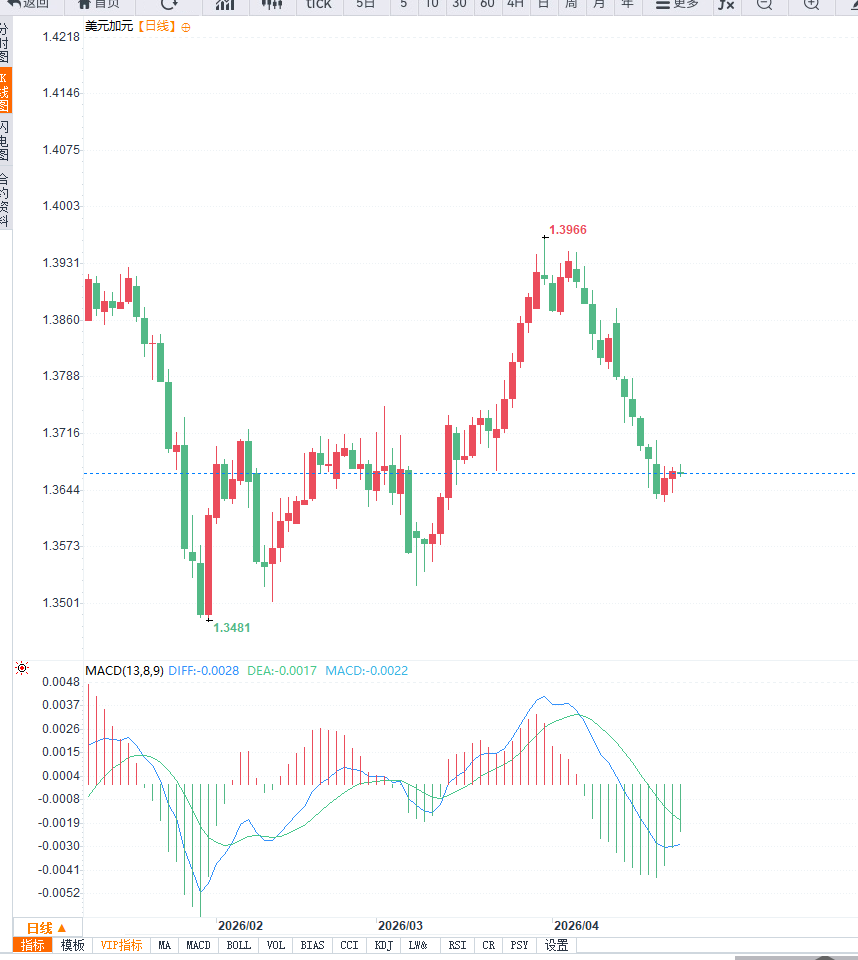
From a technical perspective, the USD/CAD pair remains within a range-bound structure on the daily chart, with no clear trend direction. Currently, a short-term resistance zone forms around 1.3800 ; a break above this level could lead to a further test of 1.3850 . On the downside, 1.3700 forms key support; a break below this level could open up further downside potential to 1.3650 . Momentum indicators suggest a lack of clear trend drivers, indicating a consolidation phase. On the 4-hour chart, the price has entered a sideways consolidation phase after a rebound, with short-term moving averages flattening and MACD momentum weakening, indicating waning bullish momentum. If the price fails to hold above 1.3780 , a further pullback to test support is possible in the short term, but as long as the 1.3700 area holds, the overall trend remains range-bound.
Editor's Summary
The USD/CAD pair is currently in a phase of hedging among multiple factors. Geopolitical risks support the US dollar, while rising oil prices and policy expectations are favorable for the Canadian dollar, causing the exchange rate to fluctuate within a range. In the medium term, oil price movements and divergent central bank policies will become the dominant variables. Until a clear trend emerges, the market is more likely to maintain range-bound trading. Investors should pay close attention to breakouts of key technical levels and changes in macroeconomic data to determine the subsequent direction.
The core conflict in the current market centers on the interplay between geopolitical risks and energy prices. The US's announcement of an indefinite extension of the ceasefire, while maintaining the maritime blockade of relevant ports, has kept the situation tense. Meanwhile, the conflict in the Strait of Hormuz continues to escalate, with shipping disruptions and frequent security incidents creating uncertainty for global energy supplies. This strait handles approximately 20% of global crude oil shipments, and its stability directly impacts oil prices and global market sentiment.
Against this backdrop, safe-haven demand supported the US dollar, allowing it to maintain its gains from the previous two days. However, on the other hand, oil prices have risen for the third consecutive trading day, with both WTI and Brent prices remaining high, which is clearly beneficial to the Canadian dollar as a commodity currency, thus limiting the upside potential of USD/CAD.
Monetary policy expectations also exacerbated exchange rate volatility. Market expectations regarding the Federal Reserve's policy stance shifted, with bets on interest rate cuts this year increasing, weakening the dollar's bullish momentum. Meanwhile, in Canada, the market began pricing in potential interest rate hikes, believing that the Bank of Canada might adopt a tighter policy path given the backdrop of rising energy prices and inflation. This combination of a weaker dollar and a stronger Canadian dollar limited the exchange rate's upward momentum.
From a market structure perspective, USD/CAD currently lacks a clear trend. Although a short-term rebound has occurred driven by risk aversion, the lack of sustained buying support indicates insufficient bullish confidence. Meanwhile, high oil prices continue to support the Canadian dollar, meaning that the downside potential for the exchange rate is also limited.
On the data front, investors will focus on the US initial jobless claims and preliminary PMI figures. These data will directly influence market expectations regarding the path of the US economy and monetary policy, thus affecting the dollar's performance. Strong data could provide short-term support for the dollar; conversely, weak data could exacerbate downward pressure.
From a technical perspective, the USD/CAD pair remains within a range-bound structure on the daily chart, with no clear trend direction. Currently, a short-term resistance zone forms around 1.3800 ; a break above this level could lead to a further test of 1.3850 . On the downside, 1.3700 forms key support; a break below this level could open up further downside potential to 1.3650 . Momentum indicators suggest a lack of clear trend drivers, indicating a consolidation phase. On the 4-hour chart, the price has entered a sideways consolidation phase after a rebound, with short-term moving averages flattening and MACD momentum weakening, indicating waning bullish momentum. If the price fails to hold above 1.3780 , a further pullback to test support is possible in the short term, but as long as the 1.3700 area holds, the overall trend remains range-bound.
Editor's Summary
The USD/CAD pair is currently in a phase of hedging among multiple factors. Geopolitical risks support the US dollar, while rising oil prices and policy expectations are favorable for the Canadian dollar, causing the exchange rate to fluctuate within a range. In the medium term, oil price movements and divergent central bank policies will become the dominant variables. Until a clear trend emerges, the market is more likely to maintain range-bound trading. Investors should pay close attention to breakouts of key technical levels and changes in macroeconomic data to determine the subsequent direction.
- Risk Warning and Disclaimer
- The market involves risk, and trading may not be suitable for all investors. This article is for reference only and does not constitute personal investment advice, nor does it take into account certain users’ specific investment objectives, financial situation, or other needs. Any investment decisions made based on this information are at your own risk.