The divergence in European manufacturing PMIs: Inflated figures mask supply chain disruptions rather than a genuine economic recovery.
2026-04-23 20:11:06
The European manufacturing PMI in April 2026 showed a significant divergence, with core economies exhibiting vastly different performances.
The Eurozone's preliminary manufacturing PMI for April came in at 52.2, exceeding expectations (50.9) and the previous reading (51.6), continuing its expansionary trend. France performed particularly well, with its PMI soaring to 52.8, significantly exceeding expectations (49.5) and reaching a near four-year high. The UK's manufacturing PMI also exceeded expectations, rising to 53.6, a significant breakthrough compared to both the previous reading (51.0) and the expected reading (50.3).
In stark contrast, German manufacturing remained weak, with the preliminary April PMI reading at only 51.2, below expectations (51.4) and down from the previous reading (52.2). Although still in expansion territory, the recovery momentum continued to weaken. On the surface, European manufacturing appears to be recovering in three strong sectors and one weak sector, but this actually conceals a structural illusion.

The unexpected expansion of manufacturing PMIs in the Eurozone, France, and the UK is not due to strong endogenous economic growth, but rather a passive increase caused by supply chain disruptions. The core drivers are two non-economic factors: extended supplier delivery times and companies stockpiling raw materials in advance.
From the perspective of the PMI sub-items, " supplier delivery time " is the only inverse indicator—the more delayed the delivery, the higher the score of this sub-item, directly pushing up the overall PMI.
Escalating geopolitical conflicts in the Middle East and increased shipping risks in the Strait of Hormuz in April put renewed pressure on European manufacturing supply chains, significantly lengthening raw material transportation cycles and exacerbating supplier delivery delays. This factor directly drove the PMI reading upward.
Meanwhile, to mitigate the risks of subsequent supply chain disruptions and raw material price increases, businesses have begun stockpiling goods in advance, driving up the "purchasing inventory" sub-index of the PMI and further amplifying the expansionary signal of the PMI.
However, in essence, this PMI rise caused by supply chain disruptions lacks support from real demand: end-consumer demand in the Eurozone and France has not recovered in tandem, and domestic and foreign demand orders in the UK are even showing signs of weakness. The expansion of the manufacturing sector is more of a "passive stockpiling to cope with risks" rather than an active expansion of production driven by improved economic conditions.
The weaker-than-expected German manufacturing PMI precisely exposes the fragility of this inflated logic: as an economy with a high proportion of energy-intensive industries and a strong export orientation, the German manufacturing sector is less resilient to supply chain disruptions. The short-term boost from stockpiling and delivery delays is insufficient to offset the long-term pressure of high energy costs and insufficient end-user demand, ultimately leading to a decline in the PMI and reflecting the true nature of the European manufacturing recovery.
The Confederation of British Industry (CBI)’s first-quarter industrial trends survey, released in April, used empirical data from 276 manufacturing companies to debunk the illusion of a stronger-than-expected UK manufacturing PMI, confirming the core judgment that the PMI was “not driven by strong economic growth.”
From the demand side, CBI data shows that total new orders in the UK manufacturing sector contracted by 22% in April, the highest level since July 2020. Domestic orders contracted by 24% and export orders contracted by 5%, indicating that both domestic and external demand were weak, which is in stark contrast to the apparent recovery in the new orders sub-index of the PMI.
Businesses generally predict that the contraction in new cyclical orders will accelerate to -31% in July. The continued shrinkage of end-user demand directly indicates that the expansion of the PMI is not driven by real demand.
From the perspective of supply chain and inventory, CBI data reveals the core driver of the PMI rise: the proportion of enterprises reporting shortages of raw materials and components surged to 30%, a significant increase from 11% in January, reaching a new high since July 2023, confirming the authenticity of supply chain disruptions.
Meanwhile, enterprises initiated proactive destocking across the entire supply chain, with raw material, work-in-process, and finished goods inventories shrinking by -17%, -21%, and -16% respectively, all the fastest contraction rates since July 2020. This indicates that previous stockpiling did not form a sustainable inventory cycle, but instead resulted in passive destocking due to weak demand, further supporting the fact that the PMI's better-than-expected performance lacked fundamental support.
From the perspective of business confidence and profitability, CBI data shows that the current business situation of the UK manufacturing sector has reached -65% and the export outlook has reached -59%, both of which have hit the lowest levels since the outbreak of the epidemic in April 2020. The pessimistic expectations of businesses for future operations are seriously at odds with the apparent expansion of the PMI.
The fact that the growth rate of unit output cost (54%) far exceeds the growth rate of selling price (16%) further squeezes corporate profit margins, indicating that the manufacturing industry lacks the motivation to actively expand production. The rise in PMI is merely a distorted reflection of short-term factors.
The divergent patterns in Europe's April manufacturing PMIs are essentially the result of a game between "short-term supply chain disruptions" and "long-term weak fundamentals": the better-than-expected PMIs in the Eurozone, France, and the UK were driven by non-economic factors such as delivery delays caused by supply chain disruptions and companies' passive stockpiling, rather than a genuine recovery in the endogenous driving force of the economy; the worse-than-expected PMI in Germany, on the other hand, exposed the unsustainability of this inflated logic in advance.
The significant divergence between UK CBI data and PMI further demonstrates that the core contradictions facing European manufacturing remain shrinking demand, high costs, and declining competitiveness, rather than robust economic growth.
This PMI signal, distorted by short-term factors, cannot mask the deep-seated predicament of European manufacturing: regional structural divergence is intensifying, real demand has not recovered, cost pressures remain high, supply chain risks are repeatedly disrupted, and stagflation characteristics are becoming increasingly prominent.
For the market, it is necessary to be wary of the "misleading" nature of PMI data and not simply equate it with a signal of economic recovery. For policymakers, the European Central Bank and the Bank of England need to carefully assess the true economic situation behind the PMI and avoid adjusting the direction of monetary policy due to short-term data misjudgments.
Looking ahead, only a genuine recovery in end-user demand and marginal improvements in energy and supply chain costs will enable a sustainable recovery for European manufacturing. Otherwise, the current better-than-expected PMI figures are likely just a flash in the pan, and the regional economy will continue to struggle with the risk of stagflation.
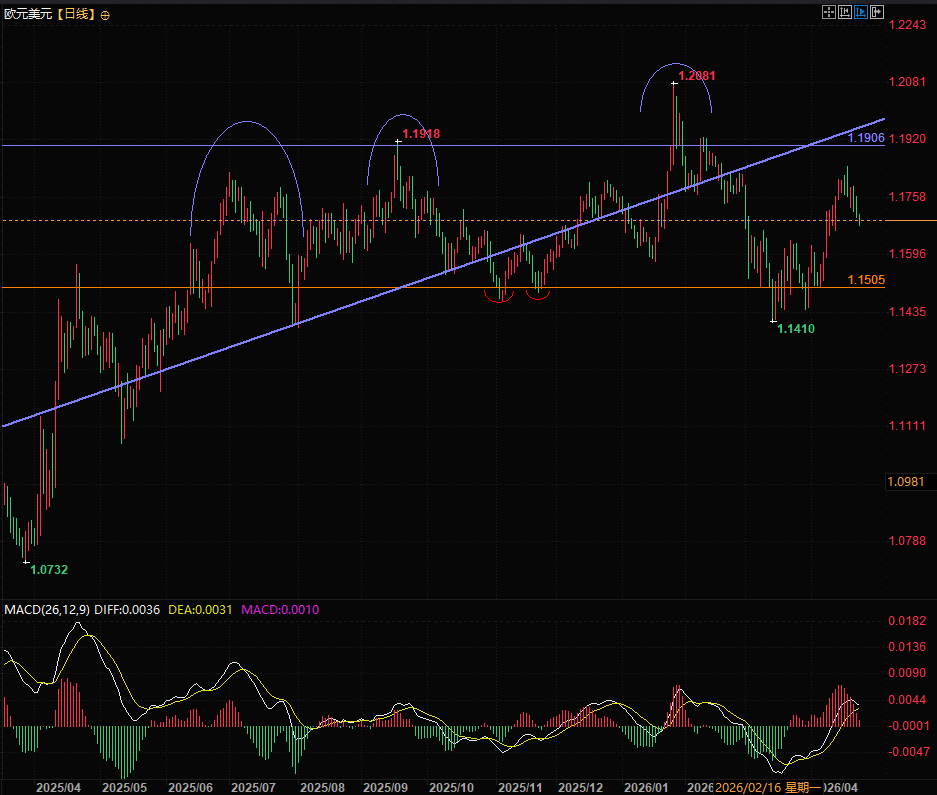
(Euro/USD daily chart, source: EasyForex)
At 20:08 Beijing time, the euro was trading at 1.1693/94 against the US dollar.
The Eurozone's preliminary manufacturing PMI for April came in at 52.2, exceeding expectations (50.9) and the previous reading (51.6), continuing its expansionary trend. France performed particularly well, with its PMI soaring to 52.8, significantly exceeding expectations (49.5) and reaching a near four-year high. The UK's manufacturing PMI also exceeded expectations, rising to 53.6, a significant breakthrough compared to both the previous reading (51.0) and the expected reading (50.3).
In stark contrast, German manufacturing remained weak, with the preliminary April PMI reading at only 51.2, below expectations (51.4) and down from the previous reading (52.2). Although still in expansion territory, the recovery momentum continued to weaken. On the surface, European manufacturing appears to be recovering in three strong sectors and one weak sector, but this actually conceals a structural illusion.
The truth behind the inflated PMI: Supply delays and the passive pull of stockpiling.
The unexpected expansion of manufacturing PMIs in the Eurozone, France, and the UK is not due to strong endogenous economic growth, but rather a passive increase caused by supply chain disruptions. The core drivers are two non-economic factors: extended supplier delivery times and companies stockpiling raw materials in advance.
From the perspective of the PMI sub-items, " supplier delivery time " is the only inverse indicator—the more delayed the delivery, the higher the score of this sub-item, directly pushing up the overall PMI.
Escalating geopolitical conflicts in the Middle East and increased shipping risks in the Strait of Hormuz in April put renewed pressure on European manufacturing supply chains, significantly lengthening raw material transportation cycles and exacerbating supplier delivery delays. This factor directly drove the PMI reading upward.
Meanwhile, to mitigate the risks of subsequent supply chain disruptions and raw material price increases, businesses have begun stockpiling goods in advance, driving up the "purchasing inventory" sub-index of the PMI and further amplifying the expansionary signal of the PMI.
However, in essence, this PMI rise caused by supply chain disruptions lacks support from real demand: end-consumer demand in the Eurozone and France has not recovered in tandem, and domestic and foreign demand orders in the UK are even showing signs of weakness. The expansion of the manufacturing sector is more of a "passive stockpiling to cope with risks" rather than an active expansion of production driven by improved economic conditions.
The weaker-than-expected German manufacturing PMI precisely exposes the fragility of this inflated logic: as an economy with a high proportion of energy-intensive industries and a strong export orientation, the German manufacturing sector is less resilient to supply chain disruptions. The short-term boost from stockpiling and delivery delays is insufficient to offset the long-term pressure of high energy costs and insufficient end-user demand, ultimately leading to a decline in the PMI and reflecting the true nature of the European manufacturing recovery.
CBI data exposes the illusion: UK PMI exceeds expectations but is severely divergent from fundamentals.
The Confederation of British Industry (CBI)’s first-quarter industrial trends survey, released in April, used empirical data from 276 manufacturing companies to debunk the illusion of a stronger-than-expected UK manufacturing PMI, confirming the core judgment that the PMI was “not driven by strong economic growth.”
From the demand side, CBI data shows that total new orders in the UK manufacturing sector contracted by 22% in April, the highest level since July 2020. Domestic orders contracted by 24% and export orders contracted by 5%, indicating that both domestic and external demand were weak, which is in stark contrast to the apparent recovery in the new orders sub-index of the PMI.
Businesses generally predict that the contraction in new cyclical orders will accelerate to -31% in July. The continued shrinkage of end-user demand directly indicates that the expansion of the PMI is not driven by real demand.
From the perspective of supply chain and inventory, CBI data reveals the core driver of the PMI rise: the proportion of enterprises reporting shortages of raw materials and components surged to 30%, a significant increase from 11% in January, reaching a new high since July 2023, confirming the authenticity of supply chain disruptions.
Meanwhile, enterprises initiated proactive destocking across the entire supply chain, with raw material, work-in-process, and finished goods inventories shrinking by -17%, -21%, and -16% respectively, all the fastest contraction rates since July 2020. This indicates that previous stockpiling did not form a sustainable inventory cycle, but instead resulted in passive destocking due to weak demand, further supporting the fact that the PMI's better-than-expected performance lacked fundamental support.
From the perspective of business confidence and profitability, CBI data shows that the current business situation of the UK manufacturing sector has reached -65% and the export outlook has reached -59%, both of which have hit the lowest levels since the outbreak of the epidemic in April 2020. The pessimistic expectations of businesses for future operations are seriously at odds with the apparent expansion of the PMI.
The fact that the growth rate of unit output cost (54%) far exceeds the growth rate of selling price (16%) further squeezes corporate profit margins, indicating that the manufacturing industry lacks the motivation to actively expand production. The rise in PMI is merely a distorted reflection of short-term factors.
Conclusion: The recovery of European manufacturing is weak, and the risk of stagflation continues to escalate.
The divergent patterns in Europe's April manufacturing PMIs are essentially the result of a game between "short-term supply chain disruptions" and "long-term weak fundamentals": the better-than-expected PMIs in the Eurozone, France, and the UK were driven by non-economic factors such as delivery delays caused by supply chain disruptions and companies' passive stockpiling, rather than a genuine recovery in the endogenous driving force of the economy; the worse-than-expected PMI in Germany, on the other hand, exposed the unsustainability of this inflated logic in advance.
The significant divergence between UK CBI data and PMI further demonstrates that the core contradictions facing European manufacturing remain shrinking demand, high costs, and declining competitiveness, rather than robust economic growth.
This PMI signal, distorted by short-term factors, cannot mask the deep-seated predicament of European manufacturing: regional structural divergence is intensifying, real demand has not recovered, cost pressures remain high, supply chain risks are repeatedly disrupted, and stagflation characteristics are becoming increasingly prominent.
For the market, it is necessary to be wary of the "misleading" nature of PMI data and not simply equate it with a signal of economic recovery. For policymakers, the European Central Bank and the Bank of England need to carefully assess the true economic situation behind the PMI and avoid adjusting the direction of monetary policy due to short-term data misjudgments.
Looking ahead, only a genuine recovery in end-user demand and marginal improvements in energy and supply chain costs will enable a sustainable recovery for European manufacturing. Otherwise, the current better-than-expected PMI figures are likely just a flash in the pan, and the regional economy will continue to struggle with the risk of stagflation.
(Euro/USD daily chart, source: EasyForex)
At 20:08 Beijing time, the euro was trading at 1.1693/94 against the US dollar.
- Risk Warning and Disclaimer
- The market involves risk, and trading may not be suitable for all investors. This article is for reference only and does not constitute personal investment advice, nor does it take into account certain users’ specific investment objectives, financial situation, or other needs. Any investment decisions made based on this information are at your own risk.