Crude oil trading alert: Escalating tensions in the Middle East coupled with restrictions in the Strait of Hormuz have led to three consecutive days of price increases. Is the bulls back in control?
2026-04-24 09:19:23
On Friday during Asian trading hours, US crude oil traded around $96.70, continuing its upward trend. New signs of tension in the Middle East have plunged the global energy market into a highly sensitive phase once again. As one of the world's most important oil shipping routes, the restricted navigation in the Strait of Hormuz has significantly impacted market supply expectations. This route handles approximately one-fifth of global seaborne crude oil transport; any disruption or decrease in efficiency will directly affect the efficiency of global crude oil circulation and push up the price level.
The key variables in the current situation lie in the escalating military standoff and deteriorating shipping security. Iran has activated its air defense system to counter potential threats, while Israel has signaled a possible resumption of military operations. Meanwhile, the United States is strengthening its maritime security directives, further escalating regional tensions. More critically, commercial shipping faces minefield risks and increased security checks, leading to a rapid rise in transportation costs and insurance premiums, indirectly compressing actual supply capacity.
Market sentiment has thus shifted significantly, moving from concerns about slowing demand to a repricing of supply shocks. Increased uncertainty in energy supply has pushed the crude oil market back into a "supply-driven" phase. Analysts point out that as long as shipping lanes remain open, global inventories will continue to decline, providing sustained support for oil prices.
Meanwhile, a clear divergence emerged within the commodity market. Copper prices fell under pressure amid rising oil prices, reflecting heightened market concerns about the economic growth outlook. Rising energy costs mean increased production costs for businesses, potentially suppressing demand in the manufacturing sector and thus dragging down the performance of industrial metals. As for gold, although geopolitical risks typically benefit safe-haven assets, the recent rise in oil prices strengthened inflation expectations, prompting the market to reassess the interest rate path. The high-interest-rate environment suppressed non-interest-bearing assets, leading to a decline in gold prices.
From a global market perspective, rising oil prices not only boost inflation expectations but also potentially have a significant impact on the monetary policies of major economies. If energy prices continue to rise, central banks may be forced to maintain a tight stance, thereby putting systemic pressure on risk assets. Investors are currently focused on the progress of shipping lane reopening, whether the conflict will escalate further, and the policy responses of major economies.
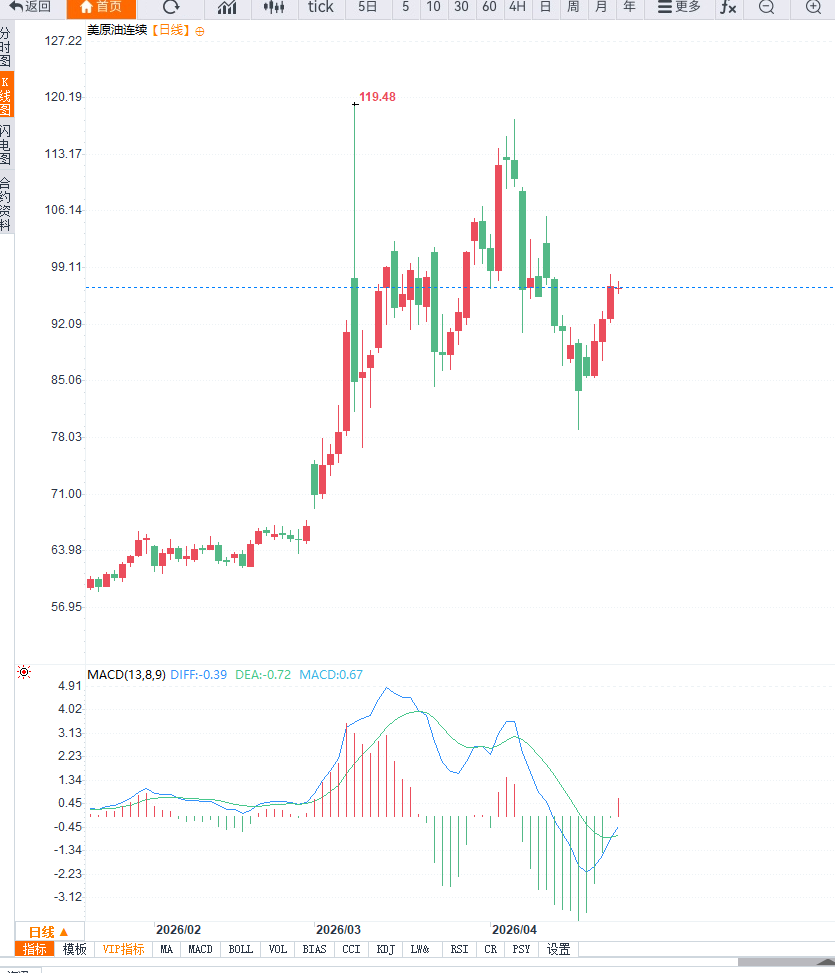
From a technical perspective, on the daily chart, WTI crude oil futures have re-entered the medium-term upward channel. After breaking through $90, a trend continuation structure has formed, with current resistance concentrated around the $100 psychological level . A break above this level could open up further upside potential. Key support lies in the $92 area , which was the previous breakout range. Momentum indicators show increasing bullish strength, but there are signs of short-term overbought conditions. On the 4-hour chart, prices are maintaining a high-level upward consolidation structure. Short-term support is around $94 . If a pullback doesn't break this area, the trend remains bullish; a break below could lead to a retest of the $90 support. Overall, the trend is still driven by geopolitical risks, and the technical indicators reflect more of a rhythm adjustment than a directional reversal.
Editor's Summary : Overall, the escalating tensions in the Middle East have rapidly increased energy supply risks, becoming the most crucial driving factor in the current market. Rising oil prices not only reflect expectations of tightening supply but also impact the performance of assets such as gold and copper through inflation. In the short term, market trends will remain highly dependent on changes in the geopolitical situation, particularly the recovery of key shipping routes. In the medium to long term, if the conflict persists, the global energy market may enter a phase of high volatility and high premiums, which will have a profound impact on inflation paths, monetary policy, and asset allocation. Investors need to closely monitor the evolution of risks and rationally assess the dynamic balance between inflation and policy.
The key variables in the current situation lie in the escalating military standoff and deteriorating shipping security. Iran has activated its air defense system to counter potential threats, while Israel has signaled a possible resumption of military operations. Meanwhile, the United States is strengthening its maritime security directives, further escalating regional tensions. More critically, commercial shipping faces minefield risks and increased security checks, leading to a rapid rise in transportation costs and insurance premiums, indirectly compressing actual supply capacity.
Market sentiment has thus shifted significantly, moving from concerns about slowing demand to a repricing of supply shocks. Increased uncertainty in energy supply has pushed the crude oil market back into a "supply-driven" phase. Analysts point out that as long as shipping lanes remain open, global inventories will continue to decline, providing sustained support for oil prices.
Meanwhile, a clear divergence emerged within the commodity market. Copper prices fell under pressure amid rising oil prices, reflecting heightened market concerns about the economic growth outlook. Rising energy costs mean increased production costs for businesses, potentially suppressing demand in the manufacturing sector and thus dragging down the performance of industrial metals. As for gold, although geopolitical risks typically benefit safe-haven assets, the recent rise in oil prices strengthened inflation expectations, prompting the market to reassess the interest rate path. The high-interest-rate environment suppressed non-interest-bearing assets, leading to a decline in gold prices.
From a global market perspective, rising oil prices not only boost inflation expectations but also potentially have a significant impact on the monetary policies of major economies. If energy prices continue to rise, central banks may be forced to maintain a tight stance, thereby putting systemic pressure on risk assets. Investors are currently focused on the progress of shipping lane reopening, whether the conflict will escalate further, and the policy responses of major economies.
From a technical perspective, on the daily chart, WTI crude oil futures have re-entered the medium-term upward channel. After breaking through $90, a trend continuation structure has formed, with current resistance concentrated around the $100 psychological level . A break above this level could open up further upside potential. Key support lies in the $92 area , which was the previous breakout range. Momentum indicators show increasing bullish strength, but there are signs of short-term overbought conditions. On the 4-hour chart, prices are maintaining a high-level upward consolidation structure. Short-term support is around $94 . If a pullback doesn't break this area, the trend remains bullish; a break below could lead to a retest of the $90 support. Overall, the trend is still driven by geopolitical risks, and the technical indicators reflect more of a rhythm adjustment than a directional reversal.
Editor's Summary : Overall, the escalating tensions in the Middle East have rapidly increased energy supply risks, becoming the most crucial driving factor in the current market. Rising oil prices not only reflect expectations of tightening supply but also impact the performance of assets such as gold and copper through inflation. In the short term, market trends will remain highly dependent on changes in the geopolitical situation, particularly the recovery of key shipping routes. In the medium to long term, if the conflict persists, the global energy market may enter a phase of high volatility and high premiums, which will have a profound impact on inflation paths, monetary policy, and asset allocation. Investors need to closely monitor the evolution of risks and rationally assess the dynamic balance between inflation and policy.
- Risk Warning and Disclaimer
- The market involves risk, and trading may not be suitable for all investors. This article is for reference only and does not constitute personal investment advice, nor does it take into account certain users’ specific investment objectives, financial situation, or other needs. Any investment decisions made based on this information are at your own risk.