Gold Trading Alert: US-Iran talks stall, putting renewed pressure on gold prices; will the Fed's decision ignite a "super week"?
2026-04-27 07:26:30
Spot gold weakened slightly in early trading on Monday (April 27), falling as much as 0.65% to $4,677.60 per ounce, as the US-Iran peace talks stalled, oil prices jumped more than 2% on Monday, inflation concerns resurfaced, expectations for a Fed rate hike this year rose slightly, and the US dollar index rose slightly, all putting pressure on gold prices. While the market continues to focus on further developments in the Middle East, its attention is shifting more towards this week's Fed rate decision. Prior to this, this week will also see rate decisions from the European Central Bank, the Bank of England, and the Bank of Japan. In addition, this week will also see the release of key US data, including first-quarter GDP and March PCE figures.
The second round of US-Iran talks, which the market had high hopes for over the weekend, ended in a complete "empty dialogue." Iranian Foreign Minister Araqchi arrived hastily in Pakistan with his "three-phase plan," only to leave empty-handed. This plan seemed ambitious: the first phase aimed to end the war and secure security guarantees; the second phase focused on managing the Strait of Hormuz; and only the third phase addressed the sensitive nuclear issue. However, Trump's reaction was direct and harsh. He bluntly stated on social media that there was "serious infighting and chaos" within Iran, even declaring, "If they want to talk, they just need to make a phone call!"
Trump not only exerted verbal pressure but also shattered any illusions of peace with his actions. He directly canceled the planned visit to Islamabad by his special envoy Witkov and son-in-law Kushner, citing reasons such as "too much travel and expense" and that the Iran proposal was "still insufficient." This almost childish diplomatic attitude has plunged the peace talks into an extremely awkward "vicious cycle."
Iran insists it will not participate in "imposed negotiations" until the US lifts its blockade of its ports; the US, holding both military and economic leverage, remains unyielding. This huge trust deficit has resulted in the continued blockade of the Strait of Hormuz, keeping one-fifth of global oil shipments blocked. Goldman Sachs analysts have had to postpone their forecast for the Strait's return to normal export levels from mid-May to late June and significantly raise their fourth-quarter crude oil price target. Thus, geopolitical tensions have evolved from a short-term impulsive event into a protracted war of attrition.
Normally, escalating war risks, soaring oil prices, and heightened risk aversion would be perfect fuel for gold price surges. However, this time the scenario is quite different. The core issue is that persistently high oil prices are giving rise to a specter more terrifying to the market than war—stubborn inflation.
As US crude oil prices hit a high of $96.63 per barrel in early trading on Monday, global investors' concerns about runaway inflation instantly overshadowed safe-haven demand. This inflation is not benign demand-pull inflation, but rather a vicious cost-push inflation triggered by disruptions in oil supply. For gold, inflation is usually a friend, as it erodes the purchasing power of currency, highlighting gold's function as a store of value; however, when inflation expectations become excessively high enough to alter the trajectory of central bank monetary policy, this friend instantly turns into the biggest enemy.
The market is beginning to reprice the Federal Reserve's interest rate path. Just last Friday, US interest rate futures pricing indicated a near 40% probability of a rate cut by the end of the year, but by Monday, with a jump in oil prices, expectations for a Fed rate hike this year had slightly increased. This dramatic shift reflects the market's deep fear of stagflation. If the Fed maintains high interest rates or even restarts rate hikes to suppress oil-driven inflation, the opportunity cost of holding non-interest-bearing assets like gold will rise sharply. Moreover, Warsh, the Fed chairman who recently emerged from an investigation, although considered slightly dovish, has had to bow to the tiger of inflation, even if he favors a more accommodative policy.
III. A Strong Dollar and US Treasury Yields: Two Heavy Burdens on Gold Prices <br />Meanwhile, the stalemate in the US-Iran conflict unexpectedly contributed to the strength of the US dollar. In this global energy crisis, funds did not flood into gold as a safe haven; instead, they flowed back into dollar assets. The dollar index rose slightly in early trading on Monday, heading towards its first weekly gain in three weeks. This seemingly contradictory phenomenon stems from the market's recognition of the relative resilience of the US economy and the ingrained mindset of viewing the dollar as the only "safe cash" during turbulent times.
For investors holding other currencies, a strong dollar means higher costs to buy gold, directly suppressing global gold demand. Even more damaging is the trend of US Treasury yields. The 10-year US Treasury yield rose sharply this week, marking its largest weekly increase since mid-March. Although yields briefly dipped on Friday due to a glimmer of hope for the resumption of peace talks, they rebounded quickly as those hopes faded. As a global benchmark for asset pricing, the rise in US Treasury yields means the allocation value of gold, a non-interest-bearing asset, is rapidly shrinking. After all, when investors can comfortably hold US Treasuries with yields above 4.3%, why risk holding highly volatile gold that offers no interest income?
Jim Barnes, a strategist at Bryn Mawr Trust, aptly described the current market sentiment: even if the war escalates again, it's unlikely to reach extreme levels, and the market has become increasingly desensitized to news about Iran. This desensitization doesn't mean a lack of attention, but rather a shift in geopolitical events from a "safe-haven-driven" to an "inflation-interest rate-driven" framework. In this framework, gold has become the one sacrificed.
At the current juncture, gold is in its most awkward phase, where geopolitical benefits are being suppressed by macroeconomic monetary policies. While the stalemate in the US-Iran talks poses a long-term test of trust in the global monetary system and provides underlying support for gold, in the short to medium term, the inflationary panic triggered by soaring oil prices and the ensuing expectations of interest rate hikes are a Damocles' sword hanging over gold prices.
This week, market focus will quickly shift from the negotiating table in Islamabad to the decision-making sessions of major central banks. The intensive meetings of the Federal Reserve, the Bank of Japan, the European Central Bank, and the Bank of England will be key variables determining the fate of gold. If the Federal Reserve releases any hawkish signals this week regarding rising inflation and the need to maintain tight monetary policy, gold prices could face a deeper correction.
As RJO futures strategists have noted, the market is currently entirely driven by news headlines. Until the US and Iran actually sit down and sign a substantive agreement, or until global central banks clearly demonstrate a return to a rate-cutting path, gold will likely continue its volatile, weakening pattern of "good news being priced in, bad news being expected." Investors need to be aware that in this drama of great power rivalry and the race against inflation, gold is no longer a simple safe haven driven solely by conflict, but has become the most complex benchmark for measuring the risk of global stagflation.
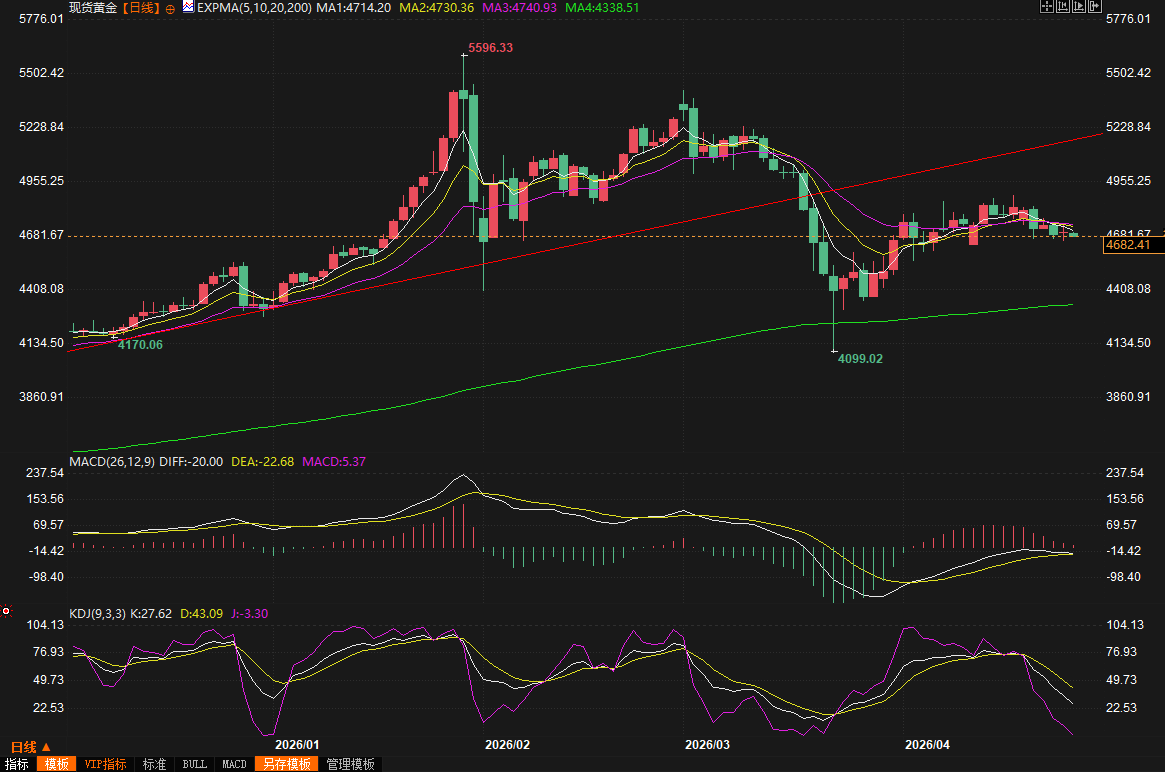
(Spot gold daily chart, source: FX678)
At 07:25 Beijing time, spot gold was trading at $4683.03 per ounce.
I. Peace talks "stalling": The endless tug-of-war exhausts market patience
The second round of US-Iran talks, which the market had high hopes for over the weekend, ended in a complete "empty dialogue." Iranian Foreign Minister Araqchi arrived hastily in Pakistan with his "three-phase plan," only to leave empty-handed. This plan seemed ambitious: the first phase aimed to end the war and secure security guarantees; the second phase focused on managing the Strait of Hormuz; and only the third phase addressed the sensitive nuclear issue. However, Trump's reaction was direct and harsh. He bluntly stated on social media that there was "serious infighting and chaos" within Iran, even declaring, "If they want to talk, they just need to make a phone call!"
Trump not only exerted verbal pressure but also shattered any illusions of peace with his actions. He directly canceled the planned visit to Islamabad by his special envoy Witkov and son-in-law Kushner, citing reasons such as "too much travel and expense" and that the Iran proposal was "still insufficient." This almost childish diplomatic attitude has plunged the peace talks into an extremely awkward "vicious cycle."
Iran insists it will not participate in "imposed negotiations" until the US lifts its blockade of its ports; the US, holding both military and economic leverage, remains unyielding. This huge trust deficit has resulted in the continued blockade of the Strait of Hormuz, keeping one-fifth of global oil shipments blocked. Goldman Sachs analysts have had to postpone their forecast for the Strait's return to normal export levels from mid-May to late June and significantly raise their fourth-quarter crude oil price target. Thus, geopolitical tensions have evolved from a short-term impulsive event into a protracted war of attrition.
II. The Phantom of Inflation Returns: When High Oil Prices Become a Double-Edged Sword Against Gold
Normally, escalating war risks, soaring oil prices, and heightened risk aversion would be perfect fuel for gold price surges. However, this time the scenario is quite different. The core issue is that persistently high oil prices are giving rise to a specter more terrifying to the market than war—stubborn inflation.
As US crude oil prices hit a high of $96.63 per barrel in early trading on Monday, global investors' concerns about runaway inflation instantly overshadowed safe-haven demand. This inflation is not benign demand-pull inflation, but rather a vicious cost-push inflation triggered by disruptions in oil supply. For gold, inflation is usually a friend, as it erodes the purchasing power of currency, highlighting gold's function as a store of value; however, when inflation expectations become excessively high enough to alter the trajectory of central bank monetary policy, this friend instantly turns into the biggest enemy.
The market is beginning to reprice the Federal Reserve's interest rate path. Just last Friday, US interest rate futures pricing indicated a near 40% probability of a rate cut by the end of the year, but by Monday, with a jump in oil prices, expectations for a Fed rate hike this year had slightly increased. This dramatic shift reflects the market's deep fear of stagflation. If the Fed maintains high interest rates or even restarts rate hikes to suppress oil-driven inflation, the opportunity cost of holding non-interest-bearing assets like gold will rise sharply. Moreover, Warsh, the Fed chairman who recently emerged from an investigation, although considered slightly dovish, has had to bow to the tiger of inflation, even if he favors a more accommodative policy.
III. A Strong Dollar and US Treasury Yields: Two Heavy Burdens on Gold Prices <br />Meanwhile, the stalemate in the US-Iran conflict unexpectedly contributed to the strength of the US dollar. In this global energy crisis, funds did not flood into gold as a safe haven; instead, they flowed back into dollar assets. The dollar index rose slightly in early trading on Monday, heading towards its first weekly gain in three weeks. This seemingly contradictory phenomenon stems from the market's recognition of the relative resilience of the US economy and the ingrained mindset of viewing the dollar as the only "safe cash" during turbulent times.
For investors holding other currencies, a strong dollar means higher costs to buy gold, directly suppressing global gold demand. Even more damaging is the trend of US Treasury yields. The 10-year US Treasury yield rose sharply this week, marking its largest weekly increase since mid-March. Although yields briefly dipped on Friday due to a glimmer of hope for the resumption of peace talks, they rebounded quickly as those hopes faded. As a global benchmark for asset pricing, the rise in US Treasury yields means the allocation value of gold, a non-interest-bearing asset, is rapidly shrinking. After all, when investors can comfortably hold US Treasuries with yields above 4.3%, why risk holding highly volatile gold that offers no interest income?
Jim Barnes, a strategist at Bryn Mawr Trust, aptly described the current market sentiment: even if the war escalates again, it's unlikely to reach extreme levels, and the market has become increasingly desensitized to news about Iran. This desensitization doesn't mean a lack of attention, but rather a shift in geopolitical events from a "safe-haven-driven" to an "inflation-interest rate-driven" framework. In this framework, gold has become the one sacrificed.
IV. Summary and Analysis: Gold is under short-term pressure, awaiting clarity on the interest rate path.
At the current juncture, gold is in its most awkward phase, where geopolitical benefits are being suppressed by macroeconomic monetary policies. While the stalemate in the US-Iran talks poses a long-term test of trust in the global monetary system and provides underlying support for gold, in the short to medium term, the inflationary panic triggered by soaring oil prices and the ensuing expectations of interest rate hikes are a Damocles' sword hanging over gold prices.
This week, market focus will quickly shift from the negotiating table in Islamabad to the decision-making sessions of major central banks. The intensive meetings of the Federal Reserve, the Bank of Japan, the European Central Bank, and the Bank of England will be key variables determining the fate of gold. If the Federal Reserve releases any hawkish signals this week regarding rising inflation and the need to maintain tight monetary policy, gold prices could face a deeper correction.
As RJO futures strategists have noted, the market is currently entirely driven by news headlines. Until the US and Iran actually sit down and sign a substantive agreement, or until global central banks clearly demonstrate a return to a rate-cutting path, gold will likely continue its volatile, weakening pattern of "good news being priced in, bad news being expected." Investors need to be aware that in this drama of great power rivalry and the race against inflation, gold is no longer a simple safe haven driven solely by conflict, but has become the most complex benchmark for measuring the risk of global stagflation.
(Spot gold daily chart, source: FX678)
At 07:25 Beijing time, spot gold was trading at $4683.03 per ounce.
- Risk Warning and Disclaimer
- The market involves risk, and trading may not be suitable for all investors. This article is for reference only and does not constitute personal investment advice, nor does it take into account certain users’ specific investment objectives, financial situation, or other needs. Any investment decisions made based on this information are at your own risk.