Supply-side shocks support oil prices; Goldman Sachs raises its Q4 oil price forecast.
2026-04-27 10:27:51
According to APP, Goldman Sachs, in a report released on April 26, raised its Q4 2026 Brent crude oil price forecast to $90 per barrel and its WTI crude oil price forecast to $83 per barrel. This adjustment is mainly due to declining crude oil production in the Middle East, highlighting the significant impact of geopolitical factors on the global energy market.
Goldman Sachs analysts emphasized that the economic risks are greater than those presented by a single crude oil benchmark scenario, due to net upside risks to oil prices, unusually high refined product prices, the risk of refined product supply shortages, and the unprecedented scale of the shock. They estimated that a 14.5 million barrel per day reduction in Middle Eastern crude oil production led to a record decline in global crude oil inventories of 11 to 12 million barrels per day in April. The normalization of crude oil exports from the Strait of Hormuz may be delayed until the end of June, further exacerbating the tight supply situation in the market.
The crude oil market is currently fluctuating at high levels, with Brent crude spot prices approaching or exceeding the $100/barrel range, a significant increase since the beginning of the year. This price trend not only reflects a sudden contraction in supply but also compounded by uncertainty on the global demand side. Goldman Sachs points out that the global crude oil market is shifting from a supply surplus in 2025 to a deficit of 9.6 million barrels per day in the second quarter of 2026, with demand declining by 1.7 million barrels per day year-on-year, further amplifying the impact of the supply shock.
This adjustment highlights the dominant role of geopolitical events in energy pricing. As a core region for global crude oil supply, the Middle East's production fluctuations directly impact international oil prices. Goldman Sachs' upward forecast reflects financial institutions' reassessment of supply disruption risks, especially given the widening of refined product crack spreads and accelerated inventory reduction. In the short term, upward pressure on oil prices is evident, but in the long term, attention must be paid to the easing of conflicts, the dissipation of geopolitical risks, and the actual demand-driving effect of global economic growth.
To clearly illustrate Goldman Sachs' adjustments to its 2026 crude oil price forecast, the following table summarizes key scenario comparisons (unit: USD/barrel):
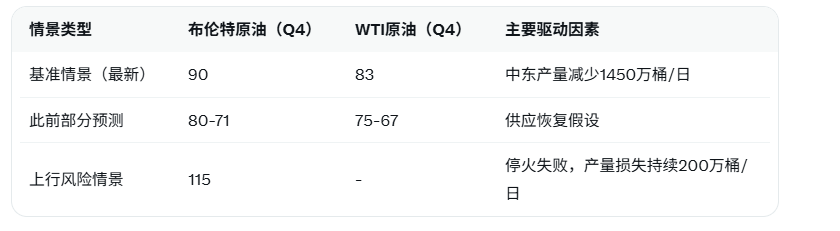
Goldman Sachs' team has repeatedly mentioned in recent reports that the risk of oil price volatility is skewed to the upside, especially when the supply shock exceeds expectations, as shortages in the refined oil market will amplify the economic transmission effect. This is highly consistent with the current reality of rapid depletion of global inventories.
Editor's Summary:
The supply contraction triggered by geopolitical tensions in the Middle East is reshaping the oil market landscape in 2026, and Goldman Sachs' upward revision of its forecast reflects the market's cautious pricing of supply risks. Investors need to closely monitor developments in the Strait of Hormuz, OPEC+ policy adjustments, and changes in global macroeconomic demand to cope with potentially high oil price volatility.
Goldman Sachs analysts emphasized that the economic risks are greater than those presented by a single crude oil benchmark scenario, due to net upside risks to oil prices, unusually high refined product prices, the risk of refined product supply shortages, and the unprecedented scale of the shock. They estimated that a 14.5 million barrel per day reduction in Middle Eastern crude oil production led to a record decline in global crude oil inventories of 11 to 12 million barrels per day in April. The normalization of crude oil exports from the Strait of Hormuz may be delayed until the end of June, further exacerbating the tight supply situation in the market.
The crude oil market is currently fluctuating at high levels, with Brent crude spot prices approaching or exceeding the $100/barrel range, a significant increase since the beginning of the year. This price trend not only reflects a sudden contraction in supply but also compounded by uncertainty on the global demand side. Goldman Sachs points out that the global crude oil market is shifting from a supply surplus in 2025 to a deficit of 9.6 million barrels per day in the second quarter of 2026, with demand declining by 1.7 million barrels per day year-on-year, further amplifying the impact of the supply shock.
This adjustment highlights the dominant role of geopolitical events in energy pricing. As a core region for global crude oil supply, the Middle East's production fluctuations directly impact international oil prices. Goldman Sachs' upward forecast reflects financial institutions' reassessment of supply disruption risks, especially given the widening of refined product crack spreads and accelerated inventory reduction. In the short term, upward pressure on oil prices is evident, but in the long term, attention must be paid to the easing of conflicts, the dissipation of geopolitical risks, and the actual demand-driving effect of global economic growth.
To clearly illustrate Goldman Sachs' adjustments to its 2026 crude oil price forecast, the following table summarizes key scenario comparisons (unit: USD/barrel):
Goldman Sachs' team has repeatedly mentioned in recent reports that the risk of oil price volatility is skewed to the upside, especially when the supply shock exceeds expectations, as shortages in the refined oil market will amplify the economic transmission effect. This is highly consistent with the current reality of rapid depletion of global inventories.
Editor's Summary:
The supply contraction triggered by geopolitical tensions in the Middle East is reshaping the oil market landscape in 2026, and Goldman Sachs' upward revision of its forecast reflects the market's cautious pricing of supply risks. Investors need to closely monitor developments in the Strait of Hormuz, OPEC+ policy adjustments, and changes in global macroeconomic demand to cope with potentially high oil price volatility.
- Risk Warning and Disclaimer
- The market involves risk, and trading may not be suitable for all investors. This article is for reference only and does not constitute personal investment advice, nor does it take into account certain users’ specific investment objectives, financial situation, or other needs. Any investment decisions made based on this information are at your own risk.