The US dollar index retreated slightly, awaiting a directional move.
2026-04-27 14:10:55
The US dollar index edged down to around 98.45 during Monday's Asian trading session, ending its previous period of strength. The decline was mainly driven by expectations of a marginal easing of geopolitical risks, which cooled market demand for the safe-haven dollar.
Iran has put forward a new proposal to the United States, which includes pushing for the reopening of the Strait of Hormuz and seeking a long-term peaceful solution by extending the ceasefire. This development has alleviated market concerns about energy supply disruptions to some extent, easing risk aversion and thus putting short-term pressure on the US dollar.
The Strait of Hormuz, as a key global energy transport route, directly impacts the global crude oil supply landscape. Previously, the market was highly sensitive to the potential risk of blockade in the region; however, improved negotiations have led to a decline in risk premiums, pushing the US dollar index slightly weaker.
Meanwhile, the US remains cautious. The previous cancellation of related third-party diplomatic trips by the US indicates that negotiations are still in a complex phase, and uncertainty remains in the short term. Therefore, although market sentiment has eased somewhat, overall risks have not been completely eliminated.
From a macroeconomic perspective, the market is gradually shifting its attention to the Federal Reserve's interest rate decision to be announced this week. The market currently widely expects the federal funds rate to remain unchanged in the 3.50% to 3.75% range. The key variable in the dollar's trajectory has shifted from geopolitical risks to monetary policy expectations , particularly guidance on the future path of interest rates.
Some institutions suggest that if oil prices remain high and increase inflationary pressures, the Federal Reserve may be forced to maintain a more hawkish policy stance, thereby supporting the dollar index. Conversely, if policy signals are neutral, the dollar may continue to face pressure for a period of correction.
From a market structure perspective, the US dollar index is currently in a high-level consolidation phase, repeatedly switching between risk aversion and policy expectations, lacking a clear unilateral trend.
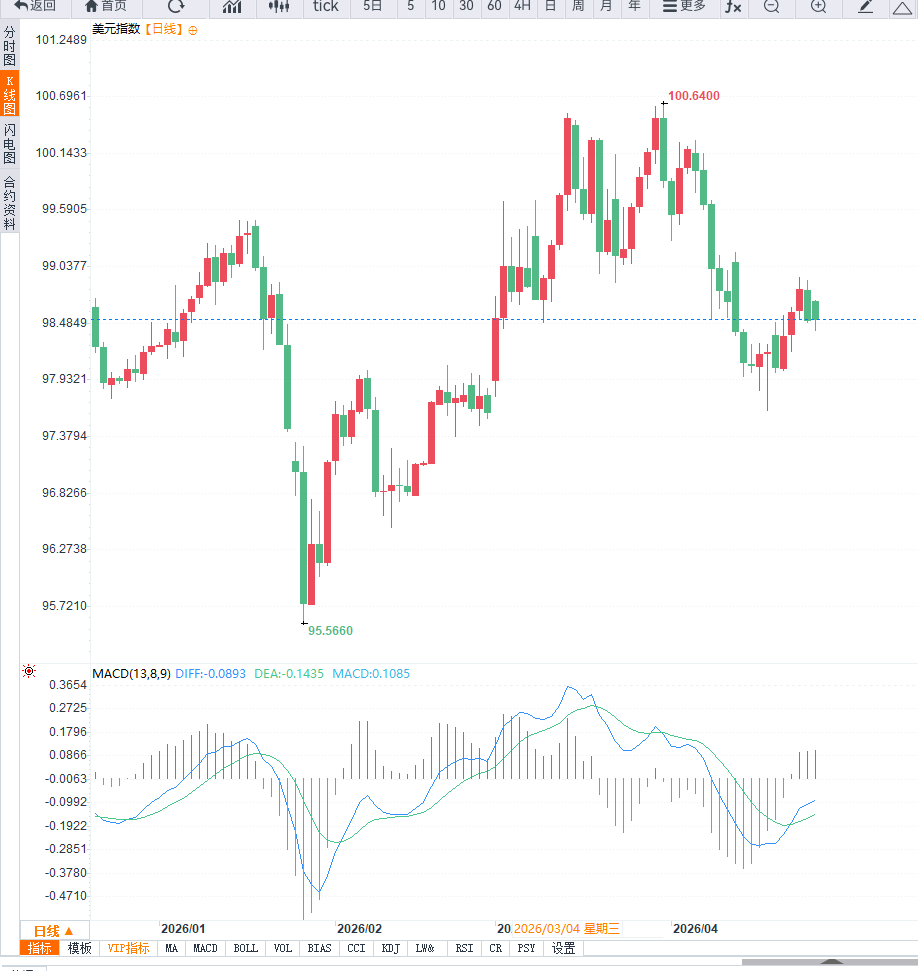
From a technical perspective, on the daily chart, the DXY has entered a consolidation phase after its previous surge, fluctuating between 98.00 and 99.00, indicating a temporary balance between bullish and bearish forces. The key support level is currently around 98.00 ; a break below this level could lead to a further decline to the 97.50 area . Resistance levels are concentrated in the 99.20 to 99.50 range , which represents previous highs and a dense area of moving average resistance. Momentum indicators suggest that upward momentum has slowed, but the overall trend has not yet turned bearish. On the 4-hour chart, the index shows a consolidation and pullback structure, with short-term moving averages flattening, indicating that the market is awaiting a new directional driver. If it fails to regain a foothold above 98.80, there is still a risk of further short-term pullback.
Editor's Summary:
The core driver of the current US dollar index movement is gradually shifting from geopolitical risk aversion to expectations regarding the Federal Reserve's monetary policy. The anticipated easing of tensions in the Middle East has cooled safe-haven demand, putting short-term pressure on the dollar, but policy uncertainty continues to provide support. In the short term, the DXY may maintain its oscillation between 98.00 and 99.00, with its direction depending on whether the Federal Reserve releases hawkish signals and the persistence of inflationary pressures.
Iran has put forward a new proposal to the United States, which includes pushing for the reopening of the Strait of Hormuz and seeking a long-term peaceful solution by extending the ceasefire. This development has alleviated market concerns about energy supply disruptions to some extent, easing risk aversion and thus putting short-term pressure on the US dollar.
The Strait of Hormuz, as a key global energy transport route, directly impacts the global crude oil supply landscape. Previously, the market was highly sensitive to the potential risk of blockade in the region; however, improved negotiations have led to a decline in risk premiums, pushing the US dollar index slightly weaker.
Meanwhile, the US remains cautious. The previous cancellation of related third-party diplomatic trips by the US indicates that negotiations are still in a complex phase, and uncertainty remains in the short term. Therefore, although market sentiment has eased somewhat, overall risks have not been completely eliminated.
From a macroeconomic perspective, the market is gradually shifting its attention to the Federal Reserve's interest rate decision to be announced this week. The market currently widely expects the federal funds rate to remain unchanged in the 3.50% to 3.75% range. The key variable in the dollar's trajectory has shifted from geopolitical risks to monetary policy expectations , particularly guidance on the future path of interest rates.
Some institutions suggest that if oil prices remain high and increase inflationary pressures, the Federal Reserve may be forced to maintain a more hawkish policy stance, thereby supporting the dollar index. Conversely, if policy signals are neutral, the dollar may continue to face pressure for a period of correction.
From a market structure perspective, the US dollar index is currently in a high-level consolidation phase, repeatedly switching between risk aversion and policy expectations, lacking a clear unilateral trend.
From a technical perspective, on the daily chart, the DXY has entered a consolidation phase after its previous surge, fluctuating between 98.00 and 99.00, indicating a temporary balance between bullish and bearish forces. The key support level is currently around 98.00 ; a break below this level could lead to a further decline to the 97.50 area . Resistance levels are concentrated in the 99.20 to 99.50 range , which represents previous highs and a dense area of moving average resistance. Momentum indicators suggest that upward momentum has slowed, but the overall trend has not yet turned bearish. On the 4-hour chart, the index shows a consolidation and pullback structure, with short-term moving averages flattening, indicating that the market is awaiting a new directional driver. If it fails to regain a foothold above 98.80, there is still a risk of further short-term pullback.
Editor's Summary:
The core driver of the current US dollar index movement is gradually shifting from geopolitical risk aversion to expectations regarding the Federal Reserve's monetary policy. The anticipated easing of tensions in the Middle East has cooled safe-haven demand, putting short-term pressure on the dollar, but policy uncertainty continues to provide support. In the short term, the DXY may maintain its oscillation between 98.00 and 99.00, with its direction depending on whether the Federal Reserve releases hawkish signals and the persistence of inflationary pressures.
- Risk Warning and Disclaimer
- The market involves risk, and trading may not be suitable for all investors. This article is for reference only and does not constitute personal investment advice, nor does it take into account certain users’ specific investment objectives, financial situation, or other needs. Any investment decisions made based on this information are at your own risk.