Five major central banks gathered this week; when will the limit of their wait-and-see approach be broken?
2026-04-27 20:17:50
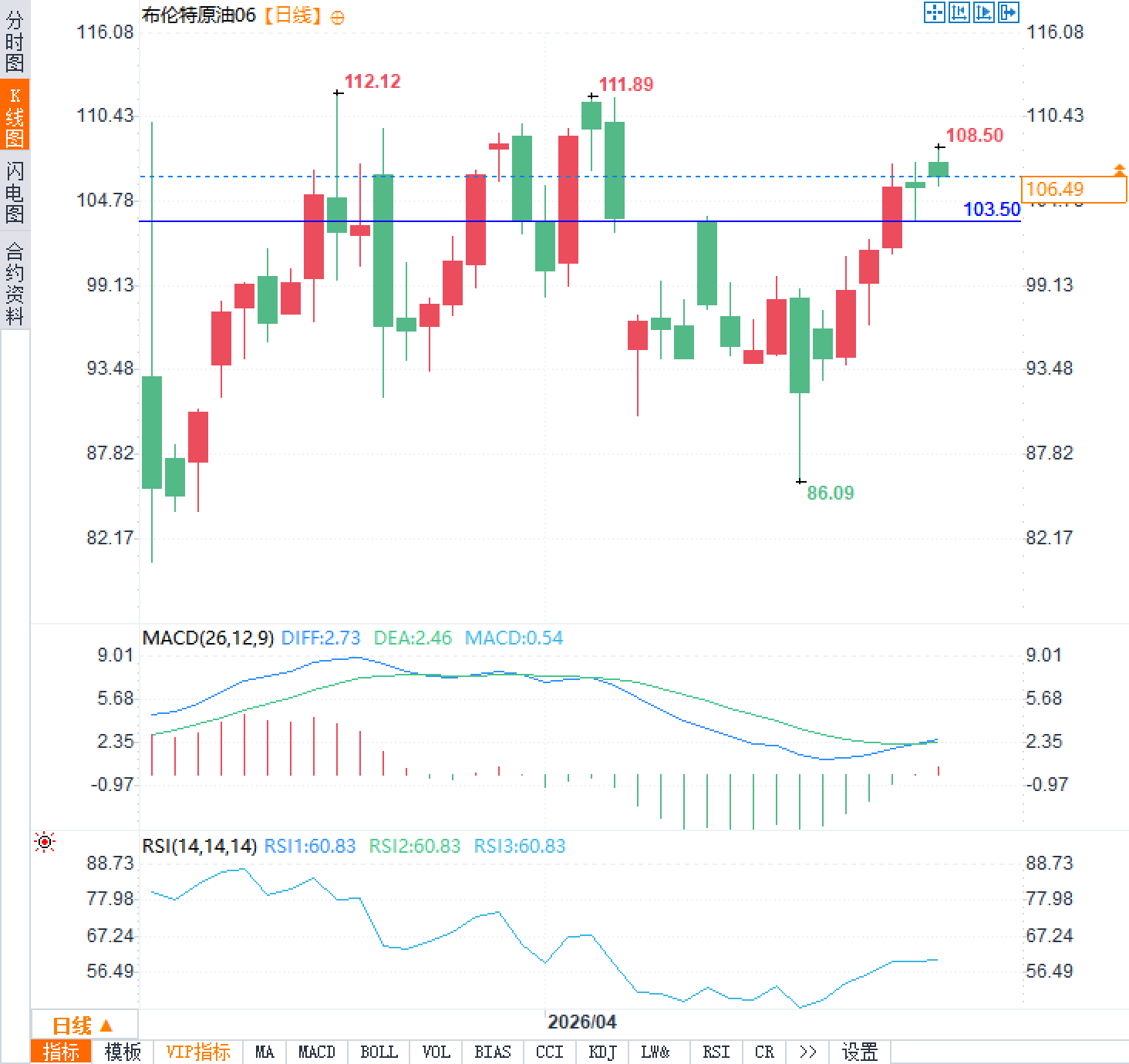
On Monday, April 27th, Brent crude oil prices hovered around $105-108 per barrel, while WTI crude oil was around $95-96 per barrel, a significant increase from pre-conflict levels. This week saw a flurry of policy meetings held by major central banks globally. The Middle East conflict has persisted for approximately nine weeks, the Strait of Hormuz remains closed, and energy supply disruptions have kept physical delivery prices for crude oil at high levels. While futures prices have fluctuated, they remain within a high range. The disconnect between landed oil prices and prices paid by end consumers is gradually transmitting to other sectors of the economy, making cost-push inflation pressures a market focus. Central banks are expected to maintain interest rates this week, but early communications have hinted at concerns about energy shocks, leading to adjustments in market expectations.
The current rise in energy prices is essentially a typical supply-side shock, rather than driven by overheated demand. The blockade of the Strait of Hormuz, which accounts for approximately 20% of global crude oil transportation, has directly driven up transportation costs and spot premiums. Although oil prices in the futures market have not broken through the $110/barrel mark, the actual physical delivery price is significantly higher, which is directly reflected in refinery procurement costs and end-user fuel prices.
According to the latest data, the Eurozone's overall inflation rate rebounded to 2.5% in March, with energy contributing 4.9 percentage points. While core inflation slightly declined to 2.3%, the lagged effects of transportation and agricultural input costs are gradually becoming apparent. Similarly, energy price transmission in the US and UK is beginning to affect producer price indices. Cost-push inflation differs from demand-pull inflation; its characteristic is that price increases are accompanied by slower economic growth, which is precisely the situation central banks least want to see.
If the conflict persists, energy prices will become more deeply embedded in wage negotiations and corporate pricing chains, creating a second round of effects. Historical experience shows that a similar supply shock in 2022 forced central banks to significantly tighten policy in a high-inflation environment, while current global growth is already near its potential growth rate, leaving very limited room for further tightening.
The table above clearly shows that current interest rates at central banks are close to or slightly above the neutral range, leaving limited room for further rate hikes, while facing pressure to anchor inflation expectations.
Monetary policy tools are inherently better suited to addressing demand-side fluctuations, but their ability to respond to supply-side shocks is naturally limited. Raising interest rates cannot repair the disruption to cross-strait shipping, nor can it increase oil supply; instead, it will exacerbate downward pressure on the economy by suppressing demand. John Williams, president of the New York Federal Reserve, recently pointed out that the situation in the Middle East has already driven up energy prices significantly, and if the conflict continues, it will bring a double shock of rising inflation and slowing economic activity.
The European Central Bank's latest staff forecast has revised its overall eurozone inflation forecast upward to 2.6% in 2026, while lowering its economic growth expectations, highlighting the double-edged sword effect of supply shocks. Policymakers now face a dilemma: if they do not act, inflation expectations may become unanchored; if they hastily raise interest rates, the supply shock could turn into a demand collapse, increasing the risk of stagflation.
Stagflation is not a distant prospect. Global central banks already faced a difficult balancing act after the Russia-Ukraine conflict in 2022, and mishandling the situation could lead to a repeat of that mistake. In particular, with energy prices remaining high for months, corporate inventory adjustments and declining consumer confidence will further amplify the negative feedback.
Early signals from the central bank have prompted a repricing in the market. The path originally expected to involve multiple rate cuts in 2026 has shifted to a possible one or two rate hikes, with financial conditions tightening accordingly. Swap markets indicate that the ECB deposit rate may rise to around 2.50% by the end of the year, barely entering a slightly restrictive range.
However, this pricing mechanism itself is inherently fragile. If the central bank ultimately determines that raising interest rates cannot solve the supply problem and chooses to remain on hold, the market will quickly shift to easing, and financial conditions will loosen again, potentially amplifying the risk of a second round of inflation. Conversely, if it does raise interest rates, it may excessively suppress already fragile demand. In the current situation, the central bank's credibility is being tested. The market has already priced in expectations of interest rate hikes into asset prices; if the policy path reverses, the difficulty of anchoring inflation expectations in the long term will increase significantly.
The best strategy for policymakers at present remains to remain on the sidelines and wait for the conflict to become clearer. However, if the situation drags on for months and inflationary pressures persist, central banks will find it difficult to remain uninvolved indefinitely. Excessive sluggishness could lead to a decoupling of inflation expectations, while excessive aggressiveness could trigger a recessionary spiral.
Inflation dynamics under energy supply shocks
The current rise in energy prices is essentially a typical supply-side shock, rather than driven by overheated demand. The blockade of the Strait of Hormuz, which accounts for approximately 20% of global crude oil transportation, has directly driven up transportation costs and spot premiums. Although oil prices in the futures market have not broken through the $110/barrel mark, the actual physical delivery price is significantly higher, which is directly reflected in refinery procurement costs and end-user fuel prices.
According to the latest data, the Eurozone's overall inflation rate rebounded to 2.5% in March, with energy contributing 4.9 percentage points. While core inflation slightly declined to 2.3%, the lagged effects of transportation and agricultural input costs are gradually becoming apparent. Similarly, energy price transmission in the US and UK is beginning to affect producer price indices. Cost-push inflation differs from demand-pull inflation; its characteristic is that price increases are accompanied by slower economic growth, which is precisely the situation central banks least want to see.
If the conflict persists, energy prices will become more deeply embedded in wage negotiations and corporate pricing chains, creating a second round of effects. Historical experience shows that a similar supply shock in 2022 forced central banks to significantly tighten policy in a high-inflation environment, while current global growth is already near its potential growth rate, leaving very limited room for further tightening.
| major central banks | Current policy interest rate | Neutral interest rate range estimation | Latest inflation forecast (2026) |
|---|---|---|---|
| Fed | 3.50%-3.75% | 2.5%-3.0% | Above 3% short-term |
| European Central Bank | Deposit interest rate 2.00% | 1.75%-2.25% | 2.6% |
| Bank of England | 3.75% | Approximately 3.0% | It may reach 3.6%. |
| Bank of Japan | 0.75% | 0.5%-1.0% | Upward revision due to energy factors |
| Bank of Canada | 2.25% | 2.0%-2.5% | Energy-driven uptrend |
The Dilemma of Central Bank Monetary Policy
Monetary policy tools are inherently better suited to addressing demand-side fluctuations, but their ability to respond to supply-side shocks is naturally limited. Raising interest rates cannot repair the disruption to cross-strait shipping, nor can it increase oil supply; instead, it will exacerbate downward pressure on the economy by suppressing demand. John Williams, president of the New York Federal Reserve, recently pointed out that the situation in the Middle East has already driven up energy prices significantly, and if the conflict continues, it will bring a double shock of rising inflation and slowing economic activity.
The European Central Bank's latest staff forecast has revised its overall eurozone inflation forecast upward to 2.6% in 2026, while lowering its economic growth expectations, highlighting the double-edged sword effect of supply shocks. Policymakers now face a dilemma: if they do not act, inflation expectations may become unanchored; if they hastily raise interest rates, the supply shock could turn into a demand collapse, increasing the risk of stagflation.
Stagflation is not a distant prospect. Global central banks already faced a difficult balancing act after the Russia-Ukraine conflict in 2022, and mishandling the situation could lead to a repeat of that mistake. In particular, with energy prices remaining high for months, corporate inventory adjustments and declining consumer confidence will further amplify the negative feedback.
Market pricing adjustments and changes in financial conditions
Early signals from the central bank have prompted a repricing in the market. The path originally expected to involve multiple rate cuts in 2026 has shifted to a possible one or two rate hikes, with financial conditions tightening accordingly. Swap markets indicate that the ECB deposit rate may rise to around 2.50% by the end of the year, barely entering a slightly restrictive range.
However, this pricing mechanism itself is inherently fragile. If the central bank ultimately determines that raising interest rates cannot solve the supply problem and chooses to remain on hold, the market will quickly shift to easing, and financial conditions will loosen again, potentially amplifying the risk of a second round of inflation. Conversely, if it does raise interest rates, it may excessively suppress already fragile demand. In the current situation, the central bank's credibility is being tested. The market has already priced in expectations of interest rate hikes into asset prices; if the policy path reverses, the difficulty of anchoring inflation expectations in the long term will increase significantly.
The best strategy for policymakers at present remains to remain on the sidelines and wait for the conflict to become clearer. However, if the situation drags on for months and inflationary pressures persist, central banks will find it difficult to remain uninvolved indefinitely. Excessive sluggishness could lead to a decoupling of inflation expectations, while excessive aggressiveness could trigger a recessionary spiral.
Frequently Asked Questions
Question 1: Why is it difficult for the central bank to directly solve the problem of rising energy prices by raising interest rates?
A: The rise in energy prices stems from supply disruptions, constituting a cost-push shock. Raising interest rates will not increase crude oil supply or restore transportation routes; instead, it will suppress consumption and investment by increasing borrowing costs, exacerbating the economic slowdown. Monetary policy primarily targets demand management and has limited effect on supply-side issues; excessive use could amplify the risk of stagflation.
Question 2: Why has the market already started pricing in an interest rate hike, while the central bank is still expected to keep interest rates unchanged this week?
A: The central bank's early communication sent a warning signal, prompting the market to adjust its expectations in advance. However, actual decision-making still needs to observe the duration of the conflict and the depth of inflation transmission. This week's meeting focused on communication rather than action, to avoid prematurely locking in a path and causing sharp fluctuations in financial conditions.
Question 3: If the conflict becomes protracted, what is the worst-case scenario that the central bank might ultimately face?
A: The worst-case scenario is stagflation, where high inflation coincides with stagnant economic growth. Energy prices are embedded in wage and pricing chains, creating a second-round effect. Central banks are forced to make difficult choices between high inflation and recession, further narrowing their policy space and significantly increasing the difficulty of economic recovery.
- Risk Warning and Disclaimer
- The market involves risk, and trading may not be suitable for all investors. This article is for reference only and does not constitute personal investment advice, nor does it take into account certain users’ specific investment objectives, financial situation, or other needs. Any investment decisions made based on this information are at your own risk.