Tensions in the Middle East continue to escalate, causing oil prices to surge and gold prices to fall.
2026-04-29 01:27:35
Gold prices fell sharply during the US trading session on Tuesday (April 28), dropping to their lowest level in nearly a month. A stronger dollar and heightened concerns about oil-related inflation contributed to the decline. From a technical perspective, the short-term outlook for gold is unfavorable, attracting speculators skilled in short-term technical analysis to short the futures market.
US and G7 monetary policymakers are likely to keep interest rates unchanged this week. The Federal Reserve Open Market Committee (FOMC) meeting begins this morning and will conclude Wednesday afternoon, at which time Fed Chairman Jerome Powell will deliver a statement and hold a press conference. This meeting is likely to be Powell's last as governor of the US central bank. Canada, the UK, Germany, and Japan are also expected to maintain their current interest rates.
This Tuesday marked two months since the US-Israel attack on Iran. While the ceasefire appears to be maintained, no substantial progress has been made in initiating a second round of peace talks.
Meanwhile, the continued rise in oil prices, exacerbated by the double blockade of the Strait of Hormuz, has further hampered shipping and increased the risk of inflation. This, in turn, has put additional pressure on the metals market, as it anticipates that central banks, particularly the Federal Reserve System in the United States, will maintain high interest rates for an extended period; if inflationary pressures persist, they may even consider raising interest rates further.
According to the CME FedWatch tool, traders are focused on the Federal Reserve's monetary policy decision to be released on Wednesday. The Fed's statement is expected to determine the next move in gold prices; if the Fed takes a hawkish stance, gold prices will face continued pressure.
Data shows that the ADP Employment Change Index's four-week average fell to 39,250 from 40,250 previously. Meanwhile, the Conference Board's Consumer Confidence Index rose to 92.8 in April, higher than the expected 89 and also higher than the previous reading of 91.8 (revised to 92.2). These figures indicate that consumer spending remains strong.
Peter Grant, Vice President and Senior Metals Strategist at Zaner Metals, said, "The Trump administration's rejection of Iran's latest offer has reignited pessimism about the Middle East peace process, with the Strait of Hormuz remaining closed. This has pushed up oil prices and reignited concerns about inflation ahead of this week's Fed meeting... causing gold prices to fall to a four-week low."
"Rising energy prices, a stronger dollar, rising inflation expectations, and renewed market expectations that U.S. interest rates will remain higher for an extended period are all contributing to a more challenging short-term environment for non-interest-bearing assets," said Ole Hansen, an analyst at Saxo Bank.
Oil prices rose by more than 3% as efforts to end the war with Iran stalled and the Strait of Hormuz essentially closed, restricting oil supplies from the Middle East. Meanwhile, the UAE announced its withdrawal from OPEC and OPEC+.
High oil prices have exacerbated inflationary pressures and increased the likelihood of rising interest rates. While gold has historically been seen as a hedge against inflation, high interest rates have diminished its appeal as a non-yielding asset.
Technical Analysis: Spot gold prices are below a key moving average.
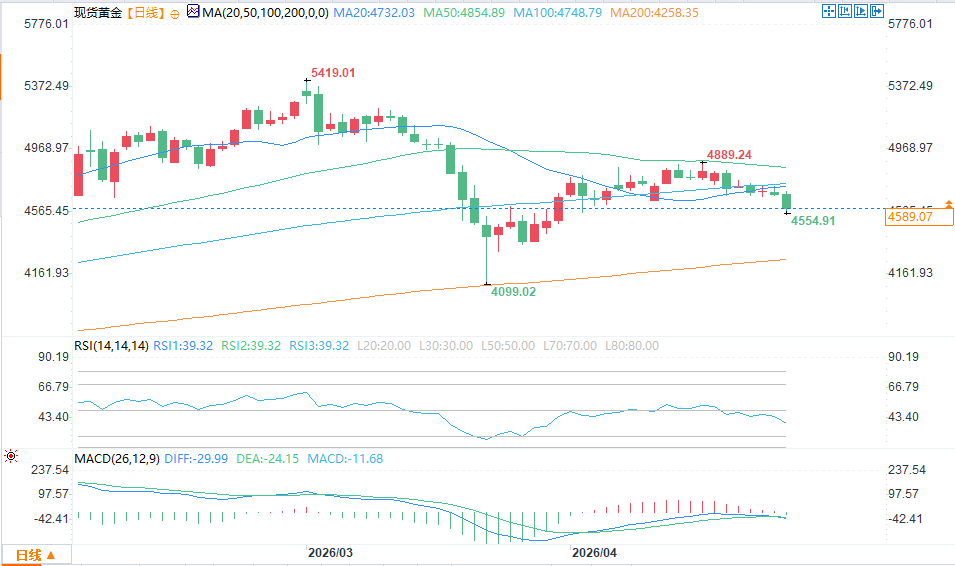
(Spot gold daily chart source: FX678)
On the daily chart, spot gold prices have consistently remained below the 100-day and 50-day simple moving averages, indicating a continued downtrend in the short term. The Relative Strength Index (RSI) is around 39, below the midline; while a negative MACD indicates increasing downward momentum, suggesting that sellers still dominate.
From a technical perspective, initial resistance is located near the 100-day simple moving average, around $4,749. The next resistance level is at the 50-day simple moving average, around $4,854. For bulls to re-establish an uptrend, the stock price needs to close above this area for several consecutive trading days. On the downside, current support is around $4,550. If prices fall further, the 200-day simple moving average around $4,263 will become the next support level. Long-term investors may attempt to hold this support level to maintain the overall uptrend.
At 01:07 Beijing time, spot gold was trading at $4,589.46 per ounce, down 1.97%.
US and G7 monetary policymakers are likely to keep interest rates unchanged this week. The Federal Reserve Open Market Committee (FOMC) meeting begins this morning and will conclude Wednesday afternoon, at which time Fed Chairman Jerome Powell will deliver a statement and hold a press conference. This meeting is likely to be Powell's last as governor of the US central bank. Canada, the UK, Germany, and Japan are also expected to maintain their current interest rates.
This Tuesday marked two months since the US-Israel attack on Iran. While the ceasefire appears to be maintained, no substantial progress has been made in initiating a second round of peace talks.
Meanwhile, the continued rise in oil prices, exacerbated by the double blockade of the Strait of Hormuz, has further hampered shipping and increased the risk of inflation. This, in turn, has put additional pressure on the metals market, as it anticipates that central banks, particularly the Federal Reserve System in the United States, will maintain high interest rates for an extended period; if inflationary pressures persist, they may even consider raising interest rates further.
According to the CME FedWatch tool, traders are focused on the Federal Reserve's monetary policy decision to be released on Wednesday. The Fed's statement is expected to determine the next move in gold prices; if the Fed takes a hawkish stance, gold prices will face continued pressure.
Data shows that the ADP Employment Change Index's four-week average fell to 39,250 from 40,250 previously. Meanwhile, the Conference Board's Consumer Confidence Index rose to 92.8 in April, higher than the expected 89 and also higher than the previous reading of 91.8 (revised to 92.2). These figures indicate that consumer spending remains strong.
Peter Grant, Vice President and Senior Metals Strategist at Zaner Metals, said, "The Trump administration's rejection of Iran's latest offer has reignited pessimism about the Middle East peace process, with the Strait of Hormuz remaining closed. This has pushed up oil prices and reignited concerns about inflation ahead of this week's Fed meeting... causing gold prices to fall to a four-week low."
"Rising energy prices, a stronger dollar, rising inflation expectations, and renewed market expectations that U.S. interest rates will remain higher for an extended period are all contributing to a more challenging short-term environment for non-interest-bearing assets," said Ole Hansen, an analyst at Saxo Bank.
Oil prices rose by more than 3% as efforts to end the war with Iran stalled and the Strait of Hormuz essentially closed, restricting oil supplies from the Middle East. Meanwhile, the UAE announced its withdrawal from OPEC and OPEC+.
High oil prices have exacerbated inflationary pressures and increased the likelihood of rising interest rates. While gold has historically been seen as a hedge against inflation, high interest rates have diminished its appeal as a non-yielding asset.
Technical Analysis: Spot gold prices are below a key moving average.
(Spot gold daily chart source: FX678)
On the daily chart, spot gold prices have consistently remained below the 100-day and 50-day simple moving averages, indicating a continued downtrend in the short term. The Relative Strength Index (RSI) is around 39, below the midline; while a negative MACD indicates increasing downward momentum, suggesting that sellers still dominate.
From a technical perspective, initial resistance is located near the 100-day simple moving average, around $4,749. The next resistance level is at the 50-day simple moving average, around $4,854. For bulls to re-establish an uptrend, the stock price needs to close above this area for several consecutive trading days. On the downside, current support is around $4,550. If prices fall further, the 200-day simple moving average around $4,263 will become the next support level. Long-term investors may attempt to hold this support level to maintain the overall uptrend.
At 01:07 Beijing time, spot gold was trading at $4,589.46 per ounce, down 1.97%.
- Risk Warning and Disclaimer
- The market involves risk, and trading may not be suitable for all investors. This article is for reference only and does not constitute personal investment advice, nor does it take into account certain users’ specific investment objectives, financial situation, or other needs. Any investment decisions made based on this information are at your own risk.